日本东证指数ETF

Search documents
ETF午评 | 特高压板块拉升,电网设备ETF、电网ETF涨2%
Ge Long Hui· 2025-12-05 03:56
Core Points - The A-share market saw all three major indices rise in the morning session, with the Shanghai Composite Index up 0.08%, the Shenzhen Component Index up 0.39%, and the ChiNext Index up 0.47% [1] - The total trading volume in the Shanghai, Shenzhen, and Beijing markets reached 999.6 billion yuan, a decrease of 40.6 billion yuan compared to the previous day [1] - Over 3,500 stocks in the market experienced gains, indicating a broad-based rally [1] Sector Performance - CPO concept stocks surged, while local stocks in Fujian remained active; sectors such as superconductors, ultra-high voltage, 6G, and photovoltaic indices showed significant gains [1] - The banking, real estate, and pharmaceutical sectors faced declines, with the real estate sector leading the losses [1] - ETFs related to industrial and non-ferrous metals led the gains, with the Wanjia Fund's industrial non-ferrous ETF rising by 2.5% [1] - The electric grid equipment sector performed well, with multiple ETFs in this category rising by 2% [1] - The photovoltaic sector also saw a rise, with leading ETFs in this space increasing by 2% [1] - Real estate ETFs declined by 1.4%, reflecting the struggles in the real estate sector [1] - Japanese stocks fell, with the Tokyo Stock Exchange Index ETF down by 1.2% [1] - The innovative drug sector showed weakness, with ETFs in this category declining by 1% [1]
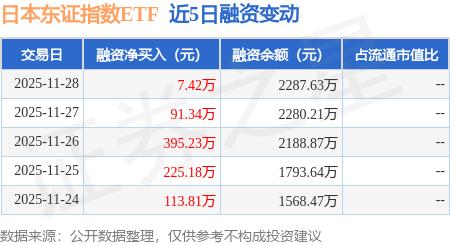
日本东证指数ETF:11月28日融资净买入7.42万元,连续3日累计净买入493.99万元
Sou Hu Cai Jing· 2025-12-01 02:46
Core Insights - The Japan Tokyo Stock Exchange Index ETF (513800) experienced a net financing purchase of 74,200 yuan on November 28, 2025, following a trend of continuous net purchases over the past three trading days totaling 493,990 yuan [1] Financing Activity Summary - On November 28, 2025, the financing balance reached 22,876,300 yuan, reflecting a 0.33% increase from the previous day [2][3] - The financing net purchases for the last five trading days are as follows: - November 28: 74,200 yuan - November 27: 913,400 yuan - November 26: 3,952,300 yuan - November 25: 2,251,800 yuan - November 24: 1,138,100 yuan [2][3] - Over the last 20 trading days, there have been net financing purchases on 15 occasions, indicating a positive investor sentiment [1] Market Sentiment Analysis - An increase in financing balance suggests a bullish market sentiment, indicating that investors are leaning towards buying [4]

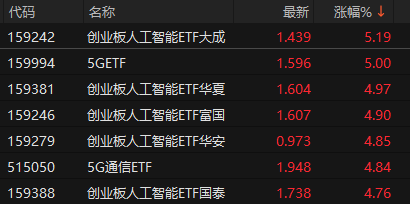
ETF午盘:创业板人工智能ETF大成涨5.19% 沙特ETF跌1.17%
Shang Hai Zheng Quan Bao· 2025-11-25 04:11
Core Insights - The article reports on the performance of various ETFs, highlighting significant gains in the AI-focused ETFs and losses in certain international ETFs [1] Group 1: ETF Performance - The leading performer is the Chuangye Ban Artificial Intelligence ETF Dachen (159242), which increased by 5.19% [2] - The 5GETF (159994) also showed strong performance with a rise of 5.00% [2] - Another notable gain was the Chuangye Ban Artificial Intelligence ETF Huaxia (159381), which rose by 4.97% [2] - Other AI-focused ETFs, such as the Chuangye Ban Artificial Intelligence ETF Fuguo (159246) and Huazhong (159279), also reported gains of 4.90% and 4.85% respectively [2] Group 2: Underperforming ETFs - The Saudi ETF (520830) led the declines with a drop of 1.17% [2] - Another Saudi ETF (159329) fell by 1.16% [2] - The Japan TSE Index ETF (513800) decreased by 0.68% [2]

ETF午评 | AI硬件报复性反弹,创业板人工智能ETF大成、5GETF涨5%
Ge Long Hui· 2025-11-25 03:58
Core Points - The A-share market saw a collective rise in the three major indices, with the Shanghai Composite Index up by 1.13%, the Shenzhen Component Index up by 2.04%, and the ChiNext Index up by 2.60% [1] - The total trading volume in the Shanghai, Shenzhen, and Beijing markets reached 11,831 billion yuan, an increase of 1,506 billion yuan compared to the previous day [1] - Over 4,800 stocks in the market experienced gains, indicating a broad-based rally [1] Sector Performance - The AI hardware sector experienced a significant rebound, with the CPO concept surging and related sectors such as fiberglass, liquid cooling, and copper-clad boards also seeing substantial increases [1] - AI applications and commercial aerospace concepts remained active, contributing to the overall market strength [1] - Conversely, the aquaculture sector faced a sharp decline, while the civil aviation and liquor sectors showed weak performance [1] ETF Performance - In the ETF market, AI hardware-related ETFs saw strong gains, with the Dachen and Yinhua 5GETF rising by 5.19% and 5%, respectively, while the Huaxia ETF increased by 4.97% [1] - Small-cap stocks in the Sci-Tech Innovation Board led the gains, with the E Fund Growth ETF and the Sci-Tech 200 ETF rising by 4.5% and 4.37%, respectively [1] - Cross-border ETFs experienced declines, with the Saudi ETF, Japan's TOPIX ETF, and France's CAC40 ETF falling by 1.17%, 0.68%, and 0.5%, respectively [1] - The transportation ETF, related to the China Shipbuilding Industry, saw a slight decrease of 0.19% [1]
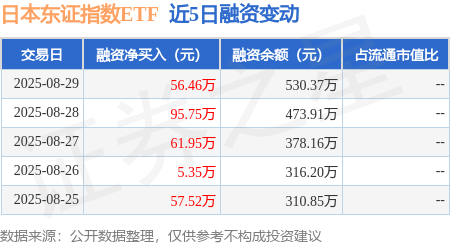
日本东证指数ETF:8月29日融资净买入56.46万元,连续3日累计净买入214.17万元
Sou Hu Cai Jing· 2025-09-01 02:54
Group 1 - The core point of the news is the recent financing activities related to the Japan Tokyo Stock Exchange Index ETF, indicating a positive trend in net buying over the past three trading days [1][2]. - On August 29, 2025, the financing net purchase amounted to 564,600 yuan, with a financing balance of 5,303,700 yuan, reflecting an increase of 11.91% from the previous day [2][3]. - Cumulatively, in the last three trading days, the total net buying reached 2,141,700 yuan, suggesting strong investor interest [1]. Group 2 - The financing balance on August 28 was 4,739,100 yuan, with a net purchase of 957,500 yuan, showing a significant increase of 25.32% compared to the previous day [2][3]. - The financing balance has been consistently rising, with notable increases on August 27 (378,160 yuan) and August 26 (316,200 yuan) [2][3]. - The current financing and securities lending balance stands at 5,303,700 yuan, indicating a robust market activity [3].
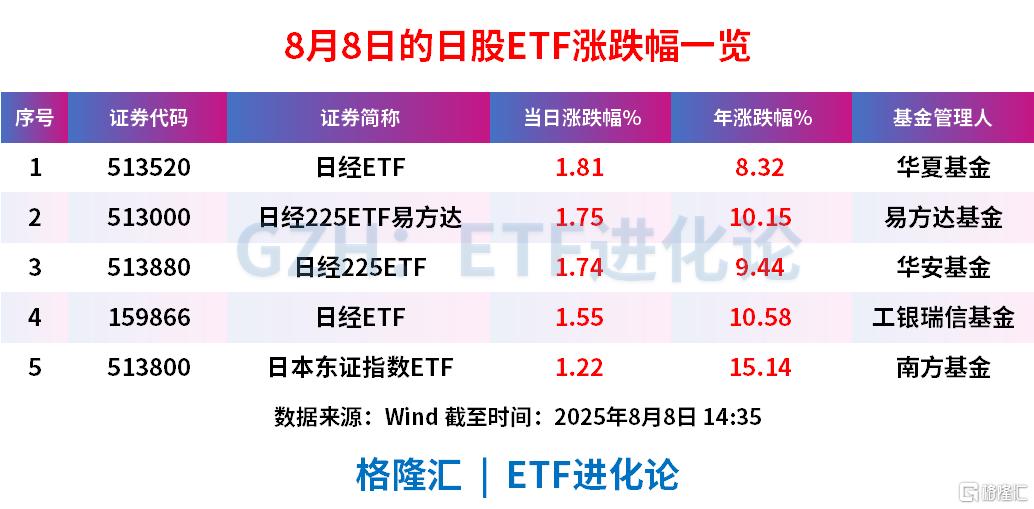
日股飙涨2%,日经ETF、日经225ETF易方达、日经225ETF涨超1.7%
Ge Long Hui· 2025-08-08 06:50
Market Performance - The Nikkei 225 index rose by 2%, while the Tokyo Stock Exchange index increased by 1.5%, reaching a historical high of 3032.88 points [1] - SoftBank Group saw its stock price surge nearly 13% during the day, closing at 14,190 yen, while Sony's stock rose over 6%, accumulating more than 10% gains over the last two trading days [1] ETF Performance - Various ETFs tracking the Nikkei and Tokyo Stock Exchange indices experienced gains, with the following performances: - Huaxia Fund Nikkei ETF: +1.81% - Nikkei 225 ETF by E Fund: +1.75% - Huazhong Fund Nikkei 225 ETF: +1.74% - ICBC Credit Suisse Fund Nikkei ETF: +1.55% - Southern Fund Tokyo Stock Exchange Index ETF: +1.22% [1] - The total net inflow for five Japanese stock ETFs this year reached 938 million yuan, with a total scale of 5.831 billion yuan, reflecting a 32% increase from the beginning of the year [7] Company Financials - Sony reported a revenue of 2.6216 trillion yen for Q1 of FY2025, a 2% year-on-year increase, with operating profit rising by 36% to 340 billion yen and net profit increasing by 23% to 259 billion yen [5] - SoftBank's Q1 FY2025 net profit was 421.8 billion yen, significantly exceeding market expectations of 158.23 billion yen, and marking the second consecutive quarter of profitability [5] - SoftBank has increased its holdings in NVIDIA from $1 billion to approximately $3 billion and has also invested in TSMC and Oracle [5] Strategic Moves - SoftBank's Vision Fund has liquidated nearly $2 billion in public and private assets in the first half of 2025, focusing on AI investments, particularly around Arm, a key player in its strategy [6] - Following a trade agreement between the U.S. and Japan, Japan's "equivalent tariff" rate will increase from 10% to 15% starting in August [6]

美日达成贸易协议,日经225ETF易方达、日本东证指数ETF、日经225ETF、日经ETF涨超3%
Ge Long Hui· 2025-07-23 04:01
Group 1: Trade Agreement Impact - The U.S. and Japan have reached a significant trade agreement, with Japan committing to invest $550 billion in the U.S. and a 15% tariff on imports to the U.S. [1] - The agreement is expected to create thousands of jobs in the U.S. and open up Japanese markets for U.S. products, including automobiles and agricultural goods [1] Group 2: Japanese Market Conditions - The Japanese economy is experiencing a phase of moderate recovery alongside structural pressures, with improvements in growth momentum but a need for further consolidation [2] - Despite inflation being above target levels, real wages are in a declining trend, raising concerns about the sustainability of the wage-price cycle [2] - Japanese corporate earnings remain relatively robust, providing support for the overall performance of the Japanese stock market [2] Group 3: Monetary Policy and Economic Outlook - The Bank of Japan decided to maintain interest rates during its meetings in May and June 2025, linking future rate hikes to economic growth and inflation forecasts [3] - Japan's core inflation rate exceeded expectations, bolstering the Bank of Japan's confidence in achieving its 2% inflation target [3] - The Japanese stock market showed strong performance in Q2, outperforming the S&P 500 index, driven by a combination of economic recovery and easing geopolitical tensions [3] Group 4: Domestic Issues and Market Stability - Rising rice prices in Japan have become a significant issue, affecting public trust in the government and prompting measures to stabilize prices [4] - The Japanese stock market has stabilized and rebounded from volatility caused by U.S. tariff policies, returning to levels seen in March or earlier [4] - The USD/JPY exchange rate has been fluctuating between 140-145, influenced by monetary policy expectations and trade tensions [4]
ETF午评:香港证券ETF领涨4.09%,建材ETF易方达领跌4.45%
news flash· 2025-07-23 03:33
Group 1 - The Hong Kong Securities ETF (513090) led the gains with an increase of 4.09% [1] - The Nikkei 225 ETF from E Fund (513000) rose by 3.69% [1] - The Japan Tokyo Stock Exchange Index ETF (513800) increased by 3.61% [1] Group 2 - The E Fund Building Materials ETF (159787) was the biggest loser, declining by 4.45% [1] - The Building Materials ETF (516750) fell by 3.81% [1] - The Building Materials ETF (159745) decreased by 3.17% [1]
ETF市场周报 | 三大指数回暖!人工智能、创新药两条主线带动相关ETF走强
Sou Hu Cai Jing· 2025-06-06 09:34
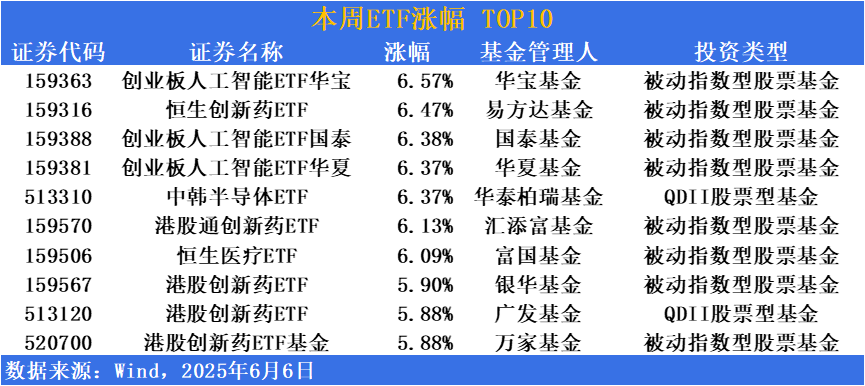
Market Overview - A-shares experienced narrow fluctuations in the first half of the week, followed by a brief rise and subsequent decline, with overall performance remaining stable and trading volume maintaining at over 1 trillion [1] - The three major indices saw a continuous recovery, with the Shanghai Composite Index, Shenzhen Component Index, and ChiNext Index rising by 1.13%, 1.42%, and 2.32% respectively [1] - The bond market showed a slight decline but remained at a relatively high level, reflecting a decrease in overall market risk appetite [1] ETF Performance - The average increase of all ETFs was 1.47%, with cross-border ETFs performing particularly well, averaging a rise of 2.23% [1] - AI and innovative pharmaceuticals were the main growth drivers, with top-performing ETFs in these sectors showing significant gains, such as the Huabao ChiNext AI ETF rising by 6.57% [2][3] - Conversely, consumer and automotive ETFs experienced notable declines, with the Greater Bay Area ETF dropping by 2.21% [4][5] Fund Flow Trends - The ETF market saw a net outflow of 24.88 billion, with a notable decrease in market activity [6] - Conservative investment preferences led to significant inflows into bond ETFs, with the Short-term Bond ETF attracting 14.69 billion, making it the top inflow [8] - The Shanghai Corporate Bond ETF recorded a weekly trading volume of 363.50 billion, indicating strong interest in bond funds [10] Upcoming ETF Listings - Four new ETFs are set to launch next week, including the Guotai ChiNext New Energy ETF, which tracks a representative index of the new energy industry [11] - The Invesco CSI 300 Enhanced Strategy ETF aims to provide returns exceeding the index through active management, focusing on high-quality core assets [12]
巴菲特说,希望持有日本五大商社至少50年,如何抄作业?
雪球· 2025-05-06 09:04
Core Viewpoint - Warren Buffett expresses a long-term commitment to investing in Japanese trading companies, aiming to hold their stocks for at least 50 years, regardless of short-term market fluctuations [1][2] Investment Decision and Sentiment - Buffett's interest in Japan's five major trading companies began six years ago when their stock prices were perceived as undervalued. He appreciates their strong operational history and the unique cultural aspects of these companies [1] - The performance of major companies like Apple, American Express, and Coca-Cola in Japan further reinforces Buffett's positive sentiment towards Japanese enterprises [1] Investment Situation - As of the end of 2024, Berkshire Hathaway's total investment in Japan's five major trading companies amounted to $13.8 billion, with a market value of $23.5 billion. Expected dividend income from these investments in 2025 is approximately $812 million, while interest costs on yen-denominated debt are around $135 million [1] - Berkshire has invested about $20 billion in the Japanese market, with aspirations to increase this to $100 billion [1] Market Valuation Insights - The current valuation metrics for the Nikkei 225 index indicate a price-to-earnings ratio of 17.52, placing it in the 34.82 percentile, and a price-to-book ratio of 1.74, in the 46.17 percentile. The dividend yield stands at 1.94%, in the 70.30 percentile, suggesting that the index is not overly expensive [2] Fund Investment Options - Several QDII passive index funds are available for investing in Japan, managed by companies such as Huaxia Fund, ICBC Credit Suisse Fund, and E Fund. The largest fund by scale is the Nikkei 225 ETF [4][5] Economic and Market Dynamics - Japan's economic recovery is supported by rising wages, with a 5.28% increase in the latest salary negotiations, which is expected to bolster domestic inflation [7][21] - The Bank of Japan's decision to abandon negative interest rates marks a significant step towards normalizing monetary policy, although the market remains cautious about potential risks [8][21] - The Japanese stock market is anticipated to benefit from ongoing governance reforms and increased shareholder returns, including stock buybacks [22][23] Short-term and Long-term Factors - Key short-term factors to monitor include actual wage growth, adjustments in corporate earnings guidance, and the progress of governance reforms [22] - Long-term factors supporting the Japanese stock market include the end of deflation, rising global investor interest, and ongoing corporate governance improvements [21][22]