智能芯片

Search documents
陆家嘴财经早餐2026年3月29日星期日
Wind万得· 2026-03-28 22:24
Group 1 - The Houthis in Yemen have launched military actions against Israel, indicating a new front in the Iran conflict and exposing the Bab-el-Mandeb Strait to risks [4] - Following military actions against Venezuela and Iran, US President Trump has threatened Cuba, stating it is next on the list [4] - Energy prices are rising, leading to inflation expectations and forcing central banks to reconsider interest rate cuts, negatively impacting stocks, bonds, and gold [4] Group 2 - The State Council's Food Safety Office has held discussions with local government officials in Chengdu and Chongqing regarding food safety issues exposed during the CCTV "3.15" gala [5] - The Ministry of Commerce announced a temporary implementation arrangement for the WTO e-commerce agreement, aiming to promote inclusive and sustainable digital trade development [6] - China's central fiscal childcare subsidies for 31 provinces have been disclosed, with significant funding allocated to several provinces [7] Group 3 - Major Chinese banks, including ICBC and CCB, reported steady growth in asset quality and profitability, with a combined net profit exceeding 900 billion yuan [8] - A subsidiary of Xilinmen, a leading mattress company, is facing internal issues with illegal fund misappropriation amounting to 100 million yuan [8] - Sanhua Intelligent Controls received attention from 284 institutions, indicating strong interest in its prospects in the global electric vehicle market [8] Group 4 - China's innovative drug transactions exceeded $60 billion in Q1, nearing half of the expected total for 2026 [9] - A significant breakthrough in nuclear medicine has been achieved with the production of medical-grade alpha isotopes in China [9] - Shanghai aims to become a leading city for developers, showcasing advancements in AI and smart technology [9] Group 5 - The global shipping industry has faced increased fuel costs due to the ongoing conflict in the Middle East, with additional costs exceeding 4.6 billion euros since February [13] - Russia plans to ban gasoline exports starting April 1 to stabilize domestic prices amid market turmoil [13] - The new Noida International Airport in India has officially opened, with an investment of approximately $1.18 billion [13] Group 6 - Thailand is negotiating with Iran to ensure safe passage for oil tankers through the Strait of Hormuz amid rising domestic oil prices [14] - The Philippines government has approved a price cap on imported rice to mitigate rising food costs due to the conflict [14] - 7-Eleven Japan is launching a new service allowing customers to order freshly cooked food via smartphone [15]

华虹半导体(01347.HK):4Q25业绩符合预期 电源类平台增长较快
Ge Long Hui· 2026-02-17 01:19
Core Viewpoint - The company's 4Q25 performance met expectations, with significant revenue growth driven by increased wafer shipments and improved average selling prices (ASP) [1] Group 1: 4Q25 Performance - The company's H-share revenue for 4Q25 was $660 million, representing a year-over-year increase of 22.4% and a quarter-over-quarter increase of 3.9% [1] - Gross margin for 4Q25 was 13%, up 1.6 percentage points year-over-year, attributed to ASP improvements and cost reductions, although it decreased by 0.5 percentage points quarter-over-quarter due to rising labor costs [1] - The net profit attributable to shareholders was $17 million, marking a return to profitability year-over-year, but a slight decline quarter-over-quarter [1] - The company guided for 1Q26 revenue between $650 million and $660 million, with an expected gross margin of 13% to 15% [1] Group 2: Revenue Analysis - Revenue from embedded products in 4Q25 increased by 31.3% year-over-year; independent non-volatile memory revenue rose by 22.9%; power revenue grew by 2.4%; RF logic revenue increased by 19.2%; and analog and power management revenue surged by 40.7% [1] - Overall, demand for MCUs, smart chips, flash memory, and power management chips remained strong, with computing product revenue increasing by 69.9% year-over-year and communication revenue rising by 29.1% [1] - Regional revenue growth for 2025 showed a year-over-year increase of 19.6% in China, 51.3% in North America, and 35.6% in Europe [1] Group 3: Annual Review and Outlook - As of the end of 4Q25, the company's total capacity was 486,000 wafers per month, an increase of 95,000 wafers per month year-over-year [2] - The company expects to complete most of the capacity ramp-up for FAB9A in 2026, with FAB9B starting equipment installation in 2027 [2] - The total revenue for 2025 is projected to be $2.4 billion, reflecting a year-over-year increase of 19.9%, primarily due to increased wafer shipments [2] - The gross margin for 2025 is expected to be 11.8%, up 1.6 percentage points year-over-year, driven by ASP improvements and cost reductions, although rising depreciation costs partially offset this advantage [2] - The company anticipates continued growth in power management chip demand driven by computing chip growth in 2026 and 2027, although there are concerns about declining sales expectations for some consumer products due to rising storage chip prices [2] Group 4: Profit Forecast and Valuation - The company has adjusted its 2026 revenue and profit forecasts down by 2.5% and 37% to $289.7 million and $13.7 million, respectively, and introduced 2027 revenue and profit estimates of $320.4 million and $16.6 million [2] - The current stock price corresponds to a 3.3x P/B for 2026 estimates, with a target price of HKD 110, reflecting a 3.6x P/B for 2026 estimates and an 11% upside potential [2]
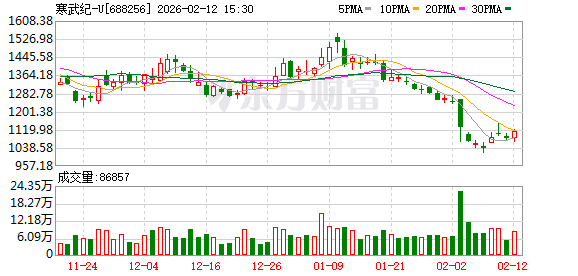
寒武纪:公司凭借在智能芯片领域里具有竞争力的产品优势及良好的服务,获得了客户的广泛认可
Zheng Quan Ri Bao· 2026-02-12 12:36
Group 1 - The core viewpoint of the article highlights the growth in demand for intelligent computing driven by advancements in large model technology [2] - The company has gained widespread recognition from clients due to its competitive product advantages and good service in the intelligent chip sector [2] - The company aims to closely monitor industry developments and market demands, seizing opportunities in computing power while deepening collaboration with clients [2] Group 2 - The company is committed to focusing on technological innovation in the field of artificial intelligence chip design to enhance its core competitiveness [2] - The company plans to actively expand its market share and accelerate the implementation of its solutions in various scenarios [2] - The overall goal is to promote sustained and positive development for the company [2]

从“建”到“用”:工业互联网标识迈向规模化“贯通”
Ke Ji Ri Bao· 2026-01-31 09:07
Core Viewpoint - The industrial internet, as a key engine for industrial transformation and competitive advantage, is advancing in China with the establishment of a unique identification and resolution system that enables data interoperability and value sharing across various sectors and regions [1][2]. Group 1: Development of the Identification and Resolution System - China's identification and resolution system for the industrial internet has transitioned from a "construction period" to an "application period" and "integration period," marking a significant advancement in its capabilities [1]. - The system has achieved controllable architecture, facilities, and technology, becoming an essential infrastructure for interconnectivity among various entities since its initiation in 2018 [1][2]. - The release of the "2024-2026 Action Plan" by the Ministry of Industry and Information Technology and other departments signifies the start of a new phase focused on large-scale applications [1]. Group 2: Trends and Applications - The recently published "Case Collection" includes 24 benchmark cases across 19 key industries and 5 major fields, showcasing the current state of industry development [2]. - Three major trends in the industry are identified: moving from internal management to full-process collaboration, from single-function applications to integrated innovation, and from key industries to broader fields [2]. - The application of identification technology has expanded from internal production tracking to encompassing the entire value chain, including R&D, production, supply chain, marketing, service, and recycling [2]. Group 3: Integration with New Technologies - Identification resolution is evolving beyond a mere tracking tool, integrating with technologies like 5G, artificial intelligence, and digital twins to create innovative applications [3]. - For instance, in the photovoltaic industry, a distributed certification platform combining identification and blockchain technology has been developed to provide each device with an immutable "digital identity," supporting green electricity trading and carbon footprint tracking [3]. Group 4: Value Creation and Impact - The application of identification resolution technology has led to significant improvements in operational efficiency and competitiveness for various companies [3]. - For example, a company increased its custom product order capacity from 5% to 30%, reduced changeover costs by 70%, and shortened order delivery cycles by 40% [3]. - The integration of the identification resolution system has improved on-time delivery rates to 98.5%, enhanced overall production efficiency by approximately 10%, and reduced inventory turnover from 226 days to 171 days [3].
重磅国家方案发布,激发数十万亿增长新动能
Di Yi Cai Jing· 2026-01-11 23:37
Core Insights - The article discusses the implementation of the "Artificial Intelligence + Manufacturing" initiative by eight departments, aiming to accelerate the integration of AI with the manufacturing sector and promote intelligent transformation [2][4] - The Ministry of Industry and Information Technology (MIIT) emphasizes that developing AI is essential for achieving new industrialization, focusing on both technology supply and application empowerment [3] - The initiative outlines seven key tasks and 21 specific measures to enhance the intelligent, green, and integrated development of the manufacturing industry [4][5] Group 1: Key Tasks and Goals - The initiative aims to apply 3 to 5 general large models in manufacturing by 2027, create 100 high-quality industrial data sets, and promote 500 typical application scenarios [4] - It seeks to cultivate 2 to 3 globally influential leading enterprises and a number of specialized small and medium-sized enterprises, establishing a robust ecosystem for AI in manufacturing [4] - The goal is to build a globally leading open-source ecosystem and enhance security governance capabilities [4] Group 2: Industry-Specific Guidelines - The "Guidelines for Key Industry Transformation" provide direction for sectors such as raw materials, equipment manufacturing, consumer goods, electronics, and software services [6] - In the automotive sector, the guidelines emphasize accelerating the intelligent upgrade of the entire supply chain, including the development of automotive large models for design optimization [6] - The integration of AI in manufacturing is seen as a critical factor for driving innovation in research and design, improving production efficiency, and optimizing supply chain management [6][11] Group 3: Industrial Internet and AI Integration - The integration of industrial internet and AI is highlighted as a key driver for new industrialization, with plans to enhance the level of integration by 2028 [7][8] - The initiative includes expanding new industrial networks to meet the demands of AI applications and improving data governance and sharing systems [7] - The focus is on creating a collaborative ecosystem that promotes the application of AI and industrial internet across various key industries [7][8] Group 4: Local Initiatives and Developments - Various local governments are launching their own "AI+" initiatives to drive high-quality development, with specific action plans and targets [9][10] - For instance, Shanghai aims to add 100 manufacturing enterprises with over 1 billion yuan in annual output by 2028 [9] - The establishment of dedicated AI development agencies in cities like Guangzhou and Zhuhai reflects a growing commitment to fostering AI innovation at the local level [10]

重磅国家方案发布,激发数十万亿增长新动能
第一财经· 2026-01-11 23:36
Core Viewpoint - The article discusses the implementation of the "Artificial Intelligence + Manufacturing" initiative by the Ministry of Industry and Information Technology (MIIT) and other departments, aiming to accelerate the integration of AI with the manufacturing sector and promote intelligent transformation in the industry [3]. Group 1: Key Tasks and Goals - The initiative outlines seven key tasks including innovation foundation, intelligent upgrade, product breakthroughs, entity cultivation, ecological expansion, safety protection, and international cooperation, with 21 specific measures to enhance the intelligent, green, and integrated development of manufacturing [5]. - By 2027, the goal is to promote the deep application of 3 to 5 general large models in manufacturing, create 100 high-quality industrial data sets, and establish 500 typical application scenarios [5]. Group 2: Industry Transformation Guidelines - The "Guidelines for Key Industry Transformation Empowered by AI" provide direction for sectors such as raw materials, equipment manufacturing, consumer goods, electronic information, and software services [6]. - In the automotive sector, the guidelines emphasize accelerating the intelligent upgrade of the entire supply chain, including the development of automotive large models for design and optimization [6]. Group 3: Industrial Internet and AI Integration - The integration of industrial internet and AI is highlighted as a crucial aspect of the initiative, with plans to enhance the level of integration by 2028, including the deployment of new industrial networks in over 50,000 enterprises [9]. - The article notes that AI is transitioning from being an auxiliary tool to becoming a core engine for industrial internet, enhancing capabilities such as real-time optimization and intelligent scheduling [10]. Group 4: Local Initiatives and Developments - Various local governments are actively promoting AI initiatives, with Shanghai aiming to add 100 manufacturing enterprises with over 1 billion yuan in annual output by 2028 [12]. - The establishment of dedicated AI development agencies in cities like Guangzhou and Zhuhai reflects a growing commitment to fostering AI innovation and integration within local industries [13].

“AI+制造”国家方案发布 激发数十万亿增长新动能
Xin Lang Cai Jing· 2026-01-11 17:16
Core Viewpoint - The Chinese government is accelerating the integration of artificial intelligence (AI) with the manufacturing sector to promote intelligent transformation and drive economic growth through the issuance of the "AI + Manufacturing" implementation opinions and the "Industrial Internet and AI Integration Empowerment Action Plan" [1][2]. Group 1: Key Tasks and Goals - The "Opinions" outline seven key tasks including innovation foundation, intelligence upgrade, product breakthroughs, entity cultivation, ecological expansion, safety protection, and international cooperation, with 21 specific measures to enhance the intelligent, green, and integrated development of manufacturing [2][3]. - By 2027, the plan aims to implement 3 to 5 general large models in manufacturing, create 100 high-quality industrial data sets, and promote 500 typical application scenarios [2][3]. Group 2: Industry Focus and Applications - The focus industries for AI integration include raw materials, equipment manufacturing, consumer goods, electronic information, and software services, with specific guidance provided for each sector [3][4]. - In the automotive sector, the plan emphasizes the intelligent upgrade of the entire supply chain, including the development of large models for automatic design and optimization of vehicle parameters [3][4]. Group 3: Infrastructure and Support - The "Action Plan" emphasizes the need for new industrial networks to support AI applications, targeting the deployment of these networks in over 50,000 enterprises by 2028 [6][7]. - The plan also aims to enhance the quality of industrial data collection and sharing in 20 key industries, establishing a robust data governance framework [6][7]. Group 4: Local Initiatives - Various local governments are launching their own AI initiatives, such as Shanghai's three-year action plan to support advanced manufacturing and Beijing's plan to establish itself as an AI innovation hub [8][9]. - The establishment of dedicated AI development agencies in regions like Guangzhou and Zhuhai signifies a growing commitment to fostering AI-driven economic growth [9].
八部门联合印发《意见》:促进人工智能技术与制造业应用“双向赋能”
Ke Ji Ri Bao· 2026-01-09 08:10
Core Viewpoint - The "Artificial Intelligence + Manufacturing" initiative aims to deeply integrate AI technology with the manufacturing industry, enhancing innovation and application capabilities by 2027 [1] Group 1: Key Objectives - By 2027, China aims to achieve secure and reliable supply of key AI technologies, maintaining a leading position in industry scale and empowerment levels [1] - The initiative plans to promote the deep application of 3-5 general large models in manufacturing, launch 1,000 high-level industrial intelligent entities, and create 100 high-quality industrial datasets [1] - The goal includes cultivating 2-3 globally influential leading enterprises and a number of specialized small and medium-sized enterprises, while establishing a leading open-source ecosystem [1] Group 2: Major Tasks - The initiative outlines seven key tasks including innovation foundation, intelligence upgrade, product breakthroughs, entity cultivation, ecosystem expansion, safety assurance, and international cooperation [1] - Specific measures include enhancing AI computing power, supporting the development of intelligent chips, and creating high-performance algorithm models tailored for manufacturing [2] - The initiative emphasizes the need for deep integration of AI in production processes, encouraging leading enterprises to pioneer AI applications and promoting digital empowerment for SMEs [2] Group 3: Product Development - The initiative aims to drive the iteration of intelligent equipment, integrating AI technology into the development and manufacturing of major technical equipment like aircraft and ships [3] - It also focuses on upgrading smart terminals, fostering innovation in AI-enabled products such as smartphones and smart home devices, and establishing testing bases for humanoid robots [3] - Policies will support the prevention of "involution" competition in the industry, coordinate funding channels for AI-related R&D, and enhance investment in quality projects [3]
发挥自身优势,抢抓人工智能发展的时代红利
第一财经· 2026-01-09 00:54
Core Viewpoint - The article emphasizes the importance of artificial intelligence (AI) in China's economic development, highlighting the government's commitment to advancing AI technologies and ensuring a robust industrial ecosystem by 2027 [2][3]. Group 1: Government Initiatives - The Ministry of Industry and Information Technology, along with seven other departments, has issued the "Implementation Opinions on the 'Artificial Intelligence + Manufacturing' Special Action," aiming for secure supply of key AI technologies and maintaining a leading industrial scale by 2027 [2]. - The "14th Five-Year Plan" explicitly calls for the comprehensive implementation of the "Artificial Intelligence +" initiative, showcasing the government's strategic focus on AI development [3]. Group 2: Industry Development - China's AI industry has made significant progress, with a developing industrial chain from foundational support to core technologies and industry applications, leading to the emergence of innovative enterprises and new business models [2]. - The listing of Zhiyun (02513.HK), recognized as the world's first "large model stock," on the Hong Kong Stock Exchange exemplifies the growth and potential of China's AI sector [2]. Group 3: Competitive Advantages - Tesla's CEO Elon Musk has expressed confidence in China's AI capabilities, particularly its electricity supply, predicting that by 2026, China's power generation could reach three times that of the U.S., supporting energy-intensive AI data centers [3]. - China possesses significant policy, market, and innovation advantages that are crucial for the rapid development of its AI industry [3]. Group 4: Challenges and Focus Areas - Despite advancements, China's AI industry faces challenges such as weak core technologies and limited application scenarios, necessitating improvements in key areas [2][4]. - The "Implementation Opinions" stress the need for secure and reliable supply of core technologies, particularly in foundational theories, methods, and tools, including breakthroughs in chip manufacturing and application scenarios [4]. Group 5: Strategic Importance of AI - AI is becoming a new engine for economic development, with its strategic value surpassing that of any other single technology, making it a focal point of international technological and economic competition [5]. - Mastering core AI technologies and achieving a leading industrial scale is essential for seizing the opportunities presented by the AI revolution [5].

工信部等八部门联合印发《“人工智能+制造”专项行动实施意见》
中汽协会数据· 2026-01-08 05:13
Core Viewpoint - The article discusses the implementation of the "Artificial Intelligence + Manufacturing" initiative, aiming to enhance the integration of AI technologies in the manufacturing sector by 2027, establishing China as a global leader in AI technology and application [1][6]. Group 1: Overall Requirements - By 2027, China aims to achieve secure and reliable supply of key AI technologies, maintaining a leading position in industry scale and empowerment levels globally. The initiative includes the application of 3-5 general large models in manufacturing, the launch of 1,000 high-level industrial intelligent entities, and the creation of 100 high-quality industrial data sets [6][5]. Group 2: Innovation Foundation - The initiative emphasizes strengthening AI computing power supply, supporting the development of intelligent chips and high-level computing facilities, and promoting the establishment of a national integrated computing network [7]. - It also focuses on developing high-performance algorithm models tailored for the manufacturing sector, encouraging the creation of industry-specific models and enhancing data governance capabilities [8][7]. Group 3: Application Empowerment - The initiative promotes the deep integration of AI in key manufacturing sectors, facilitating the development of intelligent factories and enhancing capabilities in design, production, and management processes [9][10]. - It encourages the establishment of AI application platforms to match supply and demand accurately, and supports the digital transformation of small and medium-sized enterprises [11][12]. Group 4: Product Breakthrough - The initiative aims to accelerate the iteration of intelligent equipment and the upgrade of smart terminals, including industrial robots and AI-driven medical devices, to enhance decision-making and operational capabilities [13][14]. - It also focuses on fostering new business models around intelligent entities and promoting the integration of AI with traditional software products [15][16]. Group 5: Ecological Growth - The initiative emphasizes the importance of standardization in AI development, encouraging participation in international standardization efforts and promoting an open-source ecosystem for AI projects [17][18]. - It aims to strengthen talent cultivation in the AI sector, ensuring a skilled workforce that understands both AI and manufacturing applications [19][18]. Group 6: Safety Assurance - The initiative outlines measures to enhance safety and security in AI applications, including the development of safety governance mechanisms and risk monitoring systems [20][21]. Group 7: International Cooperation - The initiative encourages international collaboration in AI, supporting enterprises in customizing AI products for different markets and participating in global AI discussions [21][20]. Group 8: Support Measures - The initiative calls for a comprehensive policy support system to facilitate the development of AI in manufacturing, including funding and resource allocation to promote new technologies and applications [22][23].