煤炭运输

Search documents
对话产业专家-散运运价淡季偏强-后续怎么看
2026-01-30 03:11
Summary of Conference Call Records Industry Overview - The conference call primarily discusses the dry bulk shipping industry, focusing on iron ore and bauxite markets, as well as coal transportation dynamics [1][2][3][4][5]. Key Points and Arguments Iron Ore and Bauxite Market - **Optimistic Price Forecasts**: The Cape FFA index is expected to exceed $25,000 per day in January 2026, driven by fundamental factors, particularly iron ore and bauxite as major incremental sources [1][2]. - **Global Iron Ore Exports**: Significant growth in global iron ore exports is anticipated in 2025, with Brazil, Australia, and West Africa contributing the majority of the increase. The Simandou project is expected to add approximately 20 million tons of production in 2026 [1][2]. - **Bauxite Exports**: Guinea is projected to maintain its dominance in bauxite exports, with expectations of a rebound to 200 million tons in 2026, an increase of about 30 million tons from the previous year [1][2]. - **Price Dynamics**: An increase in iron ore supply is expected to lead to a price decline from $160 per ton in 2021 to around $90 per ton this year. However, this price drop is not expected to significantly impact emerging projects like Simandou due to Chinese policy support [3][12]. Coal Transportation - **Declining Coal Transport Volumes**: Global sea transport of coal is projected to decrease by 58 million tons in 2025, with Capesize coal transport volumes dropping by 46 million tons, indicating a continued decline in coal's competitiveness among bulk commodities [4][5]. - **Impact of Coal Prices**: The decline in coal prices has limited trade flows, particularly affecting Colombian coal exports due to high transportation costs [5]. Steel and Shipping Dynamics - **Chinese Steel Exports**: China’s steel exports, which reached approximately 120 million tons last year, are crucial for absorbing domestic surplus and provide incremental support to the global shipping market, with 70% transported via dry bulk [8]. - **New Ship Orders**: Following the suspension of the US 301 investigation, new ship orders have rebounded significantly, indicating restored confidence in Chinese shipyards [9]. Environmental Regulations and Fleet Aging - **Impact of Environmental Policies**: Stricter environmental regulations are leading to a trend of slower ship operations and an increase in the average age of the fleet, as older vessels are less likely to be replaced due to previous high freight rates [10][14]. - **Future Supply Dynamics**: The aging fleet and environmental policies are expected to support the supply side in the medium to long term, as older ships are gradually replaced by new builds [10][12]. Market Outlook - **Demand Growth**: The overall demand for iron ore and bauxite is expected to grow by approximately 3% in 2026, with new capacity additions projected to be around 2-2.5% [11]. - **Geopolitical Considerations**: Potential geopolitical changes may introduce short-term uncertainties that could impact market dynamics [11]. Additional Important Insights - **Coal vs. Ore Transportation**: There are significant differences in the transportation and storage of coal compared to iron ore and bauxite, with coal being less suitable for long-term storage [6]. - **Trade Route Changes**: The grain market remains stable, but trade routes have shifted significantly due to geopolitical factors, particularly between the US and China [7]. This summary encapsulates the key insights from the conference call, highlighting the dynamics of the dry bulk shipping industry, particularly in relation to iron ore, bauxite, and coal transportation.
铜陵港连续三年 跻身全国内河亿吨大港行列
Xin Lang Cai Jing· 2026-01-05 16:39
Core Insights - The article highlights the significant growth in cargo throughput at Tongling Port, achieving a total of 100.54 million tons by the end of November 2025, with foreign trade cargo throughput reaching 810,900 tons and container throughput at 53,933 standard containers, representing year-on-year increases of 7.13%, 63.13%, and 11.92% respectively [1] Group 1: Port Development - Tongling Port has successfully completed its overall planning ahead of schedule, focusing on expanding development to areas such as Zongyang, Yongfeng, and Jiangbei [1] - The port has integrated several major projects into provincial planning, including the Zongyang hub port [1] Group 2: Investment and Infrastructure - During the 14th Five-Year Plan period, Tongling invested 950 million yuan in water transport fixed assets, increasing the number of productive berths to 66, which includes the addition of three 10,000-ton berths and three 3,000-ton liquid chemical product berths [1] - The 3,000-ton hazardous chemical terminal in the Lihatsan operation area has commenced operations, addressing the gap in public liquid chemical terminals [1] Group 3: Shipping Operations - The port has stabilized operations for the "Tongling-Shanghai" container foreign trade feeder line and has established regular direct shipping routes to Fukuyama, Japan [1] - It is projected that by 2025, the "water-water transshipment" business volume at Tongling Port will reach 2.529 million tons, with key material transportation including 18.48 million tons of coal and 10.76 million tons of metal ores [1]
大秦铁路:公司预计未来三年关联交易金额增加主要是基于传统业务煤炭运输需求下降
Zheng Quan Ri Bao· 2025-12-29 12:29
Core Viewpoint - The company anticipates an increase in related transaction amounts over the next three years due to a decline in traditional coal transportation demand and an expansion into the non-coal bulk market [2] Group 1: Business Strategy - The company is diversifying its operations by expanding into non-coal bulk markets, which include transportation of products such as coke, steel, and ores [2] - The majority of non-coal goods are expected to arrive at locations outside the company's network, necessitating adjustments in service offerings [2] Group 2: Market Factors - The increase in related transactions is influenced by the railway industry's pricing settlement rules and the market-oriented settlement policies for railway transportation [2] - The company is adapting to changes in the market environment, which is leading to increased revenue from network settlement services [2]


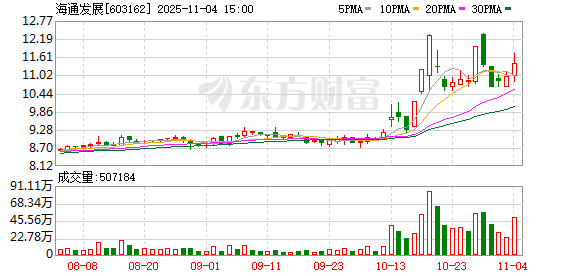
海通发展:大台北海运有限公司主要从事国际干散货航运业务,如运输煤炭、粮食等货种
Mei Ri Jing Ji Xin Wen· 2025-11-04 07:48
Group 1 - The core business of the wholly-owned subsidiary, Taipei Marine Co., Ltd., is international dry bulk shipping, primarily transporting commodities such as coal and grain [2]

秦港股份再涨超5% 三季度纯利同比增长22% 吞吐量有望继续小幅增长
Zhi Tong Cai Jing· 2025-11-04 05:11
Core Viewpoint - Qin Port Co., Ltd. (03369) has seen a stock price increase of over 5%, currently trading at HKD 2.98, with a transaction volume of HKD 86.18 million. The company reported a revenue of RMB 1.761 billion for Q3, a year-on-year increase of 9.51%, and a net profit of RMB 403 million, up 22.61% year-on-year. For the first three quarters, revenue reached RMB 5.212 billion, a 2.81% increase, and net profit was RMB 1.391 billion, up 3.87% year-on-year. The growth is attributed to enhanced customer marketing efforts and increased profitability from certain subsidiaries [1]. Financial Performance - Q3 revenue was RMB 1.761 billion, a 9.51% increase year-on-year [1] - Q3 net profit was RMB 403 million, a 22.61% increase year-on-year [1] - Revenue for the first three quarters was RMB 5.212 billion, a 2.81% increase year-on-year [1] - Net profit for the first three quarters was RMB 1.391 billion, a 3.87% increase year-on-year [1] Market Outlook - The coal throughput of Qin Port is correlated with the coal transport volume of the Daqin Railway, maintaining a ratio of approximately 54% from 2014 to 2024 [1] - The company aims to enhance market marketing efforts and optimize the source structure to create space for quality source increments, expecting stable coal throughput [1] - The metal ore throughput is related to the national iron ore import volume, with a ratio of about 11% from 2014 to 2024, showing an upward trend from 2019 to 2024 [1] - The company plans to strengthen customer relationship management and jointly explore markets, anticipating continued growth in iron ore throughput [1] - With the gradual recovery of the global economy, international trade volume is expected to increase, leading to growth in Qin Port's general cargo business [1]

Unlocking Q3 Potential of CSX (CSX): Exploring Wall Street Estimates for Key Metrics
ZACKS· 2025-10-13 14:16
Core Viewpoint - Analysts forecast a decline in CSX's quarterly earnings and revenues, indicating potential challenges for the company in the upcoming earnings report [1][2]. Earnings and Revenue Estimates - CSX is expected to report earnings of $0.43 per share, reflecting a year-over-year decline of 6.5% [1]. - Revenue is anticipated to be $3.61 billion, showing a decrease of 0.4% compared to the same quarter last year [1]. Revisions and Analyst Sentiment - The consensus EPS estimate has been revised 0.6% lower over the past 30 days, indicating a reevaluation of initial estimates by analysts [2]. - Changes in earnings projections are crucial for predicting investor reactions, as empirical studies show a strong correlation between earnings estimate trends and short-term stock price movements [3]. Key Revenue Metrics - Revenue from Coal is projected at $489.25 million, down 11.5% year-over-year [5]. - Revenue from Intermodal is expected to reach $518.62 million, up 1.9% year-over-year [5]. - Revenue from Merchandise-Fertilizers is estimated at $139.15 million, indicating a significant increase of 17.9% year-over-year [5]. - Revenue from Merchandise-Chemicals is forecasted at $722.80 million, reflecting a slight decline of 0.6% year-over-year [6]. Volume and Operating Metrics - Revenue per unit for Intermodal is expected to be $694.28, slightly down from $697.00 reported in the same quarter last year [7]. - Volume for Merchandise-Automotive is projected at 98.67 thousand, up from 98.00 thousand year-over-year [7]. - Volume for Merchandise-Minerals is expected to be 95.05 thousand, down from 96.00 thousand reported last year [8]. - Volume for Coal is anticipated to be 184.66 thousand, down from 190.00 thousand year-over-year [8]. - Volume for Merchandise-Fertilizers is projected at 50.24 thousand, up from 45.00 thousand last year [9]. - Volume for Merchandise-Metals and Equipment is expected to be 66.49 thousand, up from 64.00 thousand year-over-year [9]. - Volume for Merchandise-Agricultural and Food Products is projected at 110.94 thousand, down from 118.00 thousand reported last year [10]. Market Performance - CSX shares have returned +9.3% over the past month, outperforming the Zacks S&P 500 composite's +0.4% change [11]. - With a Zacks Rank 4 (Sell), CSX is expected to underperform the overall market in the near future [11].

秦皇岛港蝶变 | 十月行记
Jing Ji Guan Cha Wang· 2025-10-06 06:13
Core Viewpoint - The article highlights the transformation of Qinhuangdao from a small fishing village to a major city, primarily driven by the development of Qinhuangdao Port, which has been a key coal transportation hub in China. The port is now undergoing a transition towards tourism and diversified logistics services, while facing challenges in coal throughput due to market changes. Group 1: Port and Coal Transportation - Qinhuangdao Port has 21 dedicated coal berths with an annual designed throughput capacity of 193 million tons, serving as a critical endpoint for coal transportation in China [2] - In 2024, Qinhuangdao Port's total cargo throughput reached 414 million tons, with coal throughput accounting for 208 million tons, indicating its significant role in coal logistics [2] - The port was the first in the world to achieve a coal output of 200 million tons in 2007, consistently handling over 40% of the coastal coal output in China [3] Group 2: Infrastructure and Development - The port's development has been supported by extensive railway connections, including the Daqin Railway, which has transported over 9 billion tons of goods in 30 years, primarily coal [3] - The city has a dense network of railways and three major train stations, facilitating both freight and passenger transport [3] - The city has proposed relocating coal and miscellaneous goods operations from the western port area to the eastern port area to transform into a comprehensive logistics hub [6] Group 3: Tourism and Economic Transition - The port tourism industrial zone was officially opened in 2018, repurposing former industrial sites into tourist attractions, including a yacht and sailing base [8][12] - The area now features various recreational and educational facilities, aiming to attract tourists and promote maritime education [12][14] - The integration of the port tourism zone with existing tourist attractions along the coast enhances the overall visitor experience in Qinhuangdao [17]
大秦铁路(601006):受运量下滑及运输结构影响 Q2业绩表现偏弱
Xin Lang Cai Jing· 2025-09-12 02:34
Core Viewpoint - The company reported a decline in net profit for the first half of 2025, despite a slight increase in revenue, primarily due to weak coal transportation performance and rising operational costs [1][2][3]. Financial Performance - In H1 2025, the company achieved revenue of 37.29 billion yuan, a year-on-year increase of 1.9%, while net profit attributable to shareholders was 4.12 billion yuan, a decrease of 29.8% [1]. - Q2 2025 revenue was 19.49 billion yuan, up 6.3% year-on-year, but net profit fell by 45.2% to 1.54 billion yuan [1]. - The total coal dispatch volume for H1 2025 was 260 million tons, down 10.3% year-on-year, with the Daqin line contributing 190 million tons, a decrease of 2.2% [1]. Business Segmentation - Revenue from freight business was 26.09 billion yuan, down 1.7% year-on-year due to volume decline; passenger transport revenue increased by 2.6% to 5.04 billion yuan, driven by rising travel demand; other business revenue rose by 22.3% to 5.66 billion yuan [1]. - The company’s operating costs for H1 2025 were 32.07 billion yuan, an increase of 10.8%, leading to a gross margin of 14.0%, down 6.9 percentage points [2]. Cost Structure - Major cost components included personnel expenses of 9.78 billion yuan (up 2.3%), freight service fees of 9.71 billion yuan (up 37.7%), and passenger service fees of 3.36 billion yuan (up 6.6%) [2]. - Sales expenses decreased by 68.2% to 0.23 billion yuan, while management expenses increased by 37.9% to 0.36 billion yuan due to higher provisions [2]. Investment Outlook - The company is positioned as a key player in the coal transportation sector, with potential for recovery in coal volumes as the macroeconomic environment improves and production in Shanxi resumes [3]. - A cash dividend of 0.08 yuan per share is proposed, totaling 1.61 billion yuan, which represents 39.2% of the half-year net profit [3]. - Profit forecasts have been adjusted, with expected net profits of 7.01 billion yuan, 7.58 billion yuan, and 7.97 billion yuan for 2025-2027, corresponding to a PE ratio of 17.6x and a PB ratio of 0.8x for 2025 [3].
大秦铁路(601006):2025年半年报点评:煤炭需求承压叠加成本高增,25H1业绩承压
Xinda Securities· 2025-08-29 09:16
Investment Rating - The investment rating for the company is "Accumulate" [1] Core Views - The company's performance in the first half of 2025 was under pressure due to a decline in coal demand and rising costs, with a revenue of 37.286 billion yuan, a year-on-year increase of 1.86%, and a net profit of 4.115 billion yuan, a year-on-year decrease of 29.82% [1][2] - The coal transportation demand faced challenges, with coal dispatch volume down by 10.29% year-on-year in the first half of 2025, influenced by weak demand from the real estate and infrastructure sectors, as well as a decline in coal prices [3][4] - The company maintained a stable dividend policy, proposing a cash dividend of 0.08 yuan per share, with a payout ratio of approximately 39.17% [5] Summary by Sections Financial Performance - In the first half of 2025, the company achieved a total revenue of 37.286 billion yuan, with a net profit of 4.115 billion yuan, reflecting a significant decline compared to the previous year [1][2] - The second quarter of 2025 saw a revenue of 19.485 billion yuan, with a net profit of 1.544 billion yuan, marking a year-on-year decrease of 45.20% [2] Business Segments - The freight business generated 26.086 billion yuan in revenue, a decrease of 1.71% year-on-year, while the passenger transport business saw a revenue increase of 2.55% to 5.037 billion yuan [3] - The company completed a coal dispatch volume of 262 million tons in the first half of 2025, down 10.29% year-on-year, with coal accounting for approximately 80.01% of total dispatch volume [3] Cost and Profitability - The company's operating costs increased by 10.79% year-on-year in the first half of 2025, driven by a rise in non-coal freight transportation and logistics services [4] - The company expects net profits for 2025-2027 to be 9.053 billion yuan, 10.063 billion yuan, and 10.809 billion yuan, representing year-on-year growth rates of 0.15%, 11.16%, and 7.41% respectively [6] Dividend Policy - The company has a robust dividend policy, committing to a cash dividend payout ratio of no less than 55% of the annual net profit, with the potential for mid-term profit distribution [5]
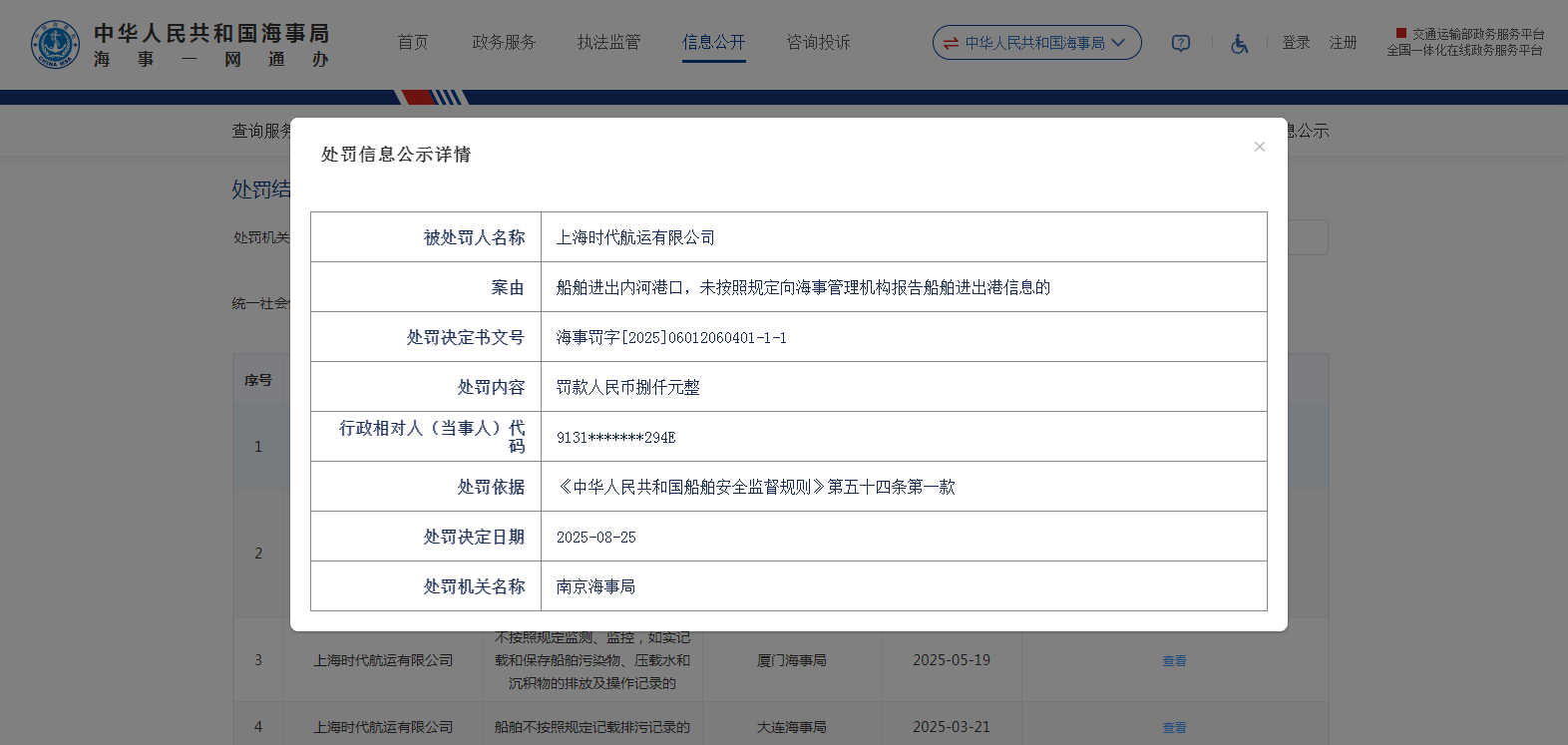
未向海事管理机构报告这类信息,上海时代航运收年内“第四罚”
Qi Lu Wan Bao· 2025-08-26 23:44
Core Viewpoint - Shanghai Times Shipping Co., Ltd. has received multiple administrative penalties from maritime authorities for failing to comply with regulations regarding vessel operations and reporting [1][2][3]. Group 1: Administrative Penalties - On August 25, 2025, Shanghai Times Shipping was fined 8,000 RMB for not reporting vessel entry and exit information to maritime management [2][3]. - The company has received four penalties in 2025, including violations related to recording pollution discharge and maintaining safe navigation speeds in designated areas [3][4]. - The penalties were issued by various maritime authorities, including Nanjing Maritime Bureau and Wu Song Maritime Bureau, indicating a pattern of regulatory non-compliance [3][4]. Group 2: Company Background - Shanghai Times Shipping Co., Ltd. was established on February 28, 2001, with a registered capital of 120 million RMB [6][7]. - The company operates 28 vessels with a total deadweight tonnage of 166.17 million tons, primarily transporting coal for Huaneng Power Plant [6][7]. - The ownership structure includes equal shares held by Shanghai Times Shipping and Huaneng International [6].