
后补贴时代

Search documents
内销大盘符合预期,两轮车补库在即
Orient Securities· 2025-12-23 08:16
Investment Rating - The report maintains a "Positive" outlook for the home appliance industry, indicating a relative strength of over 5% compared to the market benchmark index [5]. Core Insights - The domestic sales performance aligns with expectations, with a gradual transition into a post-subsidy era in 2026. In November 2025, home appliance sales reached 10.49 million units, down 31.8%, with domestic sales at 4.05 million units, down 39.8%, and exports at 6.44 million units, down 25.6% [7]. - The new national standard for electric two-wheelers is being implemented, with a significant inventory replenishment expected in the first half of 2026. The new models are being introduced, and a concentrated restocking period is anticipated [7]. - Key players in the cleaning appliance sector are undergoing ownership changes, which may impact market dynamics. iRobot is undergoing bankruptcy restructuring, while the founder of追觅科技 is acquiring a controlling stake in 嘉美包装 [7]. Summary by Sections Domestic Market Performance - The domestic market is experiencing a decline, which was anticipated. The central economic work conference confirmed the continuation of national subsidy policies into 2026, with adjustments expected to enhance service consumption [3][7]. Electric Two-Wheelers - The implementation of the new national standard for electric two-wheelers began on September 1, 2025, leading to the cessation of production and sales of old standard models. A significant inventory depletion is expected by the end of December 2025, with new models set to launch soon [7]. Key Players and Market Changes - iRobot's bankruptcy restructuring is expected to maintain brand operations but may not significantly alter market dynamics. The acquisition of 嘉美包装 by 追觅科技's founder could lead to strategic shifts in the cleaning appliance sector [7].





乘联分会:预计12月狭义乘用车零售230万辆 新能源零售138万辆
智通财经网· 2025-12-19 08:57
Core Viewpoint - The automotive market in December is expected to show a slight month-on-month increase in retail sales, but a significant year-on-year decline, with a focus on the impact of policy changes and market dynamics [1][3][6] Group 1: Market Performance - The retail market for narrow passenger vehicles in December is projected to reach approximately 2.3 million units, reflecting a month-on-month increase of 3.4% but a year-on-year decrease of 12.7% [1][3] - Retail sales of new energy vehicles (NEVs) are expected to be around 1.38 million units, with a penetration rate of 60% [1][3] Group 2: Monthly Market Review - In November, retail sales of narrow passenger vehicles totaled 2.225 million units, marking a year-on-year decline of 8.1% and a month-on-month decrease of 1.1% [2] - NEV retail sales in November reached 1.321 million units, showing a year-on-year growth of 4.2% and a month-on-month increase of 3.0%, with a market penetration rate of 59.3% [2] Group 3: Weekly Sales Trends - The first week of December saw an average daily retail of 42,000 units, a year-on-year decline of 32.3% and a month-on-month decrease of 7.8% [4][5] - The second week experienced a recovery with an average daily retail of 67,000 units, a year-on-year decline of 16.8% but a month-on-month increase of 8.8% [4][5] - The average daily retail is expected to rise to 118,000 units in the fifth week, reflecting a year-on-year increase of 9.3% but a month-on-month decrease of 4.8% [4][5] Group 4: Policy and Market Dynamics - The automotive market is transitioning to a normalized seasonal operation as multiple consumer stimulus policies are being phased out [6] - The adjustment of the new energy vehicle purchase tax subsidy from full exemption to half exemption is anticipated to influence consumer behavior, although no significant "last-minute rush" effect has been observed [6] - Several automakers have introduced "tax coverage plans" to stabilize consumer expectations amid policy changes, which may lead to some demand being postponed [6] - The industry is moving towards a more rational competitive environment, with new guidelines aimed at curbing irrational competition and promoting value-based competition [6]

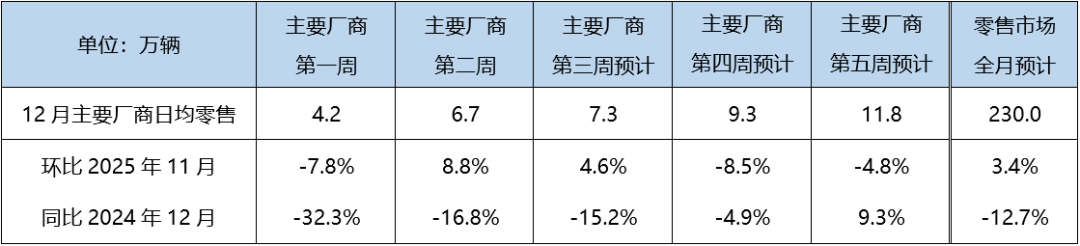
【乘联分会论坛】12月狭义乘用车零售预计230.0万辆,新能源预计138.0万辆
乘联分会· 2025-12-19 08:34
Core Viewpoint - The automotive market in China is experiencing a slowdown due to the withdrawal of replacement subsidies and consumer hesitation, with a notable decline in overall vehicle sales while the new energy vehicle (NEV) segment shows some resilience [2][7]. Group 1: November Market Review - As of mid-November, the retail sales of narrow-sense passenger vehicles reached 2.225 million units, a year-on-year decrease of 8.1% and a month-on-month decrease of 1.1% [2]. - In contrast, the retail sales of new energy narrow-sense passenger vehicles were 1.321 million units, showing a year-on-year growth of 4.2% and a month-on-month growth of 3.0%, with a market penetration rate of 59.3% [2]. Group 2: December Market Outlook - December is traditionally a peak season for the automotive market, with manufacturers leveraging the "Double Twelve" e-commerce event for promotions to boost annual sales targets [3]. - Despite the withdrawal of the old-for-new subsidy increasing consumer hesitation, the market is gradually returning to a seasonal norm due to year-end demand and expectations of reduced purchase tax subsidies [3]. Group 3: Manufacturer Sales Trends - Due to the significant adjustment of the old-for-new policy in November, most manufacturers have a neutral to conservative sales outlook for December, with major manufacturers maintaining or slightly increasing their retail targets compared to November [4]. - The estimated retail market size for December is approximately 2.3 million units, reflecting a month-on-month increase of 3.4% but a year-on-year decrease of 12.7%. The expected retail volume for new energy vehicles is around 1.38 million units, with a penetration rate of 60% [4]. Group 4: Weekly Sales Trends - In the first week of December, daily retail sales averaged 42,000 units, a year-on-year decline of 32.3% and a month-on-month decline of 7.8% [5]. - The second week saw an increase in daily retail sales to 67,000 units, a year-on-year decline of 16.8% but a month-on-month increase of 8.8% due to promotional efforts [5]. - The overall estimated retail market for December remains at 2.3 million units, with a month-on-month increase of 3.4% and a year-on-year decrease of 12.7% [5][6]. Group 5: Market Normalization Post-Policy Changes - The automotive market is currently in an adjustment phase following the exit of multiple consumer stimulus policies, with growth momentum shifting towards a demand-supply driven seasonal operation [7]. - As the new energy vehicle purchase tax subsidy transitions from full exemption to a 50% reduction, there has not been a significant "last-minute rush" effect observed in the market [7]. - Several automakers, including Weilai, Xiaopeng, and Aito, have introduced "tax coverage plans" to stabilize consumer expectations and mitigate market fluctuations caused by policy changes [7].

新能源汽车购置税减半征收倒计时,17家主流车企推出“兜底”方案
Hua Xia Shi Bao· 2025-12-10 06:56
Core Viewpoint - The Chinese new energy vehicle (NEV) market is experiencing a significant shift as the long-standing purchase tax exemption policy is set to change, prompting automakers to introduce "tax guarantee" schemes to encourage consumers to purchase vehicles before the policy change takes effect [3][5][6]. Group 1: Policy Changes and Market Reactions - The purchase tax exemption for NEVs, in place since September 2014, will transition to a 50% reduction starting January 1, 2026, with a cap of 15,000 yuan per vehicle [5][9]. - Over 17 major automotive brands have launched "tax guarantee" programs, promising to cover the tax difference for consumers who place orders before the end of 2025 but receive their vehicles in 2026 due to manufacturer delays [3][6][7]. - The cost difference for consumers purchasing NEVs is significant; for example, a vehicle priced at 300,000 yuan will save approximately 26,500 yuan in taxes if purchased in 2025, compared to 13,300 yuan in 2026, resulting in a 13,200 yuan increase in cost [5][6]. Group 2: Industry Dynamics and Consumer Behavior - The introduction of "tax guarantee" programs is a strategic response to potential consumer hesitation due to the impending tax changes, with many customers now preferring to order vehicles this year to avoid higher costs [6][7]. - The average delivery time for popular models is around 10 weeks, which could lead to order cancellations without the tax guarantee, thus stabilizing orders for manufacturers [8][9]. - The market is witnessing a shift from reliance on policy incentives to a focus on internal market dynamics, with NEV sales surpassing 50% of total new car sales for the first time in October 2025 [9][10]. Group 3: Future Market Outlook - The reduction of policy support indicates a transition to competition based on technological innovation, cost control, and brand value rather than subsidies and price wars [12]. - The new regulations set to take effect in 2026 will raise the bar for qualifying NEVs, potentially affecting around 30% of current plug-in hybrid models that may not meet the new standards [10][11]. - Industry experts predict a slowdown in sales growth for 2026, with wholesale volumes expected to increase by only 3% compared to 11% in 2025, reflecting the challenges posed by the changing subsidy landscape [11][12].

汽车企业,压力来了!年终行情悬而未决,淘汰赛鸣笛!|人民智行
Zheng Quan Shi Bao Wang· 2025-12-05 03:01
Core Viewpoint - The Chinese automotive market faces significant uncertainty as it transitions into the "post-subsidy era," with many companies expressing concerns about market conditions and competition intensifying [1][2][5]. Group 1: Market Conditions - By the end of 2025, the anticipated "tail effect" in the automotive market remains uncertain, with many companies unprepared for year-end sales targets [2][5]. - The withdrawal of local replacement subsidies and the adjustment of the new energy vehicle purchase tax from full exemption to a 50% reduction are expected to increase purchase costs for consumers [2][5]. - The overall automotive sales in China from January to October reached 27.687 million units, reflecting a year-on-year growth of 12.4% [5]. Group 2: Competitive Landscape - Companies are increasingly adopting "bottom-line" subsidy strategies to boost year-end sales, which may raise sales costs and challenge smaller brands with limited profit margins [3][4]. - The competition is expected to become more transparent and brutal, focusing on product strength, cost control, and user experience as the market moves away from policy-driven growth [5][9]. - The market is predicted to see a significant divide, with leading companies leveraging scale advantages and brand influence, while smaller brands may struggle with cash flow and product iteration [8][10]. Group 3: Future Outlook - The automotive industry is entering a phase where only a few strong brands are likely to survive, with predictions suggesting that in the future, only five dominant brands will remain in the market [10][11]. - The shift away from policy reliance is expected to allow companies to focus on technological innovation and service upgrades, fostering healthier industry development [10][11].


年终行情悬而未决,“后补贴时代”车市淘汰赛鸣笛
Zheng Quan Shi Bao· 2025-12-05 02:32
Core Viewpoint - The Chinese automotive market faces uncertainty as it transitions into the "post-subsidy era," with increased competition and policy changes impacting sales expectations for the end of 2025 [1][2][5]. Group 1: Market Conditions - Many car manufacturers are uncertain about their sales expectations for December, with some executives stating they are unprepared for the challenges ahead [2]. - The withdrawal of local trade-in subsidies and the upcoming reduction in purchase tax for electric vehicles are significant factors contributing to the market's unpredictability [2][6]. - The cumulative sales of automobiles in China from January to October reached 27.687 million units, reflecting a year-on-year growth of 12.4% [6]. Group 2: Competitive Landscape - The automotive industry is entering a new phase where competition will focus on product quality, cost control, and user experience, marking a shift away from reliance on subsidies [1][4][10]. - The introduction of "bottom-line" subsidy schemes by companies like Xiaomi and NIO indicates a strategic response to pressure from declining sales and inventory management [3][4]. - The market is expected to see a significant differentiation among brands, with larger companies better positioned to absorb profit pressures compared to smaller firms [8][9]. Group 3: Future Outlook - Analysts predict that the automotive market will experience a decline in sales pressure due to macroeconomic factors and policy changes, leading to a more stable and mature phase for the electric vehicle sector [8][10]. - The competition will intensify, with companies needing to innovate and improve efficiency to survive, as traditional factors like technology and cost control become critical in consumer decision-making [9][10]. - The industry is anticipated to undergo a significant reshaping, with only a few strong brands likely to survive in the long term, as indicated by industry leaders [11].
12.5犀牛财经早报:公募年终应对“牛皮市” “后补贴时代”车市淘汰赛鸣笛
Xi Niu Cai Jing· 2025-12-05 01:33
Group 1 - Public funds are implementing purchase limits on high-performing funds to ensure stable operation amid a narrow market fluctuation, while new funds are controlling their fundraising scale [2] - Private equity funds are actively conducting research in sectors like electronic components and healthcare devices, with a total of 13,000 research sessions conducted by 2,280 private equity institutions since the beginning of the fourth quarter [2] - Several banks have raised the minimum deposit threshold for large-denomination certificates of deposit (CDs), with some state-owned banks increasing the threshold to 1 million or 5 million yuan [2] Group 2 - The Chinese automotive market faces uncertainty as it transitions into the "post-subsidy era," with many car manufacturers resorting to subsidies and price reductions to meet year-end sales targets, raising concerns about profit margins [3][4] - Companies in the phosphate mining sector are accelerating their resource acquisition and capacity integration due to sustained high prices of phosphate rock, with the average market price for 30% grade phosphate rock at 1,016 yuan per ton [4] - The China Commodity Price Index has risen for seven consecutive months, with a November index of 114.1 points, reflecting a 0.8% month-on-month increase and a 1.6% year-on-year increase [4] Group 3 - LeEco, which has a debt of 23.8 billion yuan, plans to invest 180 million yuan in stock trading, clarifying that a significant portion of this investment is for "risk-free" purposes [5] - Country Garden has completed a debt restructuring that reduces its overall debt by over 90 billion yuan, enhancing confidence among buyers and suppliers [6] - Suhao Huihong plans to swap assets with its controlling shareholder, acquiring a 2.33% stake in Zijin Property Insurance for 262 million yuan [8]

年终行情悬而未决 “后补贴时代”车市淘汰赛鸣笛
Zheng Quan Shi Bao· 2025-12-04 22:21
Core Viewpoint - The Chinese automotive market faces uncertainty as it transitions into the "post-subsidy era," with increased competition and policy changes impacting sales expectations for the end of 2025 [1][2]. Group 1: Market Dynamics - Many car manufacturers are uncertain about their sales expectations for December, with some indicating a lack of preparedness for the end-of-year sales push [2]. - The withdrawal of local trade-in subsidies and the adjustment of the new energy vehicle purchase tax from full exemption to a 50% reduction are significant factors affecting consumer purchasing decisions [2][3]. - The market is moving away from reliance on policy support, entering a phase where product quality and user experience will be the primary competitive factors [1][6]. Group 2: Competitive Landscape - The competition among car manufacturers is expected to intensify, with a focus on product strength, cost control, and user experience as key differentiators [1][9]. - Smaller brands may struggle to absorb increased sales costs associated with "bottom-line" subsidy schemes, leading to potential operational challenges [4][9]. - The market is predicted to undergo significant differentiation, with leading companies leveraging scale and brand influence to maintain competitiveness [8][10]. Group 3: Industry Trends - The automotive industry is witnessing a shift towards a more transparent and direct competition environment, with a potential "淘汰赛" (elimination race) for less competitive players [10][11]. - Companies that can innovate and maintain service quality are likely to thrive, while those lacking core technology and cost control may face difficulties [10][11]. - The overall sentiment indicates that the automotive market will see a consolidation of strong brands, with predictions that only a few dominant players will remain in the long term [11].
年终行情悬而未决“后补贴时代”车市淘汰赛鸣笛
Zheng Quan Shi Bao· 2025-12-04 17:50
Core Viewpoint - The Chinese automotive market faces uncertainty as it transitions into the "post-subsidy era," with many companies expressing concerns about market volatility and competition intensifying [1][2]. Group 1: Market Conditions - By the end of 2025, the anticipated "tail effect" in the automotive market remains uncertain, with many companies unprepared for the challenges ahead, particularly those without existing orders [2]. - The withdrawal of local vehicle replacement subsidies and the adjustment of the new energy vehicle purchase tax from full exemption to a 50% reduction are significant factors affecting consumer purchasing decisions [2][3]. - The overall automotive sales in China from January to October reached 27.687 million units, reflecting a year-on-year growth of 12.4% [6]. Group 2: Competitive Landscape - The competition among automotive companies is expected to become more transparent and brutal, focusing on product strength, cost control, and user experience as the market moves away from policy-driven sales [1][6]. - Companies are increasingly adopting "bottom-line" subsidy strategies to boost year-end sales, which may raise sales costs and challenge smaller brands with limited profit margins [4][7]. - The market is predicted to experience significant differentiation, with leading companies leveraging scale advantages and brand influence to withstand price competition, while smaller brands may struggle with cash flow and product iteration [8][9]. Group 3: Future Outlook - The automotive industry is entering a phase where only a few strong brands are expected to survive, with predictions suggesting that in the future, only five dominant brands will remain in the market [11]. - As the market shifts away from reliance on policies, companies lacking core technology and cost control will find it increasingly difficult to maintain stability [10]. - The transition to a more mature and stable new energy vehicle market is anticipated, but not all companies will be able to remain competitive [8][10].
岚图汽车卢放:所有车企需一起努力维护好海外竞争秩序
Xin Jing Bao· 2025-11-25 12:04
Core Viewpoint - Lantu Automotive is focusing on launching three flagship models, which are expected to play a significant role in enhancing the brand's luxury positioning and technological advancement in the automotive market [1][3]. Group 1: Product Development - Lantu Automotive has introduced several upgraded models this year, including the FREE+, Zhi Yin, Chasing Light, Dreamer, and Lantu Taishan, forming a complete product matrix [2]. - The three flagship models, Dreamer, Lantu Taishan, and Chasing Light L, are crucial for leading the brand's upward trajectory and high-quality development [3]. Group 2: Market Strategy - The company aims to strengthen the image of Chinese manufacturing as it expands into international markets, emphasizing the importance of maintaining competitive order and product quality [4]. - The transition to a post-subsidy era is expected to lead to a more competitive landscape between fuel and electric vehicles, with the latter currently showing superior product capabilities [5]. Group 3: Future Outlook - The year 2026 is anticipated to mark a significant turning point in the automotive market, with intensified competition between fuel and electric vehicles [5][6]. - Companies are encouraged to focus on technological and management innovations to navigate competition effectively, rather than resorting to price wars [6].