神玑9031芯片

Search documents
蔚来,不闹了
虎嗅APP· 2026-01-12 13:34
Core Viewpoint - NIO has transitioned from a phase of high visibility and aggressive marketing to a more pragmatic and stable operational approach, focusing on solid business practices and achieving its established goals in the third development phase [5][18]. Group 1: Company Development and Strategy - NIO's recent milestone of producing its one millionth vehicle marks a significant turning point, showcasing its ability to deliver nearly 50,000 vehicles in December alone, with the new ES8 capturing 60% of the market share from competitors [4][11]. - The company is entering its third development phase, emphasizing collaboration among its three brands to meet a wide range of consumer needs, while also enhancing product competitiveness through technological innovation and increased R&D investment [5][14]. - NIO's shift from a defensive to an offensive strategy is reflected in its substantial investment of over 65 billion yuan in R&D and the acquisition of nearly 10,000 patents, which have now become a competitive advantage [11][12]. Group 2: Market Position and Performance - The new ES8 has achieved remarkable sales, becoming the fastest model to reach 40,000 deliveries in the premium segment, indicating strong market demand and operational efficiency [4][15]. - NIO's sales strategy has shifted to a more systematic approach, focusing on optimizing costs and improving operational efficiency, which has led to a significant increase in average transaction prices across its brands [15][20]. - The company is strategically targeting lower-tier cities with its new "SKY stores," aiming to penetrate markets dominated by traditional luxury brands like BBA [20]. Group 3: Leadership and Vision - NIO's CEO, Li Bin, emphasizes a grounded approach moving forward, indicating that the company no longer needs to rely on aggressive marketing tactics to establish its presence in the market [18][19]. - The company has recognized the importance of focusing on operational efficiency and profitability rather than engaging in public disputes or competitive narratives [19][20]. - NIO's leadership is now more focused on long-term sustainability and growth, with a clear understanding of its market position and the potential for future expansion [19][20].



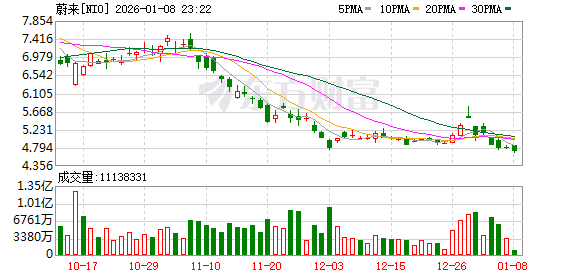
蔚来剑指2026年全年盈利
Zhong Guo Zheng Quan Bao· 2026-01-08 20:50
Core Insights - NIO has officially rolled out its one-millionth production vehicle, marking a significant milestone for the company, as stated by founder and CEO Li Bin [1] - The company anticipates a sales growth rate of 46.9% in 2025, with expectations of achieving profitability by the fourth quarter of 2025 and maintaining a steady growth rate of 40% to 50% in 2026 [1][3] Financial Performance - In Q3 of the previous year, NIO reported a loss of 2.7 billion yuan, but the fourth quarter showed improved gross margins due to higher deliveries of the new ES8 model, which had a gross margin exceeding 20% [2] - The improvement in profitability is driven by cost reduction through technology and product structure optimization, rather than merely increasing sales volume [2] Product and Brand Strategy - NIO's product lineup includes the new ES8, which delivered 22,256 units in December 2025, and the L90 model, which became the best-selling large electric SUV with annual sales of 43,439 units [3] - The company plans to leverage its three-brand strategy to achieve its next target of one million vehicles in approximately 18 months, focusing on collaboration among brands, infrastructure expansion, and market penetration [3][4] Infrastructure and Market Expansion - NIO aims to add 1,000 battery swap stations by 2026 and expand its charging network, enhancing its competitive edge in the market [4] - The company is also focusing on penetrating lower-tier markets, with 75% of current sales concentrated in major cities, indicating significant growth potential in these areas [4] Industry Outlook - Li Bin predicts that by 2030, the penetration rate of new energy vehicles in China will exceed 90%, with pure electric vehicles accounting for at least 80% [5] - The automotive industry is expected to face rising costs for raw materials, particularly memory chips, due to competition with AI and consumer electronics sectors [6] Global Strategy - NIO plans to enter 40 countries and regions by 2026, using its Firefly brand to lead international expansion, emphasizing a cautious approach to ensure profitability before entering new markets [6]
量产车终破百万辆 蔚来剑指2026年全年盈利
Zhong Guo Zheng Quan Bao· 2026-01-08 20:48
Core Insights - NIO has officially rolled out its one-millionth production vehicle, marking a significant milestone for the brand, as stated by founder and CEO Li Bin [1] - The company anticipates a sales growth rate of 46.9% in 2025, with expectations of achieving profitability by the fourth quarter of 2025 and maintaining a steady growth rate of 40% to 50% in 2026 [1][2] - NIO's strategy focuses on dual drivers for profitability: cost reduction through technology and optimization of product structure [1] Sales and Profitability - NIO delivered 326,000 vehicles in 2025, representing a year-on-year increase of 46.9%, with a notable rise in the proportion of high-margin models [2] - The new ES8 model contributed significantly to profitability, with a gross margin exceeding 20% due to increased deliveries [1] - The company has implemented effective cost control measures, which have further solidified its profitability foundation [2] Brand Strategy and Market Positioning - NIO plans to leverage its three-brand strategy to achieve its next milestone of one million vehicles within 18 months, with clear market positioning for each brand [3] - The company aims to enhance its market presence by expanding its infrastructure, including the addition of 1,000 battery swap stations by 2026 [3][4] - NIO's brands cover a price range from 100,000 to 800,000 yuan, ensuring no internal competition and a clear market strategy [3] Industry Outlook and Challenges - Li Bin predicts that by 2030, the penetration rate of new energy vehicles in China will exceed 90%, with pure electric vehicles accounting for at least 80% [6] - The automotive industry is expected to face rising costs for raw materials, particularly memory chips, due to increased competition with AI and consumer electronics [6] - NIO remains focused on its core automotive business while maintaining a cautious approach towards emerging technologies and global expansion [6] Future Plans - The company plans to enter 40 countries and regions by 2026, using its Firefly brand as a pioneer in international markets [6] - NIO emphasizes a pragmatic approach to international expansion, ensuring that any new market entry is backed by a viable business plan [6] - The focus for 2026 is on achieving sustainable profitability, with a commitment to solidifying its position as a long-term player in the automotive industry [6]
2026,李斌选择回到最原始的命题
2 1 Shi Ji Jing Ji Bao Dao· 2026-01-08 15:27
Core Insights - NIO has reached a significant milestone with the production of its one millionth vehicle, marking its entry into the "million club" alongside other new energy vehicle manufacturers [1] - The company aims for high-quality growth of 40%-50% annually without setting a specific sales target for 2026, focusing instead on sustainable operations and profitability [2][7] - NIO's strategy emphasizes efficiency improvements, channel expansion, and the integration of its three brands into a unified sales model [2][9] Group 1: Company Performance and Strategy - NIO delivered 326,000 vehicles in 2025, a year-on-year increase of approximately 47%, with December alone seeing deliveries surpassing 48,000 units, a record high [1][4] - The company is optimistic about achieving profitability in Q4 2025, with expectations of significant gross profit growth from the new ES8 model, which has a gross margin exceeding 20% [5] - NIO's CEO emphasizes the importance of maintaining a steady growth rhythm rather than chasing specific sales figures, highlighting the need for a sustainable operational pace [2][7] Group 2: Market Position and Competitive Landscape - NIO acknowledges its position as a smaller player in the competitive Chinese automotive market, which is projected to reach annual sales of over 34 million vehicles, allowing space for multiple companies to thrive [3][24] - The company is committed to its core business of electric vehicles, avoiding distractions from non-automotive ventures, and focusing on enhancing its product offerings and user experience [29][31] - NIO's long-term vision includes a robust battery swapping network, with plans to build at least 1,000 new battery swap stations to address the challenges of battery lifespan and vehicle longevity [2][16][26] Group 3: Future Plans and Innovations - For 2026, NIO plans to continue investing heavily in R&D and infrastructure while expanding its sales network through the launch of the "SKY" integrated store model in 210 cities [9][10] - The company aims to maintain a focus on high-end vehicles while also introducing new models, including three new large vehicles in the second and third quarters of 2026 [12][14] - NIO's commitment to technological innovation is evident in its development of advanced components, such as the first mass-produced 5nm automotive chip, which enhances performance while reducing costs [6][20]
2026 李斌选择回到最原始的命题
2 1 Shi Ji Jing Ji Bao Dao· 2026-01-08 15:22
Core Insights - NIO has achieved significant growth, delivering 326,000 vehicles in 2025, a year-on-year increase of approximately 47% [1][6] - The company is optimistic about achieving profitability in Q4 2025, driven by the delivery of the new ES8 model, which has a gross margin exceeding 20% [1][8] - NIO emphasizes a focus on quality growth rather than setting specific sales targets for 2026, aiming for a 40%-50% growth rate [4][10] Group 1: Company Performance - NIO's first million vehicles were produced in 91 months, making it the fifth company to join the "million club" in the electric vehicle sector [2] - The company has launched three brands, covering a price range from 100,000 to 800,000 RMB, enhancing its market reach [3][7] - NIO's technology cost reduction strategies, including self-developed chips, have led to improved gross margins [3][7] Group 2: Strategic Focus - In 2026, NIO plans to concentrate on vehicle sales and service quality, avoiding single annual sales targets [4][11] - The company aims to enhance efficiency and expand its presence in lower-tier markets through the "SKY" integrated store model [4][12] - NIO is committed to building at least 1,000 battery swap stations, leveraging partnerships to expand its network [4][18] Group 3: Market Position and Future Outlook - NIO's CEO believes that the Chinese automotive market can support at least ten major brands, with a projected annual sales volume of 35 million vehicles [5][27] - The company is focused on maintaining a competitive edge through continuous innovation and operational efficiency [5][23] - NIO's long-term strategy includes a commitment to battery swapping technology, which addresses the issue of battery lifespan and vehicle longevity [4][28]
蔚来李斌首度回应“好人论”:过去十年,我让二十多个VP走人了
21世纪经济报道· 2025-03-25 09:37
Core Viewpoint - The article discusses the management strategies and operational adjustments of NIO under CEO Li Bin, emphasizing the company's focus on achieving profitability in the fourth quarter of this year through increased sales, reasonable gross margins, and controlled expenses [4][5][6]. Management and Organizational Changes - Li Bin has faced criticism regarding his management style, with suggestions to replace some executives. However, he highlights that NIO has seen a high turnover of VPs, with over 20 leaving the company [2][3]. - In 2019, during a critical period for NIO, Li Bin made significant organizational changes, reducing the North American team from 700 to over 200 and seeing the departure of several mid-level executives [3][4]. - The current management committee consists of five key members who report directly to Li Bin, focusing on stability and practical execution [4]. Profitability Goals - Li Bin stated that achieving profitability is the primary goal for NIO this year, with a focus on increasing sales volume and maintaining a reasonable gross margin while controlling expenses [5][6]. - NIO's closest approach to profitability was in 2021, with a sales volume of 91,429 units and a gross margin of 18.9%, despite a net loss of 4.017 billion yuan [5]. Product Strategy and Market Focus - NIO plans to launch a new model in the fourth quarter, focusing on the Chinese market and enhancing the perceived value of its vehicles [9][10]. - The company aims to improve its product offerings by learning from past mistakes, particularly in product definition and market positioning [9][10]. Cost Control and Efficiency - Li Bin introduced a cost control initiative called "Cost Mining," which focuses on detailed cost analysis and efficiency improvements across the supply chain [17][18]. - The company is implementing a "transparent supply chain" strategy to reduce waste and improve cost management, aiming for a gross margin of 20% for its vehicles [20][21]. Sales and Market Expansion - NIO is expanding its market presence, with plans to enter 25 countries and regions this year, utilizing local partnerships to enhance its distribution network [13][28]. - The company has identified the importance of battery swap stations in driving sales, with significant contributions to sales in regions with established networks [12][13]. Future Outlook - NIO is set to release multiple new models this year, including the ET9 and L6 0, with a focus on technology and user experience [27][28]. - The company is investing heavily in R&D, particularly in self-developed chips and operating systems, which are expected to significantly reduce costs and enhance product competitiveness [20][28].