
细胞与基因治疗

Search documents
未来产业十大赛道公布
21世纪经济报道· 2026-03-27 04:28
Core Viewpoint - The article emphasizes the importance of "localized and differentiated development" in the context of future industries, highlighting the need for strategic planning and resource allocation to achieve high-quality growth in emerging sectors [2][5][6]. Summary by Sections Future Industry Development - The Ministry of Industry and Information Technology (MIIT) is focusing on the overall development of future industries, with a clear emphasis on strategic planning and the establishment of a technology foresight mechanism to guide local development based on regional resources [5][6]. - The government has outlined key areas for future industries, including quantum technology, biomanufacturing, hydrogen energy, and nuclear fusion, as part of the 14th Five-Year Plan [3][9]. Key Tracks for Future Industries - The 2026 Future Industry Forum announced ten key tracks for future industries: humanoid robots/embodied intelligence, biomanufacturing, brain-computer interfaces, cell and gene therapy, low-altitude equipment, nuclear fusion energy, autonomous agents, high-level autonomous driving, satellite internet, and quantum computing [10][11]. - Predictions indicate that several of these tracks will reach trillion-yuan market scales, with humanoid robots expected to see a global market demand of trillions by 2035, and biomanufacturing projected to create $30 trillion in economic value by 2050 [10][11]. Local Government Initiatives - Local governments are actively responding to national policies, with 19 provinces and cities issuing nearly 30 policy documents related to future industries, establishing over 60 provincial pilot zones focusing on key areas like artificial intelligence and quantum technology [5][6]. - The MIIT plans to enhance technological supply and support for future industries through major national projects and financial backing, while also exploring regulatory frameworks that accommodate the unique characteristics of future industries [7][10]. Market Growth and Trends - The article notes that the cell and gene therapy market is expected to grow at a rate of 20%, while the nuclear fusion industry has seen investments surge from $1.9 billion in 2021 to $9.766 billion, reflecting a compound annual growth rate of over 50% [11]. - The autonomous driving sector is on the verge of commercialization, with significant advancements in technology and successful case studies emerging in both the U.S. and China [11].


报名:第七届生物制药研发及质量控制网络大会
仪器信息网· 2026-03-23 09:06
Core Insights - The global biopharmaceutical industry is entering a rapid development phase, with accelerated technological iterations in cutting-edge fields such as antibody drugs, cell and gene therapy, and radiolabeled drug conjugates (RDC) [1] - Domestic policies are increasingly supporting innovative drug research and the standardization of quality control, presenting new opportunities for industry growth [1] Conference Highlights - Comprehensive coverage of five core biopharmaceutical areas: antibody/protein drugs, cell and gene therapy, nucleic acid drugs, peptide drugs, and RDC, addressing the entire "research and development - quality control" chain [2] - Over 25 top experts from industry and academia will participate, including R&D and quality control directors, renowned professors, and clinical department heads, fostering deep integration of industry, academia, and clinical practice [2] - All presentations will focus on core technologies and practical methods, utilizing real case studies to address technical challenges and solutions, enhancing attendees' ability to apply these methods in their work [2] Conference Details - The conference will take place from March 24 to 26, 2026, organized by the Instrument Information Network, with support from key laboratories and professional committees [4] Agenda Overview - The agenda includes specialized sessions on various topics such as antibody drug conjugation techniques, nucleic acid drug development, and quality control in cell and gene therapy, featuring presentations from leading experts in the field [5][6][7]

中国CXO:需求回暖+格局重塑,行于规模奔涌、优胜劣汰的星辰大海
BOCOM International· 2026-03-22 07:45
Group 1: Industry Trends - The CXO industry in China is experiencing a recovery driven by increased demand for outsourced research and production services, with significant growth expected in 2026-2027[5] - The global CXO market is projected to grow from $197 billion in 2024 to $298 billion by 2030, representing a compound annual growth rate (CAGR) of 7%[10] - The trend of Chinese innovative drugs going global is expected to create long-term opportunities for CXO companies, enhancing their order and pricing power[16] Group 2: Investment Recommendations - BOCOM International recommends focusing on high-quality, cost-effective leaders in the CXO sector, specifically WuXi AppTec, Kelun Pharmaceutical, and Kanglongda, all rated as "Buy"[24] - WuXi AppTec is highlighted for its strong order performance and expected revenue growth, with a target price of HKD 91, indicating a potential upside of over 60%[25] - Kelun Pharmaceutical is expected to see a revenue CAGR of 16% from 2025 to 2027, with a target price of HKD 113.8, suggesting a potential upside of over 50%[25] Group 3: Key Drivers of Growth - The expansion of demand for innovative drug development and production outsourcing is a key driver for the CXO industry, with significant increases in R&D investments expected[9] - The integration of AI in drug development is anticipated to reach a critical development point in 2026, enhancing decision-making in early-stage research[9] - The industry is witnessing a trend of consolidation, where leading companies are acquiring smaller firms to enhance their technological capabilities and market presence[14] Group 4: Risks and Challenges - Potential risks include mismatches in supply and demand, particularly in new molecular types and regulatory challenges in overseas markets[5] - The increasing complexity of global supply chains and regulatory requirements may pose challenges for CXO companies lacking international experience[21] - The industry faces uncertainties related to drug pricing reforms and geopolitical factors that could impact operational stability[12]
深圳:加快药物研发、细胞与基因治疗、精准医疗服务的研发创新与成果转化
Jin Rong Jie· 2026-02-12 11:14
Core Viewpoint - Shenzhen's Industrial and Information Technology Bureau has issued the "Shenzhen 'Artificial Intelligence +' Advanced Manufacturing Action Plan (2026-2027)", focusing on accelerating innovation and transformation in drug research and development, cell and gene therapy, and precision medical services [1] Group 1: Action Plan Objectives - The plan aims to promote technological innovation in key areas such as drug target discovery and validation, drug design, high-throughput drug screening, DNA-encoded compound library screening, computer-aided drug design, virtual screening, and gene locus screening related to drug therapy [1] - It supports the establishment of major platforms for AI-driven drug research and development, enhancing the integration of technological resources [1] Group 2: AI and Biotechnology Integration - The initiative emphasizes the deep integration of artificial intelligence and biotechnology (AI+BT) to accelerate advancements in the sector [1]
2026年31省“强产业”图景:传统、新兴、未来三维并进,推进智能化和绿色化
Xin Lang Cai Jing· 2026-02-09 03:24
Core Viewpoint - The "14th Five-Year Plan" emphasizes building a modern industrial system and strengthening the foundation of the real economy as a primary strategic task, with 2026 marking the beginning of this plan [1] Group 1: Industry Focus and Strategies - Local governments across 31 provinces are prioritizing "strong industries" with a focus on "new quality productivity," driven by technological innovation, while consolidating traditional industries and competing in AI and future industries [1] - Key emerging industries identified include artificial intelligence, biomedicine, commercial aerospace, robotics, and quantum technology, reflecting a commitment to the central government's directives [3][9] - Provinces are adopting a three-dimensional approach to industry development, focusing on upgrading traditional industries, nurturing emerging industries, and laying out future industries [3][4] Group 2: Technological Innovation and Investment - Technological innovation is seen as the primary driver for strong industries, with many provinces setting quantitative targets for R&D investment, such as Jiangsu aiming for a 7% annual increase in R&D spending [4][5] - Various provinces are investing significantly in core technology breakthroughs, with Beijing planning to invest over 1.5 billion yuan in high-tech industry technology research [7] - The establishment of innovation platforms and pilot zones is being prioritized to facilitate the transformation of technological achievements into production [7][9] Group 3: Differentiated Industrial Layout - Provinces are tailoring their industrial strategies based on local resources and advantages, with eastern coastal provinces focusing on global innovation hubs and western provinces targeting green energy and computing [11][12] - The northeastern provinces are revitalizing traditional industries and enhancing specialized equipment manufacturing, with specific initiatives to support local industrial clusters [12][13] Group 4: Talent and Policy Support - Local governments are launching new talent acquisition plans to attract high-level professionals, with Beijing implementing measures to support young innovators [13] - A comprehensive policy framework combining industrial planning, special policies, and financial support is essential for achieving the goal of strong industrial provinces [13]
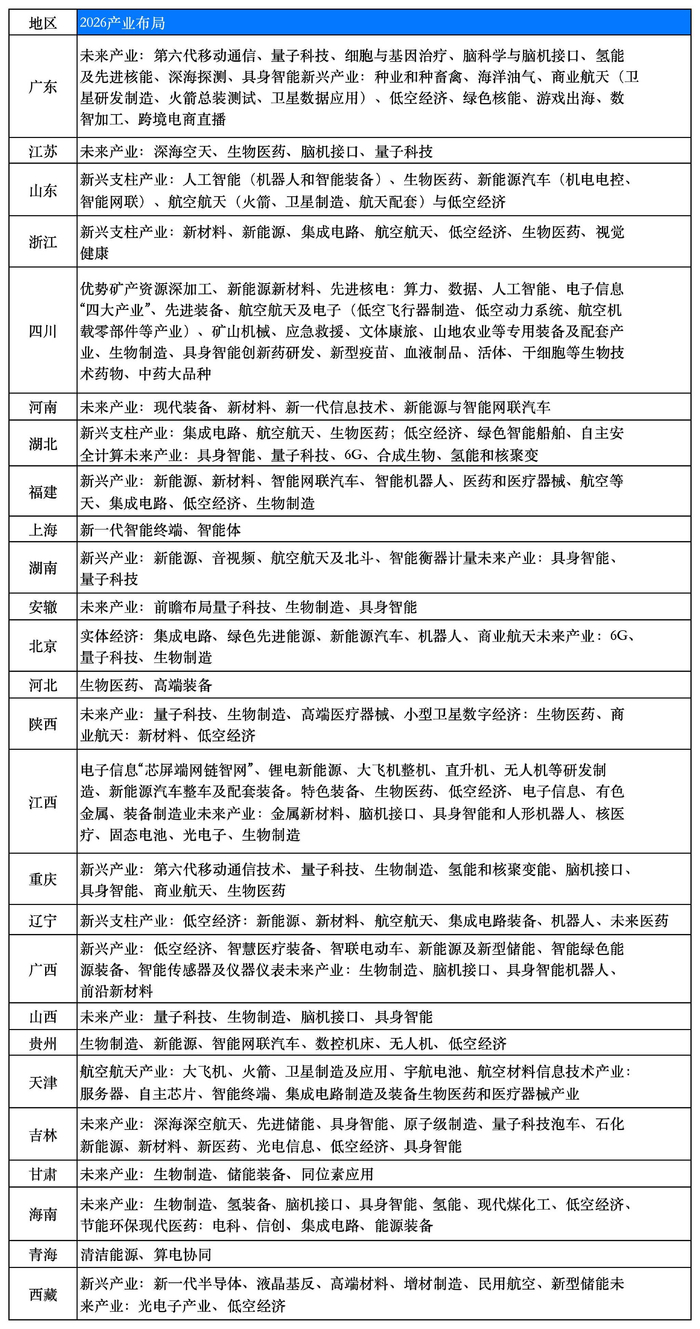
布局未来产业赛道 地方竞相激活新引擎
Xin Lang Cai Jing· 2026-02-06 18:56
Core Viewpoint - The development of future industries is essential for building a modern industrial system and promoting high-quality development, as emphasized by the highest decision-making body in China during its collective study session on January 30, 2026 [1][2]. Group 1: National Strategy and Policy - The 14th Five-Year Plan has accelerated technological layout in future industries, achieving breakthroughs in fields such as artificial intelligence, biomanufacturing, quantum information, and hydrogen energy [2]. - The 20th Central Committee of the Communist Party of China has highlighted the importance of nurturing emerging and future industries, indicating a strategic focus on these sectors [1][2]. - The recent collective study session by the Central Political Bureau has set a clear direction for "steady progress and gradient cultivation" in future industries, emphasizing the need to balance current and long-term goals [2][4]. Group 2: Regional Development Initiatives - Major provinces like Zhejiang, Beijing, and Guangdong have incorporated future industry development into their 2026 government work reports, outlining specific measures to leverage local advantages [3][4]. - Zhejiang plans to establish 10 pilot zones for future industries, focusing on human-shaped robots, brain-machine interfaces, and quantum information, among others [3]. - Beijing aims to develop high-precision industries and promote pilot zones for future industries, targeting growth in 6G, quantum technology, and biomanufacturing [3]. - Guangdong is set to enhance its future industry layout, focusing on sixth-generation mobile communication, embodied intelligence, and advanced nuclear energy, among other sectors [3][4]. Group 3: Differentiated Development Strategies - The layout of future industries across the country is characterized by a differentiated development pattern that aligns with local resource endowments and comparative advantages [5][6]. - Experts suggest that local governments should adopt a collaborative innovation approach, combining government guidance with market leadership and industry-academia-research cooperation [6]. - Specific recommendations for provinces include leveraging digital economy foundations in Zhejiang, enhancing research and application in Beijing, and fostering cross-regional industrial chain collaboration in Guangdong [6]. Group 4: Challenges and Considerations - The development of future industries faces challenges such as technological bottlenecks and talent shortages, necessitating adjustments in educational systems and collaboration between enterprises and research institutions [7].
今日视点:中国药械“出海”迈入体系化新征途
Xin Lang Cai Jing· 2026-01-23 23:26
Core Viewpoint - The Chinese pharmaceutical and medical device industry is entering a new phase of "systematic going global," supported by national platforms and multi-dimensional efforts from enterprises [1] Policy Support - The "systematic going global" initiative is receiving unprecedented systematic support, with the issuance of the first "overseas drug price certificate" in January 2026, bolstering the global pricing of China's pharmaceutical industry [2] - A multi-layered market connection network is being formed, with the National Healthcare Security Administration promoting differentiated development in regions like Guangxi, Xinjiang, Tianjin, and Ningbo, targeting Southeast Asia, Central Asia, and Central and Eastern Europe [2] - Multiple government departments, including the Ministry of Commerce and the National Medical Products Administration, are collaborating to reduce institutional costs and information barriers for enterprises going global [2] Industry Transformation - The export structure of China's pharmaceutical and medical device industry is shifting from low-value consumables to high-value innovative products, with a significant increase in the licensing-out transactions of innovative drugs expected to exceed $130 billion by 2025 [3] - Leading companies like United Imaging Healthcare and Mindray Medical are seeing a continuous increase in overseas revenue, successfully entering high-end hospital markets in Europe and the U.S. [3] Strategic Recommendations - Companies need to solidify their innovation foundation by focusing on unmet clinical needs and building proprietary technology platforms in advanced fields like ADCs, bispecific antibodies, and gene therapy [3] - Utilizing capital tools for overseas strategic layout is essential, such as raising funds through targeted placements for overseas clinical research and acquisitions of quality overseas targets [4] - Implementing differentiated market strategies is crucial, with companies needing to adopt localized thinking in different markets, maximizing product value through partnerships in mature markets and engaging in local production in emerging markets [4]


中国药械“出海”迈入体系化新征途
Zheng Quan Ri Bao Zhi Sheng· 2026-01-23 16:12
Core Insights - The Chinese medical device and pharmaceutical industry is entering a new phase of "systematic going global," supported by national platforms and multi-dimensional corporate efforts [1] Policy Support - The "systematic going global" initiative is receiving unprecedented systematic support, with the issuance of the first "overseas drug price certification" in January 2026, facilitating the global pricing of Chinese pharmaceuticals [2] - A multi-layered market connection network is being established, with the National Healthcare Security Administration promoting differentiated development in regions like Guangxi, Xinjiang, Tianjin, and Ningbo to expand services to countries along the Belt and Road [2] - Multiple government departments, including the Ministry of Commerce and the National Medical Products Administration, are collaborating to reduce institutional costs and information barriers for companies going global [2] Industry Transformation - The export structure of China's medical device and pharmaceutical industry is shifting from low-value consumables to innovative products, with a significant increase in the value chain [3] - By 2025, the total value of China's innovative drug licensing transactions is expected to exceed $130 billion, with many innovative drug companies attracting interest from international giants [3] - Leading companies like United Imaging Healthcare and Mindray Medical are increasing their overseas revenue share, successfully entering high-end hospital markets in Europe and the U.S. [3] Strategic Recommendations - Companies need to solidify their innovation foundations by focusing on unmet clinical needs and building proprietary technology platforms in advanced fields like ADCs, bispecific antibodies, and gene therapy [4] - Utilizing capital tools for overseas strategic layout is essential, such as raising funds through targeted placements for overseas clinical research and acquisitions of quality overseas targets [4] - Implementing differentiated market strategies is crucial, with companies needing to adopt localized thinking in different markets, maximizing product value through partnerships in mature markets, and engaging in local production and health ecosystem development in emerging markets [4]
广东2026年将重点建设琶洲、南山、滨海湾三大人工智能核心产业集聚区
2 1 Shi Ji Jing Ji Bao Dao· 2026-01-20 08:54
Group 1 - The core viewpoint of the articles emphasizes the deep integration of artificial intelligence (AI) with the real economy in China, particularly in Guangdong, which is driving explosive growth in high-end manufacturing, emerging consumption, and new business models [1][2]. - Guangdong aims to accelerate the development of the AI industry by 2026, establishing a global AI industry cooperation center in the Guangdong-Hong Kong-Macao Greater Bay Area and creating three core industrial clusters in Guangzhou, Shenzhen, and Dongguan [1][2]. - The province has launched various initiatives, including the "AI + Manufacturing" special action, and has developed numerous AI application scenarios and models, with 122 large models registered with national authorities [1][2]. Group 2 - As of now, China has over 6,200 AI companies, and AI large models are being integrated into various industries, expanding their application scenarios [2]. - Guangdong plans to implement action plans for AI empowerment in specific sectors such as home appliances, automotive, electronics, petrochemicals, and building materials, aiming to enhance traditional industries through leading enterprises [2]. - In the robotics sector, Guangdong will focus on enhancing the production capacity of embodied intelligent robots and aims to launch several flagship products by addressing the entire industry chain from technology to commercialization [2]. Group 3 - In the biomedicine sector, Guangdong is accelerating the layout of new industries such as medical formulations, cell and gene therapy, and brain-computer interfaces, along with a list of key scientific achievements for rapid commercialization [3]. - For the intelligent connected vehicle industry, Guangdong supports pilot city projects in Guangzhou and Shenzhen for integrated applications, promoting the approval and road testing of L3 autonomous driving vehicles [3].
医疗ETF(159828)涨超1%,行业进入创新兑现与全球布局的关键阶段
Mei Ri Jing Ji Xin Wen· 2026-01-08 07:04
Core Insights - The medical ETF (159828) has risen over 1%, indicating that the pharmaceutical and biotechnology industry is entering a critical phase of innovation realization and global expansion [1] - The industry is expected to experience a convergence of industrial, policy, and capital cycles by 2026, transitioning from "innovation narrative" to "value realization," which may lead to performance inflection points and valuation restructuring [1] Industry Trends - The next generation of innovative therapies, including ADCs, bispecific/multispecific antibodies, cell and gene therapies, and small nucleic acids, are highlighted as key areas of focus [1] - The impact of centralized procurement on medical devices is diminishing, with over half of the policy coverage achieved; the coverage rates for high-value consumables, low-value consumables, in vitro diagnostics, and medical equipment are 58%, 35%, 23%, and 3% respectively [1] - Domestic medical device companies are making breakthroughs in high-end fields such as photon-counting CT and aortic regurgitation valves, with rapid growth in exports expected (medical device exports are projected to grow by 7.3% year-on-year from January to November 2025) [1] Investment Recommendations - Companies that can quickly achieve volume growth through price adjustments post-centralized procurement, as well as those benefiting from equipment upgrades driving procurement growth, are recommended for attention [1] - The medical ETF tracks the CSI Medical Index (399989), which selects listed companies in medical devices, medical services, and medical information technology, reflecting the overall performance of the medical theme [2] - The index is characterized by high growth attributes and industry concentration, influenced by aging trends, consumption upgrades, and policy guidance [2]