美元看跌期权

Search documents
走出特朗普阴影,美元波动率跌至大选前最低水平
Hua Er Jie Jian Wen· 2025-11-10 11:15
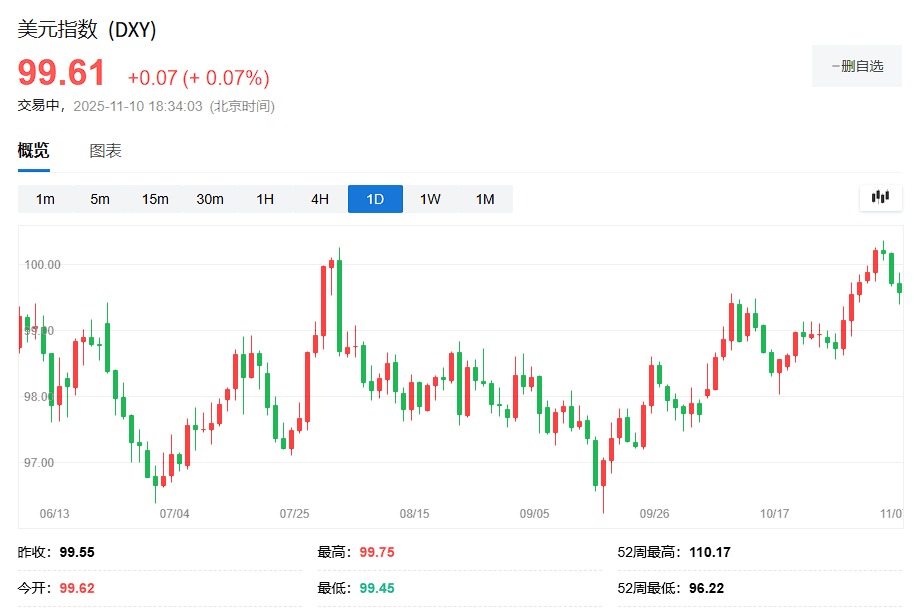
Core Viewpoint - The foreign exchange market has stabilized after the initial volatility caused by the "Trump shock," with the dollar's volatility index returning to pre-election levels, indicating reduced investor concerns over Trump's policy uncertainties [1][5]. Group 1: Market Dynamics - CME Group data shows that the index measuring the volatility expectations of the dollar against the euro and yen has dropped to its lowest level in over a year, following a significant spike after Trump's election [1][5]. - The dollar index has recovered most of its losses for the year, approaching levels seen before Trump's victory [1][5]. - Analysts believe that a series of tariff agreements between the U.S. and major trading partners has reduced market volatility, while the U.S. economy has shown resilience against tariff impacts [5][6]. Group 2: Investor Sentiment - Market participants have learned to respond more rationally to policy headlines, with ING's market research head noting that the world is learning to coexist with Trump [5][6]. - The end of the global central bank interest rate cut cycle has also alleviated another source of market instability, allowing the dollar to regain its traditional role as a safe-haven asset [5][6]. Group 3: Federal Reserve Influence - The recent Federal Reserve meeting provided additional support for the dollar, as Powell indicated that the next rate cut is not a "foregone conclusion," signaling a return to traditional currency strength determinants [7][8]. - Demand for bullish dollar options has surged, reflecting increased market bets on further dollar strength [7]. Group 4: Economic Data Impact - The longest government shutdown in U.S. history has led to a lack of macroeconomic data, suppressing volatility in the dollar and U.S. Treasury markets [8][9]. - Analysts note that the absence of comprehensive data on inflation, labor markets, and consumer spending has led investors to avoid building large positions [9]. Group 5: Dollar's Role as a Safe-Haven Asset - Some fund managers assert that the dollar is regaining its traditional stabilizing role in investment portfolios, particularly during global stress periods [10]. - Despite discussions about the end of "American exceptionalism," the dollar has remained a strong currency over the years, with this year's decline viewed as a correction rather than a trend reversal [10].

特朗普冲击波已过?美元波动性跌回大选前水平
Jin Shi Shu Ju· 2025-11-10 00:32
Core Viewpoint - The foreign exchange market has stabilized after the volatility caused by the "Trump shock," with indicators of dollar volatility returning to pre-election levels [2][3]. Group 1: Market Stability - The volatility expectations for the dollar against the euro and yen have dropped to their lowest point in over a year, recovering some of the losses seen earlier this year [2]. - The dollar index, which measures the dollar against a basket of currencies, has also regained some ground, approaching levels seen before Trump's election victory [2]. - A series of tariff agreements among major U.S. trading partners has effectively reduced market volatility, while the U.S. economy has shown more resilience than expected under tariff pressures [2][3]. Group 2: Investor Sentiment - Investors and analysts have learned to coexist with Trump's policies, adopting a more cautious approach to news headlines [2]. - Some large fund managers believe that previous concerns about U.S. assets were overstated, viewing the dollar's decline as a correction within a bull market rather than a trend reversal [3]. - The significant drop in volatility expectations indicates that the market perceives the "Trump shock" as having ended, with easing trade tensions and a more stable fiscal policy [3]. Group 3: Dollar's Role in Portfolios - The dollar is regaining its traditional role as a stabilizer in investment portfolios, particularly during global pressures [5]. - Fund managers assert that the earlier situation in which the dollar fell alongside risk assets was an anomaly rather than a long-term trend [5]. - The demand for bullish dollar options has surged, indicating a strong belief in the dollar's potential to strengthen [4].
避险需求激增 亟待外汇期货补位“最后一公里”
Zhong Guo Zheng Quan Bao· 2025-08-15 22:17
Core Viewpoint - The increasing foreign exchange risk and the importance of effective risk management tools for companies engaged in cross-border transactions are highlighted, particularly in the context of rising global economic uncertainties and currency fluctuations [1][2][3]. Group 1: Foreign Exchange Risk Management - The number of domestic listed companies participating in foreign exchange hedging has surged from 143 in 2015 to 1,241 in 2024, representing an approximate eightfold increase [6]. - The participation rate in foreign exchange hedging has grown from around 5% to 23.6% over the same period, indicating a heightened awareness of risk management among companies [6]. - The demand for standardized and highly liquid domestic RMB foreign exchange futures is increasing, which is expected to enhance the efficiency of risk management for market participants [1][7]. Group 2: Impact on Companies - BYD has raised its foreign exchange derivatives trading quota from the equivalent of $5 billion to $12 billion due to expanding overseas operations and increasing foreign exchange risk exposure [2][3]. - The company's overseas vehicle sales target for 2024 is set at 417,200 units, with a long-term goal of selling over 800,000 units abroad by 2025 [2]. - The significant scale of China's foreign direct investment, amounting to $177.29 billion in 2023, underscores the critical need for effective foreign exchange risk management [3]. Group 3: Financial Institutions and Investment Strategies - QDII funds, which invest in overseas foreign currency assets, are directly affected by currency fluctuations, with some funds maintaining a 90% foreign exchange hedging ratio this year [3][4]. - The investment logic for QDII has shifted to emphasize the importance of currency hedging alongside interest rate differentials, as the risks associated with currency fluctuations have increased [4][7]. - The introduction of RMB foreign exchange futures is anticipated to provide significant advantages, including broader participation in hedging, reduced costs, and potential additional returns from market dynamics [8][9].
避险需求激增亟待外汇期货补位“最后一公里”
Zhong Guo Zheng Quan Bao· 2025-08-15 20:11
Group 1 - The article highlights the increasing foreign exchange risk faced by companies engaged in international trade due to rising economic uncertainties and currency fluctuations [1][2] - Since 2015, the number of domestic listed companies participating in foreign exchange hedging has surged from 143 to 1,241, indicating a growth of approximately eight times [1][4] - The demand for standardized and highly liquid domestic RMB foreign exchange futures is rising, which is expected to enhance the efficiency of risk management for market participants [1][4] Group 2 - BYD has increased its foreign exchange derivatives trading limit from the equivalent of $5 billion to $12 billion in 2023, reflecting the growing foreign exchange risk exposure as its overseas business expands [2][3] - In 2023, China's outward direct investment flow reached $177.29 billion, a year-on-year increase of 8.7%, highlighting the importance of foreign exchange risk management for companies with substantial overseas assets [2][3] - The participation rate in foreign exchange hedging among listed companies has increased from around 5% to 23.6% over the past nine years, driven by the expansion of foreign-related businesses and heightened risk management awareness [4][7] Group 3 - The introduction of RMB foreign exchange futures is seen as a crucial step in improving the foreign exchange risk management framework in China, with significant advantages such as expanding participation coverage and reducing hedging costs [6][7] - The article emphasizes that foreign exchange futures can provide additional benefits in risk hedging, potentially allowing companies to achieve extra returns while managing risks [7] - The operational convenience of foreign exchange futures is highlighted, as it allows for quicker hedging without the need for complex agreements or bank credit approvals [7]
日元瑞郎避险魅力再现 美元指数持续承压
Xin Hua Cai Jing· 2025-06-12 12:24

Group 1 - The demand for USD put options is strong amid a weakening dollar, with prices for these options exceeding those for call options, particularly in the euro to USD risk reversal options, where the premium for USD puts reached a five-year high in May [1] - Two main factors supporting the dollar are the extreme divergence between the dollar and interest rates, and geopolitical tensions leading to rising oil prices, which may favor the dollar due to liquidity advantages [1] - The Swiss franc has seen the largest fluctuations against the dollar across all time frames, particularly a -1.12% change over one week, while the dollar index has remained relatively stable [2] Group 2 - The GBP/USD exchange rate rose from 1.3525 to 1.3598, reaching a high since June 5, driven by USD selling pressure, despite previous declines due to weak UK GDP data [5] - Analysts expect the UK economy to contract more than anticipated in Q2, with a 0.3% contraction in April, leading to increased expectations for interest rate cuts later this year [5] - The Japanese yen's appeal as a safe-haven currency has been bolstered by the Japanese government's cautious stance on trade negotiations with the US, with expectations that the Bank of Japan will maintain its current interest rate policy [6] Group 3 - The euro to USD exchange rate surpassed 1.1600, reaching a three-year high, with the options market prepared for this rise through risk reversal options and direct purchases of euro call options [7] - The European Central Bank's interest rates are expected to remain unchanged in the foreseeable future, although there may be policy adjustments in upcoming meetings [8]
成功预言反弹的分析师:为什么从看多转为中性?
Jin Rong Jie· 2025-05-08 02:26
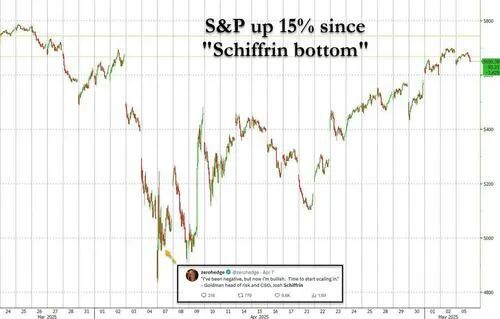
Core Viewpoint - Goldman Sachs' risk manager Josh Schiffrin shifted his stance from bearish to bullish, predicting a market rebound within 6-12 months despite current market pessimism [1] Group 1: Market Predictions - Schiffrin anticipates a strong market rebound driven by potential negotiations to lower trade barriers and tax cuts, despite risks of a global trade war or recession [1] - After a significant rebound, Schiffrin now expects the market to enter a consolidation phase, indicating a shift from bullish to neutral [3] - The current market prices reflect optimistic expectations regarding trade, which may have already been priced in [3] Group 2: Currency and Commodities Outlook - The dollar has entered a bear market, with expectations of further declines, potentially reaching a target of 1.25 against the euro [3] - Schiffrin maintains a bearish outlook on oil prices, predicting they could drop to $45 due to OPEC's production increases [4] Group 3: Investment Strategies - Recommendations include shorting overvalued sectors such as non-profitable tech stocks and high-yield stocks [5] - The market is currently influenced by three main themes: positive tariff news, underexposure of discretionary and systematic investors, and the reduction of left-tail risks [7] Group 4: Economic Indicators and Market Sentiment - Strong non-farm payroll data has temporarily alleviated recession fears, but concerns about economic slowdown and high earnings expectations remain prevalent [9] - The recent market movements reflect overly optimistic expectations regarding the economic cycle, suggesting a downward bias in risk-reward ratios [10] Group 5: Long-term Market Considerations - A potential decline in U.S. stock price-to-earnings ratios to 18 times could indicate a 20% drop from current levels, prompting diversification away from concentrated investments in large-cap stocks [11]