豆包AI手机助手

Search documents
2026年新股择股路径(一)-AI应用:AI应用春潮涌动,产业链次新股大盘点
Huajin Securities· 2026-02-15 05:24
Investment Rating - The report does not explicitly provide an investment rating for the companies discussed. Core Insights - AI technology is reshaping various industries, with significant advancements in AI models and applications, particularly following the launch of OpenAI's ChatGPT-3.5 in November 2022, which marked the beginning of a new era in artificial intelligence [2][15] - Several newly listed companies in the A-share market have integrated AI technology into their operations, seizing opportunities in the AI development strategy across various sectors, including agriculture, office, retail, medical, energy, and consumer fields [2] Summary by Sections AI Applications Surge - AI models are rapidly evolving, with diverse applications emerging across different sectors, driven by advancements from companies like OpenAI, Google, and others [15] - The commercial success of AI applications is evident in products like AI smart glasses, AI toys, and intelligent driving systems, which are gaining popularity and transforming consumer experiences [15][18][19][30] Representative New Stocks in AI - **Top Cloud Agriculture**: A leading company in smart agriculture, developing pest recognition algorithms and smart agricultural products like AR glasses and robotic dogs for field inspections [58][64] - **Hehe Information**: Focused on AI in office applications, offering products like TextIn and Qixin Huiyan that leverage AI for document processing and data analysis [72][74] - **Hanshu Technology**: A provider of digital solutions for retail, including smart shopping carts and AI cameras, enhancing the shopping experience through technology [89][91] - **Chao Yan Co., Ltd.**: Engaged in AI medical diagnostics, offering innovative products for breast cancer screening and ultrasound imaging systems for minimally invasive surgeries [99][108] - **Southern Network Digital**: Concentrating on digital solutions for energy, developing core products like the "Electric Hong" IoT operating system [2] - **Ying Shi Innovation**: Focused on consumer applications, creating AI algorithms for content creation in products like panoramic action cameras [2] Industry Trends - AI technology is deeply embedded in various sectors, including e-commerce, finance, government, energy, and education, demonstrating its commercial viability and transformative potential [44][53] - The AI toy market is projected to exceed 100 billion yuan by 2030, with a compound annual growth rate (CAGR) of over 50% [20] - The report highlights the increasing integration of AI in daily life, enhancing efficiency in personal and work scenarios, such as energy management and document processing [38][43]
AI应用ETF的“故事”讲完了?调整后,“上车”还是“下车”?机构称不要慌
Sou Hu Cai Jing· 2026-01-21 11:54
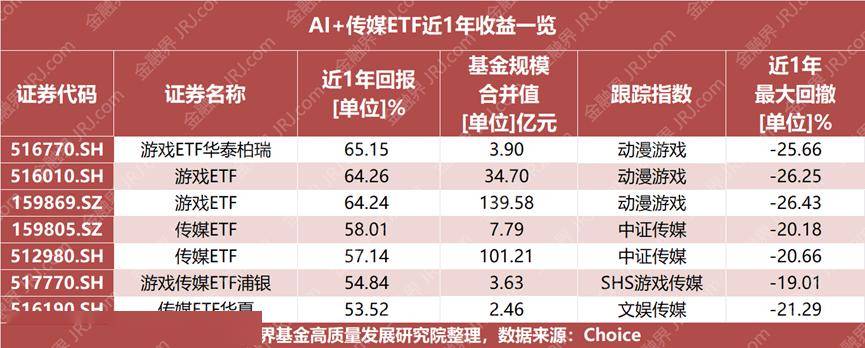
Group 1 - The AI application sector is a major focus in the market as of early 2026, with investment trends shifting from computational infrastructure to specific application scenarios [1] - There are currently seven ETFs related to the AI + media concept, which have maintained high attention due to their early association with AIGC (Artificial Intelligence Generated Content) [1] - The performance of AI + media ETFs over the past year shows significant returns, with ETFs tracking the China Animation and Gaming Index rising over 60% and those tracking the China Media Index also exceeding 50%, while drawdowns were around 20% [2] Group 2 - Since January 15, the AI application sector has experienced a continuous pullback, with a slight decline of 0.02% on January 21, raising concerns among investors about the sector's stability [3] - Despite the recent pullback, the overall industry trend for AI applications remains positive, with product innovations and active capital movements indicating ongoing interest and investment in the sector [4] - Recent insights from various institutions suggest that the current phase of adjustment does not necessarily indicate a reversal of the overall trend, with expectations for 2026 to be a pivotal year for the proliferation of AI agents and software applications [5]

电商Agent进展
2026-01-16 02:53
Summary of Conference Call Records Company and Industry Involved - **Company**: Alibaba (千问 Agent), ByteDance (豆包 APP) - **Industry**: E-commerce, AI Assistants, Local Services Key Points and Arguments 1. Performance of 千问 Agent - 千问 Agent shows good application results in local services like transportation and offline shopping but struggles in heavy e-commerce and food delivery sectors due to user needs for frequent browsing and comparison [1][4] - Users on platforms like 闲鱼 are price-sensitive and not time-sensitive, making it suitable for 千问 Agent to help find reputable and low-priced products [1][5] 2. Integration and Features of 千问 Agent - 千问 Agent integrates with various Alibaba apps (e.g., 高德, 飞猪, 淘宝, 支付宝) to complete tasks, which aligns with industry expectations but was launched later than anticipated [2] - The product's ability to store full dialogue data and recalculate historical tags enhances user profiling and product stickiness [2][19] 3. Comparison with 豆包 Assistant - 千问 Agent's advantage lies in its API-based interaction, improving efficiency compared to 豆包's UI reading method [6] - Despite similar model performance, the significant difference in daily active users (DAU) is attributed to 豆包's comprehensive user data storage and clear functional divisions [19] 4. Market Demand for AI Assistants - Domestic demand for AI assistants is lower than in developed countries, with only a small segment of the population actively seeking such services [8] - However, platforms like 闲鱼, with over 100 million daily active users, represent a valuable market for continued investment [8] 5. Challenges Facing AI Development - Tencent faces slow model development and needs to address model capabilities and policy adaptability [13] - Domestic companies lag behind Google and OpenAI in model development, making it difficult to replicate their success in international markets [31][32] 6. Future Developments and Expectations - ByteDance plans to update a visual recognition model by February 10 and may release a new version of 豆包 to enhance user interaction during major events like the Spring Festival [22] - The upcoming updates aim to improve product competitiveness and user engagement [22] 7. Revenue and Growth Projections - 豆包's user growth is expected to slow, with a target of 50% net daily active user growth in 2026 being considered a good performance [25] - The 火山引擎's growth in PaaS and SaaS is anticipated to be significant, driven by large events and new model applications, although immediate revenue growth may not match usage increases [25] 8. Strategic Differences Between Companies - ByteDance focuses on vertical integration and gradual user accumulation, while Alibaba aims for direct market penetration with functional applications [14] - Both companies exhibit strong innovation capabilities but follow different paths based on their core strengths [14] 9. Market Positioning and User Experience - The success of 千问 Agent will depend on its ability to optimize user experience across different scenarios and clarify its brand positioning [7][21] - The transition to a functional product may lead to organic growth if it effectively integrates with existing services without causing user confusion [21] 10. E-commerce Strategies and Challenges - Domestic e-commerce platforms face challenges in integrating AI technology due to conflicts with existing revenue models and the need for business model innovation [30] - The necessity for a shift in strategy to balance advertising revenue with user experience is highlighted as a critical challenge for future growth [30][26] Other Important Insights - The potential for AI products to create a data flywheel effect is discussed, with 豆包 successfully accumulating user behavior data to enhance user experience [17] - The differences in user demographics between 豆包 and ChatGPT indicate varying market needs and expectations, impacting their respective user engagement [20]
国金证券:一切仍然指向算力
Xin Lang Cai Jing· 2025-12-28 09:41
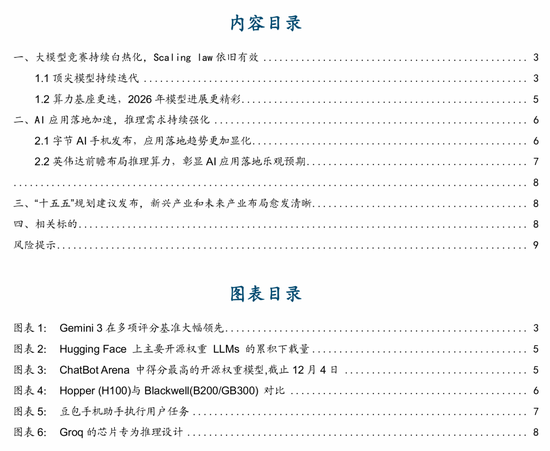
Group 1: Industry Insights - The competition in large models remains intense, with the Scaling Law still effective. Google's Gemini 3 has made significant advancements in foundational reasoning and multimodal capabilities, while OpenAI's GPT-5.2 emphasizes the potential of large models in creating economic value [1][11][14] - Meta is actively developing two heavyweight AI models, Mango for image and video processing, and Avocado to enhance programming capabilities, indicating a strong commitment to AI development [1][15] - The Chinese open-source model DeepSeek-V3.2 is approaching the performance of top closed-source models, showcasing innovations in sparse attention (DSA), high post-training ratios, and large-scale synthetic data [1][16][18] Group 2: AI Application Acceleration - ByteDance released the Doubao AI mobile assistant, which allows for cross-application autonomous operations, marking a significant evolution in mobile interaction methods [2][26] - The daily token usage of the Doubao model surged from over 16.4 trillion in May 2025 to over 50 trillion by December 2025, reflecting a rapid increase in inference demand [2][28] - NVIDIA's collaboration with Groq, a startup specializing in inference chips, highlights a strategic move towards enhancing inference capabilities while maintaining its dominance in training power [2][29][30] Group 3: Policy and Future Industry Layout - The "14th Five-Year Plan" emphasizes support for strategic emerging industries such as aerospace, quantum technology, and AI, indicating a clear direction for future industrial development [3][42] - The plan also calls for proactive infrastructure development, including information communication networks and integrated computing networks, reinforcing the importance of computational power in the AI era [3][42] Group 4: Related Companies - Key players in computing power include Cambrian, Haiguang Information, and Zhongke Shuguang, among others, indicating a diverse landscape of companies involved in AI and computing infrastructure [4][43] - Companies involved in AI agents include Google, Alibaba, Tencent, and others, showcasing a broad spectrum of firms engaged in AI development [5][44] - In the autonomous driving sector, companies like Jianghuai Automobile and Xiaopeng Motors are notable participants, reflecting the industry's growth [6][45]




年终大冲刺,中美科技大厂都杀疯了
商业洞察· 2025-12-19 09:58
Core Viewpoint - The article discusses the intensified competition among major tech companies in the AI sector as they launch new products and models towards the end of the year, marking a significant shift in the AI landscape [2][14]. Group 1: Major Product Launches - Alibaba launched the "Qianwen" app, based on its large model "Tongyi Qianwen," which is seen as a direct competitor to ChatGPT, featuring strong multilingual capabilities and a real-time translation function covering 119 languages [4][5]. - Ant Group introduced the "Lingguang" app, which emphasizes efficiency by allowing users to generate interactive applications in 30 seconds using natural language [4][5]. - Both apps quickly gained traction, with Qianwen reaching the top three in the App Store within two days and Lingguang surpassing two million downloads in six days [7]. Group 2: Competitive Landscape - ByteDance's "Doubao" launched a new AI phone assistant that integrates large model capabilities directly into hardware, allowing for complex cross-application tasks with simple voice commands [8][10]. - DeepSeek released two new models, DeepSeek-V3.2 and DeepSeek-V3.2-Speciale, aiming to enhance reasoning capabilities and cater to complex tasks, positioning itself as a competitor to Doubao [12][13]. - The competition among these companies has reached a "white-hot" level, pushing the domestic AI market to new heights [14]. Group 3: External Influences - The article highlights the influence of Silicon Valley, particularly the release of OpenAI's GPT-5.1 and Google's Gemini 3.0, which set new benchmarks for AI capabilities and prompted responses from domestic companies [16][20]. - Google's Gemini 3.0 was noted for its comprehensive upgrades and received positive feedback from industry leaders, indicating a shift towards a more collaborative AI platform [21][23]. Group 4: Strategic Timing of Releases - Major tech companies tend to launch significant AI models at the end of the year to maximize media exposure and public attention during a quieter news cycle [30][32]. - This timing allows companies to leverage the holiday season for increased visibility, as seen with the launch of ChatGPT, which coincided with the Thanksgiving to Christmas period [33]. - The end-of-year releases also serve as a strategic move for companies to define their capabilities and set competitive standards for the upcoming year [39][40]. Group 5: Future Implications - The article suggests that the current competition is shifting from merely releasing models to building comprehensive AI ecosystems that integrate model capabilities, product forms, and commercial viability [46]. - The outcomes of these year-end launches are expected to shape the future landscape of AI, indicating a new phase in the global AI race [47].

姚顺雨加盟腾讯:27岁科学家背后的三重使命
3 6 Ke· 2025-12-18 09:54
Core Insights - The article highlights Tencent's strategic shift in AI, marked by the appointment of Yao Shunyu as Chief AI Scientist, indicating a significant elevation of AI within the company's priorities [1][5][10] Group 1: Company Strategy - Tencent's organizational adjustments and key personnel appointments reflect an intensified focus on AI strategy, especially in response to competition from ByteDance and Alibaba [3][4] - The appointment of Yao Shunyu, a former OpenAI researcher, is seen as a move to replicate a latecomer strategy in the AI field, elevating AI from a support function to a central strategic role within Tencent [5][9] Group 2: Yao Shunyu's Background and Vision - Yao Shunyu's credentials include being a Princeton PhD and a member of the "Yao Class" from Tsinghua University, which positions him as a leading figure in AI innovation [5][8] - He has articulated a vision for AI's evolution, suggesting that the competition has shifted from model intelligence to defining tasks and assessing value, emphasizing the importance of practical applications [7][8] Group 3: AI Development Focus - Tencent's AI strategy under Yao Shunyu aims to bridge the gap between research and application, with a focus on enhancing foundational model capabilities while leveraging strengths in 3D generation and physical simulation [10][12] - The integration of AI into WeChat is seen as a significant opportunity, given its vast user base and complex social relationships, which could serve as a fertile ground for developing AI agents [10][12] Group 4: Ethical Considerations and Challenges - The article notes the ethical challenges and commercial conflicts that AI will face as it becomes more integrated into daily life, highlighting the need for Tencent to establish rules around AI rights and responsibilities [14][15] - The successful commercialization of AI technology hinges on building trust among users, partners, and regulators, which is critical for overcoming barriers to adoption [15]


AI手机助手查银行卡余额,真的能绕过银行核验吗?
Xin Lang Cai Jing· 2025-12-17 02:56
Core Viewpoint - The introduction of the Doubao AI assistant raises questions about its ability to bypass bank app identity verification, highlighting public concerns over the security of AI technology in financial applications [1][6]. Group 1: Technology and Security Mechanisms - The Doubao AI assistant operates under a "dual authorization mechanism," requiring users to grant access within the bank app and confirm via biometric authentication, ensuring a two-layer security process [2][7]. - The AI assistant is assigned a "digital certificate" and a "temporary access token" that refreshes every hour, minimizing the risk of long-term misuse [2][7]. - Data transmission between the AI assistant, mobile system, and bank servers is encrypted, preventing the AI from storing or accessing sensitive data directly [2][7]. Group 2: Financial System Risks - Although the AI assistant has not caused significant financial security issues, its integration into the financial system poses potential risks, especially given the high volume of transactions processed [3][8]. - Recent incidents of AI being exploited for fraudulent activities underscore the need for banks to implement stringent security measures [3][8]. - Financial institutions face challenges in balancing user privacy, service experience, and the need for robust AI risk management [3][8]. Group 3: Innovation and Regulation - The demand for security should not hinder innovation; banks must develop a balanced mechanism that allows for efficient AI integration while maintaining safety [4][9]. - Banks are encouraged to categorize AI operations by risk level and apply corresponding protective measures, avoiding blanket bans on AI tools [4][9]. - Establishing clear agreements with AI tool providers regarding data security and operational boundaries is essential for safe implementation [4][9]. Group 4: User Awareness and Responsibility - Users are advised to enhance their security awareness, carefully granting financial permissions to third-party tools and regularly reviewing account authorizations [5][10]. - The discussion surrounding the Doubao AI assistant serves as a critical opportunity for the industry to reflect on the balance between technological advancement and security [5][9].

AI手机助手查银行卡余额, 真的能绕过银行核验吗?
Jin Rong Shi Bao· 2025-12-17 01:17
Core Viewpoint - The introduction of the Doubao AI mobile assistant raises questions about its ability to bypass bank app identity verification, highlighting public concerns over the security of AI technology in financial applications [2][4]. Group 1: Technology and Functionality - The Doubao AI mobile assistant operates under a "dual authorization mechanism," requiring users to grant access within the bank app and confirm actions through biometric authentication [3]. - The AI assistant is designed to act as a highly authorized intermediary, similar to a trusted friend, needing explicit user consent to access sensitive information [2][3]. - The system employs end-to-end encryption for data transmission, ensuring that sensitive user information is protected and that the AI cannot store or access raw data [3]. Group 2: Security Concerns and Industry Response - Despite the current lack of significant security issues, the financial system's vulnerability to unauthorized external interventions necessitates cautious risk management [4]. - The Doubao AI assistant has limited its automation capabilities in critical financial scenarios, prompting banks to implement defensive measures, such as requiring users to disable the AI assistant before proceeding with transactions [4]. - The financial industry faces challenges in balancing user privacy, service experience, and the need for robust AI risk management frameworks [4][5]. Group 3: Future Directions and User Awareness - The demand for secure yet innovative financial services should not hinder technological advancements; banks are encouraged to adopt a layered control approach to manage AI-related risks effectively [5][6]. - Financial institutions can establish agreements with AI tool providers to define the scope of services and data transmission standards, ensuring a clear operational boundary [5][6]. - Users are advised to enhance their security awareness by carefully managing third-party access to their financial information and regularly reviewing authorization records [6].

国泰海通:AI端侧加速落地 关注3C产业链企业切入人形机器人赛道带来的投资机会
Zhi Tong Cai Jing· 2025-12-11 23:04
Core Insights - The 3C supply chain is benefiting from the cyclical recovery of its industry and the accelerated penetration of AI at the edge, presenting growth opportunities [1][2] - The compatibility of the 3C supply chain with humanoid robots is high, and its specialized manufacturing model is expected to adapt well to the mass production phase of humanoid robots [1][2] Group 1 - The 3C supply chain is fully embracing humanoid robots due to rapid innovation and scalable manufacturing capabilities [2] - The development of humanoid robots is still in its early stages, but the ability of 3C manufacturers to innovate with new materials, processes, and structures allows for quick integration into the humanoid robot supply chain [2] - As humanoid robots enter mass production, the industry is expected to shift to a specialized manufacturing model of "components-modules-finished products," maintaining a strong competitive advantage for the 3C supply chain [2] Group 2 - The acceleration of AI at the edge injects new growth vitality into the 3C industry [2] - The overall 3C terminal market, represented by smartphones, is entering a recovery cycle, laying the foundation for industry growth [2] - Major industry players are driving the acceleration of AI at the edge, with Apple set to launch its edge AI assistant, Apple Intelligence, in October 2024, potentially triggering a new replacement cycle for its extensive terminal products [2] Group 3 - Companies like Meta are collaborating with Qualcomm to optimize the Llama model for Snapdragon chips, enabling smooth operation of 3B parameter models on smartphones [3] - Domestic company ByteDance has launched the Doubao AI smartphone assistant, showcasing smooth cross-app operation capabilities [3] - Major AI companies are competing for dominance in the smartphone edge market, while also pushing for rapid iterations of AI glasses and other wearable devices, which could bring additional growth to the overall industry [3] Group 4 - Catalysts for growth include the large-scale production of robots and the accelerated implementation of AI at the edge [4]


国泰海通|机械:AI端侧守正、人形机器人出奇,3C供应链重拾成长
国泰海通证券研究· 2025-12-11 14:53
Core Insights - The 3C supply chain is embracing humanoid robots, leveraging rapid iteration and large-scale manufacturing capabilities to create a second growth curve [1][2] - The acceleration of AI penetration at the edge is injecting new growth vitality into the 3C industry [3] Group 1: Investment Recommendations - The 3C supply chain is expected to benefit from the cyclical recovery of its own industry, combined with the growth brought by accelerated AI penetration at the edge [2] - The compatibility of the 3C supply chain with humanoid robots is high, as its specialized manufacturing model of "components - modules - complete machines" is likely to adapt well to the mass production phase of humanoid robots [2] - Investment opportunities are suggested in 3C industry chain enterprises that are entering the humanoid robot sector [2] Group 2: Industry Trends - The development of humanoid robots is still in its early stages, but the rapid iteration and innovation in new materials, processes, and structures allow 3C OEMs to quickly integrate into the humanoid robot supply chain [2] - As humanoid robots enter the mass production era, the industry chain is expected to transition into a specialized manufacturing model, where the 3C supply chain maintains strong competitive advantages [2] Group 3: Catalysts - The large-scale production of robots is beginning, and the acceleration of AI at the edge is a significant catalyst for growth [4] Group 4: AI Integration - The overall 3C terminal market, represented by smartphones, is entering a recovery cycle, laying the foundation for industry growth [3] - Major industry players are pushing for the accelerated implementation of AI at the edge, which is expected to bring new growth to the 3C industry [3] - Companies like Apple, Google, and Meta are launching AI-powered products that enhance user experience and drive new replacement cycles in the smartphone market [3]