二手车和卡车

Search documents
华尔街怎么看1月CPI?通胀担忧暂歇,今年三次降息几率升至五成
智通财经网· 2026-02-13 23:40
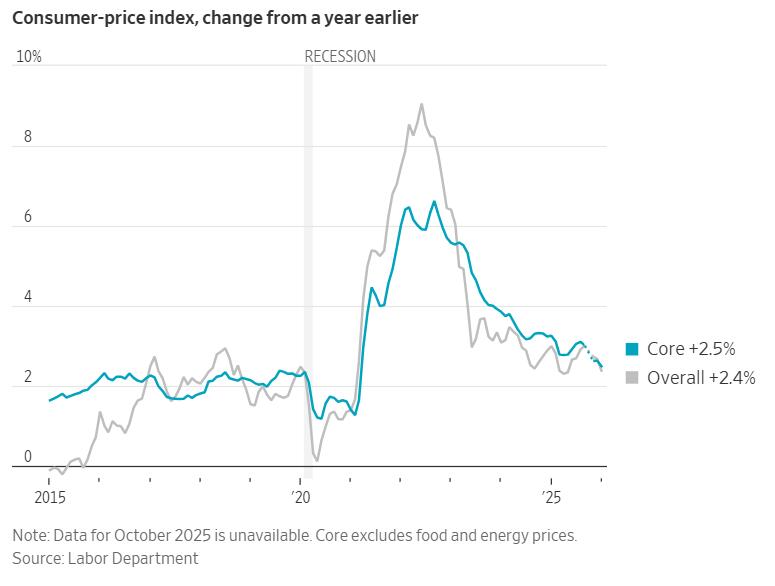
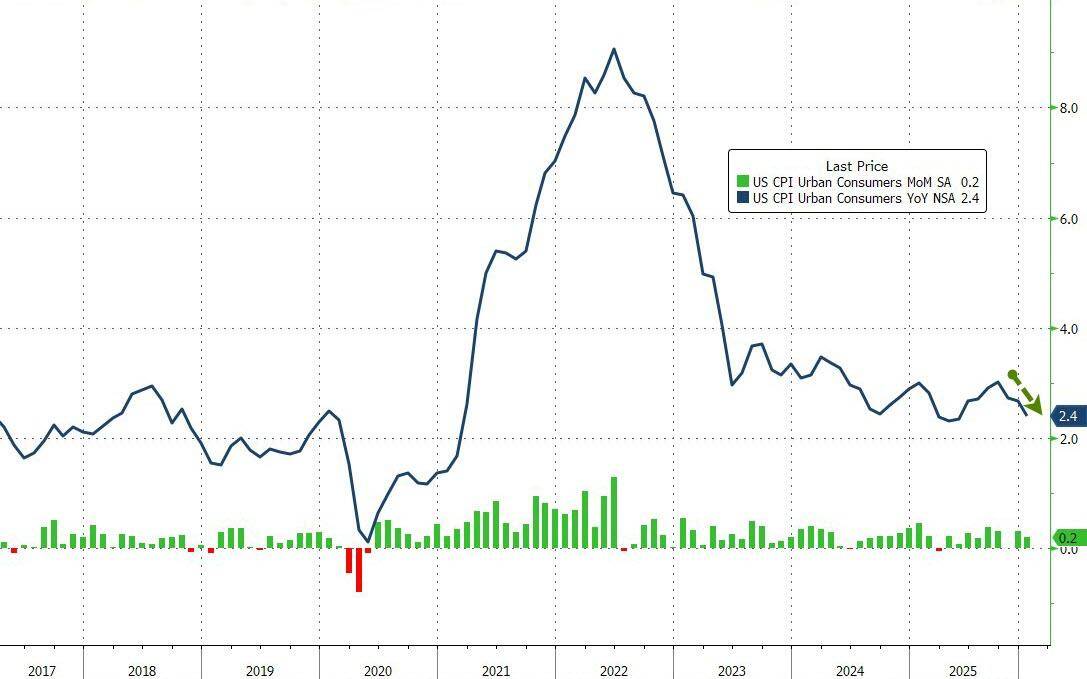
Core Insights - The U.S. inflation data showed a mild increase, with the core CPI year-on-year growth falling to its lowest level in nearly five years, indicating a continued easing of price pressures. This unexpected cooling of inflation has boosted market expectations for interest rate cuts by the Federal Reserve this year, with traders raising the probability of three rate cuts to 50% [1][4] Inflation Data Summary - The January CPI increased by 2.4% year-on-year, the lowest growth rate since May of the previous year, down from 2.7% in December and below the market expectation of 2.5%. The core CPI rose by 2.5% year-on-year, marking the lowest growth since March 2021 [1][4] - The CPI rose only 0.2% month-on-month, the smallest increase since July of the previous year, and below the expected 0.3%. Energy prices were a major drag, with the overall energy index falling by 1.5% and gasoline prices down by 3.2% [5][7] Sector-Specific Price Movements - Housing costs rose by only 0.2% month-on-month, the smallest increase since September, with year-on-year growth slowing to 3%. Prices for used cars and trucks fell by 1.8%, the largest drop in two years. Food price increases were the smallest since July 2025, with beef and veal prices down by 0.4% and egg prices plummeting by 7% [7][8] - Some categories showed signs of tariff impacts, with clothing prices up by 0.3%, video and audio products up by 2.2%, and airfares soaring by 6.5%, the largest increase since mid-2022 [7][8] Market Reactions and Expectations - Following the CPI data release, U.S. stock futures rose, U.S. Treasury prices increased, and yields fell. The two-year Treasury yield dropped by 6 basis points to 3.40%, the lowest level in nearly two months [4][9] - Market expectations for total rate cuts this year increased from 58 basis points to 63 basis points, indicating a 50% chance of three rate cuts by the end of the year. The probability of a rate cut in April is estimated at 30%, while the likelihood for June exceeds 80% [4][9] Economic Outlook - Analysts suggest that the January inflation report alleviates concerns about sustained inflation due to high tariffs from the previous administration. The lower overall price increases are seen as a positive signal for the economy, despite some persistent price pressures in certain categories [8][9] - The Federal Reserve is expected to maintain a cautious balance between curbing inflation and protecting the labor market, with some economists predicting two rate cuts this year, the next likely in June [8][9]

通胀“温和”放缓!美国1月CPI同比2.4%低于预期,核心CPI降至四年来最低水平,服务通胀坚挺
Sou Hu Cai Jing· 2026-02-13 14:10
Core Insights - The overall inflation data for January in the U.S. is described as "moderate," with the CPI year-on-year falling to 2.4%, below expectations, and the core CPI dropping to 2.5%, marking the lowest level since 2021 [1][2] - The monthly core inflation remains resilient, driven by rising service prices, despite some declines in certain goods and services [3][4] Inflation Data Summary - The January CPI increased by 0.2% month-on-month, lower than the expected 0.3%, and the year-on-year rate slowed from 2.7% in December to 2.4%, also below the anticipated 2.5% [1] - The core CPI, excluding food and energy, rose by 0.3% month-on-month, matching expectations and slightly higher than the previous value of 0.2%, with a year-on-year rate of 2.5%, down from 2.6% in December [2] Market Reactions - Following the data release, U.S. stock futures saw a short-term increase, with the Nasdaq futures up by 0.13%, S&P 500 futures up by 0.12%, and Dow futures up by 0.06%. The dollar index experienced a slight decline of 0.03% [3] - Traders are estimating a 50% probability for a third interest rate cut by the Federal Reserve this year [3] Service and Goods Price Dynamics - The rise in core inflation for January was primarily driven by service-related price increases, including airfares, personal care, entertainment, healthcare, and communication [3] - Conversely, prices for certain goods and services, such as used cars and trucks, household items, and auto insurance, decreased in January, offsetting some of the upward pressure from services [4] Federal Reserve Implications - The Federal Reserve's 2% inflation target is mainly based on the PCE price index, and both CPI and PCE remain above this target level. The labor market showed signs of stability, with January employment growth accelerating and the unemployment rate dropping from 4.4% in December to 4.3% [6] - Despite the lower-than-expected inflation readings, the resilience of core inflation and a stable labor market may lead the Federal Reserve to maintain interest rates for the time being, with the current benchmark overnight rate set between 3.50% and 3.75% [6] Seasonal Adjustments - It is noteworthy that core CPI often tends to "exceed expectations" in January, with many economists suggesting that seasonal adjustment factors may not fully capture the disturbances caused by one-time price increases at the beginning of the year [7]
【宏观】通胀担忧缓和,但短期降息必要性不强——2025年12月美国CPI数据点评(赵格格/刘星辰)
光大证券研究· 2026-01-14 23:07
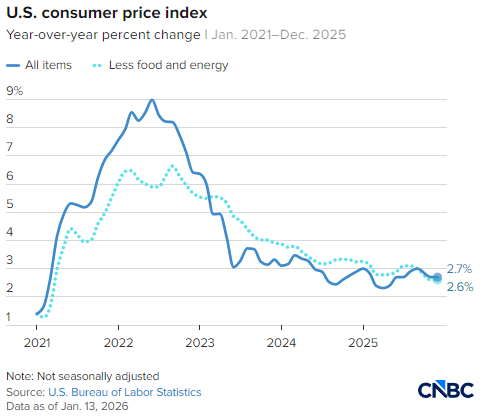
Core Viewpoints - The December US CPI year-on-year increased by 2.7%, matching market expectations, while the core CPI year-on-year rose by 2.6%, slightly below expectations of 2.7% [4][6] - The mild rebound in core CPI was influenced by a decline in used car and truck prices, indicating that tariffs have a limited impact on inflation [5][7] - Despite easing inflation concerns, the likelihood of interest rate cuts in the first quarter remains low, with expectations for the first cut still set for June [5][9] Group 1: December US Inflation Data - December core CPI reading was lower than market expectations, with a month-on-month increase of 0.2%, below the expected 0.3% [6][9] - The inflation rebound was less than anticipated due to price declines in used cars and trucks, which offset increases in food, clothing, housing, medical care services, and transportation services [7][8] - Food prices increased by 0.7%, clothing by 0.6%, housing by 0.4%, medical care services by 0.4%, and transportation services by 0.5% month-on-month, while used car and truck prices fell by 1.1% [7] Group 2: Future Inflation Expectations and Fed Policy - The focus will be on January's corporate product repricing, as limited impact from tariffs on US inflation suggests the end of this inflationary cycle [8] - The market anticipates a 48.1% probability of a Fed rate cut in June, up from 46.2% prior to the inflation data release [9] - The labor market shows resilience with a decline in the unemployment rate, and a large tax refund is expected in the first quarter, reducing the necessity for immediate rate cuts [9]

美联储第一季度降息概率不大
2 1 Shi Ji Jing Ji Bao Dao· 2026-01-14 22:34
Group 1 - The core viewpoint of the articles indicates that the U.S. inflation is showing signs of gradual decline, with the Consumer Price Index (CPI) for December 2025 reflecting the smallest month-on-month increase since July of the previous year, at 0.3%, and a year-on-year increase of 2.7%, the lowest since May 2025 [2][3] - The core CPI, excluding volatile food and energy prices, increased by 0.2% month-on-month and 2.6% year-on-year, marking the lowest levels since March 2021, indicating a consistent downward trend in inflation since September 2025 [2][3] - The main contributors to the CPI decrease in December were the prices of core goods, particularly new cars, used cars, and trucks, which showed zero growth or declines, suggesting that the impact of tariffs is milder than expected [3][5] Group 2 - The housing costs, which have a significant weight in the CPI basket, increased by 0.4% month-on-month, the largest increase in four months, and the year-on-year rate rose from 3.0% to 3.2%, indicating persistent housing inflation [3][4] - The super core inflation, excluding housing, showed a month-on-month increase of approximately 0.3% and a year-on-year increase of about 2.7%, remaining at the lowest levels since the pandemic [4] - The employment growth in the U.S. was significantly lower in 2025, with only 584,000 non-farm jobs added throughout the year, compared to 2 million in 2024, reflecting a slowdown in job creation and an increase in the unemployment rate from 4.0% to 4.4% [6][7] Group 3 - The Federal Reserve's decision-making is based on the Personal Consumption Expenditures (PCE) inflation data, which typically shows lower inflation rates than the CPI, suggesting that the PCE for December 2025 is expected to reflect a similar trend [4] - Despite the potential negative impacts of tariffs, the recent interest rate cuts by the Federal Reserve and government policies aimed at tax reduction and deregulation may improve employment and income growth [7] - The market anticipates that the Federal Reserve will maintain interest rates in January 2026, with a probability of over 97%, and is not expected to lower rates until at least June 2026 [7]

——2025年12月美国CPI数据点评:通胀担忧缓和,但短期降息必要性不强
EBSCN· 2026-01-14 08:23
Inflation Data Summary - December 2025 US CPI increased by 2.7% year-on-year, matching market expectations and previous month’s value[2] - Core CPI rose by 2.6% year-on-year, slightly below the expected 2.7%[2] Market Reactions and Expectations - The lower-than-expected core CPI growth has alleviated inflation concerns, leading to a rise in gold and silver prices post-data release[7] - Market expectations for the first interest rate cut remain set for June 2026, with a 48.1% probability following the CPI release, up from 46.2% the previous day[7] Economic Indicators - The unemployment rate has begun to decline, indicating resilience in the labor market, and a large tax refund is anticipated in Q1 2026, likely boosting economic data[3] - The impact of tariffs on inflation appears limited, as evidenced by the decline in prices for used cars and trucks, which offset price increases in other categories[5] Future Projections - The CPI growth rate is expected to peak at 3.0% in March 2026, with future inflation performance largely dependent on demand-side improvements[6] - The Federal Reserve is expected to maintain a cautious stance on rate cuts until a new chair is appointed, potentially accelerating the pace of cuts thereafter[3]
美国12月核心消费者价格指数同比上涨2.6%,低于预期
Xin Lang Cai Jing· 2026-01-13 14:42
Group 1 - The core Consumer Price Index (CPI) for December increased by 0.2% month-on-month and 2.6% year-on-year, both figures below market expectations by 0.1 percentage points, indicating a continued cooling of inflation [1][15][20] - The overall CPI rose by 0.3% month-on-month and 2.7% year-on-year, aligning perfectly with Dow Jones consensus expectations, suggesting that inflation is gradually approaching the Federal Reserve's target of 2% [2][16][20] - Housing prices, a key component of core inflation, increased by 0.4% month-on-month and 3.2% year-on-year, contributing significantly to the overall inflation rise [5][19] Group 2 - Food prices rose by 0.7% month-on-month, although egg prices fell by 8.2% month-on-month and nearly 21% year-on-year, following a previous surge [7][21] - Energy prices increased by 0.3% month-on-month and 2.3% year-on-year, while gasoline prices decreased by 0.5% month-on-month and 3.4% year-on-year [8][22] - The entertainment price index surged by 1.2% month-on-month, marking the largest single-month increase since 1993 [12][26] Group 3 - The report indicates that some categories, particularly goods, are showing signs of deflation, with used car and truck prices down by 1.1% month-on-month and communication prices down by 1.9% [12][26] - Actual wages for American citizens remained flat month-on-month but increased by 1.1% year-on-year, reflecting the impact of the December price increases [13][27]
2025年9月美国CPI数据点评:美国通胀不及预期,为降息铺平道路
EBSCN· 2025-10-25 11:36
Inflation Data Summary - In September, the U.S. CPI increased by 3.0% year-on-year, up from 2.9% in the previous month, but below the market expectation of 3.1%[2] - The seasonally adjusted CPI rose by 0.3% month-on-month, down from 0.4% previously and below the expected 0.4%[2] - Core CPI also increased by 3.0% year-on-year, down from 3.1% last month, and the month-on-month increase was 0.2%, down from 0.3%[2] Economic Implications - The mild inflation data reduces the risk of the Federal Reserve making uninformed decisions amid the government shutdown affecting non-farm data releases[3] - The overall inflation increase is tempered by declines in housing, used car, and truck prices, while tariff impacts continue to be felt in categories like appliances and furniture[3] - Market expectations are set for two rate cuts within the year, with probabilities of 96.7% for October and 94.4% for December, indicating a strong belief in easing monetary policy[7] Sector-Specific Insights - Food prices saw a month-on-month increase of only 0.2%, down from 0.5% in the previous month, with notable declines in beef prices[4] - Energy prices increased by 1.5% month-on-month, influenced by rising international oil prices due to geopolitical tensions, although overall price increases remain limited[4] - Core goods prices fell to a month-on-month increase of 0.2%, primarily due to a drop in used car and truck prices, which decreased from 1.0% to -0.4%[5]
美国9月核心CPI环比增长0.2%,为三个月来最慢增速,美联储年内再次降息预期升温
Sou Hu Cai Jing· 2025-10-24 13:25
Core Insights - The U.S. Consumer Price Index (CPI) for September increased by 3% year-over-year, which was below the expected 3.1% and higher than the previous month's 2.9% [4][6] - Core CPI rose by 0.2% month-over-month, the slowest growth in three months, and below the market expectation of 0.3% [3][6] - The data reinforces market expectations that the Federal Reserve will continue to lower interest rates within the year, clearing the way for the upcoming rate decision [6][14] Inflation Trends - The overall CPI increase was primarily driven by rising energy costs, with clothing prices rising by 0.7%, likely reflecting higher tariffs [6] - Service sector inflation showed signs of slowing, reaching its weakest level since November 2021, partially offsetting the pressure from rising energy prices [7] - Core inflation indicators are showing clearer signs of cooling, with the core CPI year-over-year growth decreasing from 3.1% in August to 3.0% in September, marking the lowest level since June [9] Specific Data Points - The "SuperCore CPI," which excludes housing from service sector inflation, also saw a slowdown, with a year-over-year growth rate of 3.30%, the lowest since May [9] - Transportation costs experienced a sharp slowdown, further contributing to the overall decline in inflation levels [11] - Goods inflation remained stable at an annual rate of 1.5%, with no significant tariff-driven inflationary pressures observed in the three and six-month annualized data [12] Market Reaction - Following the release of the CPI data, U.S. stock index futures saw a short-term increase, with Nasdaq futures rising nearly 1% [13] - U.S. Treasury yields fell sharply, with the 10-year Treasury yield dropping over 2 basis points to 3.978% [13] - The CPI report provided strong support for the market's expectation of two additional 25 basis point rate cuts by the end of the year [14]
【广发宏观陈嘉荔】关税对美国通胀的影响继续有所体现
郭磊宏观茶座· 2025-08-13 07:47
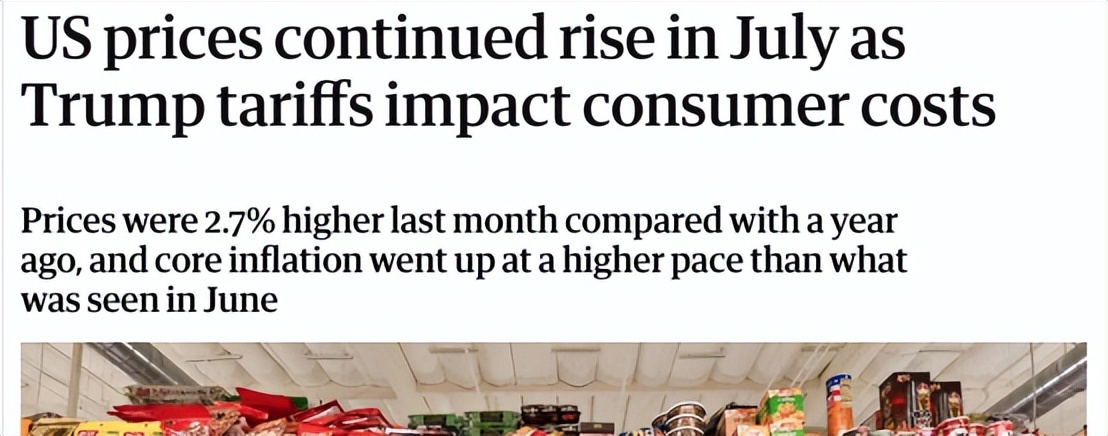
Core Viewpoint - The article discusses the stability of the U.S. inflation rate in July, with a notable rebound in core inflation, indicating potential implications for monetary policy and market expectations regarding interest rate adjustments [1][6][22]. Inflation Data Summary - In July, the Consumer Price Index (CPI) increased by 2.7% year-on-year, consistent with the previous value and slightly below market expectations of 2.8%. The core CPI rose by 3.1%, surpassing the previous value of 2.9% and the expected 3.0% [1][6][9]. - The core goods prices increased by 1.2% year-on-year, up from 0.7% in the previous month, marking the fourth consecutive month of recovery. Various core goods categories, such as furniture (+0.7% month-on-month) and shoes (+1.4% month-on-month), showed price increases, reflecting the impact of tariffs [2][13][14]. - Core services saw a year-on-year increase of 3.6%, remaining stable compared to the previous month, with a month-on-month rise of 0.4%, higher than the previous 0.3% [4][18]. Tariff Impact and Economic Outlook - The article highlights that the impact of tariffs on inflation may have become more evident in July, although the overall inflation rebound has been moderate due to product differentiation. Future impacts remain uncertain, with varying estimates on how quickly tariffs affect consumer prices [3][14][15]. - The Federal Reserve's internal divisions on monetary policy direction are noted, with some members advocating for a cautious approach while others support a shift towards a neutral interest rate stance, indicating differing views on inflation risks and economic slowdown [5][20][21]. Market Reactions - Following the inflation data, market expectations for a rate cut by the Federal Reserve in September increased, with the probability rising to 93.4% from 85.9%. This led to a decline in the U.S. dollar index and a rise in major stock indices, reflecting a favorable environment for emerging market assets [5][22].

美国7月CPI上涨 核心通胀抬头推高美联储9月降息预期
Huan Qiu Wang· 2025-08-13 05:11
Group 1 - The July Consumer Price Index (CPI) in the U.S. rose by 0.2% month-on-month, a slowdown from June's 0.3% increase, aligning with market expectations. Year-on-year, CPI increased by 2.7%, slightly below the expected 2.8% [1][3] - Core CPI, excluding food and energy, rose by 0.3% month-on-month, meeting expectations, but the year-on-year increase reached 3.1%, exceeding the anticipated 3.0% [1][3] - The overall CPI data indicates moderate inflationary pressure, alleviating previous market concerns about tariffs causing a sharp rise in inflation [3][4] Group 2 - Specific categories such as medical services, airline tickets, entertainment, household goods, and used cars saw price increases in July, while hotel accommodations and communication services experienced declines [3] - The largest price increases were observed in fuel oil and transportation costs, while gasoline and household food costs decreased month-on-month. The housing index rose by 0.2%, with both owners' equivalent rent and rent indices increasing by 0.3% [3] - Economists noted that the impact of tariffs on consumer prices takes time to manifest, with some retailers stockpiling inventory to mitigate the effects and maintain stable prices [4] Group 3 - Following the CPI data release, financial markets rapidly increased expectations for a Federal Reserve interest rate cut, with a 95% probability of a rate cut anticipated in the September meeting [4] - Despite a slight rebound in core inflation, it is viewed as insufficient to alter the Federal Reserve's direction towards a loose monetary policy [4]