
重型燃机

Search documents
北美数据中心电能自建自用-GEV订单扩产几何
2026-03-01 17:22
Summary of Conference Call Notes Industry Overview - The gas turbine industry is experiencing a surge in demand driven by AIDC (Artificial Intelligence Data Center) and environmental policy relaxations, particularly in North America, which is the largest market for gas turbines [1][2][5][7]. - The gas turbine sector is expected to see new orders reach 100 GW in 2025, representing a year-on-year growth rate of approximately 75% [1][5]. Company Insights: GEV - GEV's revenue from gas turbines exceeds 100 billion RMB, but growth is limited, with a projected revenue increase of about 10% in 2025 compared to 2024 [3][9]. - GEV plans to increase its base load power installation from approximately 200 GW to 400 GW, which is expected to enhance long-term profitability from its service business [4][16]. - GEV's product line focuses on medium to large gas turbines, unlike competitors like Siemens, which cover a broader power range [4][19]. Key Drivers of Growth - The primary drivers for the gas turbine market include: - Increased electricity demand from AIGC/AIDC [5][6]. - A replacement cycle for aging equipment, with a significant peak in installations around 2020 [5]. - The need for traditional energy sources to support renewable energy fluctuations [5][6]. Order Backlog and Delivery Challenges - GEV's backlog has risen significantly to 83 GW, with about half of this backlog consisting of "slot reservation agreements" that require prepayments [7][8]. - The delivery cycle for gas turbine equipment is estimated to take approximately 5-6 years based on current backlog and delivery rates, with heavy-duty gas turbines experiencing longer delivery times due to increased demand [11][15]. Market Dynamics - North America is the largest demand region for gas turbines, followed by the Middle East and North Africa [7]. - The Chinese market is experiencing volatility, with a significant drop in orders expected in the first half of 2025 due to the dominance of joint ventures and domestic companies [7]. Competitive Landscape - GEV's heavy-duty gas turbines are favored in North American data centers due to their higher efficiency and lower lifecycle costs compared to other options [3][12]. - The company faces competition from Siemens and other manufacturers, with a notable difference in product offerings and market strategies [4][19]. Pricing and Cost Trends - Pricing for gas turbines has increased, with "slot reservation agreements" priced 10-20% higher than standard orders [18]. - The total cost of combined cycle gas power plants has risen from approximately $2,000 to $2,500 per kW, impacting the pricing of gas turbines [18]. Future Outlook - GEV aims to achieve a production capacity of 20 GW by Q3 2026 and 24 GW by 2028, indicating a significant expansion plan [16][17]. - The company is also exploring pathways to enhance production capacity, including restarting production lines in Europe and increasing workforce [17]. Conclusion - The gas turbine industry is poised for significant growth driven by technological advancements and increasing energy demands, particularly in data centers. GEV is strategically positioned to capitalize on these trends, although it faces challenges related to production capacity and market competition.
当“飞机发动机”成为“数据中心供电”标的
Hua Er Jie Jian Wen· 2026-02-18 10:36
Core Insights - The aviation industry is providing an unexpected solution to the power supply challenges faced by AI data centers by repurposing retired Boeing aircraft engines into ground gas turbines for direct power supply [1] Group 1: Market Dynamics - The global gas turbine market is dominated by GE Vernova, Siemens Energy, and Mitsubishi Heavy Industries, which hold approximately 80% market share [2] - FTAI Aviation has identified a market opportunity due to the long lead times for heavy gas turbine orders, with the modification of an aircraft engine into a power turbine taking only 30 to 45 days once the design phase is completed [2] - FTAI's stock has risen by about 42% since entering the power business, with an estimated annual EBITDA contribution of $750 million, representing 52% of previous total annual expectations [2] Group 2: Technical Feasibility - Converting aircraft engines to land-based power generation (Aeroderivatives) is technically feasible, involving changes such as replacing fuel nozzles for natural gas and adjusting the front fan size [3] - The lifespan of aircraft components can be extended significantly in power generation, with FTAI able to utilize parts with only a few years of remaining life for several more years in this new application [3] Group 3: Competitive Landscape - Traditional giants like GE Vernova do not view these smaller units as direct competition, emphasizing the fuel efficiency advantage of heavy gas turbines over a 20-year operational cycle [4] - FTAI and Boom Supersonic are proposing their products in a "Combined Cycle" mode to enhance efficiency, potentially bridging the gap with heavy units [4] - If one-third of the approximately 1,600 commercial engines retired annually were converted for power generation, it could add 13 GW of capacity, equating to a quarter of global annual capacity [4]
上海发布先进制造业转型升级三年行动方案
Shang Hai Zheng Quan Bao· 2026-02-09 00:14
Core Insights - Shanghai has launched a three-year action plan to support the transformation and upgrading of advanced manufacturing, aiming to add 100 manufacturing enterprises with an annual output value exceeding 1 billion yuan by 2028, totaling over 600 such enterprises [1][5] - The plan includes four major actions and 17 measures to enhance the modern industrial system, focusing on structural optimization, innovation breakthroughs, quality and efficiency improvements, and resource support [1][3] Group 1: Structural Optimization and Upgrading - The action plan outlines three paths for structural optimization: enhancing traditional industries, accelerating strategic leadership in emerging sectors, and promoting the growth of key and emerging industries [2][3] - Specific initiatives include supporting traditional industries like petrochemicals and steel to innovate and expand into new materials, while also fostering advancements in integrated circuits and artificial intelligence [2][3] Group 2: Innovation and Technology - The plan emphasizes the role of enterprises in driving innovation, encouraging increased investment in basic research, and providing financial incentives for high-growth R&D companies [3][4] - It aims to deepen digital transformation through initiatives like "AI + manufacturing," promoting the application of AI technologies in production processes and enhancing the digitalization of manufacturing equipment [3][4] Group 3: Resource and Financial Support - Shanghai will strengthen support for key resources such as talent, space, and funding, optimizing financial services for the manufacturing sector, including lower interest rates and longer loan terms [4][5] - The action plan aims to create a robust ecosystem for manufacturing, addressing individual needs related to talent acquisition, land use, logistics, and energy supply [5][6] Group 4: Long-term Development Goals - By 2025, Shanghai's industrial output value is projected to grow by 5.1%, reaching a historical high of 4.07 trillion yuan, with significant investments in high-end manufacturing [4][5] - The plan sets ambitious targets for the establishment of advanced intelligent factories and green manufacturing enterprises, aiming for substantial growth in emerging industries such as electronic information and smart vehicles [6]
上海发布先进制造业转型升级三年行动方案 到2028年新增年产值10亿元以上制造业企业100家
Shang Hai Zheng Quan Bao· 2026-02-08 17:31
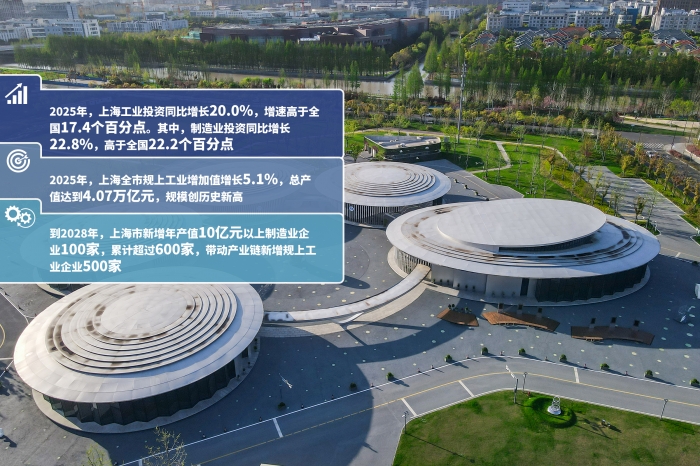
Core Viewpoint - Shanghai is launching a three-year action plan (2026-2028) to support the transformation and upgrading of advanced manufacturing, aiming to add 100 manufacturing enterprises with an annual output value exceeding 1 billion yuan by 2028, totaling over 600 [2] Group 1: Investment and Growth Targets - By 2025, industrial investment in Shanghai is expected to grow by 20.0%, surpassing the national growth rate of 17.4%, with manufacturing investment increasing by 22.8%, higher than the national rate of 22.2% [2] - The action plan aims to drive the establishment of 500 new large-scale industrial enterprises along the industrial chain [2] Group 2: Strategic Paths for Industry Optimization - The action plan outlines three strategic paths: 1. "Optimize and Upgrade" traditional advantageous industries such as petrochemicals and steel [3] 2. "Strategic Leadership" for leading industries like integrated circuits and biomedicine [3] 3. "Promote Growth" for key and emerging industries, including new electronic information and intelligent connected vehicles [3][4] Group 3: Innovation and Technology Development - The plan emphasizes enhancing corporate innovation capabilities, encouraging increased investment in basic research, and providing financial support based on investment levels [4][5] - Focus on breakthrough technologies in laser manufacturing and new energy, as well as core technologies in integrated circuits and high-end equipment [4] Group 4: Digital Transformation and Smart Manufacturing - Shanghai aims to deepen digital transformation through initiatives like "AI + Manufacturing," promoting the application of AI technologies in production processes [4] - By 2028, the goal is to achieve full coverage of smart factories among large enterprises, with a robot density of 600 units per 10,000 people and a digitalization level of over 70% for smart manufacturing equipment [4] Group 5: Elemental Support and Financial Services - The action plan includes strengthening support for talent, space, and funding, with a focus on optimizing financial services for the manufacturing sector [5] - Financial institutions are encouraged to offer lower interest rates and longer-term loans for manufacturing enterprises [5] Group 6: Long-term Development Strategy - The action plan is seen as a long-term strategy for cultivating new productive forces and building new advantages for high-quality development in Shanghai [6] - It aims to create a robust industrial growth engine, enhance the innovation system led by enterprises, and improve the support system for manufacturing development [6][7]

瞄准新赛道,上海将再造万亿级产业新增量
Xin Lang Cai Jing· 2026-02-07 11:29
Group 1 - Shanghai aims to expand its industrial economy by focusing on six emerging pillar industries, including new-generation electronic information and intelligent connected vehicles, targeting a trillion-level industrial increment [1][3] - By 2025, Shanghai's industrial added value is projected to grow by 5.1%, with total output reaching 4.07 trillion yuan, marking a historical high [3] - The city will maintain its advantages in leading industries such as integrated circuits and artificial intelligence, accelerating breakthroughs across the entire industrial chain with double-digit growth in manufacturing output [3] Group 2 - Shanghai plans to promote the transformation and upgrading of traditional industries like petrochemicals and steel towards digitalization and greening, aiming to establish 500 advanced intelligent factories during the 14th Five-Year Plan [3] - The city will create 200 green manufacturing enterprises at the municipal level and enhance the business environment to support outstanding companies [3] - Shanghai will guide districts to cultivate leading industries based on an industrial map, aiming to develop 25 billion-level niche markets [3]
热门赛道迎利好!上海,重磅宣布!
证券时报· 2026-02-07 08:15
Core Viewpoint - Shanghai aims to enhance its economic growth and industrial capabilities through strategic initiatives, including the establishment of an AI Youth Entrepreneurship Fund and increasing the application density of industrial robots to 600 units per 10,000 people by 2025 [1][3]. Economic Growth Targets - By 2025, Shanghai's GDP is projected to reach 5.67 trillion yuan, reflecting a growth of 5.4% from the previous year, with a target of around 5% growth for 2026 [1]. - The city's industrial output value exceeded 4 trillion yuan in the past year, with a forecasted increase of 5.1% in industrial added value by 2025 [3]. Industrial Development - Shanghai plans to establish 500 advanced intelligent factories and create 200 green manufacturing enterprises during the "14th Five-Year Plan" period [1]. - The proportion of emerging manufacturing industries in Shanghai has increased from 40% to 45% over the past five years, with leading industries' share rising from 7.8% to 12.4% [3]. AI and Innovation - Shanghai has seen significant advancements in the AI sector, with nearly 40 humanoid robots transitioning from labs to everyday life, and over one-third of returning overseas talents choosing to start their careers in Shanghai [1][5]. - The city is leveraging a 600 billion yuan national AI fund and a 225 billion yuan Shanghai AI mother fund to foster AI talent and support the establishment of AI application pilot bases in healthcare, finance, and manufacturing [5]. Future Industries - Shanghai is focusing on future industries such as brain-computer interfaces, quantum computing, and gene therapy, with plans to create a national brain-computer interface industrial cluster [7]. - A future industry fund of 15 billion yuan is being established to attract social capital for early-stage investments in hard technology and long-term projects [7]. Silver Economy - By the end of 2024, the elderly population in Shanghai is expected to exceed 37.6%, indicating significant potential for the silver economy [10]. - Initiatives such as the opening of silver-friendly stores and the establishment of technology platforms for elderly care are being implemented to enhance consumer experiences for the aging population [10][11].

上海市经信委:聚焦智能终端、商业航天等,再造万亿级产业新增量
Di Yi Cai Jing· 2026-02-07 06:21
Group 1 - Shanghai aims to create 25 billion-level segmented tracks tailored to local conditions as part of its "14th Five-Year Plan" and the establishment of a modern industrial system [1] - The city will focus on four main areas: implementing national strategies, accelerating industrial transformation, expanding industrial economic scale, and optimizing the industrial ecosystem [1] - Key industries such as integrated circuits and artificial intelligence will continue to maintain advantages, with manufacturing output expected to sustain double-digit growth [1] Group 2 - In the past year, Shanghai's industrial added value increased by 5.1%, with total output reaching 4.07 trillion yuan, marking a historical high [2] - The proportion of advanced manufacturing in Shanghai rose from 40% to 45%, while the share of three leading industries in manufacturing increased from 7.8% to 12.4% [2] - A new action plan aims to add 100 manufacturing enterprises with annual output value exceeding 1 billion yuan by 2028, contributing to the growth of the industrial chain [2]
大飞机、大邮轮接连取得突破,上海如何进一步提升产业核心竞争力?
Xin Lang Cai Jing· 2026-02-07 05:15
Core Insights - Shanghai aims to achieve an industrial output value exceeding 4 trillion yuan by 2025, marking a historical high, with significant advancements in key sectors such as large aircraft and cruise ships [1] Group 1: Industrial Growth and Achievements - In the past year, Shanghai's industrial added value grew by 5.1%, reaching a total output value of 4.07 trillion yuan, a record high [1] - The proportion of strategic emerging manufacturing industries increased from 40% at the beginning of the 14th Five-Year Plan to 45%, while the share of the three leading industries in manufacturing rose from 7.8% to 12.4% [1] Group 2: Future Development Strategies - Shanghai will focus on four key areas: 1. Implementing national strategies to maintain advantages in integrated circuits and artificial intelligence, aiming for double-digit growth in manufacturing output [2] 2. Accelerating industrial transformation towards digital and green development, with plans to establish 500 advanced intelligent factories and achieve an industrial robot application density of 600 units per 10,000 people [2] 3. Expanding the industrial economy by developing six emerging pillar industries, targeting new sectors such as smart terminals and commercial aerospace [2] 4. Enhancing the industrial ecosystem by guiding districts to cultivate leading industries and creating 25 billion-yuan-level niche markets [2] Group 3: Leadership and Contribution - Shanghai will leverage its leading role to contribute to the construction of a manufacturing powerhouse, embodying a commitment to national responsibilities and innovation [3]
人民日报刊文:提升国有企业创新能力
Xin Lang Cai Jing· 2026-01-28 23:07
Core Viewpoint - The innovation capability of state-owned enterprises (SOEs) is crucial for China's modernization and economic development, as emphasized by Xi Jinping's discussions on the importance of SOEs in various contexts [1][2][4]. Group 1: Importance of SOEs - SOEs are a vital foundation for socialism with Chinese characteristics, contributing significantly to economic development, technological progress, and national defense [1][2]. - The role of SOEs is to serve the national strategy, support high-quality economic development, and fulfill social responsibilities [2][4]. Group 2: Innovation Capability - Innovation capability encompasses both technological and non-technological aspects, including product, brand, organizational, and business model innovations [3]. - SOEs' innovation capability is a complex system that integrates various dimensions, including technological innovation and institutional innovation [3][11]. Group 3: International Comparison - Unlike SOEs in Western capitalist countries, which primarily address market failures, China's SOEs are integral to the national innovation system and play a leading role in economic and technological advancements [4]. Group 4: Macro Perspective - The global landscape is rapidly changing, necessitating SOEs to enhance their innovation capabilities to maintain competitive advantages and ensure national security [5]. - SOEs are essential for improving the overall effectiveness of the national innovation system and enhancing self-reliance in technology [5]. Group 5: Micro Perspective - Innovation is a core driver of enterprise development, enhancing market competitiveness and adaptability [7]. - SOEs must address deep-rooted issues to strengthen their core functions and competitiveness, aiming to become world-class enterprises [7]. Group 6: Recent Developments - During the 14th Five-Year Plan period, SOEs have significantly increased their R&D investments, with central enterprises' R&D expenditures exceeding 1 trillion yuan annually [9]. - SOEs are focusing on strategic emerging industries, with investments in these sectors reaching 2.5 trillion yuan by 2025, accounting for 41.8% of total investments [9]. Group 7: Achievements - SOEs have made substantial progress in developing original technologies and overcoming critical technical barriers, contributing to major national projects in various fields [10]. - Key achievements include advancements in high-speed rail, commercial aircraft, and energy technologies, showcasing SOEs' role as a backbone of the economy [10]. Group 8: Future Directions - There is a need for SOEs to enhance their innovation capabilities further, particularly in original innovation and the integration of technology and industry [14][15]. - Strengthening the innovation ecosystem and increasing foundational research investments are essential for sustaining long-term innovation [17][19].
哈尔滨电气:全年利润大幅超预期-20260127
HTSC· 2026-01-27 07:25
Investment Rating - The report maintains a "Buy" rating for Harbin Electric with a target price of HKD 27.05 [6][4]. Core Insights - Harbin Electric is expected to achieve a net profit of RMB 2.65 billion in 2025, representing a year-on-year increase of 57%, exceeding expectations by 10.5% [1][4]. - The profit growth is attributed to the fulfillment of new equipment orders and improved internal management efficiency, alongside the realization of high-margin orders [1][4]. - The company is positioned to benefit from increasing domestic electricity demand and the emphasis on multi-energy supply in the "14th Five-Year Plan" [1][2]. Summary by Sections Financial Performance - The forecast for net profit for 2025-2027 is adjusted to RMB 2.65 billion, RMB 3.48 billion, and RMB 4.08 billion, reflecting increases of 57%, 31%, and 17% respectively [4][10]. - The expected EPS for 2025-2027 is RMB 1.19, RMB 1.55, and RMB 1.82 [4][10]. Market Opportunities - The demand for traditional baseload power sources is driving a significant increase in equipment orders, with new orders expected to contribute to performance growth [11]. - The report highlights opportunities for Harbin Electric in overseas markets due to a global electricity shortage, particularly in regions with weak grid structures [3][11]. Industry Outlook - The report predicts a compound annual growth rate (CAGR) of 6% for national electricity consumption from 2025 to 2030, with a corresponding increase in peak load [2]. - The "14th Five-Year Plan" anticipates a fixed asset investment of RMB 4 trillion in the power grid, a 40% increase from the previous plan, which is expected to drive a new cycle of demand for traditional power equipment [2].