
金属钴

Search documents
有色金属行业经济效益大幅提升
Jing Ji Ri Bao· 2026-02-09 21:58
Group 1 - The core viewpoint of the news is that the non-ferrous metal industry in China is expected to achieve significant economic growth by 2025, with major increases in the number of enterprises, total assets, revenue, and profits [1] - By 2025, there will be over 12,000 large-scale non-ferrous metal enterprises in China, a 39.2% increase from the end of 2020 [1] - The total assets of the non-ferrous metal industry are projected to exceed 6.6 trillion yuan, an 8.2% increase from 2024 [1] - The industry is expected to achieve a total profit of 528.45 billion yuan, a 25.6% increase from 2024, marking a historical high [1] Group 2 - Continuous policy dividends are stimulating market vitality, with a series of stable growth policies supporting the development of the real economy and infrastructure investment, directly boosting demand for major metals like copper and aluminum [2] - The Ministry of Industry and Information Technology and eight other departments have jointly issued the "Non-Ferrous Metal Industry Stable Growth Work Plan (2025-2026)," providing a clear path for future industry development [2] - High prices for non-ferrous metals such as copper, aluminum, lead, and zinc are expected to maintain a high level in 2025, providing a solid foundation for industry profitability [2] - Emerging industries are expanding growth opportunities for the non-ferrous metal sector, with rapid development in aerospace, new energy, and information technology driving demand for non-ferrous metal products [2] Group 3 - Despite the expected historical leap in economic benefits for the non-ferrous metal industry in 2025, the international environment is becoming increasingly complex, with significant uncertainties [3] - The industry needs to enhance resource security and strengthen high-end supply in 2026 through innovation and structural optimization [3] - The "Non-Ferrous Metal Industry Stable Growth Work Plan (2025-2026)" released in September 2025 is a crucial guide for industry development [3] - There is a need to strengthen resource assurance and build a diversified supply system, including promoting domestic resource development and advancing the recycling of non-ferrous metals [3] Group 4 - In 2025, there is a notable increase in the prices of non-ferrous metal commodities, with expectations for a "structural differentiation and increased volatility" in the market for 2026 [4] - Various domestic and international factors are expected to provide strong support for non-ferrous metal prices in 2026 [4] - The market must remain vigilant against risks such as shifts in overseas macro policies and fluctuations in supply and demand expectations, which could lead to increased volatility [4]
中国黄金4连板!今天A股贵金属拉升!这些大事值得关注→
Sou Hu Cai Jing· 2026-01-28 08:56
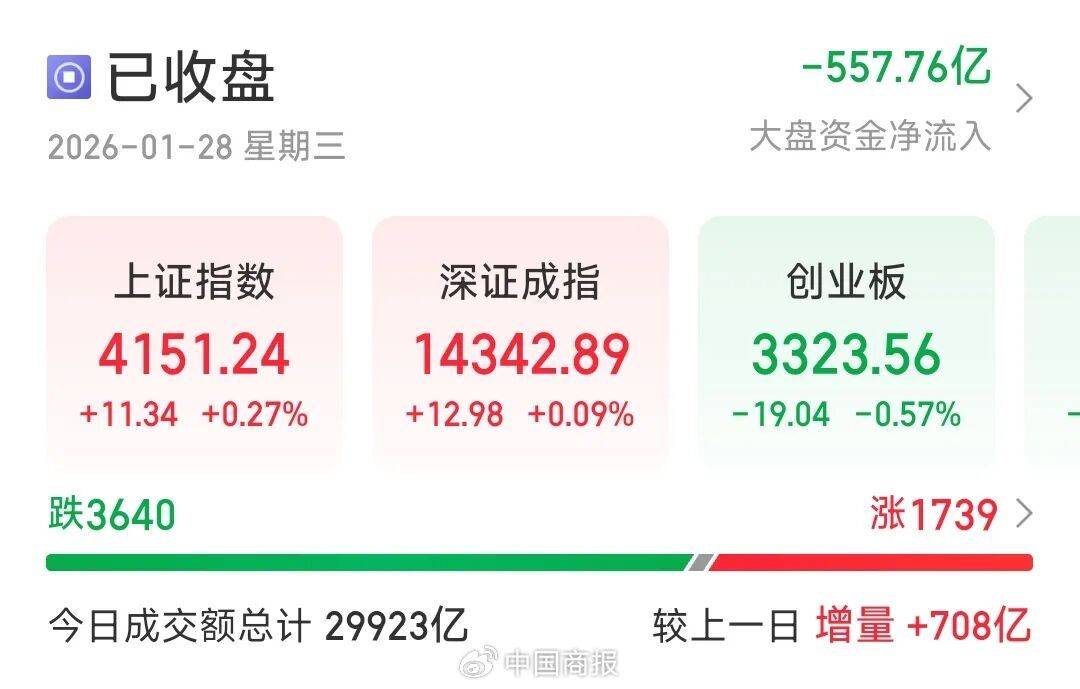
Market Overview - The A-share market showed mixed performance with the Shanghai Composite Index rising by 0.27% to 4151.24, the Shenzhen Component Index increasing by 0.09% to 14342.89, while the ChiNext Index fell by 0.57% to 3323.56 [1][2] - The total trading volume across the three major exchanges reached 29,923 billion yuan, an increase of 708 billion yuan from the previous day, with over 3,600 stocks declining [1] Sector Performance - The sectors that performed well included precious metals, non-ferrous metals, oil and natural gas, coal, chemical industry, soybeans, semiconductors, and real estate [1] - Conversely, sectors that saw declines included photovoltaic equipment, biopharmaceuticals, education, military equipment, and beauty care [1] Precious Metals - Precious metals, particularly gold, experienced significant gains due to a weaker dollar and geopolitical risks, with gold prices reaching a new high of over 5220 USD/ounce [3] - Domestic gold jewelry prices also hit new highs, with several brands quoting over 1600 yuan/gram for gold [3] - Companies in the gold sector, such as Zhongjin Gold, Hunan Gold, and Chifeng Gold, projected substantial profit increases for 2025, with Zhongjin Gold expecting a net profit of 4.8 to 5.4 billion yuan, a year-on-year increase of 41.76% to 59.48% [4] Non-Ferrous Metals - The non-ferrous metals sector saw a comprehensive rise, with metals like lead, zinc, copper, nickel, and cobalt showing strong performance [5] - Analysts predict that the copper supply-demand tightness will worsen in 2026, with expectations of continued strong copper prices due to anticipated Fed rate cuts and increased fiscal spending [6] - Despite some concerns about copper consumption weakening due to high prices, the overall market sentiment remains bullish, indicating a challenging but upward trend for copper prices [6]


有色金属周报:珍惜彭博调参机会,坚定买入有色牛市-20260111
SINOLINK SECURITIES· 2026-01-11 13:37
Group 1: Copper - The LME copper price increased by 1.94% to $12,702.0 per ton, while Shanghai copper rose by 3.23% to 101,400 yuan per ton [1] - Domestic copper inventory increased by 6.29% week-on-week, marking six consecutive weeks of accumulation, with total inventory up by 168,100 tons year-on-year [1][12] - The operating rate of the yellow copper rod industry decreased by 0.61% to 46.98%, while the enameled wire industry saw a decline of 0.66% in operating rate to 74.87% [1][12] Group 2: Aluminum - The LME aluminum price rose by 2.22% to $3,088.00 per ton, and Shanghai aluminum increased by 6.13% to 24,300 yuan per ton [2][13] - The operating rate of domestic aluminum processing leading enterprises increased by 0.2% to 60.1%, indicating a mixed performance across different aluminum processing sectors [2][13] - The total production capacity of metallurgical-grade alumina reached 110.32 million tons per year, with an operating rate of 80.51% [2][13] Group 3: Gold - COMEX gold price increased by 3.36% to $4,487.9 per ounce, with SPDR gold holdings rising by 2 tons to 1,067.13 tons [3][14] - Geopolitical risks, including U.S. military actions in Venezuela and unrest in Iran, have contributed to a strong and volatile market for gold [3][14] Group 4: Rare Earths - The price of praseodymium and neodymium oxide increased by 2.90%, with November exports of rare earth permanent magnets rising by 12% month-on-month and 28% year-on-year, reaching a historical high for the month [4][36] - The expectation of more relaxed export policies and ongoing supply constraints are likely to support future demand and price increases in the rare earth sector [4][36] Group 5: Lithium - The average price of lithium carbonate increased by 11.5% to 131,800 yuan per ton, while lithium hydroxide rose by 10.9% to 126,900 yuan per ton [4][60] - Total lithium carbonate production reached 22,500 tons, with a slight increase of 0.01 million tons week-on-week [4][60] Group 6: Cobalt - The price of cobalt in the Jiangxi market rose by 1.1% to 460,000 yuan per ton, with cobalt intermediate prices also showing slight increases [5][63] - The overall cobalt market remains strong, with supply tightness expected to continue, supporting price stability [5][63] Group 7: Nickel - LME nickel price increased by 1.8% to $17,100 per ton, while Shanghai nickel rose by 4.3% to 138,000 yuan per ton [5][64] - Nickel market sentiment turned optimistic due to potential tightening of nickel ore quotas in Indonesia, leading to price increases [5][64]



钢铁水泥电解铝配额方案落地,高能布局金矿强化资源化协同,龙净国资增持价值 | 投研报告
Zhong Guo Neng Yuan Wang· 2025-11-25 02:02
Core Viewpoint - The report highlights significant growth in the environmental protection industry, particularly in the sanitation equipment and lithium battery recycling sectors, driven by increasing demand for new energy vehicles and rising lithium prices [1][3][7]. Industry Overview - Sanitation Equipment: In the first ten months of 2025, sales of new energy sanitation vehicles increased by 61.32%, with a penetration rate rising by 6.33 percentage points to 18.02%. Total sanitation vehicle sales reached 60,675 units, a year-on-year increase of 4.61%, with 10,931 units being new energy vehicles, marking a 63.32% increase [1][7]. - Lithium Battery Recycling: The price of lithium carbonate has risen, improving profitability. As of November 21, 2025, the weekly price of lithium carbonate was 92,400 (up 8.4% week-on-week), with cobalt and nickel prices at 405,000 and 116,700 respectively [1][7]. Investment Recommendations - Key Recommendations: Companies such as Hanlan Environment, High Energy Environment, Green Power Environmental Protection, and others are highlighted as key investment opportunities [2][4][5]. - Suggested Focus: Attention is drawn to companies involved in carbon monitoring and CCER asset appreciation, as well as those engaged in plastic recycling and energy-saving projects [3][4]. Financial Performance - Solid Waste Sector: The sector showed a 12% increase in net profit for the first three quarters of 2025, with a gross margin improvement of 2.7 percentage points. Free cash flow reached 13.3 billion, up 28% year-on-year [5][6]. - Water Sector: The water sector is expected to see a significant improvement in free cash flow, with a projected increase in dividend payout ratios as cash flow stabilizes [6]. Market Trends - Carbon Emission Quotas: The Ministry of Ecology and Environment has implemented a carbon emission quota scheme for the steel, cement, and aluminum industries for 2024 and 2025, which is expected to enhance the demand for carbon monitoring equipment [3][4]. - Price Adjustments: Recent price adjustments in water services in major cities are anticipated to support revenue growth and improve investment returns [6].
钴:刚果(金)发布钴配额,战略重估正当时
2025-10-15 14:57
Summary of Key Points from the Conference Call Industry Overview - The conference call discusses the cobalt industry, specifically focusing on the recent cobalt export quota policy implemented by the Democratic Republic of the Congo (DRC) [1][3][8]. Core Insights and Arguments - **Cobalt Export Quota**: The DRC has established a cobalt export quota system, with a remaining quota of 18,100 tons for 2025 and a total quota of 96,600 tons for 2026 and 2027, which represents only 44% of the DRC's estimated cobalt production for 2024 [1][3]. - **Impact on Global Supply**: The quota is expected to significantly reduce global cobalt supply by over 40%, which will likely support an increase in cobalt prices [3][11]. - **Price Increases**: Since February 24, cobalt intermediate prices have surged by 185%, with overseas MB cobalt metal and domestic metal cobalt prices increasing by 107% and 123%, respectively [1][6]. - **Market Dynamics**: The market is expected to be dominated by a few platforms, including Glencore, the DRC government, and Eurasian Resources, which may lead to increased price volatility and elasticity [1][7]. - **Strategic Intent**: The DRC aims to enhance its international bargaining power and ensure long-term high cobalt prices through quantity control measures [8]. Additional Important Content - **Recent Import Trends**: In August, China's imports of wet-process intermediate products from the DRC fell by 91% year-on-year and 64% month-on-month, marking the third consecutive month of significant decline [2][13]. - **Domestic Production and Demand**: Domestic metal cobalt production in China decreased by 36% year-on-year in August, while the production of cobalt sulfate and cobalt oxide increased by 6% and 38%, respectively [14]. - **Company Focus**: Companies to watch include Huayou Cobalt and Liqin Resources, which have wet-process nickel-cobalt refining capacity in Indonesia, and DRC-based companies like Luoyang Molybdenum and Shengton Mining that have received quotas [15][16]. - **Future Price Expectations**: The market anticipates that cobalt prices will stabilize around 400,000 yuan per ton, which is crucial for long-term valuation models and profit forecasts for companies in the industry [12][11]. Conclusion - The DRC's new cobalt export quota policy is poised to reshape the global cobalt supply landscape, leading to significant price increases and altering market dynamics. Companies with strategic positions in this evolving market are likely to benefit from the anticipated price elasticity and reduced supply.
钴 | 行业动态:刚果(金)发布钴配额,战略重估正当时
中金有色研究· 2025-10-15 06:55
Industry Overview - On October 11, the Strategic Mineral Market Regulatory Bureau of the Democratic Republic of the Congo (ARECOMS) announced details of cobalt export quotas, effective from October 16, 2023, calculated based on mining companies' export situations until the end of 2024 [1]. Commentary - The export quotas are primarily allocated to mining companies and the Congolese government platform, with no quotas for smelters. For the remainder of this year, the cobalt export quota is set at 18,100 tons; for 2026/27, the total export is 96,600 tons, of which 87,000 tons are basic quotas and 9,600 tons are strategic quotas from ARECOMS. Major companies like Luoyang Molybdenum, Glencore, and Eurasian Resources have received significant quotas, accounting for 62% of the total [2]. - The tightening supply is expected to drive up cobalt prices, with a strategic re-evaluation of cobalt's value occurring at this time. The total export quota for 2026/27 represents only 44% of the DRC's cobalt production in 2024, with the basic quota accounting for just 40%. The demand for cobalt is anticipated to increase due to the advantages of ternary batteries in high-end, long-lasting markets and the advancement of solid-state battery technology [2]. - The DRC's export ban aims to boost cobalt prices and prevent the low-cost outflow of strategic resources while enhancing international influence through resource control [2]. Supply Dynamics - A significant reduction in supply is expected to lead to larger price increases for raw materials. The DRC's cobalt production is projected to account for 76% of global supply in 2024, with a reduction of over 50% impacting global availability. As of October 11, cobalt intermediate products, MB cobalt, and metal cobalt prices have increased by 185%, 107%, and 123% respectively since February 24 [3]. - The pricing of cobalt products may be dominated by platforms that control spot cobalt raw materials, with a few platforms holding pricing power, potentially increasing price volatility. Glencore, the DRC government platform, and Eurasian Resources hold quotas of 20%, 17%, and 11% respectively [3]. Company Quotas - The following companies have been allocated export quotas for October to December 2025, with their respective basic quota shares and estimated quotas for 2026: - Luoyang Molybdenum: 1,300 tons in October, 2,600 tons in November, 2,600 tons in December, with a 35.9% share [5]. - Glencore: 785 tons in October, 1,570 tons in November, 1,570 tons in December, with a 21.7% share [5]. - Eurasian Resources: 425 tons in October, 850 tons in November, 850 tons in December, with an 11.7% share [5]. - The total quotas for all listed companies sum up to 18,125 tons for Q4 2025, with an estimated total of 87,000 tons for 2026 [6].


美联储降息大消息!鲍威尔重磅发声!有色龙头ETF(159876)盘中拉升1%,近5日吸金超3亿元
Xin Lang Ji Jin· 2025-10-15 02:02
Group 1: Federal Reserve and Economic Outlook - Federal Reserve Chairman Powell indicated a worsening labor market and hinted at the possibility of interest rate cuts this month, despite government shutdown impacts on economic assessments [1] - The probability of a 25 basis point rate cut in October reached 97.3% according to CME FedWatch [1] - Powell's remarks are seen as reinforcing expectations for further rate cuts, which could lead to increased demand for physical assets like metals due to currency devaluation [1] Group 2: Price Movements in Minor Metals - Prices of certain minor metals have surged, with cobalt exceeding 350,000 yuan/ton, nearly doubling since the end of last year; tungsten prices reached 266,000 yuan/ton, also nearly doubling this year [2] - Molybdenum and tin prices have shown significant increases, with molybdenum at 4,380 yuan/ton (over 21% increase) and tin contracts up over 10% this year [2] - The demand for minor metals is driven by the rapid growth of new industries such as renewable energy and aerospace, particularly the increasing need for cobalt in lithium battery production [2] Group 3: Strategic Minor Metals and Investment Opportunities - Strategic minor metals are expected to see a revaluation as "quasi-safe-haven" assets due to their scarcity and essential strategic uses [2] - The market for minor metals is influenced by limited global reserves and concentrated production locations, making prices sensitive to geopolitical and production disruptions [2] Group 4: Performance of Key Companies in the Minor Metals Sector - Notable companies in the minor metals sector have shown significant stock price increases, with North Rare Earth up 168%, and Xiamen Tungsten up 72.98% year-to-date [3] - The performance of the non-ferrous metal sector is reflected in the strong inflows into the non-ferrous metal ETF, which has seen net subscriptions of 72 million units recently [3] Group 5: Future Outlook for Non-Ferrous Metals - Non-ferrous metals are positioned as key players in the current commodity bull market, driven by long-term capital expenditure cycles and rising global manufacturing investment [4] - The demand for non-ferrous metals is expected to continue increasing due to the need for strategic metal resources amid a backdrop of economic recovery expectations in China [4] - Analysts predict that industrial non-ferrous metals, minor metals, and gold will be core components of the upcoming market trends over the next one to two years [4] Group 6: Investment Strategies in Non-Ferrous Metals - A diversified investment approach through ETFs tracking the non-ferrous metal index can help mitigate risks associated with investing in individual metal sectors [6] - The non-ferrous metal ETF includes significant weights in copper (27.6%), gold (14.5%), aluminum (13.1%), rare earths (10.4%), and lithium (8.4%), providing broad exposure to the sector [6]

小金属价格“涨”声一片 龙头股年内平均涨幅超九成
Zheng Quan Shi Bao· 2025-10-14 17:28
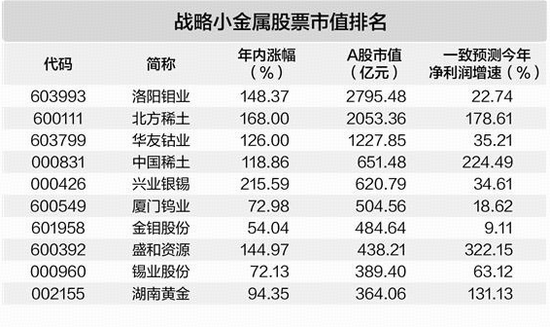
Core Insights - Recent surge in prices of certain minor metals, with cobalt exceeding 350,000 yuan/ton, tungsten reaching 266,000 yuan/ton, and molybdenum at 4,380 yuan/ton, indicating significant year-to-date increases [1] - The demand for minor metals is driven by the rapid development of new industries such as renewable energy and aerospace, particularly the increased need for cobalt in lithium battery manufacturing [1] - Strategic minor metals are being re-evaluated as "quasi-safe-haven" assets due to their scarcity and irreplaceable strategic uses, similar to traditional precious metals [1] Industry Overview - Cobalt prices have doubled since the end of last year, while tungsten and molybdenum have also seen substantial price increases [1] - The global supply of certain minor metals is limited and concentrated in specific regions, making prices sensitive to geopolitical and production disruptions [1] Company Performance - Leading companies in the strategic minor metals sector include: - Luoyang Molybdenum (603993) with a market cap exceeding 270 billion yuan and projected cobalt revenue of 5.728 billion yuan for the first half of 2025 [2] - Northern Rare Earth (600111) with a market cap over 205.3 billion yuan and a revenue increase of over 45% year-on-year [2] - Huayou Cobalt (603799) with a market cap of approximately 122.8 billion yuan, showing a significant increase in nickel product shipments [2] - Xiamen Tungsten (600549) with a competitive advantage across the tungsten industry chain [2] Stock Performance - Average stock price increase for strategic minor metal leaders exceeds 90% year-to-date, significantly outperforming the broader market [3] - Specific stocks such as Xinyi Silver Tin, Northern Rare Earth, and Luoyang Molybdenum have seen price increases over 100% [3] - Forecasts indicate potential for net profit doubling for companies like Shenghe Resources and China Rare Earth this year [3]


钴专家交流20251008
2025-10-09 02:00
Summary of Cobalt Industry Conference Call Industry Overview - The Democratic Republic of Congo (DRC) is implementing a cobalt export quota system to strengthen resource sovereignty, which is expected to systematically increase the market value of cobalt [2][3] - The DRC government has extended the cobalt export ban until October 15, 2025, and plans to implement the export quota system thereafter, marking a shift from a surplus to a shortage cycle in the cobalt market [3] Key Points Cobalt Supply and Demand - The announced export quota for 2026 is insufficient to meet 70%-80% of the production capacity needs of Chinese cobalt companies, which consume over 30,000 tons annually [4][5] - China's total cobalt consumption is approximately 110,000 tons, with an additional export demand of around 20,000 tons, leading to a total demand of 170,000 tons [4] - Cobalt prices have surged from $5.4 per pound at the end of last year to $15.5-$16 per pound, nearly tripling, which has driven up the prices of cobalt sulfate and metal cobalt significantly [4][11] Regulatory Changes - The DRC government may impose regulatory and prepayment fees, and 27 out of 33 cobalt mining companies will need export licenses to obtain quotas [6] - Quotas will be adjusted quarterly to address market imbalances, with a higher likelihood of supply shortages rather than smuggling [6][10] Local vs. Foreign Companies - Local Congolese companies have received special permits for small-scale mining and processing into end products, with specific policies to be announced [8] - The DRC government is balancing local and foreign interests, indicating a potential shift in how resources are allocated [8] Transportation and Logistics - The transportation cycle from the DRC to China takes 90-120 days, meaning any relief from supply pressures will not be felt until early next year, even if quotas are approved [7] Market Dynamics - The cobalt industry is currently experiencing a global raw material supply tightness, with the DRC's official production last year reported at 198,000 tons, but actual production likely exceeding 220,000 tons [11] - The high prices of cobalt materials may impact the consumption of ternary materials in batteries, as insufficient cobalt content can severely affect battery performance [12] Future Outlook - Cobalt prices are expected to fluctuate between 350,000 to 400,000 yuan in the next three months due to ongoing supply shortages [24] - The geopolitical landscape and technological advancements will further complicate the competition between the DRC and other cobalt sources [24] Recycling and Recovery - China recycles approximately 20,000 to 25,000 tons of cobalt annually, which provides some supply relief, but the high cost of recycled products limits their overall impact on demand [28][29] Conclusion - The DRC's new export quota system and regulatory changes are set to create significant shifts in the cobalt market, particularly affecting supply dynamics for Chinese companies. The ongoing high prices and potential supply shortages will likely continue to influence the industry in the near future.
有色金属周报:自由港铜矿超预期减产,看好铜板块机会-20250928
SINOLINK SECURITIES· 2025-09-28 08:25
Investment Rating - The report maintains a positive outlook on copper, aluminum, and precious metals, indicating a high level of market activity and potential for growth in these sectors [13][16]. Core Insights - Copper prices have surged due to unexpected production cuts, leading to significant supply shortages and rapid price increases [13]. - Aluminum is showing signs of recovery with inventory levels decreasing and downstream processing rates improving, suggesting a potential for sustained high profitability [15]. - Precious metals, particularly gold, are expected to rise further due to market anticipation of continuous interest rate cuts [16]. Summary by Sections Copper - This week, LME copper price increased by 2.09% to $10,205.00 per ton, while Shanghai copper rose by 3.20% to 82,500 yuan per ton [14]. - Supply side: The import copper concentrate processing fee index rose to -$40.36 per ton; national copper inventory decreased by 4,400 tons to 140,100 tons [14]. - Consumption side: Brass rod enterprises' operating rate was 48.49%, showing a slight increase of 0.71 percentage points [14]. Aluminum - This week, LME aluminum price decreased by 1.01% to $2,649.00 per ton, and Shanghai aluminum fell by 0.24% to 20,700 yuan per ton [15]. - Supply side: Electrolytic aluminum ingot inventory in major consumption areas dropped by 21,000 tons to 617,000 tons [15]. - Demand side: Downstream processing enterprises' operating rate increased by 0.8 percentage points to 63.0%, driven by pre-holiday stocking [15]. Precious Metals - This week, COMEX gold price rose by 0.23% to $3,789.80 per ounce, with SPDR gold holdings increasing by 5.15 tons to 1,005.72 tons [16]. - The market is experiencing fluctuations due to U.S. tariffs and escalating geopolitical risks, contributing to a volatile trading environment [16]. Rare Earths - The price of praseodymium and neodymium oxide decreased, while the export volume of magnetic materials saw significant growth [32]. - Domestic rare earth separation enterprises are preparing for production halts, indicating potential supply constraints [32]. Antimony - Antimony ingot price is at 174,900 yuan per ton, showing a decrease of 2.26% [33]. - The demand for antimony is expected to recover as the photovoltaic glass market stabilizes [33]. Molybdenum - Molybdenum concentrate price is 4,450 yuan per ton, with a slight decrease of 0.45% [34]. - The demand for molybdenum is expected to rise as major steel mills resume procurement [34]. Tin - Tin ingot price increased by 1.74% to 273,700 yuan per ton, with inventory decreasing by 6.14% [35]. - The supply-demand dynamics are favorable, supported by strong inventory levels and demand from the semiconductor sector [35].

