黄花

Search documents
多元特色产业鼓起孪井滩农民“钱袋子”
Xin Lang Cai Jing· 2026-02-01 19:21
Core Insights - The article highlights the successful agricultural practices in the Alxa League's Luanjing Tan Ecological Migration Demonstration Zone, focusing on food security, industrial efficiency, and rural revitalization [1][2][3] Group 1: Agricultural Production - The demonstration zone achieved a stable grain planting area of over 41,000 acres, with a total grain output surpassing 19 million kilograms and an average yield of 1,144.64 kilograms per acre, marking a new high in production [1] - Farmers are utilizing advanced agricultural techniques, including the promotion of salt-tolerant and lodging-resistant crop varieties, which has led to the establishment of a 10,000-acre high-yield grain demonstration area [2] Group 2: Technological Integration - The integration of technology in agriculture is emphasized, with the adoption of the BeiDou navigation automatic driving system allowing for centimeter-level precision in farming operations, contributing to a mechanization rate approaching 90% [2] - Soil testing and formula fertilization techniques have a coverage rate exceeding 90%, combined with biological pest control methods, effectively reducing pest damage and enhancing crop quality [2] Group 3: Diversification and Economic Growth - The demonstration zone is developing a "grain-economy-feed" triad planting system, guiding farmers to cultivate economic crops such as sunflowers and melons on 14,400 acres, achieving a dual win in food production and economic returns [2] - Livestock farming is also thriving, with farmers like Zhang Yinliang successfully integrating breeding and feeding practices, leading to a scale of 40 cattle and 120 sheep, thus enhancing income opportunities [3]
大国“三农”添新景
Xin Lang Cai Jing· 2025-12-29 20:21
Core Viewpoint - The news highlights significant advancements in rural development and agricultural productivity in China, showcasing improvements in infrastructure, income, and community engagement as part of the ongoing rural revitalization efforts. Group 1: Agricultural Production - China's grain production reached 14,297.5 billion jin, an increase of 167.5 billion jin or 1.2% from the previous year, maintaining stability above 14 trillion jin [3] - The average yield of wheat was 1,200 jin per mu, while corn yield was approximately 1,500 jin per mu, attributed to advanced agricultural practices and technology [3] - The national grain planting area increased to 1.791 billion mu, up by 1.348 million mu or 0.1%, marking six consecutive years of growth [4] Group 2: Rural Infrastructure and Living Standards - Over 10 million mu of high-standard farmland has been established, with crop variety coverage exceeding 96% and self-bred varieties accounting for over 95% of the area [4] - Rural sanitation has improved, with toilet coverage at around 76% and 90% of administrative villages having waste collection and processing [8] - The average disposable income for rural residents increased from 12,588 yuan in 2020 to 17,522 yuan in 2024, with a growth rate exceeding the national average for four consecutive years [7] Group 3: Community Engagement and Cultural Activities - Rural cultural and sports activities have flourished, with over 2.2 million events held in 2024, generating economic benefits of 13.09 billion yuan [9] - The vibrant community life includes various local events, enhancing social cohesion and providing entertainment for residents [10] - The ongoing support for rural revitalization includes financial and policy measures aimed at sustaining development and preventing poverty [6]
产业有活力,发展增动力——中国减贫脱贫启示录③
Ren Min Ri Bao· 2025-12-08 02:57
Group 1 - The core idea emphasizes the importance of industrial development in poverty alleviation, showcasing how modern agricultural practices can significantly increase income for farmers [1][2][5] - The transformation of traditional apple orchards in Yan'an, Shaanxi, illustrates the shift from low-efficiency farming to high-value production, with a reported increase in annual output value from 140,000 yuan to 320,000 yuan [1] - The article highlights the successful cultivation of local specialties across various regions, which has led to the establishment of 2 to 3 leading industries in each of the 832 poverty-stricken counties by the end of 2024 [2] Group 2 - The establishment of effective interest linkage mechanisms is crucial for ensuring that local communities share in the benefits of industrial development, as seen in the case of the grape industry in Inner Mongolia [3] - The integration of government support and market forces is essential for enhancing the quality and efficiency of rural industries, exemplified by the development of the river snail rice noodle industry in Guangxi [4] - The article underscores the importance of continuous improvement and strengthening of rural characteristic industries to ensure sustainable poverty alleviation and broader pathways to common prosperity [5]
产业有活力,发展增动力(人民时评)
Ren Min Ri Bao· 2025-12-07 22:02
Group 1 - The core idea emphasizes the importance of industrial development as a fundamental strategy for poverty alleviation, moving away from reliance on aid to a focus on sustainable economic growth [2][4] - The transformation of traditional agriculture into modern practices is highlighted, with specific examples such as the upgrade of apple orchards in Yan'an, which increased annual output value from 140,000 yuan to 320,000 yuan [1] - The establishment of effective market mechanisms and proactive government roles is crucial for enhancing productivity and vitality in rural industries, as seen in the development of the snail rice noodle industry in Guangxi [4] Group 2 - The development of local specialties into pillar industries is essential for stimulating endogenous growth, with examples from various regions in China showcasing successful agricultural products [2][3] - The creation of benefit-sharing mechanisms, such as the "company + cooperative + base + farmer" model in Inner Mongolia, allows farmers to participate in and benefit from the value chain [3] - Continuous efforts to strengthen rural characteristic industries are necessary to ensure sustainable poverty alleviation and pave the way for common prosperity [5]
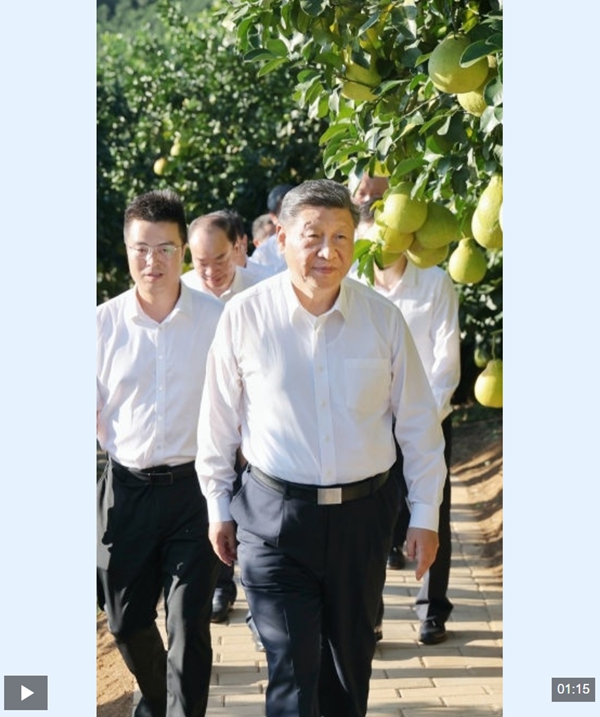
总书记关心的“土特产” 捧起乡村振兴的“金饭碗”
Yang Shi Xin Wen Ke Hu Duan· 2025-11-09 01:47
Core Viewpoint - The revitalization of industries is a key focus of rural revitalization, emphasizing the implementation of industry support policies and the development of local specialties [2] Group 1 - Xi Jinping shows particular interest in local specialties during inspections, providing guidance for the development of rural characteristic industries [2] - The local specialties, such as golden pomelo, mushrooms, daylilies, camellia oil, and coffee, have transformed into significant income-generating industries for farmers [2] - A vibrant new picture of comprehensive rural revitalization is emerging in the countryside, driven by these local specialties [2]

学习快评丨让特色产业夯实乡村全面振兴之基
Xin Hua She· 2025-11-08 22:46
Core Viewpoint - The development of rural characteristic industries is essential for promoting comprehensive rural revitalization in China, as emphasized by President Xi Jinping during his visit to the Nanfukingyou planting base in Guangdong Province [1] Group 1: Rural Revitalization - Accelerating rural revitalization is a key aspect of advancing Chinese-style modernization, with a focus on developing industries that enrich the people [1] - The revitalization of industries is considered the most important part of rural revitalization, with examples of local specialties such as mushrooms from Shaanxi, yellow flowers from Shanxi, pomegranates from Shandong, sugarcane from Guangxi, and golden pomelos from Guangdong [1] Group 2: Industry Development - The emphasis is placed on leveraging local realities, enhancing technological applications, and promoting the integration of agriculture, culture, and tourism to extend industrial chains and increase added value [1] - The successful development of local specialties is seen as a pathway to rural revitalization, leading to prosperous farmers and beautiful countryside [1]
“十四五”农业农村发展“成绩单”:稳粮增收创佳绩,科创水平跻身第一方阵
Zheng Quan Shi Bao Wang· 2025-09-16 09:13
Core Insights - The "14th Five-Year Plan" has led to steady progress in agricultural and rural development in China, with significant improvements in grain production, income growth, and technological innovation [1][2][4] Agricultural Production - China's grain production is projected to reach 1.4 trillion jin in 2024, supported by stable planting areas and increased yields [2][3] - The national grain planting area reached 1.79 billion mu in 2024, an increase of over 3.8 million mu since 2020, laying a solid foundation for food security [2] - Grain yield per mu increased to 394.7 kg in 2024, up by 12.5 kg from the end of the "13th Five-Year Plan," with single yield contributing over 60% to grain production growth [2][3] Income Growth - Rural residents' per capita disposable income reached 23,119 yuan in 2023, with the urban-rural income ratio decreasing from 2.56:1 in 2020 to 2.34:1 in 2024 [4][5] - The government has enhanced support policies for grain production, including comprehensive cost and income insurance for major grain crops [4][5] Technological Innovation - China's agricultural technology innovation has entered the world's top tier, with significant breakthroughs in key technologies and a focus on integrating industry, academia, and research [6][7] - The country has developed over 50 modern agricultural industry technology systems, providing comprehensive technological services across the entire industry chain [7] Food Supply and Nutritional Quality - The total output of livestock products and aquatic products increased by 18.8% and 12.3%, respectively, compared to 2020, contributing to a diversified food supply system [3] - The nutritional intake of urban and rural residents is approaching that of developed countries, indicating improved food quality and health [3]
农业农村部:“三农”政策让农民有更多的获得感、幸福感、安全感
Qi Huo Ri Bao Wang· 2025-09-16 08:56
Group 1 - The core viewpoint of the news is that the "14th Five-Year Plan" emphasizes the importance of addressing agricultural and rural issues, with a focus on high-quality development and the implementation of supportive policies for agriculture [1][2] - The Ministry of Agriculture and Rural Affairs has introduced a series of strong policies aimed at benefiting farmers, which include increasing financial support for high-standard farmland construction from approximately 1,000 yuan per mu to over 2,000 yuan per mu [2] - The government aims to enhance rural infrastructure and public services, improve the quality and efficiency of agricultural production, and maintain the stability of farmers' rights and interests [2][3] Group 2 - Since the beginning of the "14th Five-Year Plan," fiscal spending on agriculture, forestry, and water affairs has reached 10.8 trillion yuan, with 2.7 trillion yuan spent last year [3] - Fixed asset investment in the primary industry has reached 5.47 trillion yuan, and the balance of agricultural loans has reached 53.19 trillion yuan [3] - More than 10% of the land transfer income has been allocated to agriculture and rural development, indicating a significant financial commitment to the sector [3]
农业农村部:明确不允许城镇居民到农村购买农房、宅基地,严禁退休干部到农村占地建房
Guan Cha Zhe Wang· 2025-09-16 05:38
Core Viewpoint - The "14th Five-Year Plan" emphasizes the importance of agricultural and rural development, with a series of supportive policies aimed at enhancing the welfare of farmers and ensuring food security [1][2]. Group 1: Policy Implementation and Financial Support - Since the beginning of the "14th Five-Year Plan," fiscal expenditure on agriculture, forestry, and water affairs has reached 10.8 trillion yuan, with 2.7 trillion yuan spent last year [2]. - Fixed asset investment in the primary industry has reached 5.47 trillion yuan, and the balance of agricultural loans stands at 53.19 trillion yuan [2]. - The proportion of land transfer income allocated to agriculture and rural areas has exceeded 10% [2]. Group 2: Focus Areas of Agricultural Policies - The policies focus on ensuring stable and safe supply of food and important agricultural products, with a comprehensive support system including subsidies, prices, and insurance [2][3]. - There is an emphasis on improving rural infrastructure and public services, with increased financial support for projects like rural sanitation, water supply, and road maintenance [3]. - The promotion of rural industrial revitalization is highlighted, with initiatives to boost the agricultural processing industry and support the establishment of specialized agricultural towns and industry clusters [3][4]. Group 3: New Industries and Farmers' Rights - The development of new agricultural industries such as e-commerce, rural tourism, and leisure agriculture is thriving, with leisure agriculture revenue reaching approximately 900 billion yuan last year [4]. - Policies are in place to maintain the stability of land contracts and protect farmers' rights, ensuring that land remains with the original farmers and preventing forced land transfers [4].
重庆市铜梁区市场监督管理局关于262批次食品安全抽检情况的通告(2025年第4号)
Zhong Guo Zhi Liang Xin Wen Wang· 2025-08-06 03:03
Core Points - The Chongqing Tongliang District Market Supervision Administration conducted a food safety inspection, testing 262 samples across various categories, with 254 passing and 8 failing the safety standards [1]. Group 1: Inspection Results - A total of 262 samples were tested, with 254 samples deemed compliant and 8 samples identified as non-compliant [1]. - The non-compliant products were subjected to legal actions as per the Food Safety Law of the People's Republic of China, including recall and removal from shelves [1]. Group 2: Non-compliant Products - Specific non-compliant products included items with pesticide residues exceeding the permissible limits, such as: - Imidacloprid at 0.244 mg/kg (limit ≤0.05 mg/kg) [1] - Cadmium at 0.493 mg/kg (limit ≤0.05 mg/kg) [1] - Enrofloxacin at 157 µg/kg (limit ≤100 µg/kg) [1] - The inspection revealed multiple instances of pesticide and heavy metal residues in various food products, indicating potential health risks [1].