AI红包

Search documents
8大利好,迎接A股开门红
Sou Hu Cai Jing· 2026-02-23 11:31
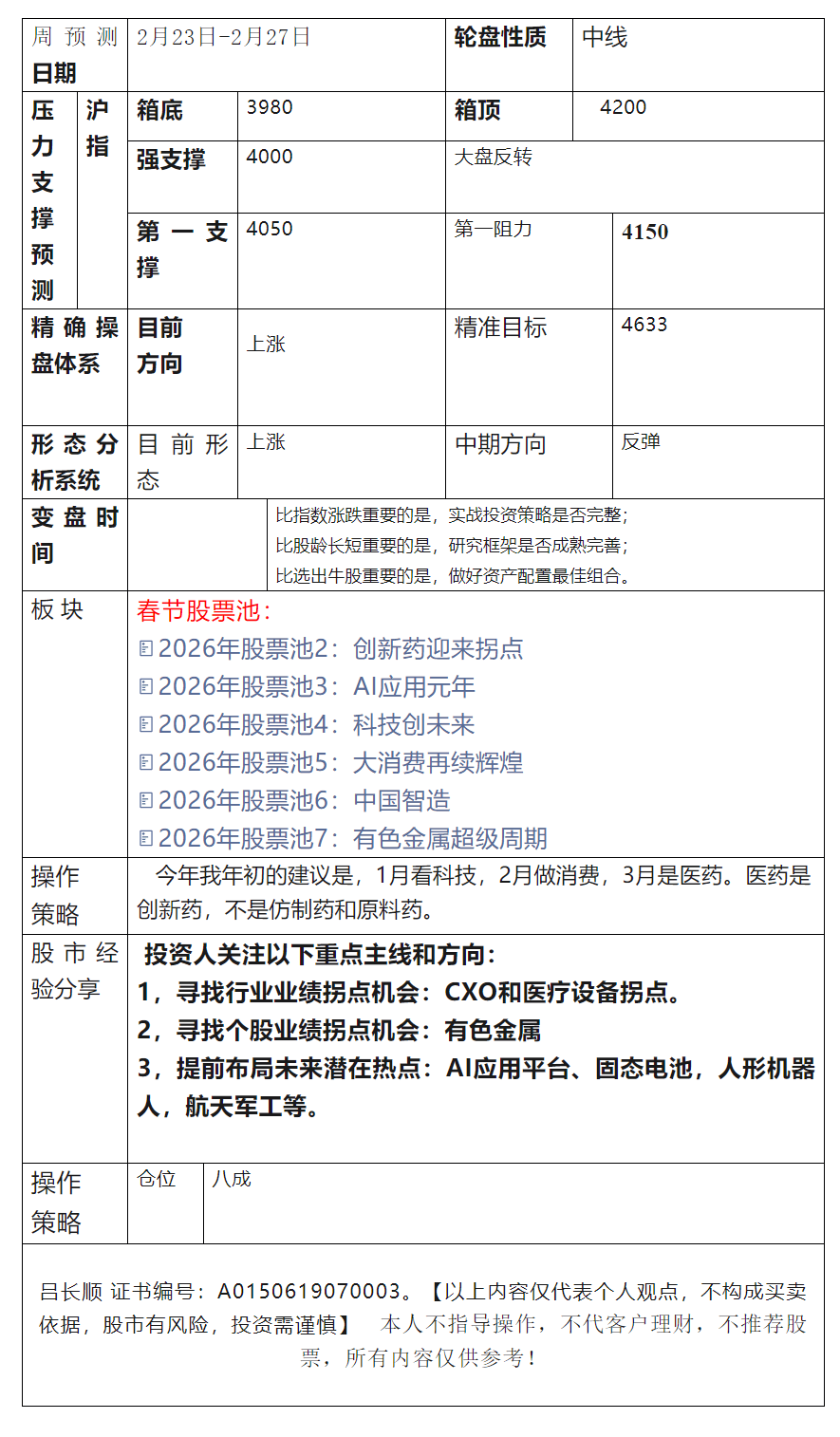
Core Viewpoint - The Hong Kong stock market is expected to open positively, which will likely influence the A-share market to also open strong after the holiday, driven by multiple favorable factors. Group 1: Market Sentiment and Predictions - Positive sentiment is expected for the A-share market due to the favorable information during the holiday period, with an 80% probability of a high opening and a 60% chance of a sustained upward trend [1] - The strong performance of the Hong Kong market is anticipated to create a positive emotional impact on the A-share market [1] - The rise in commodities such as gold and oil is expected to boost resource stocks, which has been previously highlighted [1] - The popularity of humanoid robots during the Spring Festival Gala is predicted to drive the overall robotics sector upward [1] - The AI sector is experiencing a boost, with major internet companies seeing stock price increases, as evidenced by the performance of Hong Kong's BAT stocks [1] - The fear of an AI bubble in the U.S. stock market is subsiding, as indicated by Nvidia's stock performance [1] - The surge in demand for e-commerce and food delivery during the Spring Festival is reflected in Meituan's stock price [1] - The tourism sector is thriving, with heavy traffic indicating a strong recovery, although the film industry is struggling due to lower box office numbers [1] Group 2: Investment Strategies and Sector Focus - The market is expected to see increased liquidity post-holiday, which may lead to a significant rise in trading volume [2] - Investors who held stocks during the holiday are likely to see returns, but caution is advised regarding chasing high prices after the market opens [2] - Key sectors to focus on include AI, robotics, computing power, storage, commodities, consumer goods, and pharmaceuticals [2][4] - The investment strategy suggests focusing on sectors with performance turning points, such as CXO and medical devices, and identifying individual stocks with potential turning points in performance [4] - Future potential hotspots include AI application platforms, solid-state batteries, humanoid robots, and aerospace military industries [4]

两个马年:中国互联网的十二年轮回
Hua Xia Shi Bao· 2026-02-21 10:58
Core Insights - The article discusses the cyclical nature of significant technological advancements in China, particularly focusing on the emergence of WeChat Red Packets in 2014 and the anticipated rise of AI Red Packets in 2026, highlighting the impact of these innovations on mobile payment and user engagement [2][15][19]. Group 1: Historical Context - In 2014, WeChat introduced the Red Packet feature, which unexpectedly transformed the mobile payment landscape in China, allowing WeChat to catch up with Alipay in user engagement [5][6]. - The introduction of the Red Packet feature led to a massive increase in user engagement, with families participating in Red Packet exchanges during the Spring Festival, significantly boosting WeChat's user base [6][8]. - Over the past twelve years, the mobile internet landscape has evolved, with various platforms competing for user attention during the Spring Festival, showcasing a shift from simple monetary exchanges to more complex social interactions [9][13]. Group 2: Current Trends and Future Outlook - In 2026, the focus shifts to AI Red Packets, with major companies like ByteDance, Alibaba, Tencent, and Baidu investing over 4.5 billion yuan to capture the next generation of user engagement [15][18]. - The strategy for AI Red Packets involves integrating AI with everyday services, such as food delivery and ticket booking, to create a more habitual use of AI technology among users [16][20]. - The article suggests that the next significant technological breakthrough will require a universally relatable scenario, similar to how WeChat Red Packets popularized mobile payments [19][22]. Group 3: User Engagement and Retention - Historical data indicates that while Red Packets attract users, they do not guarantee long-term retention, as evidenced by the low retention rates following significant investments by companies like Baidu and Kuaishou [10][11][12]. - The article emphasizes the importance of user engagement metrics post-Spring Festival, indicating that the success of AI Red Packets will depend on users' willingness to interact with AI technology in their daily lives [24].




一财社论:红包过度营销过犹不及
第一财经· 2026-02-13 07:44
Core Viewpoint - The article discusses the rise of red envelope marketing as a unique strategy for market promotion and customer engagement during the Chinese New Year, particularly highlighting its effectiveness in the context of AI applications and consumer behavior [2][3]. Group 1: Red Envelope Marketing - Red envelope marketing has become a common phenomenon among companies during the Spring Festival, creating numerous successful business cases [3]. - The high recognition of red envelopes in China makes them a valuable marketing tool, helping to stimulate consumer activity and enhance the festive market atmosphere [2][4]. Group 2: Consumer Behavior and Market Dynamics - Red envelopes may not provide true consumer surplus but rather represent a discount from merchants or third parties, potentially confusing the relationship between consumers and products/services [4]. - Overuse of red envelope marketing can obscure market price signals and disrupt the genuine expression of consumer preferences, leading to unnecessary purchases [4]. Group 3: Innovation and Market Competition - As the market enters a new phase dominated by AI, the traditional first-mover advantage may become a burden, necessitating rapid innovation to meet changing consumer preferences [5]. - Resources allocated to red envelope promotions may be better spent on enhancing product quality and service scarcity, which could more effectively stimulate consumer activity [5].


一财社论:红包过度营销过犹不及
Di Yi Cai Jing Zi Xun· 2026-02-12 13:57
Core Viewpoint - The use of red envelope marketing is becoming a unique strategy for market promotion and customer acquisition, particularly during the Chinese New Year, with various companies adopting this approach to stimulate consumer engagement and spending [1][2]. Group 1: Red Envelope Marketing - Red envelope marketing has become a common phenomenon, creating numerous successful business cases in recent years [2]. - Companies like Alibaba, ByteDance, Tencent, Baidu, and others have implemented red envelope strategies, especially AI red envelopes, to capture market opportunities [1]. - The high recognition of red envelopes during the Spring Festival makes them a valuable marketing tool for businesses, enhancing consumer engagement and stimulating spending [1]. Group 2: Consumer Behavior and Market Dynamics - The effectiveness of red envelope marketing may be superficial, as true connections between supply and demand are established through product quality and utility rather than promotional tactics [2]. - Overuse of red envelope marketing can blur market price signals and distort genuine consumer preferences, leading to unnecessary purchases and potential waste [3]. - Excessive stimulation from red envelopes may not enhance consumer vitality but could instead suppress it, as consumers may exceed their intended spending limits [3]. Group 3: Innovation and Market Strategy - The current market environment, characterized by rapid innovation and changing consumer preferences, suggests that traditional marketing methods like red envelopes may become burdensome rather than beneficial [4]. - Companies should focus on product and service quality, creating scarcity and consumer surplus, rather than relying heavily on red envelope promotions [4]. - Resources allocated to red envelope marketing may be better spent on innovation and developing unique offerings that resonate with consumers [4].
看懂45亿AI红包大战背后的“根生态”
Ren Min Ri Bao· 2026-02-12 03:12
Group 1 - Major tech companies in China are distributing significant amounts of money through AI-related "red envelopes," totaling over 4.5 billion yuan, to attract users and create a new wave in the AI sector [1] - The initial success of WeChat's red envelope feature in 2015 disrupted the mobile payment landscape, highlighting the importance of building infrastructure for mobile payments [1] - The challenge now is retaining users in AI applications, as the average retention rate for AI apps is only 12.8% after 30 days, compared to the previous success of WeChat [1] Group 2 - Tencent is leveraging social features by encouraging users to complete tasks and share, betting that AI integration into group chats will enhance user retention [3] - Alibaba is focusing on transaction integration, connecting its AI with platforms like Taobao and Hema, ensuring users engage with AI through essential services like food delivery [4] - ByteDance is emphasizing content creation with its Seedance 2.0, which can generate high-quality short films in 60 seconds [5] - Baidu is enhancing its search capabilities, providing direct answers to users instead of displaying numerous ads, capitalizing on its extensive user base [6] Group 3 - The competition among these companies revolves around data resources, application scenarios, and market space, with the ultimate goal of establishing a strong position in the industry [6] - China's unique market, with its vast population and diverse needs, allows for rapid AI application development, contrasting with the U.S. focus on developing advanced AI models through significant investment [6] - Despite existing weaknesses in certain AI technologies, China's rich application scenarios and data resources can drive innovation and technological breakthroughs [7] Group 4 - The investment of 4.5 billion yuan in AI is not just about user acquisition but also about the evolution of China's AI capabilities and its strategic importance [7] - Emphasizing the need for innovation in core technologies like high-end chips and foundational software is crucial for the long-term success of AI in various industries [7] - China's advancements in sectors like aviation and semiconductor technology demonstrate its potential to overcome external challenges and lead in AI development through innovation [7]
今年春节流行“AI年货”
Huan Qiu Wang· 2026-02-11 22:51
Core Viewpoint - The upcoming Chinese New Year is expected to drive significant consumer spending, particularly in AI-related products, as companies like Alibaba and Tencent engage in a competitive marketing push to attract users through innovative applications and technology [1][5]. Group 1: AI Product Sales Surge - Sales of AI toys and other tech-related products have seen a dramatic increase during the Chinese New Year shopping season, with JD.com reporting nearly a threefold increase in sales of AI toys and robots since the start of the New Year shopping festival [3][4]. - AI glasses have experienced a sales surge of over 700%, while smart robots saw an 88% year-on-year increase in transactions during the same period [4]. - The introduction of AI glasses into the national subsidy program has made them more affordable, further boosting sales among consumers [2]. Group 2: Marketing Strategies and Consumer Engagement - Major tech companies are launching "AI red envelope" campaigns to attract users, with Tencent and Alibaba investing heavily in these initiatives, totaling at least 4.5 billion yuan in marketing efforts [5][6]. - The campaigns aim to replicate the success of previous marketing strategies that popularized mobile payment systems, leveraging AI applications to create new user engagement opportunities [5][6]. - Companies are focusing on enhancing user experience, particularly for older demographics, by simplifying interactions with AI technology [8]. Group 3: Emerging Consumer Trends - There is a notable trend of younger consumers purchasing or renting cleaning robots, referred to as "cyber nannies," indicating a shift towards automation in household chores [7]. - The demand for smart home appliances, such as window-cleaning robots and vacuum cleaners, has surged, with some products seeing order volumes increase by over 376% compared to the previous year [7]. - Companies are also adapting AI applications to better serve older users, allowing them to interact with technology in familiar contexts without needing extensive training [8]. Group 4: Future Growth Potential - Experts suggest that the deepening application of AI technology could be a key driver for expanding domestic demand, with potential new business models emerging from AI innovations [8]. - The AI industry is still in a rapid growth phase, and while it shows promise, it has yet to achieve widespread economic impact comparable to the early internet economy [8].

春节,AI应用大战打响了
Xin Jing Bao· 2026-02-06 08:10
Core Insights - The article highlights the significant investment by major companies like Tencent and Alibaba in AI-based red envelopes during the Spring Festival, indicating a strategic shift in consumer behavior and technology integration in traditional practices [1] Group 1: Company Strategies - Tencent and Alibaba have invested billions in AI technology to enhance the user experience during the Spring Festival, aiming to revolutionize the traditional practice of giving red envelopes [1] - The competition between these tech giants is intensifying as they seek to capture market share and consumer attention through innovative offerings [1] Group 2: Industry Trends - The trend of integrating AI into traditional cultural practices signifies a broader shift in consumer habits, where technology plays a crucial role in enhancing social interactions [1] - This "habit revolution" reflects the growing importance of digital solutions in everyday life, particularly during significant cultural events [1]
有多少红包盛况可以重来
Bei Jing Shang Bao· 2026-02-05 16:37
Group 1 - The core competition between major platforms revolves around the integration of red envelopes and AI, with the expectation of replicating past successes being challenging [1][2] - The upcoming Spring Festival serves as a critical moment for AI competition, with significant financial investments expected to create impactful marketing strategies [2][3] - Successful red envelope products are deeply rooted in understanding human nature and creating precise scenarios, but recent years have seen a lack of innovative gameplay [3][4] Group 2 - The effectiveness of AI red envelopes should not be merely about the technology itself or the monetary value, but rather about engaging design that resonates with social and emotional elements of the Spring Festival [3][4] - The historical success of WeChat and Alipay's red envelope strategies highlights the importance of product value beyond just financial incentives [2][3] - The potential for a resurgence of red envelope popularity depends on the robustness of AI capabilities and their ability to deliver meaningful user experiences [4]
2025双11战报消失,电商平台转向差异化增长
Sou Hu Cai Jing· 2025-11-17 03:44
Core Insights - The 2025 Double 11 shopping festival marks a shift in the e-commerce landscape, moving away from the traditional GMV (Gross Merchandise Volume) reporting to a more subdued and diversified approach to growth metrics [1][3][14] Group 1: Changes in E-commerce Dynamics - The excitement and frenzy associated with Double 11 have diminished, with platforms no longer publicly announcing GMV figures, indicating a transition in consumer engagement and marketing strategies [3][4][6] - Despite the absence of GMV reports, transaction volumes continue to grow, suggesting that the underlying market remains active, albeit with a different focus [5][13] - Platforms are now emphasizing differentiated growth strategies rather than competing solely on GMV, reflecting a more sustainable approach to e-commerce [6][11] Group 2: Consumer Behavior Shifts - Consumers are increasingly prioritizing value over discounts, with a notable decrease in the proportion of shoppers motivated by sales promotions compared to previous years [7][10] - The shopping experience has evolved, with consumers now more inclined to compare products and seek out quality, rather than simply chasing the lowest price [10][12] - The rise of younger consumers (post-95 and post-00) is reshaping shopping habits, favoring instant purchases and diverse product categories, which contributes to the changing dynamics of Double 11 [13][14] Group 3: Technological Integration and Efficiency - Platforms are leveraging AI and digital tools to enhance operational efficiency and improve user engagement, with notable examples including Tmall's AI "Smart Benefit Engine" and JD's digital influencers [12][14] - The integration of online and offline shopping experiences is becoming more prevalent, with over 48% of consumers engaging in a blended shopping journey [13][14] - The focus has shifted from creating hype to ensuring operational efficiency and customer retention, indicating a more mature phase in the e-commerce sector [11][14]