
Ironwood TPU

Search documents
Broadcom Q1 Earnings Call Highlights
Yahoo Finance· 2026-03-05 00:00
Core Insights - Broadcom reported record financial results for Q1 2026, driven by faster-than-expected growth in AI semiconductors and strong profitability across its Semiconductor Solutions and Infrastructure Software segments [4][6]. Financial Performance - The Semiconductor Solutions segment generated Q1 revenue of $12.5 billion, up 52% year-over-year [1]. - Consolidated revenue for Q1 2026 was $19.3 billion, reflecting a 29% year-over-year increase and exceeding company guidance [3]. - Adjusted EBITDA was $13.1 billion, representing 68% of revenue, indicating strong operating leverage [3][19]. - Gross margin stood at 77% of revenue, with operating income reaching a record $12.8 billion, up 31% year-over-year [2][19]. - Operating margin increased to 66.4% [2]. AI Semiconductor Growth - AI semiconductor revenue grew 106% year-over-year to $8.4 billion, exceeding expectations, with momentum expected to continue into Q2 [1][6]. - For Q2, Broadcom anticipates AI semiconductor revenue to reach approximately $10.7 billion, up 140% year-over-year [5][15]. - AI networking revenue grew 60% year-over-year and is expected to rise to 40% of total AI revenue in Q2 [6]. Customer Demand and Roadmap - Broadcom has secured key supply chain components for 2026 through 2028, ensuring capacity for AI demand [8]. - The company has a "line of sight" to achieve over $100 billion in AI chip revenue by 2027, with significant customer engagement from Google, Anthropic, Meta, and OpenAI [9][7]. - Specific customer updates include strong demand for Google's seventh generation Ironwood TPU and Anthropic's expected demand surge for TPUs in 2027 [7]. Shareholder Returns and Capital Allocation - In Q1, Broadcom returned $10.9 billion to shareholders through $3.1 billion in dividends and $7.8 billion in stock buybacks [13]. - An additional $10 billion share repurchase program has been authorized [5][13]. Infrastructure Software Performance - Infrastructure Software revenue for Q1 was $6.8 billion, up 1% year-over-year, with Q2 guidance of approximately $7.2 billion, reflecting a 9% year-over-year increase [11]. - VMware revenue grew 13% year-over-year, with total contract value booked in Q1 exceeding $9.2 billion [12].

芯片竞赛,转向存储
半导体芯闻· 2026-02-05 10:19
Core Viewpoint - Intel is preparing to challenge Nvidia's dominance in the AI accelerator market, but the CEO emphasizes that the most critical constraint in the industry is related to memory supply, which favors Korean memory giants like Samsung and SK Hynix [1] Group 1: Memory Supply Constraints - The global shortage of advanced memory is expected to last at least two more years, driven by the rapid expansion of AI systems and the increasing demand for memory that outpaces supplier capacity [1] - Nvidia's next-generation AI platform, Vera Rubin, is anticipated to significantly increase memory consumption per system, exacerbating the supply-demand imbalance [1] Group 2: Market Dynamics - Samsung and SK Hynix dominate the high-bandwidth memory (HBM) market, which has become a critical component in AI computing [1][2] - Despite increasing competition among GPU manufacturers and custom chip designers, the trend in memory development is moving towards centralization, benefiting established players like Samsung and SK Hynix [1] Group 3: Importance of HBM - As AI models grow in scale and complexity, performance bottlenecks are shifting from raw computing power to memory throughput, making HBM a fundamental requirement for AI chips [2] - HBM has transitioned from a niche component to an essential part of AI systems, embedded in chips from major companies like Google, Microsoft, and Meta [2] Group 4: Competitive Landscape - SK Hynix is a primary HBM supplier for Nvidia, with long-term supply contracts already locked in, indicating that their HBM, DRAM, and NAND flash capacities are sold out until 2026 [3] - Samsung is actively expanding its HBM3E capacity and developing next-generation memory, leveraging its ability to integrate memory, wafer fabrication, and advanced packaging [3] - The increasing unit HBM consumption in AI servers and ongoing infrastructure investments suggest that supply will likely not keep pace with demand in the short term, allowing Samsung and SK Hynix to maintain pricing power and strategic advantages in the AI ecosystem [3]


Alphabet(GOOG) - 2025 Q4 - Earnings Call Transcript
2026-02-04 22:30
Financial Data and Key Metrics Changes - Alphabet's annual revenues exceeded $400 billion for the first time, with Q4 consolidated revenues reaching $113.8 billion, up 18% year-over-year [4][29] - Net income increased by 30% to $34.5 billion, and earnings per share rose by 31% to $2.82 [31] - Operating income increased by 16% to $35.9 billion, with an operating margin of 31.6% [31] Business Line Data and Key Metrics Changes - Google Services revenues increased by 14% to $95.9 billion, driven by a 17% increase in Search and Other revenues [32] - YouTube advertising revenues grew by 9% to $11.4 billion, primarily due to direct response advertising [32] - Google Cloud revenue accelerated by 48% to $17.7 billion, with significant growth in enterprise AI products [34] Market Data and Key Metrics Changes - Google Cloud's backlog increased by 55% quarter-over-quarter to $240 billion, reflecting strong demand for AI products [4][35] - The number of new customer acquisitions in Google Cloud doubled compared to Q1, with larger customer commitments also increasing [12][34] - YouTube's annual revenue surpassed $60 billion across ads and subscriptions, indicating strong market performance [65] Company Strategy and Development Direction - The company is focusing on AI investments, with anticipated CapEx for 2026 in the range of $175 billion to $185 billion to support AI compute capacity and infrastructure [5][39] - The launch of the Universal Commerce Protocol aims to enhance product discovery and improve user experience across various platforms [9][80] - Continued integration of AI capabilities into products and services is a key strategic focus, with significant investments in AI infrastructure and talent [6][40] Management's Comments on Operating Environment and Future Outlook - Management expressed optimism about the ongoing momentum in business performance, particularly in AI and cloud services, despite supply chain constraints [38][77] - The company is committed to driving efficiencies while ramping up investments to meet extraordinary demand for AI capabilities [50][77] - Management highlighted the importance of maintaining a healthy financial position while pursuing growth opportunities [76] Other Important Information - The company reported a $2.1 billion stock-based compensation charge related to Waymo's valuation increase [30] - Record operating cash flow of $52.4 billion in Q4 and $164.7 billion for the full year [31][32] - The company is collaborating with Apple as their preferred cloud provider to develop next-generation foundation models based on Gemini technology [15][26] Q&A Session Summary Question: Progress on agentic commerce products and YouTube integration - Management noted that 2025 was about laying the foundation for agentic commerce, with significant progress in coding and the launch of the Universal Commerce Protocol [44] - On YouTube, the integration of new content creation tools like Genie is expected to enhance creator experiences and engagement [46] Question: Addressing AI demand and operational efficiencies - Management acknowledged supply constraints but emphasized long-term planning to meet demand, with a focus on operational efficiencies across the organization [50][52] Question: Maintaining Gemini's position in the LLM frontier - Management expressed confidence in maintaining momentum through continuous innovation and integration of multimodal models [58] Question: YouTube ad revenue growth and SaaS pricing power - Management explained that YouTube's ad revenue growth was impacted by lapping strong election spending, but overall subscription growth remains strong [65] - Management highlighted that successful SaaS companies are leveraging Gemini to enhance product experiences and drive efficiency [68]

OpenAI Trashes Nvidia
247Wallst· 2026-02-03 14:15
Core Viewpoint - OpenAI is reportedly dissatisfied with Nvidia's latest AI chips and is exploring alternative options, which may complicate their relationship in the competitive AI landscape [1]. Group 1: OpenAI and Nvidia Relationship - OpenAI has partially distanced itself from Nvidia, which was expected to invest in a new $100 billion funding round [1]. - Sources indicate that OpenAI has been seeking alternatives to Nvidia's AI chips since last year, raising concerns about the future collaboration between these two key players in the AI sector [1]. - Nvidia's CEO Jensen Huang stated that there was never a firm agreement for Nvidia's participation in OpenAI's investment round, suggesting a potential decline in Nvidia's confidence in OpenAI's future valuation [1]. Group 2: Competitive Landscape - The AI chip market is becoming increasingly competitive, with companies like AMD, Amazon (with its Trainium3 chip), Google (with Ironwood TPU), and Microsoft also entering the fray [1]. - Despite the emergence of these competitors, Nvidia remains a dominant player in the AI chip industry, making it challenging for alternatives to gain significant traction [1]. - The tension between Nvidia and OpenAI reflects a broader struggle among major AI companies as they vie for leadership in the rapidly evolving AI market [1].
Alphabet的新时代来了?
美股研究社· 2026-01-10 06:16
Core Viewpoint - Alphabet Inc. has surpassed Apple in market capitalization for the first time since 2019, although analysts view this as more anecdotal than a bullish market driver, with the company's stock price rising by a low single-digit percentage [1]. Group 1: Key Drivers - The current performance of Alphabet is driven by three main narratives: consumer AI chatbot powered by Gemini [2], AI chips driven by Ironwood TPU [3], and autonomous driving through Waymo [4]. Group 2: Gemini vs. ChatGPT - Gemini has shown a 30% growth in monthly active users (MAU) from August to November 2025, reaching 346 million, while ChatGPT only grew by 6% during the same period, with 810 million MAU [8][9]. - In December, traffic data indicated a 5.6% decline for ChatGPT, while Gemini's traffic increased by 28.4%, with average visit durations of 6 minutes 31 seconds for ChatGPT and 7 minutes 16 seconds for Gemini [8]. - Analysts estimate that if Gemini maintains its growth rate, it could potentially surpass ChatGPT in about 12 months [11]. Group 3: TPU and Market Dynamics - Alphabet's TPU is designed for inference tasks, reducing reliance on Nvidia GPUs, with significant cost advantages: a Google TPU cluster costs $99 million compared to $852 million for an equivalent Nvidia setup [15]. - However, analysts express skepticism about the TPU narrative due to energy efficiency concerns, as Nvidia's GPUs outperform Google's TPUs in this regard [18]. Group 4: Valuation and Market Sentiment - Alphabet's P/E ratios are competitive within the cloud services sector, with a Non-GAAP P/E of 30.58 for FY1, second only to Amazon [20]. - Analysts believe the optimistic sentiment is driven by Gemini's growing appeal against ChatGPT, positioning Alphabet as a key challenger in the consumer AI space [22]. - There are potential headline risks related to regulatory scrutiny, particularly concerning the acquisition of Wiz, which could impact market sentiment [23][26]. Group 5: Future Outlook - Analysts are closely monitoring Gemini's user growth and the outcome of the Wiz acquisition decision by the European Commission, as these factors will influence Alphabet's valuation and market position [26]. - Alphabet is currently testing historical highs in market capitalization, indicating strong investor interest [27].
ETFs to Gain as Alphabet Beats Apple in Market Capitalization
ZACKS· 2026-01-08 16:01
Core Insights - Alphabet (GOOGL) surpassed Apple (AAPL) in market capitalization for the first time since 2019, closing the first week of 2026 at $3.88 trillion compared to Apple's $3.84 trillion, following a 65% surge in 2025 [1][10] Market Dynamics - The shift in market valuation is attributed to a widening innovation gap, with Alphabet leading in artificial intelligence (AI) advancements while Apple has been criticized for its restrained approach and delays in AI developments [2] - Alphabet's introduction of its seventh-generation "Ironwood" tensor processing unit (TPU) and the launch of its advanced AI model, Gemini 3, have solidified its position in the generative AI market, alongside a reported over 30% growth in Google Cloud in Q3 2025 [3] Competitive Landscape - Alphabet's Waymo is recognized as the leader in the U.S. robotaxi market, planning a 2026 expansion into London with a projected standalone valuation of $110 billion, contrasting with Apple's cancellation of its autonomous electric vehicle project, Project Titan, in 2024 [5][6] - Wall Street's confidence in Alphabet has increased due to its dual success in autonomous EVs and generative AI, while Apple has faced a rate downgrade from Raymond James due to its stretched valuation [6] Investment Strategy - Investors are encouraged to consider diversified exchange-traded funds (ETFs) to gain exposure to Alphabet's growth while mitigating risks associated with single-stock investments [7] - ETFs provide a way to benefit from Alphabet's leadership in AI while also gaining exposure to a broader ecosystem of companies, including semiconductor manufacturers and cloud infrastructure providers [8] ETF Recommendations - **Global X PureCap MSCI Communication Services ETF (GXPC)**: Assets worth $63.09 million, with GOOGL holding 28.84% weightage [11] - **Vanguard Communication Services ETF (VOX)**: Assets worth $6.3 billion, with GOOGL holding 14.52% weightage [12] - **Communication Services Select Sector SPDR ETF (XLC)**: Assets under management of $26.88 billion, with GOOGL holding 11% weightage [13]


AI大周期初段下的六大关键议题
Hua Er Jie Jian Wen· 2026-01-08 06:43
Group 1 - The core viewpoint of the articles is that the AI sector is entering a significant growth phase, with expectations for substantial capital expenditure increases and productivity enhancements by 2026 [1][2][4]. - HSBC's analysis suggests that the S&P 500 index is projected to reach 7500 points by 2026, indicating a positive outlook for the U.S. stock market [1]. - The report emphasizes that the focus on AI will shift from infrastructure suppliers to application developers and promoters [1]. Group 2 - Major cloud providers, including Amazon, Microsoft, and Alphabet, are facing capacity constraints due to data center construction cycles, which are expected to persist until 2026 [2]. - HSBC forecasts a 44% increase in capital expenditure for relevant companies in 2026, driven by strong demand and limited construction capabilities [2][4]. - The report indicates that the capital expenditure guidance for 2026 may have upward risks due to the current capacity limitations and strong demand [4]. Group 3 - The primary bottleneck for AI development is identified as power supply, with significant delays in heavy gas turbine deliveries and limited contributions from small modular reactors until 2035 [3]. - Chinese brands are rapidly penetrating the large engine market due to shorter delivery times, contrasting with the global market [3]. Group 4 - ASIC chips are gaining traction in the AI chip market, challenging NVIDIA's GPU dominance, with a projected increase in ASIC's share of cloud service capital expenditure from 2% in 2023 to 13% by 2027 [5]. - Discussions around orders and technology agreements in 2026 are expected to influence valuations, despite external chip sales not contributing significantly until 2027 [5]. Group 5 - The competition among leading AI models is shifting towards an oligopoly, with high sunk costs leading to market rationalization and dominance by a few major players [6]. - The gap between open-source models and closed-source models is narrowing, with advancements in AI capabilities expected to accelerate [6]. Group 6 - 2026 is anticipated to be a pivotal year for integrating AI into smartphones and introducing new hardware that challenges traditional platforms [7]. - Companies like Apple, Meta, and others are expected to enhance their hardware's AI capabilities significantly, with innovations such as upgraded Siri and smart glasses [7].
英伟达封死了ASIC的后路?
半导体行业观察· 2025-12-29 01:53
Core Viewpoint - NVIDIA aims to dominate the inference stack with its next-generation Feynman chip by integrating LPU units into its architecture, leveraging a licensing agreement with Groq for LPU technology [1][18]. Group 1: NVIDIA's Strategy and Technology Integration - NVIDIA plans to integrate Groq's LPU units into its Feynman GPU architecture, potentially using TSMC's hybrid bonding technology for stacking [1][3]. - The LPU modules are expected to enhance inference performance significantly, with Groq's LPU set to debut in 2028 [5]. - The Feynman core will utilize a combination of logic and compute chips, achieving high density and bandwidth while maintaining cost efficiency [6]. Group 2: Inference Market Dynamics - The AI industry's computational demands have shifted towards inference, with major companies like OpenAI and Google focusing on building robust inference stacks [9]. - Google’s Ironwood TPU is positioned as a competitor to NVIDIA, emphasizing the need for low-latency execution engines in large-scale data centers [9][10]. - Groq's LPU architecture is designed specifically for inference workloads, offering deterministic execution and on-chip SRAM for reduced latency [10][14]. Group 3: Licensing Agreement and Market Position - NVIDIA's agreement with Groq is framed as a non-exclusive licensing deal, allowing NVIDIA to integrate Groq's low-latency processors into its AI Factory architecture [18][21]. - This strategy is seen as a way to circumvent antitrust scrutiny while acquiring valuable talent and intellectual property from Groq [19][21]. - The transaction is viewed as a significant achievement for NVIDIA, positioning LPU as a core component of its AI workload strategy [16][21].
谷歌 Ironwood TPU 突袭,英伟达 GPU 迎来挑战者?
Tai Mei Ti A P P· 2025-11-27 07:35
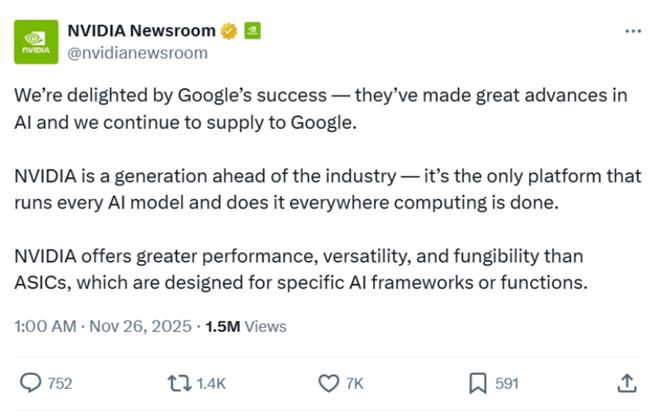
Core Viewpoint - Nvidia issued an urgent statement in response to market discussions regarding AI hardware development, particularly in light of Google's launch of the seventh-generation Ironwood TPU and Meta's consideration of TPU solutions [1][2]. Group 1: Nvidia's Market Position - Nvidia's stock experienced volatility, with a peak decline of 7% and a closing drop of 2.59% following the statement [2]. - The statement has garnered over 1.5 million views and more than 750 comments, indicating significant interest within the AI community [2]. - Observers note that as major clients begin to develop their own chips, the competitive landscape for AI chips is changing [2]. Group 2: Google's AI Infrastructure Strategy - Google is redefining AI infrastructure with a comprehensive solution that integrates custom hardware, cloud services, and specialized chips [3][5]. - The Ironwood TPU is Google's most powerful and energy-efficient accelerator to date, achieving a performance increase of approximately 10 times compared to the previous TPUv5p and over 4 times compared to TPUv6e [3]. - The Ironwood TPU features high bandwidth, large memory capacity, and advanced cooling systems, making it suitable for complex, high-concurrency, low-latency model deployments [3]. Group 3: Implications for the AI Chip Market - Google's introduction of Ironwood signals a significant challenge to Nvidia's GPU dominance, raising questions about the future of Nvidia's market position [8]. - Nvidia emphasizes its unique value proposition as the only platform capable of running all AI models anywhere, highlighting its established ecosystem [8][9]. - Nvidia's advantages include generality and compatibility, a mature ecosystem, and flexibility that allows it to adapt to rapid AI technology iterations [9][12]. Group 4: Future Market Dynamics - Meta is reportedly negotiating with Google to procure TPU chips for deployment in its data centers starting in 2027, reflecting a strategic shift among major tech companies towards diversified AI infrastructure [14]. - If Google continues to leverage its TPU and integrated infrastructure, the AI industry may undergo a profound transformation affecting hardware market dynamics and investment valuation logic [15][16]. - The AI hardware market is expected to transition from a GPU-dominated landscape to a more diversified ecosystem featuring GPUs, TPUs, custom ASICs, and cloud services [17]. Group 5: Investment and Valuation Changes - The focus of hardware competition is shifting from selling chips to providing comprehensive services and infrastructure [18]. - Future valuation metrics will prioritize companies that can offer economical, scalable, and integrated infrastructure solutions [18]. - The lowering of infrastructure barriers is likely to stimulate innovation among AI startups and service-oriented companies, driving the next wave of AI commercialization [19].
Prediction: This Stock Can Outperform Nvidia in 2026
Yahoo Finance· 2025-11-25 15:43
Core Insights - Alphabet achieved a significant milestone by surpassing $100 billion in quarterly revenue for the first time, driven by AI technologies across its Search, YouTube, and Google Cloud businesses [2][7] - The company is experiencing robust growth in its AI capabilities, with a notable increase in monthly active users and queries on its Gemini app, alongside substantial processing of AI tokens [1][10] Financial Performance - In Q3 of fiscal 2025, Alphabet's revenues rose 16% year-over-year to $102.3 billion, marking a historic quarter for the company [2][7] - Google Cloud revenues increased by 34% year-over-year to $15.2 billion, with an operating margin improvement of 6.6 percentage points to 23.7% [11] AI Strategy and Infrastructure - Alphabet's AI infrastructure utilizes a combination of Nvidia's GPUs and its own TPUs, with the latest Ironwood TPU set to launch soon [8][10] - The company is witnessing increased enterprise demand for its AI models, with significant discussions ongoing with Apple regarding licensing its AI model for Siri [9][10] Market Position and Growth Potential - Alphabet's diversified revenue base includes 13 product lines with an annual run rate exceeding $1 billion, positioning it well for future growth [7][16] - The company is expected to see multiple expansion in 2026, driven by its strong Search business and rapidly scaling Google Cloud operations [18] Valuation - Alphabet currently trades at a P/E ratio of 29.6, which is considered conservative compared to Nvidia's 44.3, reflecting its scale and diversified revenue [16] - Management has projected capital expenditures of $91 billion to $93 billion in 2025, indicating a strong commitment to AI and infrastructure investments [17]