Opera浏览器

Search documents
昆仑万维:A股稀缺AI大模型龙头,曾对标ChatGPT,亏麻了!周亚辉前妻李琼早就套现约13亿元!
Xin Lang Cai Jing· 2026-02-25 16:57
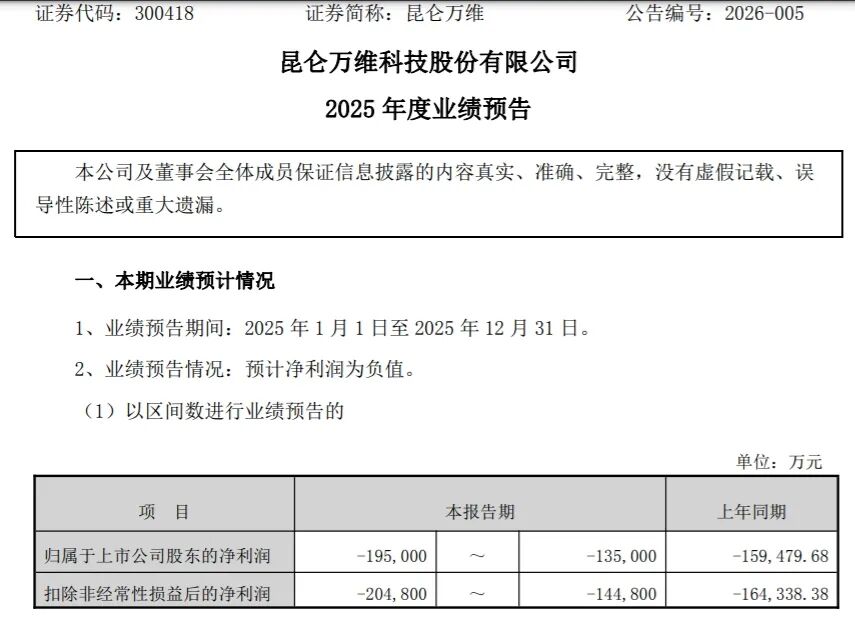
Core Viewpoint - Kunlun Wanwei, a company that claims to benchmark against ChatGPT, continues to face significant losses despite its "All in AI" strategy, projecting a net loss of 1.35 billion to 1.95 billion yuan for 2025, extending its previous year's losses [1][4]. Financial Performance - The company expects a revenue increase of over 40% in 2025, with overseas revenue share further rising, contrasting with a 15.20% revenue growth in 2024 [4]. - For 2025, the net profit attributable to shareholders is projected to be between -1.35 billion and -1.95 billion yuan, while the net profit after deducting non-recurring items is expected to be between -1.448 billion and -2.048 billion yuan [1][4]. - In 2025, the sales expenses surged to 2.891 billion yuan, a year-on-year increase of 105.75%, which offset the growth in core business [5]. Business Strategy and Market Position - Kunlun Wanwei has diversified its business across AGI, AIGC, overseas information distribution, short drama platforms, and social entertainment, operating in over 100 countries [4]. - The company has been recognized as a "rare large model and overseas application leader in A-shares" despite its ongoing financial struggles [12]. Investment and R&D - The company has significantly increased its R&D investments, with 2023 expenditures reaching 968 million yuan and projected to rise to 1.543 billion yuan in 2024 [12]. - Marketing expenses remain high to capture overseas market share, contributing to the ongoing financial losses [12]. Product Performance - The short drama platform has emerged as an unexpected growth point, with projected revenues of 1.68 billion yuan in 2025, representing a 900% year-on-year increase [13]. - Despite the growth in internet business revenue by 52.01% in the first half of 2025, the cost of sales increased by 108.98%, leading to a decline in gross margin [12]. Challenges and Future Outlook - The company faces challenges in sustaining its AI strategy amid continuous losses, with the need for substantial commercial viability to support its nearly 100 billion yuan market valuation [13]. - Analysts predict that losses will narrow to 94 million yuan in 2026, with a potential return to profitability in 2027, contingent on effective commercialization [13].


昆仑万维的AI“大航海”
Bei Jing Shang Bao· 2025-12-25 09:45
Core Insights - The core message of the news is that Kunlun Wanwei's AI music product Mureka has achieved positive gross profit for the first time after reducing marketing expenses, highlighting the company's ability to convert technology into commercial success amidst the challenges faced by the AI industry in monetization [1][2]. Group 1: Financial Performance - In Q3 2025, Kunlun Wanwei reported revenue of 2.072 billion yuan, a year-on-year increase of 56.16%, and a net profit of 190 million yuan, marking a turnaround from losses in the previous year [1]. - For the first three quarters, the company achieved revenue of 5.805 billion yuan, up 51.63% year-on-year, with overseas business revenue reaching 5.41 billion yuan, a significant increase of 58%, accounting for 93.3% of total revenue [1]. Group 2: Business Strategy and Global Expansion - Kunlun Wanwei has been focusing on overseas markets since its establishment in 2008, leveraging the team's experience and market insights to expand its business across over 100 countries and regions [4]. - The company has established offices in more than 20 countries and employs around 1,200 overseas staff, with research and development centers in locations like Poland [5]. Group 3: AI Integration and Efficiency - The integration of AI technology has significantly improved efficiency and reduced costs in content production, with Mureka reducing the cost of music generation from 100,000 yuan to less than 1 yuan [7]. - The AI product matrix includes DramaWave, generating an annual revenue of 240 million USD, and Linky, an AI social product with over 20 million downloads and a monthly revenue peak of over 1 million USD [7]. Group 4: Localization and Compliance - Kunlun Wanwei emphasizes the importance of local adaptation to navigate regulatory and cultural challenges in international markets, ensuring compliance with local rules before launching operations [10]. - The company employs local staff for customer service and sales roles to better connect with users, and it actively engages with local regulations to minimize policy risks [10]. Group 5: Long-term Vision - The company's approach combines technology development with local adaptation, embodying a long-term commitment to sustainable growth in the global market [11].

AI出海 民企彰显全球化竞争力
Bei Jing Qing Nian Bao· 2025-12-24 18:26
Core Viewpoint - Kunlun Wanwei has evolved from a domestic gaming company to a global leader in artificial intelligence, with significant overseas revenue and a strong user base, positioning itself as a benchmark for Chinese tech companies going global [1][4]. Group 1: Company Growth and Strategy - The company was founded with a global vision, starting from online game development and expanding into international markets early on [1][2]. - Kunlun Wanwei's flexible market strategy allows it to focus on rapidly growing markets without fixed revenue targets, adapting to industry changes effectively [2]. - The company has made strategic investments, such as acquiring Opera and launching successful products like StarMaker, which has over 310 million registered users [2][4]. Group 2: AI Development and Revenue - In 2025, Kunlun Wanwei achieved a total revenue of 5.8 billion yuan, a 52% year-on-year increase, with overseas revenue accounting for 93% [4]. - The company has established a comprehensive presence in the AI sector, with products like DramaWave generating significant revenue and Linky achieving over 20 million downloads [4][5]. - The AI music platform Mureka and the Opera browser also contribute to the company's strong market performance, with Opera being the fourth largest browser globally [4]. Group 3: Market Expansion and Compliance - Kunlun Wanwei emphasizes "technological innovation" and "proactive compliance" as key factors for success in international markets [5]. - The company invests heavily in technology and localizes its products to fit diverse cultural contexts in regions like India and Africa [5]. - A rigorous compliance approach ensures that the company secures necessary licenses before launching operations in new markets [5]. Group 4: Government Support - The rapid growth of Kunlun Wanwei is supported by various levels of government in Beijing, providing policy, talent, and funding advantages [6]. - The local government offers tailored services to address the company's needs and assists in obtaining operational licenses for AI products [6]. - Chinese embassies abroad also play a crucial role in facilitating business operations and ensuring the stability of overseas teams [6].
Opera (NasdaqGS:OPRA) FY Conference Transcript
2025-11-18 19:17
Summary of Opera's Conference Call Company Overview - **Company**: Opera - **Industry**: Internet Browsers - **Headquarters**: Norway - **User Base**: Approximately 300 million monthly users - **Public Since**: 2018 - **CAGR Growth**: Over 20% since going public - **Profitability**: The company is profitable and pays a dividend with a recurring yield exceeding 5% [3][30][29] Core Business and Monetization - **Primary Product**: Opera browser, with a focus on driving traffic to partners such as search engines and advertisers [3][4] - **New Product**: Neon browser, which offers advanced agentic capabilities for a monthly subscription, targeting enthusiasts who want more control and automation in their browsing experience [11][12] Competitive Landscape - **Emerging Competitors**: AI-native companies like Perplexity and OpenAI are entering the browser space, which Opera views as an opportunity rather than a threat [4][5] - **Differentiation Strategy**: Opera aims to remain agnostic and independent, allowing users to utilize multiple AI platforms without being locked into one [6][30] Technological Advancements - **AI Integration**: Opera uses a combination of models, including Gemini and ChatGPT, to enhance user experience and browser capabilities [7][10] - **Agentic Capabilities**: The browser is designed to assist users in tasks such as research and e-commerce, with the goal of improving efficiency and user satisfaction [13][24] Revenue Streams - **Query Revenue**: Approximately one-third of revenue comes from query revenue, which has seen a tripling in growth over the past year [16][18] - **Advertising Revenue**: Roughly two-thirds of revenue, with e-commerce advertising growing rapidly, expected to represent half of advertising revenue by Q4 [19][21] - **Performance-Based Advertising**: Opera focuses on performance-based advertising, which is seen as more beneficial for partners compared to traditional display advertising [20][21] E-commerce Strategy - **Key Partners**: Major e-commerce partners include Amazon, Booking, Temu, and Shein, with a focus on driving traffic to these platforms [22][21] - **User Engagement**: The browser aims to present users with options while allowing agents to facilitate transactions, ensuring that advertising opportunities remain intact [23][25] Financial Discipline and Future Outlook - **Profitability**: Opera maintains a strong EBITDA margin of 24% and has returned approximately $500 million to shareholders since 2020 through buybacks and dividends [33][47] - **Opay Stake**: Opera holds a 9.4% stake in Opay, a successful mobile wallet in Nigeria, which is expected to go public, potentially generating significant gains for Opera [40][42] New Initiatives - **MiniPay**: A non-custodial wallet focused on stablecoins, aimed at emerging markets, which has quickly grown to 10 million wallets [34][35] - **Market Positioning**: Opera positions MiniPay as a trusted solution in regions where it has established a long-standing presence [36][38] Misunderstandings in the Market - **Market Perception**: Opera is not a direct competitor to large language models (LLMs) but rather aims to integrate and enhance user experiences through its browser [28][30] - **Partnerships**: The company emphasizes the importance of long-term partnerships, particularly with Google, which have been beneficial for its business model [31][32] This summary encapsulates the key points discussed during the conference call, highlighting Opera's strategic positioning, technological advancements, revenue generation, and future outlook in the competitive landscape of internet browsers.

Perplexity可能只想恶心一下谷歌
Hu Xiu· 2025-08-13 16:05
Core Viewpoint - Perplexity's $34.5 billion bid to acquire Google's Chrome browser is seen as a strategic move amidst ongoing antitrust pressures on Google, despite the bid being significantly higher than Perplexity's own valuation of $18 billion [1][2][7]. Group 1: Perplexity's Acquisition Intent - Perplexity's offer is perceived as an attempt to provoke Google and draw attention to its antitrust issues, rather than a serious acquisition effort [1][3]. - The company has committed to maintaining Chrome's open-source foundation and investing $3 billion in development over the next two years if the acquisition goes through [4][5]. - Perplexity aims to leverage Chrome's vast user base of over 3 billion to enhance its AI capabilities and improve its search engine performance [6]. Group 2: Google's Position - Google is currently facing potential forced divestiture of Chrome due to a federal court ruling on illegal monopoly practices in the online search market [2]. - The company plans to appeal against the divestiture, arguing that it would harm innovation and security [2]. Group 3: Market Dynamics and Implications - The acquisition bid highlights the competitive landscape in the AI and browser market, with other companies like OpenAI and Baidu also developing AI-enhanced browsing solutions [5]. - Analysts suggest that if the acquisition were successful, it could be a transformative move in the AI era, although the bid is considered low compared to Chrome's estimated value of at least $50 billion [6][7]. - Regardless of the outcome, Perplexity's bold move serves as a marketing strategy to increase its visibility and attract investor interest [7].

微软推广Edge无所不用其极,友商忍无可忍
3 6 Ke· 2025-08-01 11:24
Core Viewpoint - Opera has filed a complaint with Brazil's antitrust agency CADE, accusing Microsoft of anti-competitive practices in promoting its Edge browser, which has negatively impacted Opera's market position as the third most popular PC browser in Brazil [1][3]. Group 1: Allegations Against Microsoft - Opera claims that Microsoft has employed various "manipulative design strategies" to persuade Windows users to adopt Edge, effectively blocking competition by pre-installing Edge and creating barriers for users to download other browsers [3][8]. - Specific tactics include forcing Edge to open links from Microsoft applications like Outlook and Teams, regardless of user settings for default browsers, and promoting Edge prominently in Bing search results while downplaying Chrome's download link [8][10]. Group 2: Impact on Opera - The competitive landscape has shifted since Microsoft transitioned Edge to the Chromium engine, diminishing Opera's performance advantage, which previously allowed it to attract a loyal user base due to its speed and unique features [6][12]. - Microsoft's strategies have limited Opera's visibility and accessibility, making it increasingly difficult for the browser to reach potential users, thereby exacerbating its challenges in a market dominated by larger players like Chrome and Edge [12][14].


被理想i8撞到四轮弹起!乘龙卡车:被摆了一道;前毫末智行产品副总裁蔡娜已加入Momenta;乐道高管:L90顶配不超过32万元
雷峰网· 2025-07-31 00:55
Group 1 - Li Xiang, CEO of Li Auto, reflects on being ousted by a trusted partner during a financial crisis at Autohome in 2008, ultimately choosing reconciliation over resentment [4][5][6] - Li Xiang emphasizes the importance of understanding others' perspectives to avoid self-harm and achieve personal peace [5][6] Group 2 - Former Vice President of Product at Haomo.ai, Cai Na, has joined Momenta, bringing valuable experience from her previous roles [9][10] - Momenta aims to achieve profitability by 2026 and is involved in various autonomous driving projects [10] Group 3 - Li Auto's new electric SUV, the Li i8, has undergone rigorous safety testing, showcasing its structural integrity during crash tests [11] - Controversy arose when the truck used in the testing was identified as a Chenglong truck, leading to safety concerns and legal responses from the truck manufacturer [11] Group 4 - Alibaba has adjusted its stock vesting schedule for new employees to 15%, 25%, 30%, and 30% over four years, effective from April 1, 2024 [14][15] - This change aims to provide more immediate stock benefits to employees compared to the previous vesting schedule [14][15] Group 5 - ByteDance's AI programming tool, Trae, has been accused of unauthorized data collection, prompting concerns over user privacy [16][17] - ByteDance responded by stating that data collection practices are in line with industry standards and do not involve personal identification [17] Group 6 - Xiaomi's new end-to-end driving assistance system for its SU7 series has been launched, with a reminder that it is not equivalent to full autonomous driving [13] - The system has seen significant improvements in highway scenarios, but users are urged to remain attentive while driving [13] Group 7 - Stellantis reported a net loss of €2.3 billion in the first half of the year, with a 13% decline in net revenue compared to the previous year [35][36] - The company faces challenges in various markets, including China and India, and plans to launch several new models by the end of the year [36][37] Group 8 - Samsung is reconsidering a $7 billion investment in advanced packaging production in Texas, driven by demand for advanced process chips [44] - This move aligns with the growing need for localized chip production in the U.S. market, particularly for companies like Tesla [44]


网页浏览器Opera在巴西起诉微软 指控其垄断市场
Ge Long Hui A P P· 2025-07-30 01:53
Core Viewpoint - Opera has filed a lawsuit against Microsoft with Brazil's antitrust agency CADE, accusing Microsoft of unfair advantages with its Edge browser [1] Group 1: Legal Actions - Opera previously complained to the European Commission in December 2007, alleging that Microsoft bundled Internet Explorer with the Windows operating system, resulting in a fine of €561 million against Microsoft [1] - The latest statement from Opera's General Counsel, Aaron McParlan, indicates that Microsoft is obstructing competition in the browser market on Windows [1] Group 2: Market Competition - Opera claims that Microsoft prevents other browsers from being pre-installed on Windows devices and restricts users' ability to download and use alternative browsers [1]
微软(MSFT.O)将因与竞争对手浏览器Opera的纠纷,被巴西反垄断监管机构提出投诉。
news flash· 2025-07-29 19:23
Core Viewpoint - Microsoft (MSFT.O) is facing a complaint from Brazil's antitrust regulatory agency due to a dispute with competitor browser Opera [1] Group 1 - The complaint indicates potential regulatory scrutiny on Microsoft's competitive practices in the browser market [1] - The situation highlights ongoing tensions between major tech companies and regulatory bodies regarding market competition [1]
国家队杀疯了!AI三巨头订单爆200%,这波能上车?
Xin Lang Cai Jing· 2025-07-27 09:13
Group 1 - The AI sector in A-shares is experiencing significant growth, driven by government support and increased demand for AI applications across various industries [1][5] - The term "national team intervention" refers to policy-level backing rather than direct stock purchases, indicating a shift towards AI as a new infrastructure akin to electricity [5] - Companies in the AI sector are essentially providing the "electricity" of the AI era, with a surge in orders reflecting increased adoption of AI technologies by businesses [5] Group 2 - Three leading companies in the core multimodal AI space are Wanjing Technology, Kunlun Wanwei, and iFlytek, which have transitioned from conceptual products to generating real revenue [6] - Wanjing Technology has upgraded its video editing software with AIGC features, significantly reducing costs for small businesses and projecting a 60% increase in net profit for H1 2025 [6][7] - Kunlun Wanwei's Opera browser, with 300 million monthly active users, has integrated an AI assistant, enhancing user experience and monetization potential [7] Group 3 - iFlytek focuses on embedding AI into hardware, such as AI learning machines that enhance educational outcomes, leading to a doubling of revenue in the education sector [8] - The rise of vertical industry AI solutions aims to automate repetitive tasks, freeing up human resources for more analytical roles [9] - Companies like Yonyou Network and Hand Information are developing financial and supply chain AI solutions that improve efficiency and reduce labor costs [10] Group 4 - Hengsheng Electronics is a leader in financial IT, providing AI solutions that automate trading and risk management, significantly reducing the need for human traders [11] - RunDa Medical's AI diagnostic systems have received FDA approval, demonstrating their effectiveness in improving diagnostic accuracy in hospitals [12] - AI infrastructure companies like Tuwei Information and Inspur Information are benefiting from the growing demand for AI computing power, essential for running AI applications [12] Group 5 - To assess the legitimacy of the AI boom, three indicators are suggested: the source of revenue, R&D investment, and the necessity of the product [13][14] - Companies with substantial overseas revenue and high R&D investment are more likely to be genuine players in the AI space, while those with low investment may be opportunistic [14] - The current AI market is viewed as an investment in the foundational technologies of the future, rather than a speculative trading opportunity [15]