
Ke Ji Ri Bao

Search documents
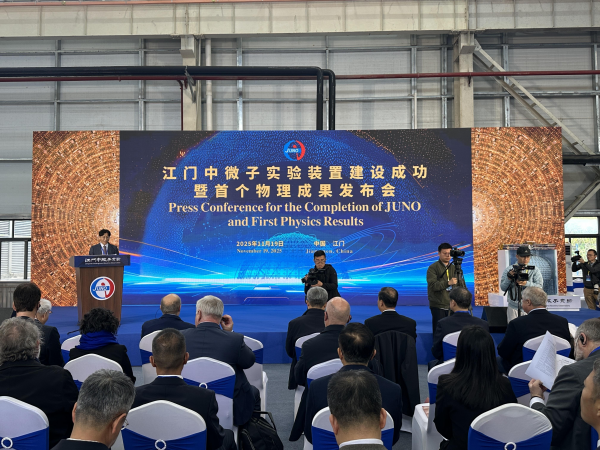
【科技日报】江门中微子实验看透“幽灵粒子”
Ke Ji Ri Bao· 2025-11-19 06:03
Core Insights - The Jiangmen Underground Neutrino Observatory (JUNO) has successfully completed its construction and released its first physical results, achieving a measurement precision of 1.5 to 1.8 times better than previous best results for two key solar neutrino oscillation parameters [2][3] Group 1: Scientific Objectives - JUNO aims to determine the mass ordering of three types of neutrinos: electron neutrinos, muon neutrinos, and tau neutrinos, which is a fundamental question in neutrino physics [3] - The observatory will also conduct precise measurements of neutrino oscillation parameters and cross-research on solar neutrinos, terrestrial neutrinos, supernova neutrinos, atmospheric neutrinos, and proton decay [3] Group 2: Significance for Humanity - Neutrinos are linked to the origins of the universe and play a crucial role in determining the conditions necessary for the existence of matter [4][5] - The study of neutrinos is a pure exploration of natural laws, with potential long-term value that is currently unpredictable, similar to the early days of electricity [5] Group 3: Importance of Precision Measurement - Accurate measurements of neutrino oscillation parameters are essential for addressing fundamental mysteries in physics, such as whether neutrinos are their own antiparticles [6] - The recent results from JUNO significantly improve the measurement precision of solar neutrino oscillation parameters, which may clarify discrepancies in previous measurements and could indicate new physics [6]

驭风于天!高空风力发电开辟风能利用新疆界
Ke Ji Ri Bao· 2025-11-19 02:30
Core Viewpoint - The successful trial of the world's largest 5000 square meter high-altitude wind energy capturing parachute marks a significant step in the engineering application of high-altitude wind power generation technology in China [1] Group 1: High-altitude Wind Power Technology - High-altitude wind power generation utilizes airborne components tethered to capture wind energy above 300 meters, converting it into electrical energy [1][3] - The technology involves a three-tier energy transfer path: airborne energy capture, cable energy transmission, and ground power generation [1][2] - The airborne system is supported by a helium balloon and utilizes a working parachute to capture wind energy, with a cable made of ultra-high molecular polyethylene capable of withstanding hundreds of tons of tension [1][2] Group 2: Advantages and Opportunities - Traditional wind power faces limitations due to the scarcity of high-quality wind fields and the intermittent nature of wind, which challenges grid stability [3] - High-altitude wind energy, located between 300 to 10,000 meters, offers a rich and underutilized resource with theoretical reserves exceeding global electricity consumption by over 100 times [3] - High-altitude wind energy has advantages such as increased energy density, stable wind direction and speed, and widespread global distribution, providing potential solutions for new power system stability and peak-shaving needs [3] Group 3: Commercialization and Application Scenarios - The first engineering trial project for high-altitude wind energy generation in China, located in Anhui, has a total installed capacity at the megawatt level, utilizing wind energy from 300 to 3000 meters [4] - The parachute-based land-based high-altitude wind power generation technology shows significant commercial potential and application flexibility, supporting various deployment schemes [4][5] - Potential applications include deployment in wind-rich areas, off-grid power supply for remote locations, emergency support in urban areas, and complementing other energy sources like thermal and solar power [5]

多项网间电力灵活互济工程获核准
Ke Ji Ri Bao· 2025-11-19 00:44
Core Viewpoint - The approval of the Xiangqian, Xiangyue, and Yuchuan flexible interconnection power projects will significantly enhance the power transmission capacity between the Southern Power Grid and the State Grid, with a total investment exceeding 15.6 billion yuan and a maximum transmission capacity of 9 million kilowatts by 2027 [1][2]. Group 1 - The three projects are set to start construction by the end of this year and are expected to be operational before the summer peak in 2027, increasing the number of transmission channels between the Southern Power Grid and the State Grid from 2 to 5 [1]. - Each of the three projects will involve the construction of a 3 million kilowatt flexible DC back-to-back converter station in Guizhou, Hunan, and Chongqing, along with related line construction to enhance interconnectivity [1][2]. - The projects will provide a solid physical foundation for normalized electricity trading between interconnected regions, supporting high-quality economic and social development and green energy demands [1]. Group 2 - The Xiangqian project will enable peak-shaving interconnection between Hunan, which experiences high electricity load in summer, and Guizhou, which has a "winter high, summer low" load characteristic, thus enhancing power supply security and renewable energy absorption [2]. - In case of extreme weather events, such as high temperatures or severe cold, the Xiangqian project will allow for emergency power support from the opposite side, significantly improving the grid's disaster response capability [2]. - The Southern Power Grid and the State Grid will enhance collaboration and resource investment to ensure high-quality construction and operation of the projects, accelerating the development of a new energy system and power structure [2].
猪肾移植人体详细免疫反应图谱发布
Ke Ji Ri Bao· 2025-11-19 00:18
Core Insights - The studies published in the latest issue of "Nature" detail the immune response following the transplantation of genetically modified pig kidneys into a brain-dead patient model, identifying key factors and potential biomarkers that contribute to xenotransplantation failure [1] Group 1: Xenotransplantation Research - Xenotransplantation is viewed as a potential solution to the shortage of organ donors for patients with end-stage organ failure [1] - The research highlights that organ rejection is a common complication in all types of transplants, with limited understanding of the immune response involved in xenotransplantation [1] Group 2: Study Findings - The research team from NYU Langone Health successfully maintained the function of the transplanted pig kidney for 61 days despite experiencing two rejection episodes, which were treated effectively with existing therapies [1] - The studies identified key mobilization pathways of immune cells in response to the transplant and created a genomic map related to these responses [1] Group 3: Future Implications - The detailed immune response map provided by these studies offers critical insights that could enhance the long-term success rates of xenotransplantation in future research [1]
轻质高强复合材料可耐500℃高温
Ke Ji Ri Bao· 2025-11-19 00:18
Core Viewpoint - A research team from the University of Toronto has developed a new composite material that maintains lightweight and high strength characteristics at high temperatures (up to 500°C), showing potential applications in the aerospace industry [1]. Group 1: Material Characteristics - The new material utilizes a titanium alloy mesh structure as a "reinforcement skeleton" and is filled with an aluminum-silicon-magnesium alloy as a "cement matrix" through micro-casting technology, incorporating nano-scale precipitated particles for enhanced performance [1]. - Compared to traditional aluminum alloys, which soften at high temperatures (with a strength of only about 5 MPa at 500°C), the new material exhibits impressive performance, maintaining a strength of 300-400 MPa at 500°C, comparable to mid-grade steel, while being two-thirds lighter [1]. - The yield strength of the new material reaches 700 MPa at room temperature, indicating its robustness under stress [1]. Group 2: Technological Innovation - The research team employed computer simulations to discover that the new material maintains its strength at high temperatures through a unique deformation mechanism known as "enhanced twinning" [1]. - This breakthrough highlights the innovative potential of additive manufacturing technology, paving the way for the development of lighter, stronger, and more energy-efficient transportation tools [1].
韩称半数主力出口产业竞争力被中国赶超
Ke Ji Ri Bao· 2025-11-19 00:05
Core Insights - The report from the Korea Economic Association indicates that half of South Korea's top ten export industries have been surpassed by China in terms of competitiveness, with a prediction that all ten industries may fall behind China in five years [1][2] - A survey of 200 major companies in these industries revealed that 62.5% view China as their biggest competitor, with this figure expected to rise to 68.5% by 2030 [1] - The competitiveness index set by the surveyed companies ranks South Korea at 100, while China and the US are projected to surpass South Korea by 2030, with indices of 112.3 and 112.9 respectively [1] Industry Competitiveness - In specific sectors, Chinese companies lead in steel (112.7), general machinery (108.5), secondary batteries (108.4), displays (106.4), and automotive parts (102.4) [2] - South Korean companies still maintain an edge in semiconductors (99.3), electronics and electrical machinery (99), shipbuilding (96.7), petrochemicals and petroleum products (96.5), and biopharmaceuticals (89.2) [2] - The report highlights that China holds advantages in price competitiveness, production capacity, and government support, while South Korea only leads in brand competitiveness, which is expected to be overtaken in five years [2]
追踪超千亿颗恒星的银河系模型创建
Ke Ji Ri Bao· 2025-11-19 00:05
Core Insights - An international team from Japan's RIKEN, the University of Tokyo, and the University of Barcelona has developed the first galaxy model capable of tracking the evolution of over 100 billion stars, achieving a scale 100 times greater than previous models [1][2] - Traditional models were limited to simulating systems of up to 1 billion solar masses, while the Milky Way contains over 100 billion stars, leading to challenges in accurately representing astronomical events [1] - The new model combines deep learning with traditional physical simulations, allowing for significant reductions in computation time for simulating the evolution of the galaxy [2] Summary by Sections - **Model Development** - The new galaxy model can track the evolution of over 100 billion stars, surpassing previous models by a factor of 100 [1] - Previous models could only simulate systems up to 1 billion solar masses, which limited their accuracy in representing the Milky Way [1] - **Computational Efficiency** - The new approach reduces the time required for simulating a million years of evolution to just 2.78 hours, and a billion years to 115 days [2] - Traditional simulations required 315 hours for a million years and 36 years for a billion years, highlighting the efficiency of the new model [1][2] - **Technological Innovation** - The integration of deep learning with traditional simulations marks a significant advancement, moving beyond mere pattern recognition to becoming a genuine scientific discovery tool [2] - The AI system was trained on high-resolution supernova simulation data to predict the movement of interstellar gas following supernova explosions [1]
迈向能量增益的重要一步 新一代聚变装置等离子体压力创纪录
Ke Ji Ri Bao· 2025-11-18 23:59
Group 1 - Zap Energy announced its latest "Fusion Z-Pinch Experiment 3" (FuZE-3) achieved an electron pressure of up to 830 MPa, corresponding to a total plasma pressure of approximately 1.6 GPa, setting a new record for shear flow-stabilized Z-pinch devices [1] - The pressure is a key indicator reflecting the temperature and density of plasma, with higher pressure leading to more frequent fusion reactions, moving closer to the goal of energy output exceeding input [1] - The team utilized "optical Thomson scattering" technology to measure the plasma electron pressure, which is approximately double the total pressure due to contributions from both electrons and ions [1] Group 2 - In the recent FuZE-3 experiment, repeated discharge measurements showed electron density ranging from 3×10^24 m^-3 to 5×10^24 m^-3, with electron temperatures exceeding 1 keV (approximately 11.67 million degrees Celsius) [2] - FuZE-3 aims to achieve new heights in the "triple product" (density × temperature × confinement time), which is a crucial indicator of fusion performance [2]
国内首个生产型大白菜无人农场科技感满满
Ke Ji Ri Bao· 2025-11-18 23:56
在一片绿油油的蔬菜试验田里,无人耕整装备精准翻耕,无人收获机高效采收白萝卜、大白菜等作物。 这不是未来农业的科幻场景,而是日前记者在全国首个生产型大白菜无人农场看到的真实画面。 根茎类蔬菜收获区更显热闹。白萝卜、胡萝卜专用收获机"张开大口",精准夹住萝卜缨叶,轻松将其从 土壤中拔出,松土、扶叶、夹拔、输送、切缨等工序一次性完成。切缨后的萝卜直接被传送至运输机器 人上,实现收获与转运全自动衔接。相较传统人工方式,单台收获机作业效率相当于50名劳动力,大幅 降低人工投入。 在白菜收获区,全国首台纯国产的大白菜无人收获机亮相。该机通过北斗定位与视觉精准对行系统,自 动识别白菜位置,平稳执行扶正、抱球、切割、传送等采收动作,实现大白菜精准有序采收,作业过程 安全高效、秩序井然。 "太舟坞示范区通过物联网、无人农机与智能管理系统的深度融合,实现了大白菜、胡萝卜等主要露地 蔬菜全程机械化、少人化生产,显著提升了作业效率,降低了用工成本。"北京市农林科学院副院长杨 国航表示,全国首个生产型大白菜无人农场是该院"奇稷智慧农场"系列的重要组成,标志着智慧农 业"北京模式"在全国蔬菜领域率先落地,为蔬菜产业高质量发展提供了新路径 ...
新技术突破低品位铜钴矿利用瓶颈
Ke Ji Ri Bao· 2025-11-18 23:56
科技日报记者 夏天一 通讯员 甘欣鑫 记者近日从中铝国际昆明有色冶金设计研究院(以下简称"昆明院")获悉,由该院牵头完成的"刚果 (金)低品位复杂铜钴伴生矿绿色高效冶炼关键技术及应用"项目通过中国有色金属工业协会组织的科 技成果评价,整体技术达到国际领先水平,标志着我国在复杂矿产资源绿色冶炼领域取得重要突破。 昆明院副总经理张春生介绍,低品位、高复杂性氧化铜钴矿的高效利用一直是行业难题。项目团队创新 研发并集成了"原矿吸酸—强化还原浸出—多段逆流浸出—高效萃取—节能电积—智能检测—多金属回 收"全流程关键技术及专用装备体系,成功攻克了有价元素综合回收率低、能耗高、环境友好性差等瓶 颈,实现了铜、钴等战略金属的绿色高效提取。 据悉,目前该技术已在刚果(金)成功实现产业化应用,建成年产4万吨及2.5万吨阴极铜的生产线各一 条,并实现长期稳定运行。项目累计创造经济效益数亿元,展现出优越的技术适应性和推广前景。 ...
