
Ke Ji Ri Bao

Search documents
风电行业从规模扩张转向价值提升
Ke Ji Ri Bao· 2025-11-02 23:43
Core Insights - The wind power industry in China is transitioning from a focus on "generation capacity" to "generation value" as market dynamics change, particularly with the move towards market-driven pricing for electricity [1][4][3] Group 1: Industry Developments - China has maintained its position as the world's largest wind power market for 15 consecutive years, with an annual installation rate exceeding 10 million kilowatts [2] - The country aims to achieve a wind power installed capacity of 50 billion kilowatts by 2060, with significant contributions expected from wind energy [3][2] - The "Three North" region has over 75 billion kilowatts of economically viable wind energy resources, while offshore wind resources within 300 kilometers are entering large-scale commercial development [2] Group 2: Technological Innovations - The industry is adopting a "value per kilowatt-hour" strategy, moving away from merely increasing turbine size to optimizing the economic value of electricity generated [4][5] - Goldwind Technology has introduced the GWH204-Ultra series turbines, which enhance output during high-value trading periods through advanced materials and intelligent systems [5][6] - The integration of artificial intelligence in wind energy systems is becoming prevalent, with companies like Envision Energy and CRRC Group launching AI-driven solutions to improve operational efficiency and revenue [7][8] Group 3: Market Dynamics - The shift towards market-driven pricing has led to a reevaluation of traditional profit models, emphasizing the need for precise forecasting and adaptive generation strategies [4][6] - The new paradigm requires wind power companies to respond to price fluctuations and optimize generation accordingly, moving from a fixed-price subsidy model to a competitive market environment [4][6] - The focus on artificial intelligence is expected to enhance the industry's ability to manage the uncertainties of renewable energy generation and pricing [8]


科技日报:谁在破坏全球芯片供应链一目了然
Ke Ji Ri Bao· 2025-11-02 23:36
Core Viewpoint - The recent actions of Nexperia, a Dutch semiconductor company, to stop supplying wafers to its Dongguan packaging and testing factory have raised significant concerns about the global chip supply chain, particularly affecting the automotive industry [1][2]. Group 1: Company Actions and Responses - Nexperia announced the cessation of wafer supply to its Dongguan factory due to alleged non-payment by the management, which Nexperia claims is a breach of contract [1]. - Nexperia China strongly opposed these claims, stating that the Dutch parent company owes approximately 1 billion yuan to the Dongguan factory [1]. - The Dutch government's intervention in Nexperia's operations has been criticized for disrupting the company's normal functioning and management [1][3]. Group 2: Industry Impact - The disruption caused by Nexperia's actions has led to an increase in delivery times for automotive components from 12 weeks to over 20 weeks, with some chip prices rising by 10 times [1][2]. - Major automotive manufacturers, including Nissan, are facing chip supply challenges, which may force them to reduce production due to dwindling inventory [1][2]. - Nexperia's decision to halt wafer supply is seen as a further destabilization of an already turbulent global chip supply chain [1]. Group 3: Market Performance and Future Outlook - Following its acquisition by Chinese investors, Nexperia has experienced rapid growth in both capacity and profits, with projected revenues reaching 14.7 billion yuan in 2024 [3]. - The growth is attributed to effective management by the Chinese team and the increasing market demand from emerging industries in China [3]. - The Dutch government is urged to cease its inappropriate interventions to allow Nexperia to return to a healthy growth trajectory [3].
具有超导性能的锗材料制成 为开发可扩展量子器件开辟新路径
Ke Ji Ri Bao· 2025-11-02 23:35
Core Insights - An international research team has developed superconducting germanium materials that can conduct electricity without resistance, paving the way for scalable quantum devices based on existing semiconductor technologies [1][2] - The breakthrough was achieved through molecular beam epitaxy, allowing precise doping of gallium atoms into the germanium lattice, resulting in a highly ordered crystal structure [1][2] Group 1: Scientific Breakthrough - The research indicates that achieving superconductivity in traditional semiconductors like germanium and silicon has been a long-standing challenge, with this study overcoming previous limitations related to high concentration doping [1][2] - The team successfully induced a band structure in germanium that supports electron pairing, which is essential for superconductivity, by altering its crystal structure [2] Group 2: Implications for Technology - This advancement not only enhances the understanding of the physical properties of group IV semiconductors but also opens possibilities for their use in next-generation quantum circuits, low-power low-temperature electronic devices, and high-sensitivity sensors [2] - The ability to create clean interfaces between superconducting and semiconductor regions is crucial for integrating quantum technologies, and the compatibility of this technology with existing chip manufacturing processes could accelerate the practical application of quantum technology [2]
“心脏”强大 “大脑”聪明 “嗅觉”灵敏 无人机“飞向”千行百业
Ke Ji Ri Bao· 2025-11-02 23:33
Core Insights - The integration of drones in various industries is transforming traditional practices, enhancing efficiency and safety in operations [1][4][5] - China's drone industry is experiencing rapid growth, with significant advancements in technology and applications, positioning the country as a global leader in drone exports and patents [1][2][5] Group 1: Technological Advancements - Drones are now equipped with advanced AI capabilities, allowing for autonomous decision-making and route planning, which enhances operational efficiency [3] - The development of high-performance lithium-ion batteries has improved drone endurance by 20% to 40%, enabling stable operation in extreme temperatures [2] - New sensor technologies, such as gas detection modules, have enhanced drones' environmental sensing capabilities, allowing them to detect minute changes in air quality [3] Group 2: Industry Applications - Drones are revolutionizing traditional industries, such as mining, by autonomously generating high-precision 3D models and collecting data in hazardous environments [4] - In logistics, drones are effectively handling an average of 20,000 packages daily in Shenzhen, demonstrating the maturity of the technology and the viability of the business model [5] - The integration of drones in disaster response has proven effective, with drones being used for reconnaissance and communication in emergency situations [5] Group 3: Market Growth - The drone industry in China is expanding rapidly, with projections indicating that the number of registered drones will exceed 2.726 million by June 2025, reflecting a net increase of 513,000 from the previous year [5]
我国低碳冶金技术迈入世界第一方阵
Ke Ji Ri Bao· 2025-11-02 15:13
Core Insights - The Chinese steel industry has made significant progress in high-quality development during the "14th Five-Year Plan" period, particularly in high-end, intelligent, and green development [1] - Breakthroughs in low-carbon metallurgy technology innovation and application have positioned China among the global leaders, with several pioneering projects launched [1] Industry Developments - The introduction of the world's first "hydrogen-based vertical furnace - near-zero carbon electric arc furnace" project by Hebei Steel represents a major advancement in low-carbon steel production [1] - The world's first hydrogen metallurgy green automotive sheet continuous casting production line has been established, showcasing China's commitment to sustainable practices [1] - China Steel Research has launched the world's first pure hydrogen vertical furnace demonstration line, further emphasizing the shift towards low-carbon technologies [1] - Additional cutting-edge low-carbon metallurgy technology demonstration projects, such as thin strip casting and dry granulation of blast furnace slag, have been implemented, contributing to the global transition to green steel production [1]
美的集团第30届科技月大会举行 展现前沿技术与产业布局
Ke Ji Ri Bao· 2025-11-02 12:56
Core Insights - Midea Group held its 30th Technology Month Conference, themed "AInnovation," showcasing advancements in technology innovation, industry breakthroughs, and talent cultivation [1][3] - The awards included 17 "Technology Stars" and 12 "Technology New Stars" in individual categories, along with 18 "Technology Breakthrough Awards" and 12 "Product Contribution Awards" in project categories [1][2] Awards and Recognition - The structure of the awards was adjusted, adding categories for overseas breakthroughs and new industries under the "Product Contribution Award" to enhance strategic focus on OBM business and new industry development [1] - The number of AI innovation-related "Technology Breakthrough Awards" was significantly increased, with two additional "Technology Stars" and "Technology New Stars" in AI innovation [1][3] AI Innovations - Midea is shifting its focus in AI from mere efficiency improvements to applications in products and business scenarios, with new awards recognizing AI innovations [3] - Notable AI projects include the "AirAgent" system for home air conditioning and a high-quality medical imaging technology platform that integrates deep learning [3] R&D Investment and Global Strategy - Midea has emphasized its commitment to R&D, with over 430 billion yuan invested in the last three years and more than 88 billion yuan planned for the first half of 2025, reflecting a year-on-year increase of over 14.4% [4] - The company has established a "North-South Dual Core" R&D network with innovation centers in Shanghai and Foshan, alongside global R&D bases in the US, Europe, and Japan [4] - By the end of 2024, Midea aims to have over 23,000 R&D personnel globally, making up more than 50% of its non-production workforce [4]

美科学家推测—— “行星Y”在扰动太阳系边缘天体轨道
Ke Ji Ri Bao· 2025-11-01 23:13
Core Viewpoint - The research led by astrophysicist Amir Siraj from Princeton University suggests the existence of a previously undetected planet, referred to as "Planet Y," which may be influencing the orbits of distant celestial bodies beyond Neptune [1][3]. Group 1: Research Findings - The study published in the Monthly Notices of the Royal Astronomical Society proposes that the gravitational pull of "Planet Y" could be the reason behind the orbital anomalies of approximately 50 cold Kuiper Belt objects, with their orbits tilted by about 15 degrees [3][4]. - The analysis indicates a 96%-98% confidence level in the observed orbital tilt, which exceeds the gravitational influence of Neptune [4][6]. - Simulations suggest that a celestial body with a mass between Mercury and Earth, located 100-200 astronomical units from the Sun, could account for the observed tilt in the Kuiper Belt's orbital plane [4][5]. Group 2: Historical Context - The concept of an unknown planet affecting the orbits of Neptune and Uranus dates back to the 19th century, with the idea of "Planet X" proposed by astronomer Percival Lowell [5]. - The discovery of Eris in 2005 reignited interest in the search for distant planets, leading to the hypothesis of a "Ninth Planet" proposed by Mike Brown and colleagues in 2016 [5][6]. - The current "Planet Y" theory does not negate the existence of the "Ninth Planet" but offers an alternative explanation for the observed orbital distortions in the Kuiper Belt [6]. Group 3: Future Observations - The upcoming Vera C. Rubin Observatory in Chile is expected to play a crucial role in confirming the existence of "Planet Y" or the "Ninth Planet" through its extensive survey of the southern sky over the next decade [8]. - The observatory's capabilities will allow for systematic observations of distant celestial bodies, potentially leading to the direct detection of "Planet Y" within the first few years of its operation [8].


前三季度全国铁路多项运输指标创历史新高
Ke Ji Ri Bao· 2025-11-01 12:57
Core Insights - The China National Railway Group (referred to as "the company") achieved a total operating revenue of 912.2 billion yuan and a net profit of 11.72 billion yuan in the first three quarters of the year, indicating significant enhancement in the impact of railway construction investment and new achievements in high-quality development of national railways [1] Revenue and Profit - The company reported total operating revenue of 912.2 billion yuan and a net profit of 11.72 billion yuan for the first three quarters [1] Transportation Metrics - The national railway sent a total of 3.54 billion passengers, a year-on-year increase of 6%, marking a historical high for the same period [1] - The national railway transported 3.03 billion tons of goods, with an average daily loading of 185,300 cars, representing year-on-year growth of 3.4% and 4.3% respectively, showing a stable upward trend [1] Investment and Infrastructure - The company completed fixed asset investment of 593.7 billion yuan, a year-on-year increase of 5.8%, and put into operation new lines totaling 968 kilometers, achieving the best level for the same period in history [1] Technological Innovation - The CR450 technology innovation project has progressed smoothly, with prototype tests successfully conducted on multiple high-speed rail lines, achieving a new record of 453 km/h for a single train and 896 km/h for relative passing speed [1] - The company is advancing technological innovations in various fields including railway mobile equipment, engineering, communication signals, and transportation organization, with a focus on deepening digital technology innovations and the application of new technologies such as artificial intelligence [1]
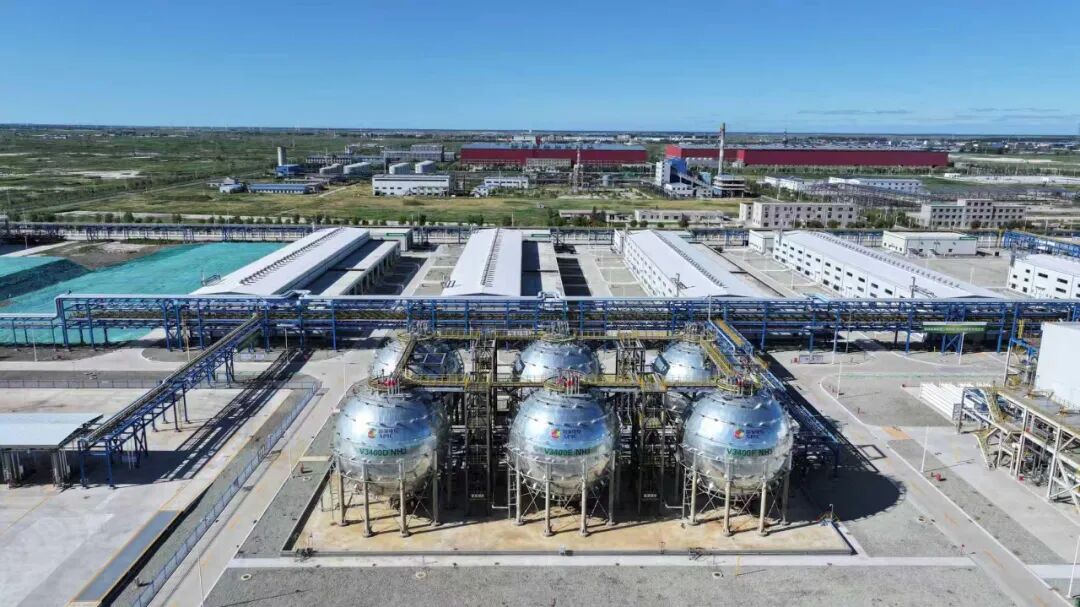
全球首张!我国项目获颁“非生物来源可再生燃料氨”国际认证
Ke Ji Ri Bao· 2025-11-01 08:07
Core Insights - The Jilin Da'an Wind-Solar Green Hydrogen Synthesis Ammonia Integrated Demonstration Project (Phase I) developed by State Power Investment Corporation has officially passed the International Sustainability and Carbon Certification System (ISCC EU) audit, receiving the world's first certification for "non-biological renewable fuel ammonia" [1][3] Group 1 - The "renewable" attribute of the certification indicates that the green ammonia produced by the project is entirely generated from renewable energy sources such as wind and solar power [3] - The "non-biological" designation differentiates this method from traditional ammonia production that utilizes biomass materials like straw and biogas, specifically referring to the industrial process of "wind-solar power generation - water electrolysis to produce hydrogen - hydrogen synthesis to produce ammonia" [3] - Green ammonia is becoming a key pathway for high-energy-consuming industries such as steel and chemicals to achieve deep decarbonization [3] Group 2 - The certification signifies that the green ammonia produced by the Da'an project has successfully obtained a "pass" to enter the international green ammonia market [3] - This achievement is expected to play a significant role in promoting the standardization and commercialization of global hydrogen energy and hydrogen-based energy [3]
中国企业驶入APEC市场新航道
Ke Ji Ri Bao· 2025-11-01 02:21
Group 1 - APEC's 32nd informal leaders' meeting was held in Gyeongju, South Korea, from October 31 to November 1, highlighting the increasing trade ties and expanding cooperation between China and other APEC members [1] - Zhejiang's total import and export value with other APEC economies reached 2.02 trillion yuan in the first three quarters of this year, marking a year-on-year increase of 3.8% [1] - Exports of electromechanical products from Zhejiang to APEC economies amounted to 654.68 billion yuan, growing by 4.0%, with automotive parts and "new three samples" products seeing increases of 6.1% and 15.8% respectively [2] Group 2 - Zhejiang Berteli Technology Co., Ltd. reported a staggering 1500-fold increase in exports to Singapore, attributed to optimized management practices in response to customs certification requirements [2] - Guangzhou Zhuofen Cosmetics Co., Ltd. exported nearly 100 million yuan worth of cosmetics to APEC countries such as Indonesia, Japan, and Malaysia, reflecting a year-on-year growth of 12% [3] - Guangzhou Customs reported an export value of 53.155 billion yuan to other APEC economies, with cosmetic exports reaching approximately 6 billion yuan, a significant increase of 37.5% [4]