
Zheng Quan Shi Bao

Search documents
600676,筹划重大资产置换!下周6股解禁市值高
Zheng Quan Shi Bao· 2026-01-10 00:38
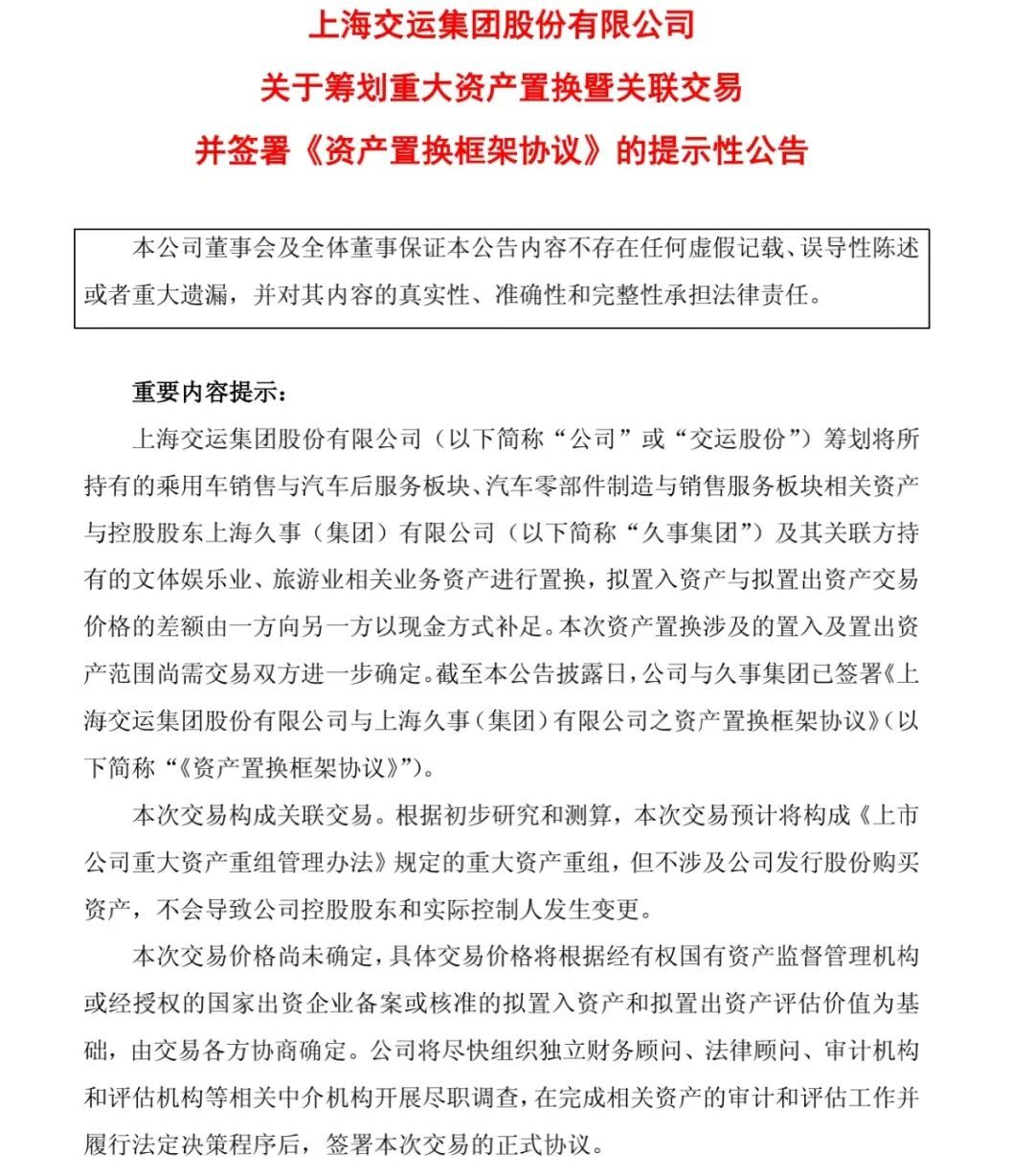
Group 1 - The core point of the news is that Jiaoyun Co., Ltd. is planning a significant asset swap involving its passenger car sales and automotive after-service segments with assets related to the cultural and entertainment industry held by its controlling shareholder, Jiushi Group, and its affiliates [1] - The transaction is expected to constitute a major asset restructuring, with the price difference between the assets to be settled in cash [1] - The transaction price has not yet been determined [1] Group 2 - On January 9, Jiaoyun Co., Ltd. closed at the daily limit, with a total market value of 6.983 billion yuan [2] - Next week, a total of 23 stocks will have their shares unlocked, amounting to 2.434 billion shares, with a total unlock market value of 48.556 billion yuan based on the latest closing prices [5] - Among the stocks with significant unlock pressure, Zhongke Lanyun is expected to have the highest unlock market value at 11.087 billion yuan, followed by Tianxin Pharmaceutical at 7.841 billion yuan [6][7]


隔夜美股拉升,黄金大涨
Zheng Quan Shi Bao· 2026-01-10 00:12
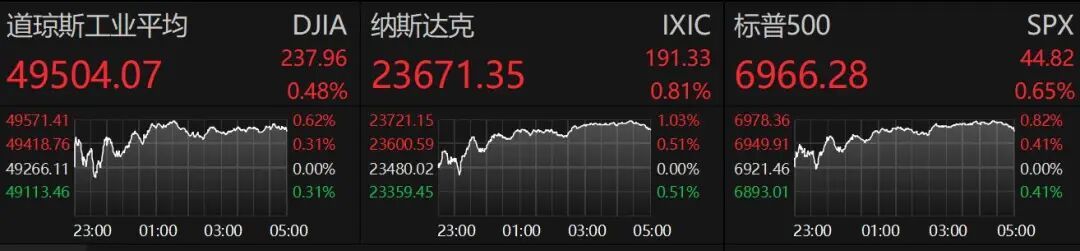
Group 1 - U.S. stock markets experienced a rally, with all three major indices closing higher; the Dow Jones and S&P 500 reached all-time closing highs [3] - Intel shares surged by 10.8% following a positive meeting between CEO Pat Gelsinger and former President Trump, who praised the investment as "very successful" [5] - Tesla rose over 2%, while Meta increased by more than 1%; Apple, Microsoft, Google, and Amazon saw slight gains, while Netflix and Nvidia experienced minor declines [5] Group 2 - International gold and silver prices saw significant increases, with COMEX gold futures rising by 1.29% to $4,518 per ounce, marking a weekly gain of 4.34%; COMEX silver futures jumped 5.92%, with a weekly increase of 12.07% [7] - International crude oil futures also rose, with WTI crude oil futures up 2.35% and Brent crude oil futures up 2.18% [9] - The U.S. non-farm payroll report indicated a slower but stable labor market, with employment increasing by 50,000, which may influence the Federal Reserve's decision on interest rate cuts later this year [9] Group 3 - Citigroup forecasts the Federal Reserve will cut rates by 25 basis points in March, July, and September, a shift from previous expectations of cuts in January, March, and September [10] - Morgan Stanley anticipates rate cuts of 25 basis points in June and September, revising earlier predictions of cuts in January and April [11] - The U.S. Supreme Court's potential ruling on the legality of tariffs imposed by the Trump administration is under scrutiny, which could impact trade policy and national fiscal conditions [11]

事关特朗普政府关税案!美最高法院:暂缓裁决
Zheng Quan Shi Bao· 2026-01-09 23:12
Core Viewpoint - The U.S. Supreme Court will not make a ruling on the Trump administration's tariff case on January 9, focusing on the legality of tariffs imposed under the International Emergency Economic Powers Act (IEEPA) and potential refunds to importers if deemed illegal [1] Group 1: Legal and Policy Implications - The Supreme Court's review centers on whether the Trump administration had the authority to impose tariffs under IEEPA and if the government must refund tariffs paid by importers if the tariffs are found illegal [1] - U.S. Treasury Secretary Scott Bansen emphasized the importance of maintaining tariff revenue levels, noting that an unfavorable ruling would limit the President's flexibility in using tariffs as negotiation tools, which could be detrimental to the American public [1] Group 2: Economic Impact - The actual effects of the tariff policy have diverged from initial analyst predictions, with limited impact on U.S. inflation but a significant reduction in trade deficits, which fell to the lowest level since the 2009 financial crisis by October 2025 [2] - The upcoming tariff ruling is expected to gradually reveal its effects on U.S. trade dynamics, fiscal health, and global economic interactions, warranting ongoing monitoring of policy adjustments and market responses [2]
泸州老窖,拟分红约20亿元
Zheng Quan Shi Bao· 2026-01-09 23:07
Group 1 - Luzhou Laojiao announced a mid-term profit distribution plan for 2025, proposing a cash dividend of 13.58 yuan per 10 shares, totaling approximately 2 billion yuan [1] - Kweichow Moutai's mid-term profit distribution plan for 2025 was approved, with a cash dividend of 23.957 yuan per share, amounting to a total distribution of 30 billion yuan [1] - The record date for Kweichow Moutai's dividend is December 18, 2025, with the payment date set for December 19, 2025 [1] Group 2 - Wuliangye announced its mid-term profit distribution plan for 2025, agreeing to a cash dividend of 25.78 yuan per 10 shares, totaling 10 billion yuan [2] - The record date for Wuliangye's dividend is December 17, 2025, with the payment date on December 18, 2025 [2] - Wuliangye will not issue bonus shares or increase capital from reserves in this distribution [2]

锂电回收行业迎来转机能源金属涨价推升“城市矿山”价值
Zheng Quan Shi Bao· 2026-01-09 23:02
Core Viewpoint - The lithium battery recycling industry is transitioning from extensive development to a new phase characterized by refinement, standardization, and globalization, driven by rising prices of lithium and cobalt, along with supportive policies [1][8]. Industry Overview - The lithium battery recycling sector is being recognized as a "urban mine," converting waste batteries into valuable, recyclable resources [1]. - A green circular market exceeding 100 billion yuan has emerged, reshaping the resource supply landscape in the new energy industry [1]. Profitability and Market Dynamics - The profitability of lithium battery recycling businesses has improved significantly due to increased retirement volumes and rising prices of lithium and cobalt [2]. - The price surge of energy metals has shifted the profit model from relying on subsidies to focusing on the intrinsic value of recycled materials, expanding profit margins for companies [2][3]. Policy Developments - New regulations have eased the import of recycled materials, allowing certain types of black powder to be imported without being classified as solid waste, thus facilitating the global resource allocation for China's battery recycling industry [2][3]. Capacity Expansion and Capital Operations - Leading companies are adopting a dual strategy of capacity expansion and capital operations to seize market opportunities, including new base construction and technology partnerships [4][6]. - Companies like Greeenme and Tianqi are actively pursuing acquisitions and financing to enhance their operational capabilities and market presence [4][5][6]. Technological Advancements and Industry Collaboration - The industry is evolving from merely end-of-life disposal to playing a crucial role in the entire battery lifecycle, with companies establishing comprehensive value chains [7]. - Greenme has achieved a lithium recovery rate exceeding 96.5% and has formed partnerships with over 1,000 automotive and battery manufacturers to create a closed-loop supply chain [7]. Market Outlook - The lithium battery recycling market is expected to grow at an annual rate exceeding 50% over the next 3 to 5 years, with the domestic market projected to surpass 100 billion yuan by 2030 [8].


国家将开展外卖行业市场竞争状况调查三大平台积极回应并呼吁公平竞争
Zheng Quan Shi Bao· 2026-01-09 22:58
Core Viewpoint - The State Administration for Market Regulation has initiated an investigation into the competitive landscape of the food delivery platform service industry in China, aiming to address issues of irrational competition, such as price wars and excessive subsidies, which have negatively impacted the real economy and intensified "involution" within the industry [1] Group 1: Investigation and Regulatory Actions - The investigation will utilize methods such as on-site verification, face-to-face interviews, and surveys to gather comprehensive insights into competitive behaviors within the food delivery platforms [1] - The goal is to promote lawful and compliant operations among food delivery platforms, ensuring fair competition and a healthy market order [1] Group 2: Responses from Major Food Delivery Platforms - Meituan expressed strong support for the investigation and emphasized the need for rational competition, advocating for a return to responsible market practices [2] - Taobao Shanguo welcomed the investigation and committed to cooperating fully, highlighting the importance of fair competition as a core principle of the market economy [2] - JD Delivery also supported the decision, focusing on resisting "involution" and promoting high-quality development through supply chain innovations [2] Group 3: Financial Impact and Industry Challenges - The intense competition has led to significant financial losses for major platforms, with Meituan reporting an adjusted net loss of 16 billion yuan in Q3 2025, compared to a profit of 12.8 billion yuan in the same period last year [3] - Alibaba's net profit for the same period fell by 52% to 20.99 billion yuan, while JD's net profit decreased by 55% to 5.3 billion yuan [3] - The high subsidy costs have created a vicious cycle affecting the quality of food services, as restaurants face pressure to lower quality to maintain profitability [3][4] Group 4: Underlying Issues of Subsidy Mechanisms - There is a need to scrutinize the subsidy cost transfer mechanisms, questioning whether the platforms or the merchants bear the burden of these costs [4] - Platforms may impose hidden costs on merchants through algorithms that dictate pricing and traffic distribution, leading to a situation where merchants must subsidize their own promotions [5]


瑞纳智能设备股份有限公司 第三届董事会第十八次会议决议的公告
Zheng Quan Shi Bao· 2026-01-09 18:01
Group 1 - The company held its 18th meeting of the 3rd Board of Directors on January 9, 2026, with all 9 directors present, meeting the legal requirements for the meeting [1] - The Board approved a proposal to invest approximately 169.9 million yuan in the construction of a modern intelligent and efficient heat pump R&D and production base in Changfeng County, Hefei, Anhui [2] - The new facility is expected to have an annual production capacity of about 9,135 units of standard intelligent and efficient heat pump units upon completion [2] Group 2 - The strategic committee of the Board also approved the investment proposal [3] - The voting results showed unanimous support with 9 votes in favor, 0 against, and 0 abstentions [4] - Relevant documents, including the resolutions from the strategic committee and the Board meeting, are available for review [5]
A股硬科技企业 赴港“二次上市”潮涌
Zheng Quan Shi Bao· 2026-01-09 17:51
Group 1 - A-share hard technology companies are experiencing a wave of "secondary listings" in Hong Kong, with 19 companies expected to list by 2025, indicating a push towards global development and the activation of a new A+H ecosystem [1][2] - The A-share market has established a cluster effect for hard technology enterprises, with the STAR Market and ChiNext serving as important breeding grounds, while the Hong Kong market has seen rapid growth in the hard technology sector, establishing a new valuation logic [2][3] - A-share companies generally enjoy a premium over their H-share counterparts, with premium rates ranging from 40% to 110%, particularly in sectors like AI and semiconductors [2] Group 2 - Recent A-share hard technology leaders, such as Lanqi Technology and Zhaoyi Innovation, are initiating their listing processes in Hong Kong, with Lanqi Technology planning to raise up to $1 billion for R&D and strategic investments [3] - MiniMax, a leading AI model company, successfully listed on the Hong Kong Stock Exchange, raising over HKD 4.8 billion with a subscription rate of 1837.17 times for public offerings, and its stock price increased by 109.09% on the first day [4] - The semiconductor company Biran Technology became the first domestic GPU stock in Hong Kong, achieving the largest fundraising scale since the implementation of new listing rules [5] Group 3 - The pipeline of hard technology companies preparing for Hong Kong listings is expanding, with companies like Kunlun Core and Chipmike Semiconductor nearing their listing processes, which will inject new vitality into the Hong Kong market [7] - Institutions and brokerages are optimistic about the trend of hard technology companies listing in Hong Kong, with Goldman Sachs predicting significant growth in MSCI China and CSI 300 indices, driven by corporate earnings and supportive policies [8]
苏州高新子公司拟设合资公司 开发运营新能源项目
Zheng Quan Shi Bao· 2026-01-09 17:48
在新兴产业运营业务领域,绿色低碳也是主要方向。2025年上半年,苏州高新签约光储项目23.65兆 瓦,同比增长118%。绿碳公司已累计并网及在建光伏储能项目56个,装机容量超75兆瓦,2025年上半 年发电量1668.90万度,同比增长64%。在绿电交易方面,2025年上半年完成电量签约及续约44亿千瓦 时,同比增长12.8%;绿电绿证交易量突破1亿千瓦时,已超2024年全年总额,同比增长120%;带动区 内企业减少碳排放、履行可再生能源配额义务,合计减少碳排放7.5万吨。 在实业投资之外,苏州高新以资本链赋能产业链,积极布局高端装备、AI、半导体、芯片等新兴产 业,形成与产业园运营高度协同的产业储备,以投资促转型。目前,公司已形成战略投资、产业投资、 定增投资三大模式。截至2025年末,公司存量投资项目累计出资金额超55亿元,产业投资规模持续增 长。 近日,苏州高新被频繁问及是否在商业航天板块有所布局。据透露,苏州高新子公司苏州东菱振动试验 仪器有限公司(以下简称"东菱振动")主要从事力学环境及试验设备的供应和测试服务,提供试验装备 研发、制造、安装测试和减振等技术服务,业务涉及航空航天、汽车交通等多个领域 ...

间接控股股东筹划重大事项 德邦股份继续停牌
Zheng Quan Shi Bao· 2026-01-09 17:48
Group 1 - The core point of the news is that Debon Logistics (德邦股份) announced a continued suspension of its stock trading due to uncertainties related to significant matters being planned by its indirect controlling shareholder, JD Zhaofeng Enterprise Management Co., Ltd. [1] - The company has been in collaboration with JD Logistics, and there are speculations that the ongoing significant matters may involve further deepening of this partnership and optimizing business layout [1][2] - Debon Logistics reported total assets of 16.141 billion yuan and total liabilities of 8.088 billion yuan, with a net profit attributable to shareholders of -277 million yuan for the first three quarters of 2025 [2] Group 2 - The logistics industry is experiencing intensified competition, with leading companies enhancing their core competitiveness through resource integration and business collaboration [2] - In 2025, the logistics industry's market scale is expected to continue expanding, with a logistics industry prosperity index averaging 50.8%, indicating sustained resilience in industry operations [3] - There is a notable industry differentiation, with 35 A-share logistics companies reporting profits while 8 faced losses due to intensified market competition and high operational costs [3]
