Zheng Quan Shi Bao

Search documents
300059、601899,放量狂飙
Zheng Quan Shi Bao· 2026-01-06 11:09
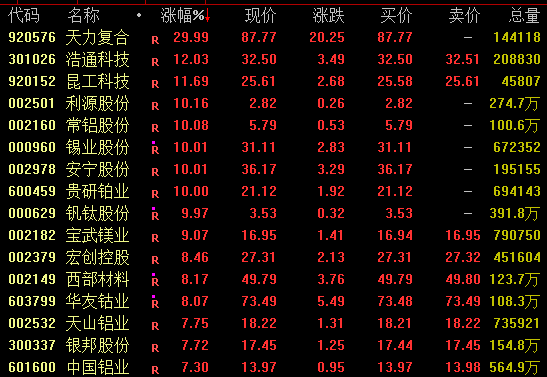
Market Overview - A-shares continued to rise strongly, with the Shanghai Composite Index achieving a 13-day winning streak and reaching a 10-year high, closing at 4083.67 points, up 1.5% [1] - The total trading volume in the A-share market exceeded 2.8 trillion yuan, with over 4100 stocks gaining, and more than 140 stocks hitting the daily limit [1] Sector Performance - The insurance and brokerage sectors led the market rally, with New China Life Insurance and China Pacific Insurance both rising over 5% to new highs [2][3] - The brokerage sector saw significant gains, with Huayin Securities and Huaan Securities both hitting the daily limit, and Dongfang Caifu rising nearly 6% [2][3] - The non-ferrous metals sector experienced a collective surge, with stocks like Chang Aluminum and Xiyang Co. hitting the daily limit, and Zijin Mining rising over 6% to a historical high [2][5] Financial Sector Insights - The insurance sector's performance is driven by stable interest rates, with the 10-year government bond yield exceeding 1.8%, supporting the valuation recovery of listed insurance companies [3] - Institutions are optimistic about the insurance sector's growth, particularly in life insurance and non-auto insurance segments, which are expected to see significant profit growth [3] - The brokerage sector is anticipated to benefit from a favorable regulatory environment, with expectations for improved profitability in investment banking, public funds, and overseas business [3][4] Emerging Concepts - The autonomous driving sector showed strong performance, with stocks like Hanxin Technology and Wanjie Technology hitting the daily limit, indicating growing investor interest [7] - Nvidia's release of the Alpamayo series AI models is expected to accelerate the development of next-generation autonomous driving technologies, potentially boosting demand for self-driving taxis [9]






10年新高!转债市场火了
Zheng Quan Shi Bao· 2026-01-06 11:06
Core Viewpoint - The China Convertible Bond Index has reached a new high not seen in over a decade, reflecting its unique value in the volatile equity market, characterized by both offensive and defensive capabilities [1][2]. Group 1: Market Performance - On January 6, the China Convertible Bond Index surged by 1.35% to 505.77 points, marking the highest level since June 2015 [2]. - The recent performance of the index has been strong since 2025, highlighting its resilience amid fluctuations in the equity market [1][2]. - The strong performance of convertible bonds is closely linked to the performance of underlying stocks, with the index showing a rise of 18.66% in 2025, slightly outperforming the Shanghai Composite Index's 18.41% increase [5]. Group 2: Key Drivers - The core catalyst for the current market rally is the commercialization breakthrough in the brain-computer interface industry, with significant announcements from companies like Neuralink [3]. - Domestic policy support has intensified, with regulatory bodies accelerating the approval processes for related medical devices [3]. - Notable convertible bonds such as the Seli Convertible Bond have seen substantial gains, driven by the strong performance of their underlying stock, Seli Medical, which has been favored due to its advancements in AI and medical data [2][3]. Group 3: Market Trends and Analysis - Analysts have identified two main characteristics of the current convertible bond rally: the clear influence of underlying stock performance and the concentration of investment in high-growth sectors such as brain-computer interfaces and AI healthcare [3]. - The convertible bond market is experiencing a structural rally, with several bonds showing gains exceeding 10% [3]. - The market sentiment is expected to improve further due to seasonal capital inflows and policy expectations, potentially leading to a "spring rally" in the A-share and convertible bond markets [7].
揭秘涨停 | 脑机接口热门股封单超22亿元
Zheng Quan Shi Bao· 2026-01-06 10:04
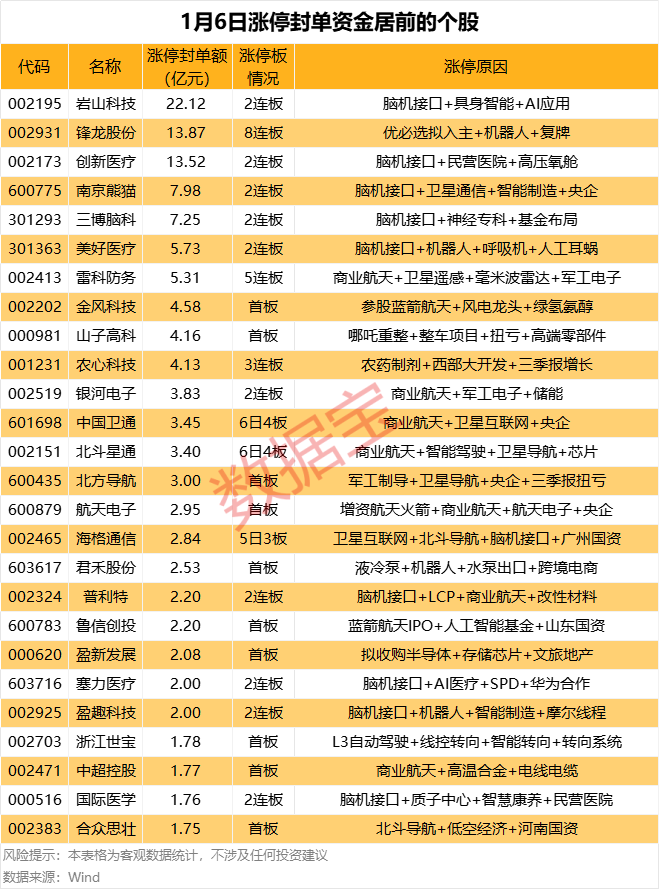
截至收盘,上证指数报收4083.67点,上涨1.50%;深证成指收于14022.55点,上涨1.40%。创业板指上 涨0.75%;科创50指数上涨1.84%。 不含未开板新股,今日(1月6日)可交易A股中,上涨个股超4100只,占比超75%,下跌个股有1222 只。其中,收盘封死涨停的有144只,30股封板未遂,整体封板率为82.76%。 | 代码 | 名称 | 涨停封单额 | 涨停板 | 涨停原因 | | --- | --- | --- | --- | --- | | | | (亿元) | 情況 | | | 002195 岩山科技 | | 22.12 | 2连板 | 脑机接口+具身智能+AI应用 | | 002931 | 锋龙股份 | 13.87 | 8连板 | 优必选拟入主+机器人+复牌 | | 002173 | 创新医疗 | 13.52 | 2连板 | 脑机接口+民营医院+高压氧舱 | | 600775 | 南京龍猫 | 7.98 | 2连板 | 脑机接口+卫星通信+智能制造+央企 | | 301293 | 一博脑科 | 7.25 | 2连板 | 脑机接口+神经专科+基金布局 | | 301363 | ...



基础化工行业资金流入榜:君正集团、万华化学等净流入资金居前
Zheng Quan Shi Bao· 2026-01-06 10:00
Market Overview - The Shanghai Composite Index rose by 1.50% on January 6, with 30 industries experiencing gains, led by non-ferrous metals and non-bank financials, which increased by 4.26% and 3.73% respectively [1] - The basic chemical industry ranked third in terms of daily gains [1] - The communication industry saw the largest decline, dropping by 0.77% [1] Capital Flow Analysis - The main capital flow showed a net outflow of 1.033 billion yuan across both markets, with 17 industries experiencing net inflows [1] - The non-bank financial sector had the highest net inflow of 6.961 billion yuan, coinciding with its 3.73% increase [1] - The non-ferrous metals sector followed with a net inflow of 5.885 billion yuan and a daily increase of 4.26% [1] - Conversely, 14 industries faced net outflows, with the communication sector leading at a net outflow of 10.507 billion yuan, followed by the media sector with 4.144 billion yuan [1] Basic Chemical Industry Performance - The basic chemical industry increased by 3.12% with a net inflow of 0.954 billion yuan, comprising 408 stocks, of which 314 rose and 82 fell [2] - Notably, 18 stocks hit the daily limit up, while 205 stocks experienced net inflows, with 10 stocks seeing inflows exceeding 0.1 billion yuan [2] - The top three stocks by net inflow were Junzheng Group (0.419 billion yuan), Wanhua Chemical (0.307 billion yuan), and Zhongtai Chemical (0.205 billion yuan) [2] Top Gainers in Basic Chemical Industry - Junzheng Group: +9.48%, turnover rate 4.89%, net inflow 41.861 million yuan [3] - Wanhua Chemical: +7.27%, turnover rate 1.87%, net inflow 30.681 million yuan [3] - Zhongtai Chemical: +9.94%, turnover rate 4.15%, net inflow 20.513 million yuan [3] Top Losers in Basic Chemical Industry - Yilong Shares: +4.49%, turnover rate 4.05%, net outflow -46.719 million yuan [4] - Dongcai Technology: -2.86%, turnover rate 9.07%, net outflow -38.330 million yuan [4] - Guofeng New Materials: +1.62%, turnover rate 23.78%, net outflow -18.762 million yuan [4]



主力资金 | 尾盘主力资金大幅出逃2股
Zheng Quan Shi Bao· 2026-01-06 09:59
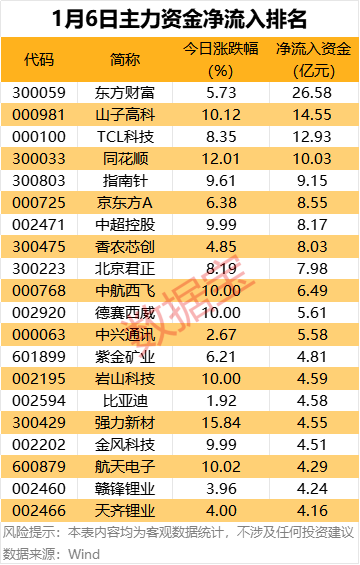
Core Viewpoint - The A-share market continues to show strong performance, with the Shanghai Composite Index achieving a 13-day winning streak, reaching its highest level since July 2015. However, there was a net outflow of main funds totaling 17.668 billion yuan across the market [2]. Group 1: Industry Performance - All major industry sectors saw gains, with notable increases in insurance, energy metals, chemical fertilizers, securities, and small metals. The beauty and personal care sector was the only one to decline [2]. - Among the 13 industries with net inflows, non-ferrous metals, non-bank financials, automotive, and computer sectors had net inflows of 3.423 billion yuan, 2.185 billion yuan, 1.477 billion yuan, and 1.064 billion yuan respectively. Other sectors like banking, oil and petrochemicals, electronics, and public utilities also saw inflows exceeding 100 million yuan [2]. Group 2: Individual Stock Performance - A total of 54 stocks experienced net inflows exceeding 200 million yuan, with 10 stocks seeing inflows over 600 million yuan. Notably, Dongfang Caifu had a net inflow of 2.658 billion yuan, while Shanzhi Gaoke saw 1.455 billion yuan [3][4]. - The top stocks with significant net inflows included: - Dongfang Caifu: 5.73% increase, 2.658 billion yuan net inflow - Shanzhi Gaoke: 10.12% increase, 1.455 billion yuan net inflow - TCL Technology: 8.35% increase, 1.293 billion yuan net inflow - Tonghuashun: 12.01% increase, 1.003 billion yuan net inflow - Zhinan Zhen: 9.61% increase, 915 million yuan net inflow [4]. Group 3: Net Outflow Analysis - A total of 63 stocks experienced net outflows exceeding 200 million yuan, with notable outflows from Zhongji Xuchuang, Xinyi Sheng, and Tianji Shares, each exceeding 1 billion yuan [5][6]. - The stocks with the highest net outflows included: - Zhongji Xuchuang: -2.93% change, 2.647 billion yuan net outflow - Xinyi Sheng: -2.13% change, 2.277 billion yuan net outflow - Tianji Shares: 0.35% change, 1.281 billion yuan net outflow [6]. Group 4: Tail-End Fund Movement - At the end of the trading day, the main funds saw a net inflow of 1.805 billion yuan, with significant inflows in the computer, non-bank financial, and national defense industries, each exceeding 400 million yuan [7]. - Individual stocks with notable tail-end inflows included: - Dongfang Caifu: 5.73% increase, 508.907 million yuan net inflow - Liou Shares: 6.94% increase, 271.545 million yuan net inflow - Tonghuashun: 12.01% increase, 233.563 million yuan net inflow [8].




商业航天,资金加仓+机构密集调研,仅9股
Zheng Quan Shi Bao· 2026-01-06 09:58
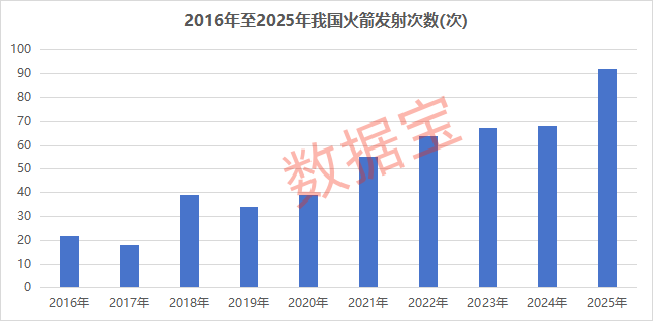
Group 1 - The commercial aerospace sector remains a hot topic in the capital market, with the Wande Commercial Aerospace Theme Index achieving an 8-day consecutive rise and a cumulative increase of over 35% since December 24, 2025 [1][8] - In 2025, China achieved a record high in rocket launches, totaling 92, which is over a 30% increase compared to 2024, indicating a new phase of "normalization, high frequency, and large scale" in China's launch capabilities [2] - The IPO progress in the capital market includes the acceptance of Blue Arrow Aerospace's IPO and the approval of the registration for the Electric Science and Technology Blue Sky on the Sci-Tech Innovation Board [4] Group 2 - The development of reusable rocket technology is accelerating, significantly reducing launch costs and improving response efficiency for launch missions. Current costs for some reusable rockets are around $67 million, with potential reductions to between $2 million and $5 million as technology advances [5] - The application of reusable rocket technology is expected to lower the cost of satellite constellation networking in China by over 70%, supporting the demand for high-frequency constellation deployment [6] - A comparison of domestic and international reusable rockets shows varying payload capacities and costs, with SpaceX's Falcon 9 having a launch cost below $1,000 per kilogram, while Blue Arrow's Zhuque-3 costs approximately $4,200 per kilogram [7] Group 3 - As of January 6, 2026, the total financing balance for 30 stocks related to reusable technology in the A-share market reached nearly 29.9 billion yuan, an increase of over 65% since the third quarter of 2025 [9] - Nine stocks that received over 30% increase in financing and were researched by more than ten institutions since the fourth quarter of last year include companies like Rigol Navigation and Srey New Materials [10] - Notable companies such as Jili Rigging and Aerospace Electric have provided products supporting domestic reusable rockets, contributing to their stock performance with significant increases since December 24, 2025 [8][10]
黄仁勋,重磅发声!
Zheng Quan Shi Bao· 2026-01-06 08:56
Core Insights - Huang Renxun stated that the "ChatGPT moment of physical AI" is approaching, highlighting a significant transformation in the computing industry driven by AI advancements [1][2]. Group 1: Industry Transformation - The computing industry is undergoing a historic transformation every 10-15 years, characterized by a "dual platform shift" where applications are built on AI, and the core computation is shifting from CPU to GPU [2]. - Approximately $10 trillion of global computing infrastructure is transitioning towards AI, with billions of dollars in venture capital flowing into the AI sector [2]. Group 2: Technological Breakthroughs - The Vera Rubin AI supercomputer was launched to address the exponential growth in AI model size and inference token requirements, featuring a design that integrates six custom chips and significantly enhances performance [3]. - The open model ecosystem is rapidly expanding, with models like DeepSeek R1 gaining traction and NVIDIA providing open-source tools to empower global enterprises and research institutions [3]. - Agentic systems, capable of reasoning and planning, are expected to be fully adopted by 2025, transforming software programming methodologies [3]. - The Cosmos foundational model, which can understand physical laws and generate realistic simulation data, is positioned as a key support for robotics and autonomous driving [3]. - The Alpamayo autonomous driving AI has achieved "thinking driving," utilizing end-to-end training to make autonomous decisions and explain actions clearly [3]. Group 3: Industry Collaboration - NVIDIA announced strategic partnerships with Siemens, Palantir, and others to integrate AI into various industrial processes, addressing labor shortages and enhancing automation [4]. - The AI ecosystem now encompasses a wide range of robotics applications, from consumer to industrial robots, all built on NVIDIA's Jetson platform [4]. Group 4: Open Access and Participation - NVIDIA aims to create a full-stack AI platform that allows every enterprise and individual to participate in the AI revolution, providing comprehensive tools for data processing, model training, and deployment [5]. - The introduction of a "blueprint" framework enables developers to easily create customized AI assistants, balancing privacy and functionality [5]. - The future is projected to see widespread adoption of autonomous vehicles, physical AI robots, and AI-driven smart industries, with NVIDIA committed to driving this technological revolution [5].

易会满被中纪委机关报点名
Zheng Quan Shi Bao· 2026-01-06 08:33
Core Viewpoint - The article emphasizes the ongoing commitment of the Central Commission for Discipline Inspection (CCDI) and the National Supervisory Commission to combat corruption through a multi-faceted approach, aiming to eliminate the conditions that foster corruption by 2025 [1][2][3]. Group 1: Anti-Corruption Measures - In 2025, the CCDI and National Supervisory Commission will continue to publish information on investigations and disciplinary actions, with 65 senior officials reported to be under investigation throughout the year [1][3]. - The CCDI and local supervisory bodies are focusing on key issues, areas, and individuals, particularly targeting systemic corruption risks [3][4]. - High-pressure tactics will be maintained to deter corruption, with a focus on political discipline as the most fundamental aspect of governance [3][4]. Group 2: Focus Areas and Targets - The CCDI is intensifying efforts to address corruption in critical sectors such as finance, state-owned enterprises, energy, and construction, aiming for breakthroughs that will drive overall progress [4][5]. - Specific cases involving senior officials, including Jiang Chaoliang and Yi Huiman, are under investigation, highlighting the focus on the "key minority" within the party [5][6]. - The CCDI is enhancing its toolkit to tackle new and hidden forms of corruption, including the issuance of guidelines for investigating these issues [6][8]. Group 3: Cultural and Systemic Reforms - The article discusses the importance of strengthening a culture of integrity among party members to resist corruption, with initiatives planned for 2025-2027 to promote clean governance [10][11]. - The CCDI is implementing reforms to improve the regulatory framework governing power distribution and oversight, aiming to prevent corruption at its roots [8][9]. - Emphasis is placed on the integration of digital tools in anti-corruption efforts, enhancing the effectiveness of monitoring and enforcement [9][10].
A股新纪录!沪指日线13连阳 创出该指数史上最长连阳纪录
Zheng Quan Shi Bao· 2026-01-06 07:50
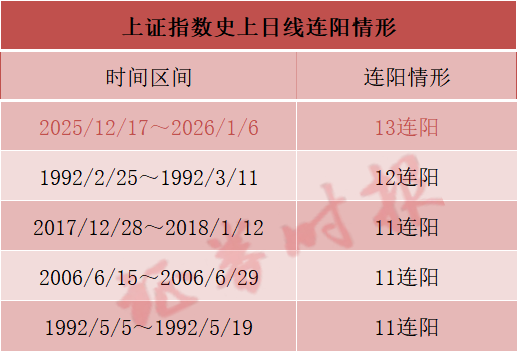
(原标题:A股新纪录!沪指日线13连阳 创出该指数史上最长连阳纪录) 见证历史! 数据显示,上证指数历史上实现10连阳以上的情形并不多,上世纪90年代因年代久远,参考意义相对较 弱。 从本世纪的情形来看,在上证指数长时间连阳后,后续市场走势仍存在较大不确定性,历史走势数据分 化较大,且与当时的时空背景有一定关系。 比如,进入本世纪以来,上证指数曾在2006年6月15日至2006年6月29日期间实现11连阳,上证指数在这 一时间段累计上涨9.16%。资料显示,在上述11连阳后,上证指数逼近1700点,这一连阳的时间段成为 当时牛市行情的上涨中继。此后一年多时间里A股市场涨势凌厉,上证指数继续上涨超过两倍,直到 2007年10月突破6000点大关。 2017年12月28日至2018年1月12日期间,上证指数再度实现11连阳,累计涨幅为4.68%,上证指数随之 向上突破了3400点。但不久之后,上证指数陷入调整状态,至2019年1月一度跌破2500点。 1月6日,上证指数收盘大涨1.5%,再度收出阳线,实现日线13连阳,创出该指数史上最长连阳纪录。 在此之前的1992年2月25日至1992年3月11日期间,上证指数 ...
见证历史,A股新纪录
Zheng Quan Shi Bao· 2026-01-06 07:45
见证历史! 1月6日,上证指数收盘大涨1.5%,再度收出阳线,实现日线13连阳,创出该指数史上最长连阳纪录。 从本世纪的情形来看,在上证指数长时间连阳后,后续市场走势仍存在较大不确定性,历史走势数据分 化较大,且与当时的时空背景有一定关系。 比如,进入本世纪以来,上证指数曾在2006年6月15日至2006年6月29日期间实现11连阳,上证指数在这 一时间段累计上涨9.16%。资料显示,在上述11连阳后,上证指数逼近1700点,这一连阳的时间段成为 当时牛市行情的上涨中继。此后一年多时间里A股市场涨势凌厉,上证指数继续上涨超过两倍,直到 2007年10月突破6000点大关。 | 上证指数史上日线连阳情形 | | | --- | --- | | 时间区间 | 连阳情形 | | 2025/12/17~2026/1/6 | 13连阳 | | 1992/2/25~1992/3/11 | 12连阳 | | 2017/12/28~2018/1/12 | 11连阳 | | 2006/6/15~2006/6/29 | 11连阳 | | 1992/5/5~1992/5/19 | 11连阳 | 2017年12月28日至2018年1 ...