
Xin Hua Cai Jing

Search documents
山西电网用电负荷创新高 最高达4469.4万千瓦
Xin Hua Cai Jing· 2026-01-23 08:11
Core Viewpoint - The State Grid Shanxi Electric Power Company has successfully managed to meet the record-high electricity demand of 44.694 million kilowatts during a cold wave, ensuring stable and reliable power supply for winter heating needs [1][2]. Group 1: Electricity Demand and Supply - On January 21, the maximum electricity load in the Shanxi power grid reached a historical high of 44.694 million kilowatts [1]. - The company has implemented multiple measures to ensure the power supply meets the heating demands of the population during the cold wave [1]. Group 2: Infrastructure and Capacity Enhancement - The company has launched 16 key projects to enhance winter peak supply capacity, increasing the power supply capability of the Shanxi grid by approximately 3 million kilowatts [1]. - To improve disaster prevention and resistance capabilities, the company has upgraded 97 transmission lines in micro-topography areas and installed 437 ice monitoring devices on 315 lines [2]. Group 3: Operational Measures and Technology Utilization - The company deployed over 1,000 personnel, 351 vehicles, and 126 drones to patrol 2,300 kilometers of transmission lines during the cold wave response [2]. - Various methods such as direct current ice melting vehicles and drones equipped with ice-breaking tools were utilized to ensure the safe and stable operation of the power grid [1][2].
黄金时间·每日论金:金价5000美元技术目标即将实现
Xin Hua Cai Jing· 2026-01-23 08:02
Group 1 - Gold and silver prices have surged significantly in recent days, with gold opening at $4831.25 and closing at $4935.96 on January 23, marking an increase of $102.56 or 2.12% [1] - Gold prices have broken through last year's high of $4550 and are now in an accelerated upward trend, with a technical target of $5000 becoming increasingly realistic [1] - The geopolitical landscape, including ongoing conflicts and challenges to U.S. government policies, has heightened the appeal of gold as a safe-haven asset, leading to its increased market value surpassing that of major tech companies like Nvidia [1] Group 2 - Technically, after breaking the $4550 high, gold prices have recently experienced a strong upward movement, with conservative targets pointing to $4825, and are now close to the psychological barrier of $5000 [2] - Gold has successfully crossed the resistance zone of $4852-$4937, with $4895 and $4852 now serving as key support levels; the price is currently operating above the upper Bollinger Band, indicating a strong upward trend [2] - The strong bullish pattern is expected to continue as long as gold prices hold above the support levels of $4895 and $4852, although volatility near the $5000 mark is anticipated [2]
【环球财经】日本央行维持利率水平不变 上调2026财年通胀预期
Xin Hua Cai Jing· 2026-01-23 07:55
新华财经东京1月23日电 日本央行23日在结束为期两天的货币政策会议后宣布,维持现行利率水平不 变,将2026财年(2026年4月至2027年3月)通胀预期由1.8%上调至1.9%。 (文章来源:新华财经) 日本央行当天发表公告说,央行决定在下次议息会之前将政策利率(无担保隔夜拆借利率)保持在 0.75%左右。公告显示,出席货币政策会议的9名央行审议委员意见出现分歧,审议委员高田创加息至 1.0%的提议遭到其他8名审议委员的否决。 日本央行当天同时发表经济与物价形势展望报告,将2025财年日本经济增长预期上调至0.9%,2026财 年预计经济增幅为1.0%。 关于日本物价形势,央行认为,2026年上半年随着大米等食品价格回落,物价涨幅或回落至2%以下, 全年来看物价仍将呈缓慢上涨态势。央行继续将2025财年通胀预期维持在2.7%,同时将2026财年通胀 预期由1.8%上调至1.9%。 由于日本首相高市早苗为了赢得即将举行的众议院选举近日再次释放减税信号,导致日本债市汇市出现 剧烈震荡,日元急剧走软,长期利率大幅上扬。当天,市场高度关注日本央行行长植田和男在记者会上 的表态,日本央行是否被迫放缓货币政策正常化步 ...
英国零售销售数据好于预期 黄金白银需求增加
Xin Hua Cai Jing· 2026-01-23 07:33
Core Viewpoint - UK retail sales showed a rebound during the key holiday season, with consumer confidence seemingly boosted by the Labour government's budget announcement in November last year [1] Group 1: Retail Sales Performance - In December, the seasonally adjusted retail sales in the UK recorded a month-on-month increase of 0.4%, ending a two-month decline [1] - This performance exceeded economists' expectations, who had predicted sales would remain flat for the month [1] Group 2: Government Budget Impact - The budget announced by UK Chancellor Reeves on November 26 included tax increases, but most measures were not as severe as anticipated and will take effect later in Parliament [1] Group 3: Online Retail Trends - Online retail, particularly in jewelry, performed strongly in December, indicating higher demand for gold and silver [1]
资管一线 | 聚焦结构性行情,银河基金五位基金经理拆解医药、周期、光伏等核心赛道机遇
Xin Hua Cai Jing· 2026-01-23 07:33
Group 1: Market Overview - The structural characteristics of the A-share market in 2026 are becoming increasingly distinct, with changes in sector rotation and investment logic shifting from broad allocation to selective stock picking [1] - Key investment opportunities in 2026 include left-side positioning in the pharmaceutical and cyclical sectors, exploration of new tracks in renewable energy and technology, and the realization of AI applications in media [1] Group 2: Pharmaceutical Sector - The pharmaceutical sector is expected to experience a mild rebound, with upcoming 2025 annual reports and 2026 Q1 reports serving as critical windows to validate the industry's recovery pace [2] - Focus areas include contract research organizations (CROs) and medical devices, particularly those with strong technological attributes and competitive R&D expense ratios [2] - The brain-computer interface field is highlighted as a promising area for future growth, with potential applications expected to emerge as market sentiment stabilizes [2] Group 3: Cyclical Sector - The cyclical industry is likely to show significant differentiation, with opportunities in precious metals and high-quality chemicals [3] - Precious metals, particularly silver, are expected to gain investment value if the gold bull market continues, while small metals related to AI and renewable energy may also present opportunities [3] - The chemical sector is currently at a bottoming phase, with expectations for price recovery, and stock selection should focus on industries with favorable competitive dynamics and new growth points [3] Group 4: Renewable Energy Sector - The lithium battery sector is anticipated to wait for quarterly report catalysts, while space photovoltaic and grid export sectors may open new growth avenues [5] - Space photovoltaic has significant market potential, with domestic companies expected to capture market share due to China's competitive advantage in the global photovoltaic industry [6] - The grid export sector is entering a performance realization phase, particularly for companies targeting the North American market, with expectations for order volume to increase this year [6] Group 5: AI and Media Sector - 2026 is expected to be a pivotal year for the realization of AI applications, with the media sector poised to benefit significantly [7] - Key focus areas include AI in marketing and multi-modal content generation, with the potential for substantial market growth in the video content sector [7][8] - The media sector's AI application market is expected to experience continuous upward movement, driven by competition among major internet companies and advancements in multi-modal technology [8] Group 6: Technology Sector - The AI industry is projected to evolve over the next 3-5 years, with a shift towards commercializing AI applications [9] - The robotics sector should focus on companies achieving performance milestones and those with potential to penetrate core supply chains [9]
【财经分析】白银创新高后带火“熊猫银币” 买币卖币有哪些“坑”要避
Xin Hua Cai Jing· 2026-01-23 07:32
Core Viewpoint - The price of silver has been on an upward trend since 2026, reaching historical highs, which has significantly increased market demand for investment and collection of silver products [1][2]. Group 1: Silver Price Trends - As of January 23, 2026, spot silver prices have surpassed $99 per ounce, with a year-to-date increase of over 37% [1]. - The main silver futures contract in Shanghai has also broken through the 25,000 yuan per kilogram mark, setting new historical records [1]. - The surge in silver prices has led to a notable increase in customer traffic and transaction volume in markets dealing with silver coins and collectibles [1][2]. Group 2: Market Dynamics - Major banks, including Industrial and Agricultural Banks, are experiencing temporary shortages of silver products due to increased demand driven by rising silver prices [2]. - The frequency of transactions for physical silver products, such as silver coins and bars, has significantly increased in both the collection market and trading platforms [2]. - The investment attributes of silver coins, particularly the Panda silver coin, are influenced by both the price of silver and their collectible value, which can lead to confusion among investors [2][3]. Group 3: Investment Characteristics - The Panda silver coin has seen a price increase from approximately 200 yuan at the beginning of 2025 to 715 yuan by January 22, 2026, representing a cumulative increase of 257% [3]. - Younger investors tend to focus on the price alignment with silver prices, preferring lower premium coins, while older consumers often prioritize long-term collection [4][6]. - The dual attributes of the Panda silver coin—its value as a precious metal and its collectible nature—create complexities in investment decisions [6][8]. Group 4: Investment Strategies and Risks - Investors are advised to prioritize silver products with a strong alignment to silver prices and to be cautious of high premiums associated with collectible items [6][8]. - The market for silver coins is characterized by significant volatility, with prices influenced by both silver market trends and speculative trading [9][10]. - Experts recommend avoiding impulsive buying during price surges and suggest a more measured approach to investing in silver, including strategies like dollar-cost averaging [10].
收评:沪指涨0.33%市场成交额重回3万亿元 光伏概念股掀起涨停潮
Xin Hua Cai Jing· 2026-01-23 07:31
新华财经北京1月23日电周五三大指数集体收涨,北证50指数大涨超3%。截至收盘,沪指报4136.16 点,涨0.33%,成交13369亿元;深证成指报14439.66点,涨0.79%,成交17484亿元;创业板指报 3349.50点,涨0.63%,成交8226亿元。沪深京三市成交额达到31184亿元,较上一交易日放量4017亿 元。 板块方面,光伏设备、能源金属、电池、有色金属、贵金属、珠宝首饰、非金属材料、风电设备板块涨 幅居前,保险板块逆市走弱。 盘面热点 盘面上,光伏概念爆发,隆基绿能、钧达股份、协鑫集成、明阳智能、拓日新能等30余股涨停。商业航 天概念反复活跃,十余只成分股涨停,金风科技、润贝航科、西部材料涨停。AI应用概念走高,浙文 互联4天2板。贵金属概念延续强势,白银有色4连板,中国黄金、豫光金铅涨停。医药商业概念表现活 跃,益丰药房涨停。下跌方面,保险、银行板块跌幅居前。 个股方面,全市场超3900只个股上涨,其中121只个股涨停。 消息面上 碳酸锂期货主力合约突破18万元/吨大关 广期所碳酸锂期货主力合约突破18万元/吨大关,涨幅6.5%,报180300元/吨,创2023年9月以来新 高。 ...
外交部:中英加强交往合作符合两国和世界利益
Xin Hua Cai Jing· 2026-01-23 07:28
Group 1 - The core viewpoint of the article emphasizes the importance of strengthening communication and cooperation between China and the UK, especially in the context of the current unstable international situation [1] - The spokesperson from the Ministry of Foreign Affairs, Guo Jia Kun, indicated that as permanent members of the UN Security Council, both countries have mutual interests in enhancing their interactions [1] - Specific details regarding upcoming high-level visits between the two nations will be announced at an appropriate time [1]
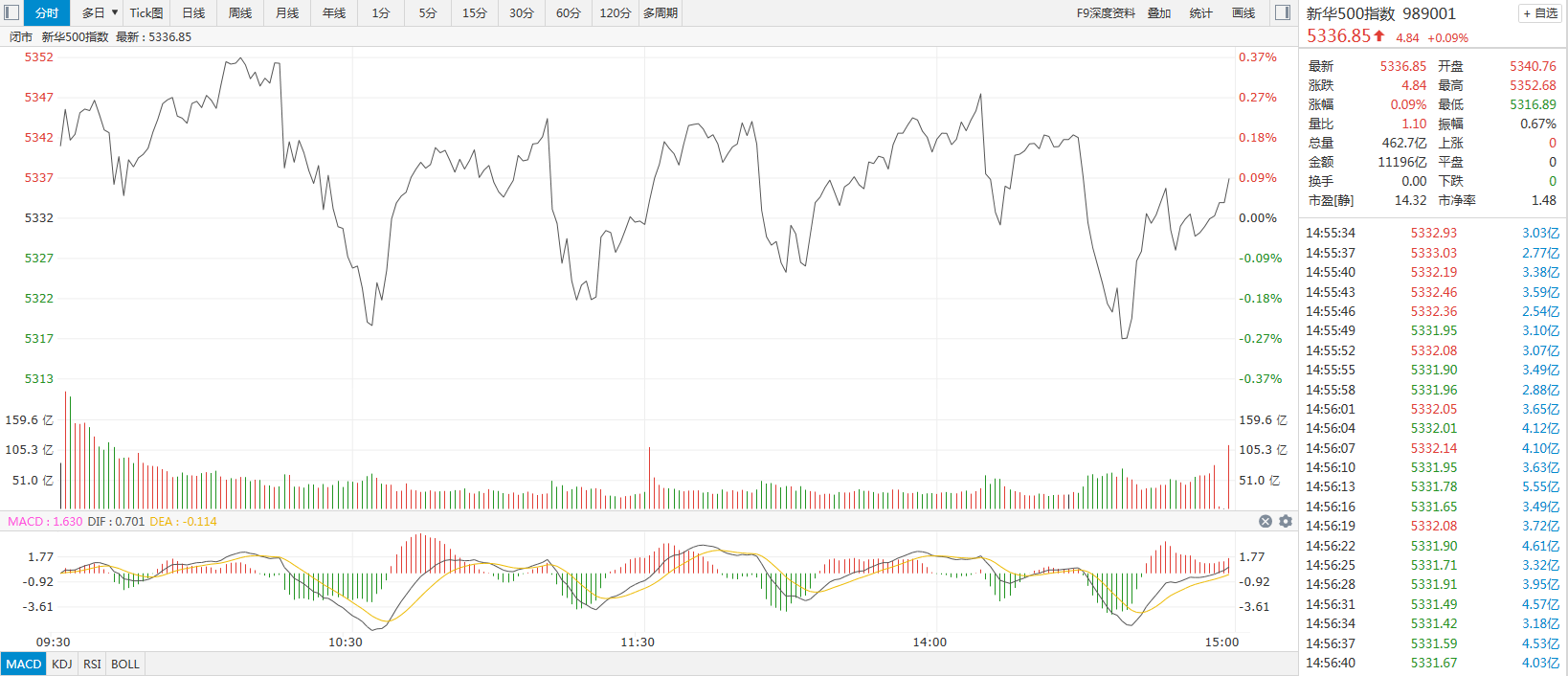
【新华500】新华500指数(989001)23日涨0.09%
Xin Hua Cai Jing· 2026-01-23 07:28
新华财经北京1月23日电 新华500指数(989001)1月23日收盘上涨4.84点,涨幅0.09%,报5336.85点。 (文章来源:新华财经) 成分股方面,美畅股份、迈为股份、捷佳伟创、晶科能源收于约20%涨停,晶盛机电、容百科技、天合光能、蓝思科技、禾迈股份、先导智能涨逾10%,益 丰药房、明阳智能、隆基绿能、中国卫星、金风科技、爱旭股份、四维图新、福斯特、铜陵有色收于约10%涨停;深南电路、华峰化学、中国长城、中际旭 创、沪电股份等跌幅靠前。 新华500指数本周(2025年1月19日至1月23日)累计上涨0.41%。 走势上看,新华500指数(989001)23日早间小幅高开,指数盘初震荡上扬,早盘期间最高涨0.39%,此后呈宽幅整理态势,收盘时微幅上涨。 指数盘中最高触及5352.68点,最低触及5316.89点,成分股全天总成交额报11196亿元,总成交额较上一交易日小幅放量。 ...

科创板收盘播报:科创50指数涨0.78% 通信设备股表现强势
Xin Hua Cai Jing· 2026-01-23 07:26
Group 1 - The Sci-Tech Innovation 50 Index opened lower on January 23, followed by a narrow adjustment, and eventually closed with a slight increase of 0.78% at 1553.71 points, with a total trading volume of approximately 110.8 billion yuan [1] - The overall Sci-Tech Innovation Index rose by 1.85% to 1899.78 points, with a total trading volume of about 334.9 billion yuan [1] - On January 23, 600 stocks in the Sci-Tech Innovation Board saw an average increase of 2.28% and an average turnover rate of 3.87%, with a total trading volume of 334.9 billion yuan and an average fluctuation of 4.77% [1] Group 2 - In terms of individual stock performance, stocks such as Ruihua Technology, Laplace, Zhenlei Technology, and Jinko Solar reached their daily limit, showing significant gains [1] - Conversely, Jucheng Co. experienced a decline of 7.87%, marking the largest drop among the stocks [1] - In trading volume, Lanke Technology led with a total of 12.04 billion yuan, while ST Pava had the lowest trading volume at 1.258 million yuan [2] Group 3 - Regarding turnover rates, Aerospace Huanyu had the highest turnover rate at 22.28%, while Bairen Medical recorded the lowest at 0.18% [3]


