Xin Hua Cai Jing

Search documents
摩根士丹利力挺瑞郎:被低估的“终极避险资产” 升值潜力远超预期
Xin Hua Cai Jing· 2026-02-24 07:40
Core Viewpoint - Morgan Stanley has issued a research report strongly bullish on the Swiss Franc, labeling it as a currently "overlooked and significantly undervalued" safe-haven asset, with expectations for its appreciation to exceed mainstream forecasts [1] Group 1: Performance and Resilience - The report highlights that while investors typically recognize the US Dollar, Japanese Yen, Gold, and government bonds as traditional safe-haven assets, their performance under extreme market stress has been "surprisingly inconsistent" [1] - In contrast, the Swiss Franc has demonstrated the strongest resilience, maintaining positive returns regardless of various shocks, including geopolitical conflicts, financial turmoil, or soaring inflation [1] Group 2: Unique Advantages - Morgan Stanley emphasizes the unique advantages of the Swiss Franc, which align closely with current investor concerns, including combating inflation and currency depreciation, reliance on Swiss fiscal discipline, robust investor protection mechanisms, and asset safety due to political neutrality [1] - The report asserts that the Swiss Franc exhibits clear and systematic advantages across these dimensions [1] Group 3: Market Mispricing and Predictions - Notably, Morgan Stanley believes that the market has significantly underestimated the Swiss National Bank's (SNB) tolerance for a stronger Swiss Franc, suggesting that the SNB may be more willing to accept appreciation as long as it does not harm inflation prospects [1] - This perspective challenges the long-standing market assumption that the SNB will inevitably intervene against a strong Swiss Franc [1] - Morgan Stanley sets explicit target prices, predicting that the Euro to Swiss Franc exchange rate will fall to 0.87, and in a potential "bear market scenario" for the US Dollar, the Dollar to Swiss Franc rate could drop to 0.64 [2]
科创板收盘播报:科创50指数跌0.34% 元器件股表现强势
Xin Hua Cai Jing· 2026-02-24 07:28
Group 1 - The core viewpoint of the news is that the STAR Market indices experienced fluctuations, with the STAR 50 Index closing down by 0.34% at 1465.37 points, and the STAR Composite Index down by 0.61% at 1798.21 points, indicating a mixed performance in the market [1][2]. Group 2 - On February 24, the total trading volume for the STAR Market was approximately 229.8 billion yuan, with an average turnover rate of 2.87% for the 603 stocks excluding the suspended stock [2]. - The performance of individual stocks varied, with Yunzhong Technology hitting the daily limit up, while Borui Data saw a significant decline of 15.42%, marking the largest drop [3]. - In terms of trading volume, Hanwujing led with a transaction amount of 8.89 billion yuan, while ST Pava had the lowest at 625,000 yuan [4]. - Regarding turnover rates, Yuxun Co. had the highest turnover rate at 31.77%, while Haohai Biological had the lowest at 0.17% [5].
春节消费韧性凸显 下沉市场成增长新引擎
Xin Hua Cai Jing· 2026-02-24 07:28
Group 1 - The domestic consumption market showed strong resilience during the 2026 Spring Festival holiday, driven by the holiday economy, with lower-tier markets becoming a structural highlight [1][3] - National key retail and catering enterprises reported an average daily sales increase of 8.6% compared to the same period in 2025 during the first four days of the holiday [1] - The sales of upgraded products surged, with smart wearable device sales increasing by 19.7% in the first three days of the holiday, including a 250% increase in smart glasses and a 48.6% increase in smart blood glucose meters [1] Group 2 - Restaurant reservations for New Year's Eve and Spring Festival gatherings were booming, with a 60% increase in search volume for must-try restaurants during the holiday period [2] - Haidilao reported serving over 14 million customers across its nationwide stores during the nine-day holiday, with significant demand from lower-tier cities [2] - New-style tea beverage consumption also saw explosive growth, with some lesser-known destinations experiencing sales increases of up to 4500% [2] Group 3 - The trend of returning home for the New Year created new consumption scenarios, with many young people opting to stay in hotels in their hometowns, leading to a nearly 20% year-on-year increase in hotel night stays in third to fifth-tier cities [3] - In popular return-home cities like Zhoukou, hotel order volume saw a staggering 77% year-on-year increase, indicating an upgrade trend in accommodation consumption in lower-tier markets [3] - The 2026 Spring Festival holiday highlighted the recovery of first-tier city business districts while lower-tier cities and county markets emerged as new engines for driving domestic demand due to population return and upgraded consumption habits [3]
收评:三大股指显著上涨 油气股和培育钻石股领涨 AI应用股和影视股领跌
Xin Hua Cai Jing· 2026-02-24 07:25
Market Performance - A-shares opened significantly higher on the first trading day after the long holiday, with major indices showing notable gains by the close [1] - The Shanghai Composite Index closed at 4117.41 points, up 0.87%, with a trading volume of approximately 938.6 billion yuan [1] - The Shenzhen Component Index closed at 14291.57 points, up 1.36%, with a trading volume of about 1263.5 billion yuan [1] - The ChiNext Index closed at 3308.26 points, up 0.99%, with a trading volume of around 597 billion yuan [1] Sector Performance - Oil and gas extraction, precious metals, and CPO concepts led the gains in the early session, while AI application-related stocks and film industry stocks faced significant adjustments [1] - The oil and gas extraction, cultivated diamonds, and precious metals sectors were the top gainers by the close [1] - The technology sectors, particularly AI applications and human-like robots, experienced a downturn [2] Investment Insights - Investment firms suggest focusing on sectors with high growth potential such as semiconductors, consumer electronics, artificial intelligence, and commercial aerospace [2][3] - The market is expected to maintain an upward trend, with a potential spring rally anticipated due to favorable liquidity conditions and positive consumer data [3] - The A-share market is projected to benefit from policy stimuli, with a synchronized upward trend expected alongside the economy [2] Regulatory Developments - The Supreme People's Court plans to establish judicial interpretations regarding insider trading and market manipulation by 2026, enhancing the legal framework for financial markets [4] Electric Vehicle Sector - The National Energy Administration reported a record high in electric vehicle charging during the Spring Festival, with 602.10 million charging instances and a total charging volume of 14,976.75 million kWh, marking a 52.01% increase from the previous year [5][6] Artificial Intelligence Initiatives - Hainan Province aims to establish 4-5 AI industry application demonstrations by the end of 2026, with plans for significant advancements in AI integration across key industries by 2028 [7]
一周流动性观察 | 节后超2.7万亿元资金回笼 央行大概率呵护流动性边际宽松
Xin Hua Cai Jing· 2026-02-24 07:19
Core Viewpoint - The People's Bank of China (PBOC) is actively managing liquidity in the market through various monetary policy tools, particularly focusing on reverse repos to ensure stability during the post-Spring Festival period [1][2][3]. Group 1: Monetary Policy Operations - On February 24, the PBOC conducted a 7-day reverse repo operation of 526 billion yuan, resulting in a net withdrawal of 926.4 billion yuan from the market due to the maturity of previous reverse repos [1]. - In the week leading up to the Spring Festival, the PBOC injected a total of 1.25 trillion yuan in short-term funds through reverse repos, effectively addressing liquidity needs during the holiday [1]. - The PBOC's actions included an excess rollover of 500 billion yuan in 6-month reverse repos and a net injection of 100 billion yuan in 3-month reverse repos, cumulatively releasing 600 billion yuan in medium to long-term funds in February [1]. Group 2: Market Liquidity and Interest Rates - Despite the seasonal demand for cash and over 700 billion yuan in government debt repayments, the pressure on liquidity was manageable, with overnight rates peaking at 1.46% and 7-day rates not exceeding 1.60% [1][2]. - Analysts expect that post-holiday liquidity will generally ease, with a significant drop in 7-day funding rates anticipated, although the upcoming tax payments and large reverse repo maturities may limit the extent of this decline [2][3]. - The PBOC is expected to maintain a supportive stance on liquidity, with forecasts suggesting that overnight rates may settle between 1.35% and 1.45% and 7-day rates between 1.50% and 1.60% [2]. Group 3: Economic Indicators and Future Outlook - The PBOC's recent monetary policy report indicates a commitment to maintaining ample liquidity, with social financing growing by 8.2% year-on-year and M2 increasing by 9%, both outpacing nominal GDP growth [3][4]. - There is a consensus among analysts that the PBOC will likely continue to adopt a loose monetary policy environment, especially in light of weak credit demand and the need to support economic growth [4].
2月14日中国汽、柴油批发价格分别为7451、6066元/吨
Xin Hua Cai Jing· 2026-02-24 07:08
Core Viewpoint - As of February 14, China's wholesale prices for gasoline and diesel show a trend of "gasoline rising and diesel stable," with the average wholesale price for 92 gasoline at 7,451 yuan per ton, an increase of 8 yuan per ton from the previous day, while the average wholesale price for diesel remains unchanged at 6,066 yuan per ton [1]. Market Overview - On February 13, international crude oil futures prices experienced a slight increase, with the average price change rate for a basket of crude oil showing positive movement, indicating a generally favorable market sentiment [1]. - The sales cycle for the month is relatively short, prompting operating units to implement favorable policies to stimulate sales, resulting in a relatively firm gasoline price [1]. Regional Price Changes - Gasoline wholesale prices increased in regions including Jilin, Liaoning, Inner Mongolia, Anhui, Jiangsu, Jiangxi, Guangdong, Shanxi, and Henan, while prices decreased in Xinjiang, Chongqing, and Hainan [1]. - Diesel wholesale prices rose in Liaoning and Gansu, but fell in regions such as Heilongjiang, Inner Mongolia, Jiangsu, Shanghai, Jiangxi, Hainan, Tianjin, Shanxi, and Henan [1]. - In Shandong, local refinery gasoline prices remained stable, while diesel prices saw a slight decline [1]. Data Source - The wholesale prices for gasoline and diesel are published by the China Economic Information Agency and the China Petroleum Economic and Technological Research Institute's "Energy Big Data Laboratory," based on data collection from major operating units and social operating units (excluding refineries) across the country, serving as an authoritative reflection of China's gasoline and diesel wholesale market [1].
E-Gas系统:2月16日-2月22日当周中国LNG进口量约53万吨
Xin Hua Cai Jing· 2026-02-24 06:56
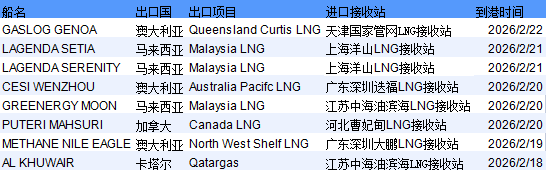
Core Viewpoint - China's LNG imports saw a significant decrease in the week from February 16 to February 22, with only 8 vessels bringing in approximately 530,000 tons, down from 1,190,000 tons in the previous week [1]. Group 1: Import Analysis - During the week of February 16 to February 22, China imported LNG from four countries, with Australia supplying 3 vessels and approximately 210,000 tons, accounting for about 41% of the total imports [3]. - The LNG receiving stations in China during this period included 2 vessels in South China, 4 in the Yangtze River Delta, and 2 in the Bohai Rim region, with the Jiangsu CNOOC Binhai LNG receiving station handling the most at 2 vessels totaling around 170,000 tons [3]. Group 2: Future Projections - For the upcoming week from February 23 to March 1, it is projected that China will import 19 vessels of LNG, with an estimated total volume of approximately 1,380,000 tons [3].

美债遭前三大海外“债主”减持 中国一年净卖出755亿美元
Xin Hua Cai Jing· 2026-02-24 06:51
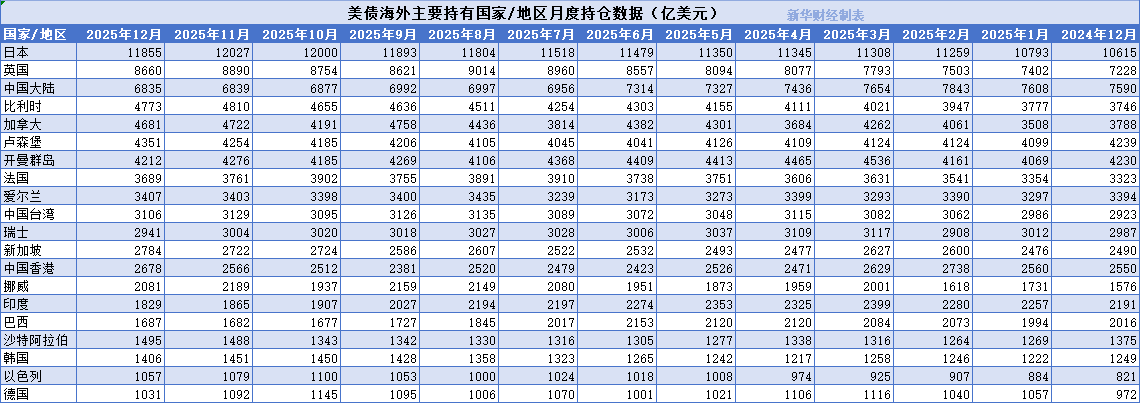
Core Viewpoint - The U.S. Treasury Department's TIC report for December 2025 indicates a significant reduction in U.S. Treasury holdings by major foreign investors, with a total decrease of $88.4 billion to $9.27 trillion from the previous month's record high of $9.36 trillion [1] Group 1: U.S. Treasury Holdings - Major foreign holders of U.S. debt, including Japan, the UK, and mainland China, reduced their holdings by $17.2 billion, $23 billion, and $400 million respectively in December [1] - Japan's U.S. Treasury holdings decreased to $1.1855 trillion, while mainland China's holdings fell to $683.5 billion, marking a widening gap of $502 billion between the two [3] Group 2: Trends in Foreign Investment - Japan's net purchases of U.S. Treasuries for 2025 amounted to $124 billion, despite a significant reduction in December [2] - Mainland China has maintained a steady reduction in U.S. Treasury holdings, with a cumulative net sale of $75.5 billion in 2025, contributing to an increasing disparity with Japan's holdings [3] Group 3: Global Reserve Trends - The World Gold Council reported that as of November 2025, global official gold reserves exceeded 900 million ounces, valued at $3.93 trillion, surpassing U.S. Treasuries as the largest reserve asset for the first time in 30 years [5] - China's foreign exchange reserves rose to $33,579 billion by the end of December 2025, with a continuous increase in gold reserves for 14 consecutive months [5] Group 4: Capital Flows - In December 2025, the U.S. experienced a net inflow of $44.9 billion in overseas capital, with individual investors contributing $32.7 billion and official institutions adding $12.2 billion [5] - Foreign investors net purchased $62.9 billion in U.S. long-term securities during the same month, with individual investors accounting for $55.7 billion of this total [6]
ComericaBank:美国经济韧性支撑利率高位 5月前难见降息
Xin Hua Cai Jing· 2026-02-24 06:36
Core Viewpoint - Comerica Bank's chief economist Bill Adams suggests that the Federal Open Market Committee (FOMC) is likely to maintain the federal funds rate unchanged before Jerome Powell's term ends in May 2026, despite robust economic growth and inflation remaining above target [1]. Economic Outlook - The FOMC perceives strong resilience in the U.S. economy, with no immediate recession risks [1]. - Positive factors supporting growth until 2026 include the lagged effects of previous rate cuts, increased government spending, a recovering real estate market, and a surge in artificial intelligence investments [1]. - A recent Supreme Court ruling against tariffs imposed by the Trump administration is expected to provide additional liquidity to businesses and consumers, further boosting economic activity [1]. Inflation Concerns - Policymakers remain cautious about inflation, despite January's Consumer Price Index (CPI) dropping to 2.4%, the lowest since May 2025 [1]. - Core inflation remains sticky, and structural tightness in the labor market poses potential upward risks [1]. - The primary downside risk to economic growth is not insufficient demand but rather labor supply bottlenecks, which could trigger a resurgence in inflation if wage-price spirals re-emerge [1]. Policy Stance - The FOMC is inclined to adopt a wait-and-see approach regarding policy adjustments [1]. - Even with favorable economic data, the FOMC lacks sufficient reasons to initiate a new round of rate cuts as long as inflation does not sustainably and credibly return to the 2% target [1]. - This strategy aims to prevent premature easing that could reignite inflation and to provide policy space for Powell's successor [1]. Market Expectations - Market expectations for rate cuts in 2026 have shifted, with traders anticipating that the first cut may be delayed until after mid-year, barring significant economic deterioration [2].

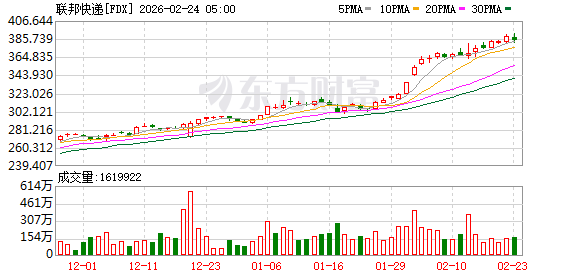
【环球财经】联邦快递起诉美国联邦政府要求退还关税
Xin Hua Cai Jing· 2026-02-24 06:33
Core Viewpoint - FedEx and its subsidiary FedEx Logistics Inc. have filed a lawsuit against the U.S. Customs and Border Protection (CBP) and the U.S. government for a full refund of import duties paid under the International Emergency Economic Powers Act, following a recent Supreme Court ruling that overturned the imposition of these tariffs [2][3]. Group 1 - FedEx seeks a full refund of the duties paid under the International Emergency Economic Powers Act, as the Supreme Court ruled that the President did not have the authority to impose large-scale tariffs [2][3]. - The lawsuit was filed in the U.S. International Trade Court, which has jurisdiction over judicial challenges to these tariffs and can issue relief measures [2]. - Over 1,000 companies, including major firms like Costco and Reebok, have joined the legal action to demand refunds of the duties paid [3]. Group 2 - FedEx executives have indicated that trade fluctuations are expected to impact the company's performance by $1 billion in fiscal year 2026, starting June 1, 2025 [3]. - The U.S. International Trade Court has issued an administrative order to pause the proceedings of all cases related to the International Emergency Economic Powers Act tariffs that have not yet been assigned a judge, pending further decisions after the Supreme Court's final ruling [3]. - The Supreme Court's ruling is estimated to involve a total refund amount of $175 billion related to the tariffs imposed under the International Emergency Economic Powers Act [3].