
Guan Cha Zhe Wang

Search documents
昔日广州首富梦碎:张劲领刑无期,雪松控股百亿非法集资帝国崩塌
Guan Cha Zhe Wang· 2026-02-11 10:11
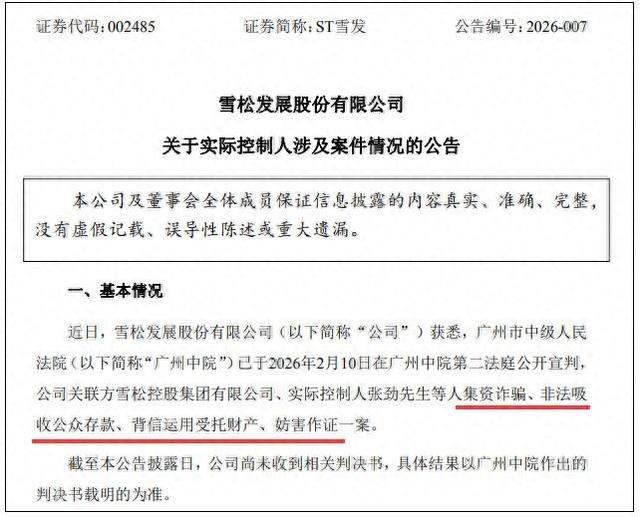
1971年生于广州的他,拥有深圳大学本科、香港理工大学研究生学历,1997年4月创立君华集团有限公 司,这便是雪松实业的前身,也为后来雪松控股的崛起埋下伏笔。2015年,君华集团重组成雪松控股, 张劲提出了雄心勃勃的"三个万亿"目标——未来五年实现万亿销售额、万亿资产和万亿市值。为实现这 一目标,雪松控股开启了疯狂的扩张之路,先后收购齐翔腾达、雪松发展、中江信托等企业,业务版图 不断扩大。 【文/羽扇观金工作室 李丕】 2月10日,广州市中级人民法院的一纸宣判,为雪松控股集团有限公司及其实控人张劲长达数年的非法 金融运作画上了句号。 据雪松发展股份有限公司公告,广州市中级人民法院已于2026年2月10日在广州中院第二法庭公开宣 判,公司关联方雪松控股集团有限公司、实际控制人张劲先生等人集资诈骗、非法吸收公众存款、背信 运用受托财产、妨害作证一案。 据《财新》根据庭审现场消息,张劲这位曾登顶"广州首富"、打造出世界500强企业的资本玩家,被判 处无期徒刑,雪松控股被判处罚金11亿元。这场牵涉近8000名投资者、数百亿元资金的金融骗局,最终 以核心人物锒铛入狱落幕。而从意气风发的 "万亿目标" 到非法集资暴雷,雪 ...

网易2025年营收1126亿元,AI新质生产力体系赋能全业务
Guan Cha Zhe Wang· 2026-02-11 10:00
Core Insights - NetEase reported a stable performance in Q4 2025 with revenue of 27.5 billion yuan and total annual revenue of 112.6 billion yuan, achieving a Non-GAAP net profit of 37.3 billion yuan [1] - The company has invested 17.7 billion yuan in R&D for six consecutive years, focusing on AI as a core productivity system integrated across gaming, music, and education [1] - The "AI-native" strategy has led to significant revenue growth in various segments, with online gaming revenue reaching 89.6 billion yuan, a year-on-year increase of 11% [1] Financial Performance - Q4 revenue reached 20 billion yuan for innovation and other businesses, a 42% quarter-on-quarter increase, with total annual revenue of 6.8 billion yuan [2] - NetEase Youdao achieved annual revenue of 5.9 billion yuan, marking its first year of positive operating profit and cash flow [1][2] - NetEase Cloud Music generated 7.8 billion yuan in revenue, with steady growth in subscription services [1] AI Integration and Development - The company has implemented AI across various processes, achieving efficiency improvements of up to 300% in certain areas [3] - AI tools like CodeMaker and DreamMaker have transformed content production, enabling rapid creative delivery and significant expansion of asset libraries [3] - NetEase has pioneered AI-native gameplay features, including intelligent NPCs and real-time voice AI teammates, enhancing user engagement and retention [4][5] Product and Market Expansion - The classic game "Dream of the Red Chamber" achieved record revenue in its 23rd year, while "Yanyun Sixteen Sounds" saw significant user engagement and revenue growth [8][10] - NetEase's global strategy has led to "Yanyun Sixteen Sounds" reaching over 80 million users, marking a successful cultural export [10][11] - The company continues to innovate with new game releases and expansions, maintaining strong performance in both domestic and international markets [11] AI Commercialization and Ecosystem - NetEase Youdao's AI subscription service sales exceeded 100 million yuan in Q4, indicating strong market demand [6] - The company has developed a comprehensive AI content safety and risk control service, serving over 90% of leading large model vendors [7] - NetEase Cloud Music has enhanced user experience through AI-driven features, resulting in increased user engagement and content creation [7]

网易2025年营收1126亿元,Non-GAAP净利润373亿元
Guan Cha Zhe Wang· 2026-02-11 09:56
Core Insights - NetEase reported a stable performance in Q4 2025 with revenue of 27.5 billion yuan and total annual revenue of 112.6 billion yuan, achieving a Non-GAAP net profit of 37.3 billion yuan [1] - The company has invested 17.7 billion yuan in R&D for six consecutive years, focusing on AI as a core productivity system integrated across gaming, music, and education [1] - The "AI-native" strategy has led to significant revenue growth in various segments, with online gaming revenue reaching 89.6 billion yuan, a year-on-year increase of 11% [1] Financial Performance - Q4 revenue reached 20 billion yuan for innovation and other businesses, a 42% quarter-on-quarter increase, with total annual revenue of 6.8 billion yuan [2] - NetEase Youdao achieved annual revenue of 5.9 billion yuan, marking its first year of positive operating profit and cash flow [1][2] - NetEase Cloud Music generated 7.8 billion yuan in revenue, with steady growth in subscription services [1] AI Integration and Development - The company has implemented AI across various stages of production, achieving efficiency improvements of up to 300% in certain areas [3] - AI-driven tools like CodeMaker and DreamMaker have transformed content production, enabling rapid creative delivery and significant expansion of asset libraries [3] - NetEase has pioneered AI-native gameplay features, including intelligent NPCs and real-time voice AI teammates, enhancing user engagement and retention [4][5] Product and Market Expansion - The classic game "Dream of the Red Chamber" achieved record revenue in its 23rd year, while "Yanyun Sixteen Sounds" saw significant user engagement and revenue growth [8][10] - The global user base for "Yanyun Sixteen Sounds" surpassed 80 million, marking a successful cultural export of Chinese gaming [10][11] - New products like "Forgotten Sea" and "Infinite Big" are in development, aimed at meeting global demand for high-quality original content [11] AI Commercialization and Business Strategy - NetEase has accelerated AI commercialization, with Youdao's AI subscription service sales exceeding 100 million yuan for the first time [6] - The company is expanding its AI capabilities in advertising, with net revenue from gaming and AI applications growing over 50% year-on-year [6] - NetEase's enterprise service division has developed a comprehensive AI agent matrix, serving thousands of enterprises and enhancing productivity [7]
于东来:过年后将正式退休
Guan Cha Zhe Wang· 2026-02-11 09:30
将企业经营权交给职业经理人,自己保留财务、后勤方面的服务及重大决策方向。 过去几年,他仍深度参与企业事务,包括帮扶步步高(002251)、永辉超市(601933)等调改项目。 本文系观察者网独家稿件,未经授权,不得转载。 2月11日,胖东来创始人于东来在社交平台发文表示,过年后正式退休,将转为顾问,胖东来工作由胖 东来决策委员会主持。 据悉,这并非于东来首次提及退休。 实际上,他早在2023年6月就曾表示"我把精力用在量力而行地去建设、传播生活的理念方面,企业经营 80%放手了"。 他还表示,"这个是放下,而不是放弃,可能等到我死了,依然还在这个企业,还在这个事业的平台 上,放下是对团队最大的信任,相信他们已经长大了,相信他们能做得更好。胖东来在未来的发展过程 当中,可能在10年左右,胖东来的董事长包括总经理到50岁,不管多大的能力都必须下来,基层的每个 分公司经理只要到45岁必须要退下来。" ...

本地发力:京东联合上海市杨浦区发放百万消费券
Guan Cha Zhe Wang· 2026-02-11 09:09
春节临近,上海市杨浦区迎来新一波线下消费热潮。 2月10日,京东本地生活服务首次与上海杨浦区政府合作,启动为期一个月的消费券发放活动,覆盖餐 饮团购、到店自提、家政服务等多个领域,旨在激活线下消费活力。 这是京东作为本地生活服务平台首次与政府合作推出消费券,打破了以往仅与支付工具类平台合作的模 式。 此次消费券活动将持续至3月9日,每日10点至20点分6轮发放。消费者通过京东APP首页搜索或"秒 送"频道点击"杨浦消费券""乐享杨浦",即可领券核销,当日有效,次日可续领。到店自提券还可叠加 平台百亿补贴,进一步提升消费体验。 与以往政府发放的消费券不同,本次活动特别设置了多档小额满减优惠,更贴合日常消费场景。 京东相关负责人介绍,本次共设置5档到店团购消费券(满500减200、满300减110、满100减36、满50减 16、满30减8元)及2档到店自提消费券(满30减3、满25减2元),覆盖杨浦区内所有开通京东到店业务 的商户。 咖浦消费音 乐享杨浦 服务惠民 :200- 最高领200元杨浦消费券 2026年2月10日-3月9日 | 每日10点-20点分6轮发放 每日10、12、14、16、18、20点限量 ...


从调改到深耕:永辉超市宣布2026年为“品质零售元年”,打造100个亿级口碑单品
Guan Cha Zhe Wang· 2026-02-11 09:03
Core Insights - Yonghui Supermarket's CEO Wang Shoucheng outlined the company's strategic transformation achievements and 2026 plans in a New Year letter, highlighting a significant turnaround with a dual growth in same-store traffic and sales for the first time in five years [1] Group 1: Strategic Transformation - The company acknowledged past mistakes in prioritizing scale over core values, admitting to having let down employees and customers [1] - In 2025, Yonghui initiated a large-scale restructuring, closing nearly 400 low-quality stores and focusing on systematic renovations of over 300 existing stores, covering a total area exceeding 2 million square meters [1] - This transformation is described as a major redefinition of operational philosophy and organizational mindset [1] Group 2: Initial Results and Employee Engagement - The dual growth in same-store traffic and sales indicates that returning to a focus on "people and products" can rebuild trust and enthusiasm [1] - The company has begun to implement a profit-sharing model, distributing nearly 50 million yuan in profit dividends to employees in 2025, fulfilling its commitment to share operational success [1] Group 3: 2026 Strategic Focus - For 2026, Yonghui aims to deepen its efforts in three main areas: enhancing product quality, transforming stores into community service hubs, and empowering organizational capabilities [2] - The company plans to upgrade its procurement role to become a "quality enabler," collaborating with 200 core production areas and factories to create a "quality community" and develop 100 flagship products [2] - The transformation of stores will shift from mere transaction points to "lifestyle spaces," including community kitchens and neighborhood lounges [2] - Organizational changes will focus on empowering employees through clearer responsibilities, streamlined processes, increased training, and investment in AI technology [2] - Wang emphasized the commitment to a long-term quality retail strategy, expressing gratitude to the supporting teams, partners, customers, and employees for their contributions [2]


本地发力:京东联合上海市杨浦区发放百万消费券 线下餐饮迎来春节新客流
Guan Cha Zhe Wang· 2026-02-11 08:33
春节临近,上海市杨浦区迎来新一波线下消费热潮。 2月10日,京东本地生活服务首次与上海杨浦区政府合作,启动为期一个月的消费券发放活动,覆盖餐饮团购、到店自提、家政服务等多个领域,旨在激活 线下消费活力。 这是京东作为本地生活服务平台首次与政府合作推出消费券,打破了以往仅与支付工具类平台合作的模式。 全场景覆盖,线下门店迎来消费增长 此次消费券活动将持续至3月9日,每日10点至20点分6轮发放。消费者通过京东APP首页搜索或"秒送"频道点击"杨浦消费券""乐享杨浦",即可领券核销,当 日有效,次日可续领。到店自提券还可叠加平台百亿补贴,进一步提升消费体验。 与以往政府发放的消费券不同,本次活动特别设置了多档小额满减优惠,更贴合日常消费场景。 京东相关负责人介绍,本次共设置5档到店团购消费券(满500减200、满300减110、满100减36、满50减16、满30减8元)及2档到店自提消费券(满30减3、 满25减2元),覆盖杨浦区内所有开通京东到店业务的商户。 "之前的消费券大多是大额的,像我们这样的平价餐饮很难用到。"胡子大厨紫金广场店店长赵三娟表示,"这次有小额满减券,更适合我们这类主打工作餐 的餐厅,预计 ...

自建欧洲物流网络,京东JoyExpress上线
Guan Cha Zhe Wang· 2026-02-11 08:33
京东全球超级供应链和海外物流网络建设再次取得重要进展。 2月10日,京东集团宣布,快递品牌JoyExpress在欧洲多国正式推出,将率先为京东欧洲线上零售业务Joybuy用户提供 高品质的快递物流服务。 为保障服务品质,京东物流已在欧洲为Joybuy运营了超60个物流仓库、快递站点,并规模化打造运输车队,通过全流 程数智化、标准化管理,持续提供稳定、高质量的一体化供应链物流及配送服务。 伴随Joybuy欧洲业务的快速发展,京东物流还将进一步扩大供应链物流基础设施规模,并投用更多前沿物流科技产 品,推动整体供应链降本增效。 目前,京东欧洲线上零售业务Joybuy已在英国、德国、荷兰、法国、比利时和卢森堡启动试运营。 国际化始终是京东集团的重要战略方向,近年来,京东正在加速物流供应链出海的步伐,目前在海外已运营超130个 各类型海外仓,总管理面积超过130万平方米,开通了数十条国际货运航线,构建了全球多个核心市场"2-3日达"时效 圈,通过遍布全球的仓网布局与先进的技术能力,助力全球经贸流通更加高效、顺畅。 本文系观察者网独家稿件,未经授权,不得转载。 目前,JoyExpress已在英国、德国、荷兰和法国等国家的 ...
反超阿根廷!中国成为巴西最大汽车进口来源国
Guan Cha Zhe Wang· 2026-02-11 08:19
Core Insights - Chinese automotive companies have become the largest car importers in Brazil, surpassing Argentina for the first time in over 30 years, marking a significant shift in the market dynamics [2] - The growth of Chinese brands in Brazil is part of a broader global strategy rather than an over-concentration on a single market [4] Group 1: Market Performance - In January, China exported 16,800 vehicles to Brazil, while Argentina exported 13,400 vehicles, indicating a notable increase in Chinese market share [2] - The export value of Chinese automobiles to Brazil surged to $375 million in January, more than ten times the amount from a year earlier, accounting for approximately 65% of Brazil's total automotive import value [2] - Despite the rise of Chinese brands, Brazil's overall automotive production decreased by 12% year-on-year, and sales saw a slight decline [4] Group 2: Strategic Developments - Chinese companies like Great Wall Motors and BYD are rapidly expanding in Brazil by initially importing vehicles and subsequently establishing local assembly operations [2] - BYD plans to invest 5.5 billion Brazilian Reais (approximately $1.06 billion) to convert a Ford plant in Bahia into a production base, initially using a semi-knocked down (SKD) assembly model [3] - The Brazilian Automotive Manufacturers Association (Anfavea) has criticized the simplified assembly model for creating fewer jobs compared to full manufacturing and has welcomed the government's decision to not extend the tax exemption on imported automotive parts [3] Group 3: Industry Challenges - The sales of new energy vehicles in Brazil reached a record high of 16.8%, but only about 35% of these vehicles are produced locally [4] - The Brazilian automotive industry faces challenges such as rising financing costs and tightened credit, which are impacting various market segments, including heavy trucks [4] - Despite the rapid growth of Chinese brands, Brazil remains the fifth-largest destination for Chinese automotive exports, trailing behind Mexico, Russia, the UK, and the UAE [4]

首次反超福特!比亚迪全球销量跻身前五
Guan Cha Zhe Wang· 2026-02-11 08:19
导读:比亚迪2025年以460.2万辆的全年销量成绩首次进入全球车企集团销量前五,超越通用、福特、 本田、日产等企业。 (文 / 观察者网 周盛明 编辑 / 高莘) 据彭博社2月11日报道,比亚迪历史首次在全球销量上超过福特。 比亚迪官方数据显示,其2025年以460.2万辆的全年销量成绩首次进入全球车企集团销量前五,成为首 个跻身该榜单前五名的中国汽车集团,实现历史性突破,超越通用、福特、本田、日产等企业。 2025全球汽车集团销量TOP5 比亚迪 数据显示,福特去年批发销量下降近2%,降至略低于440万辆的水平。据悉,尽管福特去年在美国本土 销量有所增长,但其在欧洲,尤其是在中国市场份额下滑明显。 据悉,福特去年12月表示,将放弃全面电动化,并且因此计提195亿美元(约合人民币1404亿元)的资 产减值,并取消多款电动车型。 加拿大安大略省伦敦市福特经销店待售车辆 彭博社 受此影响,福特的财报显示,其2025年全年净亏损达82亿美元(约合人民币590.40亿元)。 此外,福特首席财务官雪莉·豪斯(Sherry House)周二表示,福特遭遇了额外9亿美元(约合人民币 64.80亿元)的关税成本"意外冲击" ...

