
Zhong Guo Chan Ye Jing Ji Xin Xi Wang

Search documents
“醉美”厦门再掀夏日消费热潮
Zhong Guo Chan Ye Jing Ji Xin Xi Wang· 2025-08-25 00:38
Core Insights - The 2025 Xiamen Beer Consumption Season is themed "Seaside Garden, Beautiful Xiamen" and features a city-wide collaborative approach to promote beer consumption and night economy [2][4] - The event includes multiple venues and activities, attracting significant participation and enhancing local tourism and hospitality sectors [3][4] Group 1: Event Overview - The main venues for the beer consumption season are Siming and Tong'an districts, showcasing a vibrant atmosphere with a mix of culture, food, and international beer brands [1][2] - The event spans nearly two months, with various sub-events across different districts, each highlighting local characteristics and resources [2][3] Group 2: Participation and Impact - The Tong'an main venue attracted 356,000 participants over five days, while the Haicang district event drew over 70,000 attendees [2][3] - The integration of beer with local culture and activities is expected to significantly boost the night economy and overall consumer spending in Xiamen [3][4] Group 3: Strategic Initiatives - The "Beer+" model combines beer with tourism, sports, and shopping, effectively extending the consumption chain and enhancing the city's appeal [4] - The initiative is a key strategy for driving domestic demand and promoting industry upgrades, positioning Xiamen as a summer tourism hotspot [4]
税务部门支持科技创新和制造业发展 深圳“独角兽”勇闯“硬科技”赛道
Zhong Guo Chan Ye Jing Ji Xin Xi Wang· 2025-08-25 00:33
Core Insights - The 2025 China (Shenzhen) Unicorn Enterprise Conference highlighted the growth of unicorn companies in Shenzhen, with 42 unicorns valued at $159.9 billion and an average valuation of $3.71 billion, marking Shenzhen as the leader in new unicorns with 13 new additions [1] - Shenzhen's unicorn companies are primarily focused on "hard technology," with significant representation in integrated circuits and robotics, reflecting the city's industrial development ecosystem [1] - The Shenzhen government has implemented four action plans this year to foster the growth of unicorn companies, emphasizing support for strategic emerging industries and establishing a comprehensive service mechanism for the entire lifecycle of unicorn enterprises [1] Group 1: Unicorn Companies in Shenzhen - The report indicates that 66.7% of Shenzhen's unicorn companies are in cutting-edge technology sectors, showcasing the city's innovation capabilities [1] - The tax department in Shenzhen has introduced various policies to support technology innovation and manufacturing, enhancing the operational environment for unicorn companies [1] Group 2: Case Study - Yuanxiang XVERSE - Yuanxiang XVERSE, established in 2021, is among the new unicorns, leveraging both AI and 3D technologies, and has quickly become a leader in the VR market by launching five VR products across 33 cities [2] - The company has benefited from the Shenzhen tax department's streamlined services, which include one-stop tax handling and personalized support for complex tax matters [2] Group 3: Globalization of Unicorn Companies - A significant trend among Shenzhen's unicorns is their global expansion, with 80% of the 42 unicorns being global companies [3] - Companies like Xinwanda have established overseas production bases and received tailored tax services to facilitate their international operations, including expedited export tax refunds [3] Group 4: Credit Taxation Mechanism - In Qianhai, the tax department has implemented a "credit taxation" mechanism, allowing high-credit unicorn companies to enjoy expedited services such as instant invoice approvals [4] - Shenzhen has a robust ecosystem of specialized and innovative small and medium enterprises, with over 10,000 such companies supporting the city's innovation drive [4]

1至7月国有土地使用权出让收入16950亿元,同比下降4.6%
Zhong Guo Chan Ye Jing Ji Xin Xi Wang· 2025-08-25 00:27
Group 1 - The core viewpoint of the article highlights the significant decline in state-owned land use rights transfer income, which reached 1.695 trillion yuan in the first seven months of 2025, a year-on-year decrease of 4.6% [2] - The land transfer income has dropped over 50% compared to the peak period in 2020, indicating ongoing pressure in the land market despite some positive signals from recent policy measures [2] - Factors contributing to the decline include overall tightening of land supply, slower project development and sales by real estate companies, and increased focus on inventory reduction [2] Group 2 - As of July 2025, half of the top 100 real estate companies have not recorded new land reserves, while leading firms are actively acquiring land, with the top 10 companies accounting for 70% of new value added [3] - The transaction area of residential land in 30 key cities increased by 17% year-on-year, contrasting with a 9% decline in the overall 300 cities, indicating a structural recovery in the market [3] - The land market is expected to continue showing a "focus and deepen" investment strategy, with competition for quality land in core cities remaining intense, while other cities may continue to experience low activity [3] Group 3 - The adjustment of land regulations is seen as a way to address structural imbalances in the market, potentially reducing development intensity and easing financial pressures on real estate companies [4] - The central government has prioritized revitalizing existing land and commercial properties, providing operational guidelines for policy execution [4] - The inventory clearance cycle for new homes in 50 key cities remains around 20 months, indicating ongoing de-stocking pressure, while well-positioned projects are achieving good sales, suggesting room for improvement in housing demand [4]
7月工业生产保持较快增长 新质生产力成关键支撑
Zhong Guo Chan Ye Jing Ji Xin Xi Wang· 2025-08-25 00:11
Core Insights - Industrial production in July maintained rapid growth, with the equipment manufacturing sector acting as a stabilizing force, leading to a year-on-year increase of 5.7% in industrial added value [1] - The development of new productive forces is a key driver for high-quality industrial growth, supported by significant advancements in technology and innovation [1] Group 1: Technological Innovation - Continuous increase in R&D investment has led to breakthroughs in key technology areas, with high-tech manufacturing value added growing by 9.3% year-on-year, outpacing overall industrial growth [1] - The rapid development of new productive forces is enhancing the support for the economy and pushing industrial production towards higher-end manufacturing [1] Group 2: Green Development - Significant achievements in green development are evident, with July production of new energy vehicles increasing by 17.1% and lithium-ion battery production rising by 29.4% [2] - The production of green materials such as carbon fiber and bio-based chemical fibers grew by 43.8% and 19.8%, respectively, indicating a strong commitment to green technology and production [2] Group 3: Digital Transformation - The value added of the digital product manufacturing sector increased by 8.4% year-on-year, with smart device manufacturing and electronic components achieving double-digit growth [3] - The integration of information technology with industrial production is enhancing efficiency, product quality, and management levels, laying a solid foundation for sustainable industrial development [3] Group 4: Policy Support - A series of proactive macro policies have significantly impacted industrial production, with notable growth in shipbuilding and related equipment manufacturing (29.7%) and electric motor manufacturing (15.9%) [3] - The precise support from policies has created favorable conditions for technological innovation and market expansion, encouraging enterprises to develop new productive forces [3][4]
加快释放内需潜力 为经济平稳健康发展提供支撑
Zhong Guo Chan Ye Jing Ji Xin Xi Wang· 2025-08-25 00:09
Group 1: Economic Policy and Internal Demand - The central government emphasizes the need to effectively release internal demand potential and stimulate consumption to support economic growth [1][6] - In the first half of the year, internal demand contributed 68.8% to GDP growth, with final consumption expenditure accounting for 52% [2] - The government has implemented policies such as the "old for new" consumption program, which has led to significant increases in retail sales across various categories [2] Group 2: Service Consumption Growth - Service consumption has been growing rapidly, with projections indicating that by 2024, it will account for 46.1% of per capita consumption expenditure [3] - Households are increasingly spending more on services like home care, fitness, and tourism compared to goods, indicating a substantial growth potential in service consumption [3] - Strategies to activate consumer demand include creating immersive consumption experiences and issuing targeted consumption vouchers [3] Group 3: Investment Expansion - The government has allocated 800 billion yuan for "two heavy" construction projects and 735 billion yuan for central budget investments, which are expected to drive infrastructure investment growth [4] - Manufacturing investment has increased by 6.2% year-on-year, outpacing overall investment growth, supported by large-scale equipment updates [4][5] - There is a focus on optimizing investment structure to meet changing demand, particularly in education, healthcare, and quality housing [5] Group 4: Reform and Market Integration - The government aims to deepen reforms to address the challenges of insufficient internal demand, with policies focusing on stabilizing employment, enterprises, and market expectations [6][7] - Efforts will be made to enhance the consumption policy framework and expand effective investment, particularly in sectors like transportation, energy, and water resources [7] - The goal is to create a unified national market that facilitates efficient resource allocation and circulation [6][7]
机器人竞争进入“中国时间”
Zhong Guo Chan Ye Jing Ji Xin Xi Wang· 2025-08-25 00:02
Group 1 - The global robotics industry is entering a new stage of intelligence and embodiment, with China emerging as a key driver in the global robotics technology competition [2][3] - IDC predicts that by 2029, the global robotics market will exceed $400 billion, with China accounting for nearly half and leading with a compound annual growth rate (CAGR) of nearly 15% [3] - China's rapid development in the robotics sector is attributed to manufacturing capabilities, advanced technology investments, improved scene adaptability, and strong industrial policy support [3] Group 2 - In the commercial service robot sector, global shipments are expected to surpass 100,000 units in 2024, with Chinese manufacturers leading with 84.7% of the shipment volume [3] - Chinese companies are making significant breakthroughs in core technologies such as embodied intelligence and system integration, driving rapid intelligent upgrades in commercial service robots [3][5] - The humanoid robot industry in China is accelerating through a dual-cycle model of "technological breakthroughs and application validation," with projected sales of approximately 5,000 units in 2025 and nearly 60,000 units by 2030, reflecting a CAGR of over 95% [4] Group 3 - Chinese industrial robots are expanding into overseas markets, with total overseas revenue exceeding $2 billion in 2024, and collaborative robot export revenue reaching approximately $74.1 million, a year-on-year increase of 34.7% [4] - The development of embodied intelligent robots is characterized by enhanced perception capabilities, the emergence of large models as core drivers, and the improvement of simulation and world models [5][6] - The industry is actively promoting open-source sharing of key resources to support the development of embodied intelligence, fostering a collaborative innovation ecosystem [6]



努力实现从“量”到“质”的跨越 我国原料药产业积极提升国际竞争力
Zhong Guo Chan Ye Jing Ji Xin Xi Wang· 2025-08-25 00:02
Core Insights - The raw material pharmaceutical industry in China is undergoing a transformative period amid global restructuring, focusing on enhancing international competitiveness through innovation and global collaboration [1][5]. Export Performance - China has become the world's largest producer and exporter of raw pharmaceuticals, with export value increasing from $23.55 billion in 2015 to $42.98 billion in 2024, reflecting a compound annual growth rate (CAGR) of 7.7% [2]. - The total export volume of raw pharmaceuticals has also shown stable growth, with a CAGR of 9.0% during the same period [2]. - In the first half of 2025, both imports and exports of Western medicine raw materials from China experienced year-on-year growth [2]. Challenges in Internationalization - Despite strong export performance, challenges remain in the internationalization process, including global supply chain restructuring, increasing international trade friction, and intensified market competition [2]. - The uncertainty of global tariff policies poses potential pressure on export-dependent companies [2]. Impact of Indian Market - India, as the third-largest importer of raw pharmaceuticals, sources 68.8% of its imports from China, while also competing directly with China as the second-largest exporter [3]. - India's Production Linked Incentive (PLI) scheme supports local production of 53 raw pharmaceuticals, which may pressure Chinese companies' pricing power and profit margins [3]. - Stricter registration management and extended approval cycles in India increase export costs for Chinese firms [3]. Structural Issues in Domestic Industry - Structural overcapacity in China's raw pharmaceutical industry has led to price competition, further squeezing profit margins [4]. - Domestic companies have focused on traditional areas like vitamins and antibiotics, leading to saturation and intense competition, while high-value specialty raw pharmaceuticals remain underdeveloped [4]. Path to High-Quality Development - The industry needs to shift from cost competition to enhancing technological barriers as a foundation for international market presence [5]. - Emphasizing innovation in technology, processes, and materials is crucial for meeting international demand for high-quality raw pharmaceuticals [6]. - Targeting high-growth areas such as oncology, metabolic diseases, and neurological disorders is essential for building a differentiated competitive advantage [6]. Market Diversification Strategies - To mitigate external challenges, companies should reduce reliance on single markets and actively explore emerging markets [6]. - In the first five months of 2025, exports to Belt and Road Initiative countries reached $7.75 billion, a year-on-year increase of 4.2%, indicating significant market potential in Southeast Asia, the Middle East, and Latin America [6]. - Companies are encouraged to avoid over-dependence on single products or markets and to strategically incorporate emerging markets into their plans [6]. Collaborative Approaches - The overall production cost of Chinese raw pharmaceuticals is 20% to 30% lower than that of India, which remains a competitive advantage [7]. - Companies should transition from traditional trade to deep industry collaboration, such as supplying key intermediates to Indian firms and co-developing specialty raw pharmaceuticals [7].
2025年7月份邮政行业运行情况
Zhong Guo Chan Ye Jing Ji Xin Xi Wang· 2025-08-25 00:00
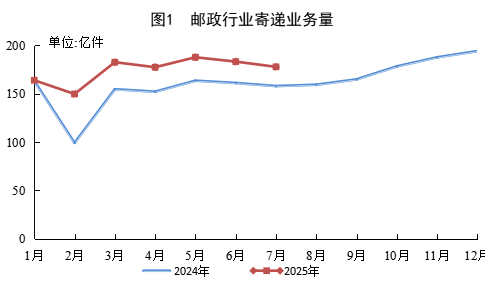
Core Insights - In July, the postal industry's business revenue (excluding direct operating income from Postal Savings Bank) reached 144.98 billion yuan, marking a year-on-year growth of 8.6% [1] - The express delivery business revenue amounted to 120.64 billion yuan in July, with a year-on-year increase of 8.9% [1] Revenue and Volume Summary - From January to July, the postal industry's cumulative business revenue totaled 1,018.07 billion yuan, reflecting a year-on-year growth of 8.3% [3] - Cumulative express delivery revenue for the same period reached 839.42 billion yuan, showing a year-on-year increase of 9.9% [3] - The total volume of postal delivery services from January to July was 122.3 billion pieces, up 16.2% year-on-year [3] - Express delivery volume for the same period was 112.05 billion pieces, with a year-on-year growth of 18.7% [3] Segment Analysis - In the first seven months, the cumulative volume of same-city express delivery reached 9.26 billion pieces, growing by 6.5% year-on-year [4] - The volume of intercity express delivery was 100.43 billion pieces, reflecting a significant year-on-year increase of 19.9% [4] - International/Hong Kong, Macau, and Taiwan express delivery volume reached 2.36 billion pieces, with a year-on-year growth of 19.2% [4] Market Share Dynamics - As of January to July, the shares of same-city, intercity, and international/Hong Kong, Macau, and Taiwan express delivery volumes were 8.3%, 89.6%, and 2.1%, respectively [7] - Compared to the same period last year, the share of same-city express delivery volume decreased by 0.9 percentage points, while intercity express delivery volume's share increased by 0.9 percentage points [7] Regional Performance - In the first seven months, the revenue share of express delivery in the eastern, central, and western regions was 74.0%, 15.5%, and 10.5%, respectively [9] - The volume share for these regions was 71.5%, 19.4%, and 9.1%, respectively [9] - The eastern region's revenue share decreased by 0.8 percentage points year-on-year, while the central and western regions saw increases of 0.5 and 0.3 percentage points, respectively [9] Industry Concentration - The concentration index CR8 for express and parcel service brands was 86.9, a slight decrease of 0.1 from the previous month [10]
山东:2027年数字经济核心产业增加值年均增速超10%
Zhong Guo Chan Ye Jing Ji Xin Xi Wang· 2025-08-24 23:58
Group 1 - The core viewpoint of the news is the implementation of the "Implementation Opinions" by the Shandong Provincial Government, which aims to accelerate the integration of the digital economy with the real economy, enhancing the quality and scale of digital economic core industries [1][2] - By 2027, the market-oriented and value-oriented path for data elements is expected to mature, with the annual growth rate of the added value of digital economy core industries exceeding 10%, and the proportion of this added value in GDP steadily increasing [1] - The plan emphasizes the development of key core technologies, focusing on cutting-edge fields such as humanoid robots, brain-computer interfaces, and quantum science, with a commitment to implement major foundational research projects annually [1][2] Group 2 - The "Implementation Opinions" outline the optimization of digital infrastructure construction, including the high-standard establishment of the Qingdao International Communication Business Exit Bureau and the acceleration of high-speed data transmission network construction [2] - The initiative includes the promotion of digital transformation in traditional industries, with specific targets such as creating over 100 smart farms and smart fisheries by the end of 2025, and establishing around 10 national-level intelligent factories [2] - The plan also aims to develop high-end productive service industries, including digital finance and modern logistics, while accelerating the digital transformation of marine industries, particularly in smart fisheries [2]
天津滨海高新区上半年交出亮眼成绩单
Zhong Guo Chan Ye Jing Ji Xin Xi Wang· 2025-08-24 23:58
Group 1 - The core viewpoint emphasizes the high-quality development initiatives in Tianjin Binhai New Area, focusing on innovation, industry, reform, and governance [1][2] - In the first half of the year, the GDP of Tianjin Binhai New Area grew by 6.5%, with retail sales of consumer goods and general public budget increasing by 10.2% and 8.8% respectively [1] - The area has introduced 305 high-growth technology companies, with 24 selected for the Tianjin Technology Innovation Board, accounting for nearly 60% of the city's total [1] Group 2 - The five leading industries, including information technology innovation, new energy, and high-end equipment manufacturing, saw a revenue increase of 14% [2] - A total of 793 new investment projects were established, with a total investment of 34 billion yuan [2] - The area has made significant progress in reform and opening up, with state-owned enterprises' revenue increasing by 34% year-on-year in the first half of the year [2] Group 3 - Future plans for Tianjin Binhai New Area include focusing on high-quality development goals, enhancing regional development dynamics, and promoting collaborative development in the Beijing-Tianjin-Hebei region [3] - The area aims to accelerate the creation of an upgraded version of the national independent innovation demonstration zone and establish a first-class science and technology city in northern China [3]