
Zhong Guo Chan Ye Jing Ji Xin Xi Wang

Search documents
纸品唯一!心相印蝉联消费者十大首选品牌和增速前十品牌双榜
Zhong Guo Chan Ye Jing Ji Xin Xi Wang· 2025-08-25 07:18
Core Insights - The report highlights the top ten preferred brands and the fastest-growing brands in the Chinese market, with Hengan Group's brand, Heartfelt, being the only brand in the household paper industry to appear on both lists, achieving a consumer reach of 552 million [1][2][3] - The report emphasizes the importance of "consumer reach" as a key metric, reflecting brand penetration and purchase frequency, which are crucial for understanding market dynamics in the fast-moving consumer goods sector [2][3] Brand Performance - Heartfelt has established itself as a leader in the household paper industry, with a consumer reach growth rate of 14.5%, bringing its penetration rate close to 70% [3] - The brand's strategic initiatives, including the introduction of 100% virgin wood pulp labeling and emotional marketing campaigns, have contributed to its strong market presence and consumer loyalty [2][3] Market Trends - The report indicates that the dual drivers of penetration and purchase frequency are essential for brand growth in the Chinese market, with a notable shift towards integrating online and offline channels [2][3] - Future strategies for Heartfelt will focus on consumer insights, product innovation, and emotional value to meet the increasing demand for health-conscious products [3]
2025年1—7月份固定资产投资规模继续扩大
Zhong Guo Chan Ye Jing Ji Xin Xi Wang· 2025-08-25 07:15
Group 1 - National fixed asset investment (excluding rural households) reached 288,229 billion yuan from January to July, with a year-on-year growth of 1.6% [1] - Equipment purchase investment showed significant growth, increasing by 15.2% year-on-year, which is 13.6 percentage points higher than the overall investment growth rate, contributing 2.2 percentage points to total investment growth [2] - Manufacturing investment grew rapidly, with a year-on-year increase of 6.2%, 4.6 percentage points higher than the overall investment growth, contributing 1.5 percentage points to total investment growth [3] Group 2 - Infrastructure investment increased by 3.2% year-on-year, contributing 43.0% to total investment growth, which is an increase of 6.0 percentage points compared to the first half of the year [4] - Green energy investment surged by 21.5% year-on-year, contributing 1.4 percentage points to total investment growth, with solar, wind, nuclear, and hydropower investments collectively growing by 21.9% [5] - High-tech service industry investment rose by 6.2% year-on-year, with a share of 5.1% in total service industry investment, an increase of 0.4 percentage points from the same period last year [6] Group 3 - Project investment (excluding real estate development) grew by 5.3% year-on-year, 3.7 percentage points higher than the overall investment growth rate, with private project investment (excluding real estate) increasing by 3.9% [7] - The focus for the next phase includes implementing government investment tools effectively, promoting high-quality "two重" construction, and accelerating the development of high-end, intelligent, and green manufacturing [7]
中国石化8项成果入选能源电力行业高价值专利及技术成果转化典型案例
Zhong Guo Chan Ye Jing Ji Xin Xi Wang· 2025-08-25 07:14
Core Viewpoint - The China Energy Research Society's Technology Achievement Transformation and Patent Evaluation Working Committee has announced the third batch of high-value patents and typical cases of technology transformation in the energy and power industry, highlighting significant innovations from various companies [1] Group 1: Selected Innovations - Eight achievements from Southwest Oil and Gas Company, Petrochemical Research Institute, and Shengli Oilfield have been recognized for their high value [1] - Notable innovations include: - Southwest Oil and Gas Company's "Full-Diameter Continuously Adjustable Sliding Sleeve System" and "Nano-Modified Low-Damage Fracturing Fluid Technology for Tight Gas Reservoirs" [1] - Petrochemical Research Institute's "Composition and Preparation Method for Reducing CO and NOx Emissions" and "Alkylation Reaction Device and Method" [1] - Shengli Oilfield's "Viscoelastic Particle Oil Displacement Agent to Significantly Improve Oil Recovery" and "Water-Gas Alternating Injection Column and Operation Method" [1] Group 2: Technological Applications - The recognized technologies aim to enhance oil recovery and reduce emissions, showcasing advancements in both extraction methods and environmental sustainability [1] - Specific applications include: - Shengli Oilfield's "Method for Extracting Shale Oil through Volume Fracturing in Horizontal Wells" [1] - Research on "Slow-Release Activator System for Microbial Oil Displacement" by Shengli Oilfield's Petroleum Engineering Technology Research Institute [1]

贝壳惠居王拥群:轻资产托管模式的核心驱动力是服务和效率
Zhong Guo Chan Ye Jing Ji Xin Xi Wang· 2025-08-25 05:44
Core Insights - The 2025 China Housing Rental Development Forum highlighted the significant impact of the Housing Rental Regulations on the industry, providing strong policy momentum for compliance and high-quality development [1][7] - Experts emphasized the milestone significance of the regulations in clarifying the status of rental enterprises, expanding housing supply paths, and promoting service standardization [1][2] Group 1: Opportunities and Market Changes - The introduction of the regulations presents three key opportunities for the industry: clarifying the independent identity of rental enterprises, broadening housing supply paths, and driving service upgrades [2] - The market is experiencing three notable changes: a diverse tenant demographic, a predominance of decentralized housing facing quality issues, and a shift in landlords' rental motivations towards professional management [2] Group 2: Strategic Positioning and Business Model - The "Big Rental Era" is characterized by marketization, specialization, and diversification, with Beike Huiju proposing four value propositions to align with policy directions and market demands [2][3] - Beike Huiju's rental strategy integrates into a broader framework, leveraging a 20-year network and data infrastructure to meet the housing needs of a diverse population [3][4] Group 3: Service Innovation and Operational Efficiency - The "Beike Peace of Mind Rental" model focuses on service quality rather than traditional profit margins, offering transparent management and comprehensive tenant services [5][6] - This model enhances operational efficiency through a digital management system and collaboration with ecosystem partners, aiming to optimize the rental experience for both landlords and tenants [6][7] Group 4: Regulatory Alignment and Industry Transformation - The regulations establish a legal foundation for the rental industry, clarifying the operational norms and development direction for rental enterprises, which aligns with Beike's service-oriented approach [7] - Beike's innovative practices exemplify the industry's shift from compliance to quality service, demonstrating a successful response to regulatory requirements and market needs [7]


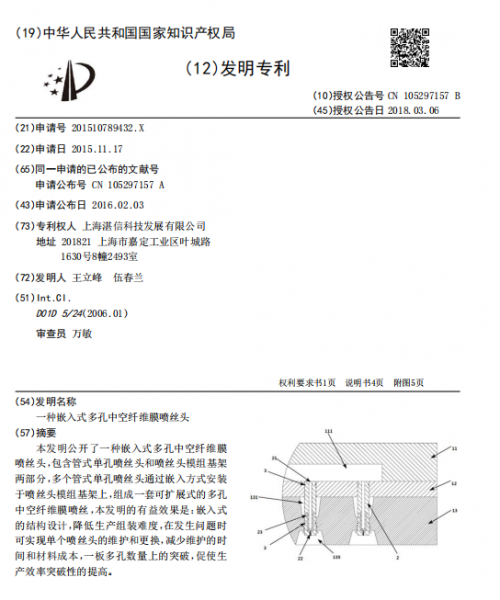
上海湛信科技(鑫高度)取得嵌入式中空纤维膜喷丝头发明专利
Zhong Guo Chan Ye Jing Ji Xin Xi Wang· 2025-08-25 04:01
Core Viewpoint - Shanghai Zhanxin Technology Development Co., Ltd. has achieved a breakthrough in the field of hollow fiber membrane spinnerets with the authorization of a national invention patent for its "embedded multi-porous hollow fiber membrane spinneret" [1][3] Group 1: Innovation and Technology - The patented technology addresses industry pain points such as low production efficiency and high maintenance costs associated with traditional spinnerets [3] - The innovative structure of the spinneret, which includes a modular base frame and a tubular single-hole spinneret, allows for the simultaneous production of hundreds of membrane fibers, significantly increasing production efficiency by several dozen times compared to traditional single-hole spinnerets [3] - The patent achieves dual breakthroughs in "multi-porous expansion" and "convenient maintenance," reducing maintenance time from hours to minutes and lowering material waste by over 80% [3] Group 2: Market Position and Applications - The patented technology has been successfully applied in critical areas such as environmental water purification and medical dialysis membranes, supporting the company's continuous product upgrades from the 5th to the 9th generation of spinneret products [5] - The company serves 634 global customers, holds over 90% market share in the domestic high-end market, and has expanded into 37 countries and regions, establishing itself as a benchmark enterprise in the hollow fiber membrane spinneret field in China [5] - As a national high-tech enterprise, the company has accumulated over 40 independent intellectual property rights, showcasing its innovative strength under the "integration of production, education, research, and application" development model [5]

商务沟通洽谈不再依靠人工同传,时空壶W4Pro打破外贸新场景
Zhong Guo Chan Ye Jing Ji Xin Xi Wang· 2025-08-25 03:58
Core Insights - The W4Pro AI simultaneous translation headset has emerged as a revolutionary tool for enhancing cross-language communication in the global business environment, addressing the increasing demand for effective multilingual communication solutions [1][7] Group 1: Key Features - The W4Pro headset boasts a high translation accuracy rate of 96%, with a 15% improvement in accuracy during low-volume speech, making it suitable for both formal meetings and casual discussions [1] - It supports two-way phone translation in 40 languages, allowing business professionals to communicate seamlessly with international partners without the need for professional interpreters [3] - The headset's hardware design includes a three-microphone array for precise voice localization and vector noise reduction technology, ensuring clear communication even in noisy environments like international exhibitions [5] Group 2: Applications - In high-stakes business dinners, the W4Pro effectively facilitates communication among executives by accurately translating industry jargon and colloquial expressions, fostering potential collaboration opportunities [1] - During international trade discussions, the headset helps avoid misunderstandings regarding order details, thereby preventing delays and disputes in foreign trade operations [3] - The audio and video translation capabilities of the W4Pro enhance business learning and collaboration by providing real-time translations and generating bilingual subtitles for online seminars and internal team meetings [7]

从"炫技"到"实用":人工智能加速落地应用
Zhong Guo Chan Ye Jing Ji Xin Xi Wang· 2025-08-25 03:01
Group 1: AI Technology Evolution - Artificial intelligence is transitioning from a "cool concept" to a practical tool integrated into various aspects of production and daily life, driven by policy guidance and market demand [1][2] - The State Council's recent approval of the "Artificial Intelligence+" action plan aims to promote large-scale commercial applications of AI across various sectors, providing clear direction for technology implementation [1][2] Group 2: Market Trends and Growth - By 2025, the AI terminal market is expected to flourish, with AI smartphones, glasses, and computers becoming mainstream, driven by practical applications rather than just technical specifications [4][5] - AI smartphone penetration is projected to reach 34% by 2025, with significant growth in the mid-range market, allowing more consumers to benefit from smart technology [4] - The global smart glasses market saw a shipment of 1.487 million units in Q1 2025, marking an 82.3% year-on-year increase, with China experiencing a 116.1% growth [4] Group 3: Intelligent Devices and Applications - AI computers are evolving to perform generative AI tasks and real-time data analysis, with expected shipments exceeding 100 million units by 2025, accounting for 40% of total PC shipments [5] - Wearable devices like headphones and smartwatches are emerging as new AI interaction points, contributing to a significant increase in sales in the digital product sector [5] Group 4: Intelligent Agents Development - Intelligent agents are evolving from auxiliary tools to decision-making hubs, capable of executing complex tasks and improving operational efficiency across various industries [6][7] - Companies like China Mobile and Lenovo are enhancing AI collaboration and integration, enabling intelligent agents to perform tasks across multiple applications and sectors [6][7] Group 5: Sector-Specific Applications - In education, AI tutors are personalizing learning paths, leading to significant improvements in student performance, while in healthcare, AI-assisted surgical systems are reducing error rates [7] - The application of intelligent agents in finance and manufacturing is streamlining processes and enhancing accuracy, indicating a shift from efficiency tools to collaborative partners in various industries [7]
白酒企业瞄准光瓶酒赛道
Zhong Guo Chan Ye Jing Ji Xin Xi Wang· 2025-08-25 00:42
Core Insights - The light bottle liquor segment has become a significant focus for the Chinese liquor industry in 2023, with many companies targeting this market to capture lower-tier consumers [1][2] - The market for light bottle liquor is projected to grow from 988 billion yuan in 2021 to over 1500 billion yuan in 2024, with a compound annual growth rate of 13.8% [2] Industry Trends - Major liquor companies such as Jiangsu Yanghe Brewery Co., Ltd., Luzhou Laojiao Co., Ltd., Anhui Gujing Distillery Co., Ltd., and Jiangsu Jinshiyuan Liquor Co., Ltd. have launched new products in the light bottle liquor category this year [1] - The shift in consumer demand towards light bottle liquor is driven by a combination of rational consumption, the rise of younger demographics, and an upgrade in quality expectations [1][2] Market Dynamics - The light bottle liquor market is currently characterized by a fragmented competitive landscape, with no clear leading groups among participants [2] - The price range for light bottle liquor is expanding, with products now available from tens to hundreds of yuan, indicating a transition from being perceived as low-end to quality liquor [2]


浙江科技创新投入2030年将达到1.1万亿元
Zhong Guo Chan Ye Jing Ji Xin Xi Wang· 2025-08-25 00:42
Group 1 - The core viewpoint of the news is that Zhejiang Province is implementing a comprehensive plan to enhance its innovation ecosystem and establish a robust mechanism for technology innovation investment, focusing on artificial intelligence, life health, new materials, and new energy [1][2] - By 2027, the total technology innovation investment in Zhejiang is expected to exceed 900 billion yuan, with R&D expenditure surpassing 360 billion yuan and accounting for over 3.4% of GDP [2][3] - The plan aims to create a favorable environment for innovation, with government technology innovation investment exceeding 150 billion yuan and a well-established technology finance system [2][3] Group 2 - The government will increase its technology innovation investment steadily, ensuring that the growth rate of government funding exceeds that of regular fiscal revenue [3] - Enterprises are encouraged to enhance their technology innovation investments, with financial rewards for those meeting specific R&D criteria [3] - The initiative includes the establishment of a rigid growth mechanism for R&D expenses in state-owned enterprises, with annual increases exceeding the provincial average by 2 percentage points [3]
订单压力缓解+情绪面好转 风向标钢企再度调涨钢材出厂价
Zhong Guo Chan Ye Jing Ji Xin Xi Wang· 2025-08-25 00:41
Group 1 - The core viewpoint is that China Baowu has raised steel prices for September due to easing order pressure and increased downstream restocking expectations as the off-season approaches its end [1][3] - Specific price increases include a rise of 200 CNY/ton for thick plates, hot-rolled products, non-oriented silicon steel, high aluminum zinc aluminum magnesium plates, aluminum zinc plates, and color-coated plates, and a rise of 300 CNY/ton for pickled products, cold-rolled products, hot-dip galvanized plates, electro-galvanized plates, and medium aluminum zinc aluminum magnesium plates compared to August [1] - The current market shows improved purchasing willingness among merchants, with steady downstream order growth and strong overseas industrial product consumption driving continued export order growth [1][2] Group 2 - The steel market is characterized by low inventories of finished products and raw materials in the manufacturing sector, with expectations for a stronger peak season [2] - Steel companies are maintaining profits, with flat steel gross margins expected to rise to 250-300 CNY/ton in August, while supply remains stable and steel inventories are low [2] - Export demand is expected to continue supporting the market, with July export data showing a year-on-year increase, particularly in industrial products, driven by international trade dynamics [2]
