
Guo Ji Jin Rong Bao

Search documents
A股震荡轮动下,如何抓住机会?
Guo Ji Jin Rong Bao· 2026-01-19 18:30
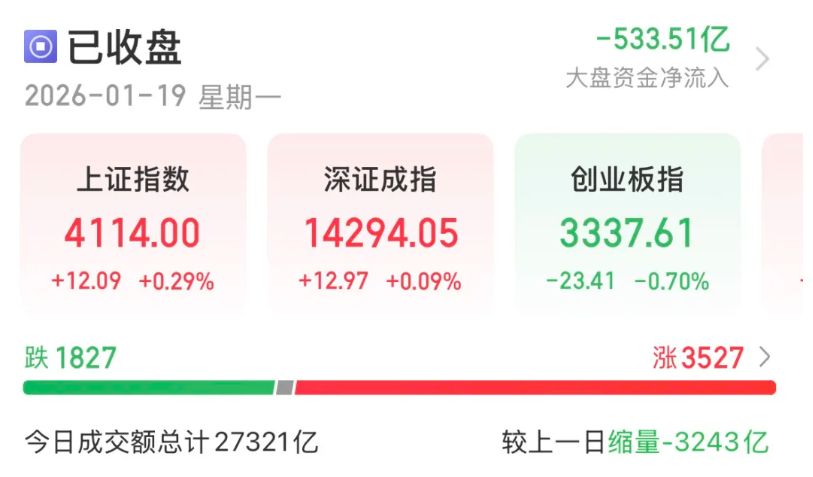
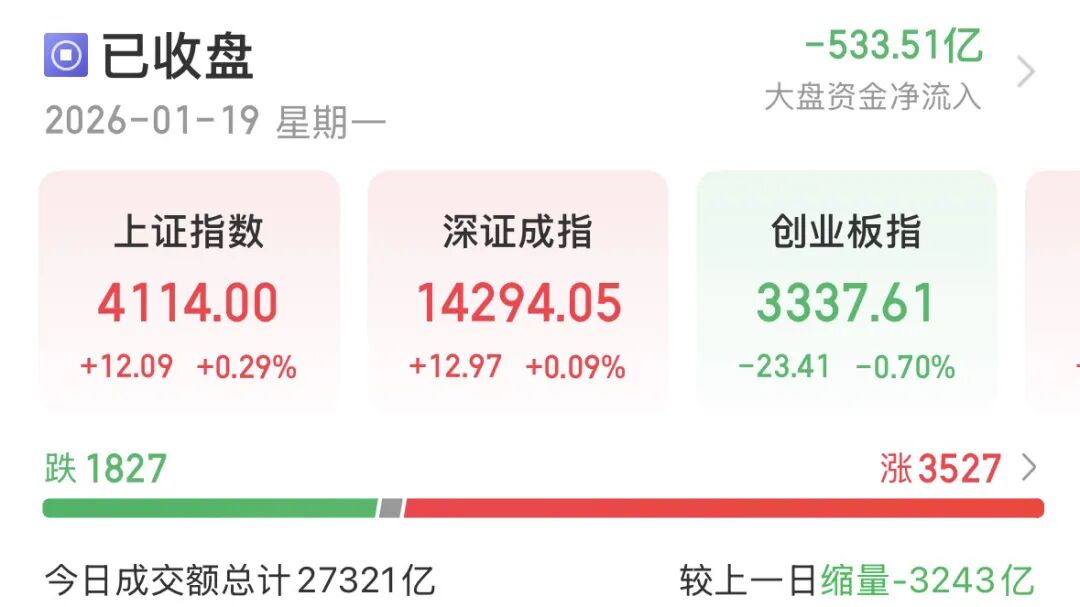
Core Viewpoint - The A-share market continues to experience narrow fluctuations, with most stocks closing in the green but showing increased differentiation and accelerated rotation, particularly in the power equipment sector, aerospace, and a continued pullback in AI applications [1][3]. Market Performance - The Shanghai Composite Index rose by 0.29% to 4114 points, while the ChiNext Index fell by 0.7% to 3337.61 points. The Shenzhen Component, CSI 300, and Northbound 50 indices showed slight gains, while the Sci-Tech 50 and SSE 50 indices experienced minor declines [4]. - The trading volume decreased to 324.3 billion yuan, with a total turnover of 2.73 trillion yuan. As of January 16, the margin financing balance in the Shanghai and Shenzhen markets increased to 2.73 trillion yuan [4]. Stock Performance - A total of 3527 stocks closed higher, with 103 hitting the daily limit up, while 1828 stocks closed lower, with 30 hitting the daily limit down. Only 16 stocks had a daily turnover exceeding 10 billion yuan [6]. - Notable performers included TBEA Co., Ltd. (30.50 yuan, +66.6%), Goldwind (27.70 yuan, +2.44%), and China Satellite (104.89 yuan, +2.93%) [7][12]. Sector Analysis - The power equipment sector saw significant gains, with 23 stocks hitting the daily limit up. Key contributors included TBEA Co., Ltd., which rose by 66.6%, and several other companies in the sector showing increases of over 10% [12][13]. - The chemical, oil, automotive, and military sectors also performed well, while sectors such as computers and communications experienced declines [10][15]. Investment Strategy - Investors are advised to focus on sectors with strong industrial trends, clear policy expectations, and robust earnings performance. There is a caution against sectors that have seen significant price increases and high valuations [3][15]. - The market is expected to maintain a "slow bull" trend under policy support, with a focus on structural opportunities in industries like new energy, digital economy, and aerospace [14][18].


金银价格再创新高 还能涨多久?
Guo Ji Jin Rong Bao· 2026-01-19 17:39
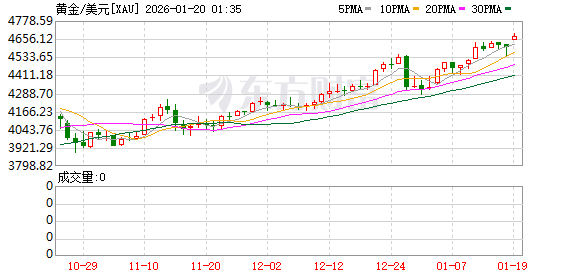
Core Viewpoint - Gold and silver prices have reached historical highs, driven by geopolitical tensions and market uncertainties, particularly following the announcement of punitive tariffs by the U.S. on several European countries [3][4][5]. Group 1: Market Performance - As of January 19, gold prices surged by 1.73% to $4,675.213 per ounce, with an intraday high of $4,690 per ounce [3]. - Silver prices increased by 3.75%, reaching $93.514 per ounce, with a peak of $94.12 per ounce during the day [3]. - COMEX gold futures rose by 1.81% to $4,678.4 per ounce, while COMEX silver futures jumped by 5.44% to $93.35 per ounce [3]. Group 2: Factors Behind the Surge - The price increase was triggered by U.S. President Trump's announcement of a 10% tariff on goods from eight European countries, which could rise to 25% if disputes continue [4][5]. - This geopolitical move has heightened market fears and increased demand for safe-haven assets like gold and silver [5][6]. Group 3: Market Sentiment and Future Outlook - Analysts suggest that the recent price surge reflects both immediate reactions to geopolitical risks and underlying structural trends in the precious metals market [6]. - The long-term outlook for gold remains bullish due to ongoing geopolitical tensions and central bank gold purchases, despite potential short-term volatility [7]. - Silver's price dynamics are more complex, influenced by industrial demand and potential supply constraints, which may support higher prices in the long run [7][8].
中国星网低轨19组卫星成功发射 卫星研制方系银河航天
Guo Ji Jin Rong Bao· 2026-01-19 17:27
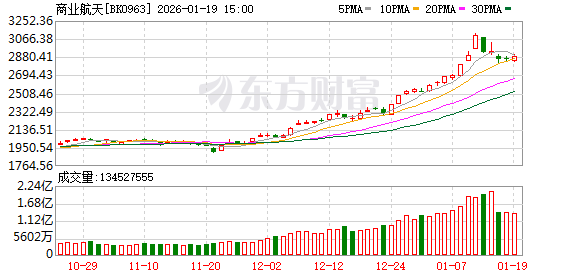
Core Insights - Satellite mass production has become a key capability for the development of new space infrastructure [2][3] - The China Star Network, responsible for the first giant satellite internet project in China, aims to establish a global integrated communication system with a target of 400 satellites in orbit by 2027 [2] Group 1: Company Overview - Galaxy Space, founded in 2018, is a leading private satellite internet company in China and the first unicorn in the commercial space sector [3] - The company focuses on the independent research and low-cost mass production of communication payloads, core components, and satellite platforms [3] Group 2: Technological Advancements - The recent satellite group developed by Galaxy Space incorporates several core technologies, including phased array, millimeter-wave antennas, and integrated electronics, showcasing industry-leading technical levels and cost advantages [3] - The company has achieved a fully digital process for satellite production, implementing automated testing, intelligent assembly, and optimized launch procedures to significantly enhance production efficiency [3] Group 3: Recent Developments - On January 19, 2024, Galaxy Space successfully launched a group of 19 low-orbit satellites, marking its second batch of satellites for space infrastructure construction [2] - The company’s satellite factory has established a complete industrial ecosystem from component development to satellite integration testing, continuously improving batch production efficiency and shortening development cycles [3]
A股震荡轮动下 如何抓住机会?
Guo Ji Jin Rong Bao· 2026-01-19 17:04
Core Viewpoint - The A-share market is expected to maintain a high-level oscillation pattern in the short term, characterized by a "slow bull" market under policy support, with a focus on sectors with strong industrial trends, clear policy expectations, and robust earnings realization [3][13][14]. Market Performance - The Shanghai Composite Index rose by 0.29% to 4114 points, while the ChiNext Index fell by 0.7% to 3337.61 points, indicating a mixed performance across indices [4]. - The total trading volume decreased to 2.73 trillion yuan, with a margin balance of 2.73 trillion yuan as of January 16 [4]. Sector Performance - The electric power equipment sector saw a surge, with 23 stocks hitting the daily limit, including notable gains from companies like TBEA Co., Ltd. and Goldwind Science & Technology [10][11]. - Traditional industries such as chemicals and oil, as well as emerging sectors like military industry, attracted significant capital, aligning with China's industrial upgrade and economic restructuring [13]. Individual Stock Highlights - TBEA Co., Ltd. (stock code: 600089) experienced a 66.6% increase year-to-date, with a market capitalization of 154.1 billion yuan [5]. - Goldwind Science & Technology (stock code: 002202) saw a year-to-date increase of 244%, with a market capitalization of 117 billion yuan [5]. - The defense and military sector had seven stocks hitting the daily limit, including AVIC Aircraft and AVIC Power [12]. Investment Strategy - Investors are advised to focus on sectors with long-term growth potential, such as new energy, digital economy, and aerospace, while also considering market capital flows and industry trends for portfolio adjustments [16]. - The recommended investment strategy includes a focus on "technology innovation + cyclical growth," with an emphasis on high-dividend stocks as a stable base [16].



市值缩水近四成 华润饮料换帅破局
Guo Ji Jin Rong Bao· 2026-01-19 16:04
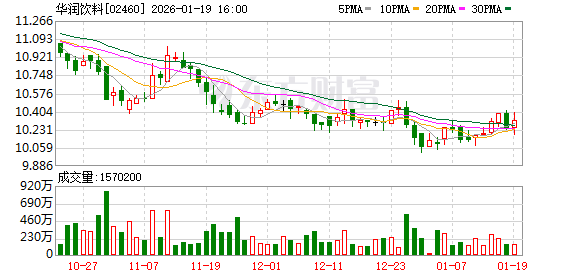
Core Viewpoint - The leadership change at China Resources Beverage, with Gao Li taking over as chairman, comes at a critical time as the company faces performance pressures and intensified industry competition [2][3]. Group 1: Leadership Change - Gao Li, a veteran of the China Resources Group, has been appointed as the new chairman, succeeding Zhang Weitong, who stepped down due to work adjustments [2]. - Gao Li has a strong financial background, having served as the financial director of China Resources Beverage from 2012 to 2020 and as the general manager of the finance department of China Resources Group since January 2025 [2]. Group 2: Performance Challenges - China Resources Beverage's revenue growth has stagnated, with a reported revenue of 13.52 billion yuan in the year of its IPO, reflecting only a 0.05% increase, while profit growth of 23.12% was primarily due to cost control [4]. - In the first half of 2025, the company experienced a decline in both revenue and profit, with revenue dropping to 6.206 billion yuan, a year-on-year decrease of 18.52%, and net profit falling to 808 million yuan, down 28.63% [4]. Group 3: Market Competition - The bottled water market has seen significant changes, with competitors like Wahaha and Nongfu Spring impacting China Resources Beverage's sales, particularly in the small-sized bottled water segment [5]. - In the first half of 2025, Nongfu Spring's bottled water revenue grew by 10.7% to 9.443 billion yuan, while China Resources Beverage's revenue in the same segment fell by 23.1% to 5.251 billion yuan [6]. Group 4: Strategic Initiatives - To diversify its revenue streams, China Resources Beverage has been actively launching new products in tea, juice, and sports drinks, introducing 14 new SKUs in the first half of the previous year [7]. - Despite these efforts, non-water beverage revenue only accounted for approximately 15.4% of total revenue, indicating that the second growth curve has not yet materialized [7]. Group 5: Market Position and Valuation - China Resources Beverage's revenue has remained stagnant around 13.5 billion yuan in 2023 and 2024, with expectations that its total revenue for 2025 will likely be surpassed by competitors like Dongpeng Beverage and Yuanqi Forest [7]. - As of January 19, 2026, the company's stock price had dropped to 10.32 HKD, a decline of 29% from its one-year high and over 38% from its IPO closing price, resulting in a market capitalization of 24.749 billion HKD, down 36.8% from its IPO value [8].
市值缩水近四成,华润饮料换帅破局
Guo Ji Jin Rong Bao· 2026-01-19 16:02
Core Viewpoint - The leadership change at China Resources Beverage comes at a critical time as the company faces declining performance and increased competition in the beverage industry [1][3]. Group 1: Leadership Change - Zhang Weitong has stepped down as Chairman of China Resources Beverage due to work adjustments, with Gao Li taking over for a three-year term [1]. - Gao Li has a strong financial background and has previously held key positions within the China Resources Group, including serving as the CFO of China Resources Beverage from 2012 to 2020 [1]. Group 2: Performance Challenges - In 2024, China Resources Beverage's revenue growth stagnated, with total revenue at 13.521 billion yuan, reflecting a mere 0.05% increase, while net profit grew by 23.12% mainly due to cost control [3]. - By the first half of 2025, the company experienced a decline in both revenue and profit, with operating income at 6.206 billion yuan, down 18.52% year-on-year, and net profit at 0.805 billion yuan, down 28.63% [3]. - The core packaged water business, which accounts for nearly 90% of revenue, has seen significant declines, particularly in the sales of its flagship product, Yibao [3][5]. Group 3: Market Competition - The competitive landscape in the packaged drinking water market has shifted, with Wahaha regaining market presence and Nongfu Spring launching a low-priced product that negatively impacted Yibao's sales [3]. - In the first half of 2025, Nongfu Spring's revenue from packaged drinking water reached 9.443 billion yuan, a 10.7% increase, while China Resources Beverage's water segment revenue fell to 5.251 billion yuan, a 23.1% decline [5]. Group 4: Growth Strategy - China Resources Beverage has been criticized for its reliance on a single product line and has attempted to diversify by launching new products in tea, juice, and sports drinks [6]. - In the first half of 2025, non-water beverage revenue was 0.955 billion yuan, a 21.3% increase, but still only accounted for about 15.4% of total revenue, indicating that a second growth curve has not yet materialized [6]. Group 5: Market Position and Valuation - Competitors like Dongpeng Beverage and Yuanqi Forest are expected to surpass China Resources Beverage in revenue, with Dongpeng projected to exceed 20 billion yuan and Yuanqi Forest anticipating a 26% growth [8]. - China Resources Beverage's stock price has declined significantly, with a closing price of 10.32 HKD on January 19, 2026, down 29% from its peak and over 38% from its IPO price, leading to a market capitalization decrease of 36.8% from its initial value [8].
2025年四季报透视:“翻倍基”押中哪些赛道?
Guo Ji Jin Rong Bao· 2026-01-19 16:00
Core Viewpoint - High-performing funds that doubled their net value last year are maintaining high positions and continuing to invest heavily in AI infrastructure and humanoid robots, while also warning about the risk of overvaluation in popular sectors [1][2]. Group 1: High Position Operations - Over a hundred public funds have disclosed their Q4 2025 reports, including four funds that saw their net value increase by over 100% last year [2]. - The four funds that doubled their net value are: - China Europe Digital Economy with a stock position of 88.24% and a growth of 143.07% - Qianhai Kaiyuan Hong Kong and Shanghai Enjoy Life with a stock position of 94.5% and a growth of 122.08% - Rongtong Industry Trend Selection with a stock position of 93.09% and a growth of 100.22% - Huafu Technology Momentum with a stock position of 87.34% and a growth of 108.28% [2]. Group 2: Focus on Technology - The manager of China Europe Digital Economy fund emphasized a strategy focused on five core investment areas: AI infrastructure, AI applications, intelligent robots and autonomous driving, domestic AI supply chain, and edge AI [3]. - The fund increased its allocation to domestic AI and AI infrastructure while optimizing stock selection in intelligent robots, reducing exposure to autonomous driving and edge AI [3]. - Concerns about a potential "bubble" in the AI sector were raised, with the manager suggesting that the industry is in the early stages of bubble formation rather than at its peak [3]. Group 3: Sector-Specific Strategies - Qianhai Kaiyuan Hong Kong and Shanghai Enjoy Life fund is focused on global AI infrastructure, particularly in optical communication and liquid cooling, and plans to adjust holdings based on market changes [4]. - Huafu Technology Momentum fund continues to invest in the humanoid robot sector, covering various stages of production, while cautioning about uncertainties in technology paths and potential delays in mass production [4]. - Rongtong Industry Trend Selection fund adopts a more balanced approach, investing across technology, new energy, pharmaceuticals, and consumer sectors, while looking for new opportunities in AI, energy storage, and the internet [4].
达沃斯论坛今开幕:特朗普将携“史上最大美国代表团”参会
Guo Ji Jin Rong Bao· 2026-01-19 15:06
当地时间1月19日至23日,世界经济论坛(又称"达沃斯论坛")第56届年会在瑞士达沃斯举行。 与往年一样,这场年度会议将吸引世界各国政要、跨国企业高管以及民间社会代表齐聚这个阿尔卑斯山 小镇,围绕全球经济走势与地缘政治风险展开密集讨论。 但不同的是,会议召开之际的外部环境已发生显著变化。全球经济增长动能趋弱,地缘政治摩擦频繁, 主要经济体之间的政策协调空间持续收窄,国际体系的不确定性明显上升。在这样的背景下,达沃斯面 对的已不只是周期性波动,而是结构性转折。 世界经济论坛主席、挪威前外交大臣博格·布伦德在论坛召开前坦言,此次会议是在"世界经济论坛成立 以来最复杂的地缘政治背景下"举行的。这一判断,凸显了当前国际环境对多边对话机制构成的现实压 力。 在规则争议不断、联盟关系趋于紧张、国际信任持续流失的现实中,达沃斯论坛试图聚焦一个更为基础 的问题:在分歧扩大、共识稀缺的世界里,全球合作是否仍具备重启与修复的空间。 除何立峰外,出席年会的各国领导人还有美国总统特朗普、加拿大总理卡尼、德国总理默茨、欧盟委员 会主席冯德莱恩、阿根廷总统米莱、乌克兰总统泽连斯基,以及叙利亚过渡政府总统艾哈迈德·沙拉 等。 此外,还有约 ...
半月两波换帅!一汽大众押宝“老将”救场
Guo Ji Jin Rong Bao· 2026-01-19 15:04
Group 1 - The recent personnel changes at FAW-Volkswagen include Wang Shengli and Zhang Yan taking on new roles, while Wu Yingkai has stepped down, occurring shortly after Dong Xiuhui was appointed as the new Party Secretary and General Manager [2][3] - Wang Shengli, a veteran within the FAW-Volkswagen system, has extensive experience in both production and sales, having worked in various roles since joining in 2002, including leadership positions in sales and service operations [2][3] - Zhang Yan's background is less documented, with prior roles including serving as a member of the Discipline Inspection Commission and Director of the Party Inspection Office at China FAW [3] Group 2 - The leadership transition is part of a broader strategy as FAW-Volkswagen faces challenges, including a decline in sales and profitability, with 2025 sales figures showing a drop to 1.5871 million vehicles, down 4.3% from 2024 [4][6] - The company has struggled with a significant slowdown in growth since 2020, with sales growth of only 1.5% in 2020, followed by declines in subsequent years, highlighting issues with the transition to electric vehicles [6] - Despite the global increase in electric vehicle sales by the Volkswagen Group, FAW-Volkswagen's electric vehicle sales remain low, with the ID series achieving only 16,494 units for ID.4 CROZZ, 864 units for ID.6 CROZZ, and 1,363 units for ID.7 VIZZION in the previous year [6]
构建“有效市场”与“有为政府”新范式
Guo Ji Jin Rong Bao· 2026-01-19 14:55
党的二十大提出了中国式现代化的理论与战略方向,为我国区域经济发展描绘了崭新蓝图。 党的二十届四中全会为"十五五"时期擘画蓝图,并将"坚持有效市场和有为政府相结合"确立为经济 社会发展必须遵循的根本原则。这不仅是对社会主义市场经济规律认识的深化,更是在全球变局与国内 转型交织的关键阶段,推动区域经济实现系统性升级、支撑中国式现代化行稳致远的战略总纲。面向新 征程,如何将这一核心原则转化为构建优势互补、高质量发展区域经济新格局的具体实践,已成为支撑 中国式现代化行稳致远的时代命题与决胜关键。 中国式现代化开启了国家区域经济发展的崭新场景和复式赛道 第一,科技创新领域正以自立自强为重点,形成全球创新竞争新优势。通过构建教育、科技、人才 三位一体发展格局,强化基础研究布局,聚焦集成电路等"卡脖子"技术协同攻关,实施"人工智能+"行 动,推动技术赋能实体经济。 第二,产业发展领域正聚焦新质生产力,构建现代化产业体系新支柱。以智能化、绿色化、融合化 为方向,重点培育新能源、航空航天等战略性新兴产业,前瞻布局量子科技、生命科学等未来产业,深 入实施"专精特新"企业培育工程。 第三,改革开放领域正突出制度攻坚,激发高质量发展 ...