Jin Rong Shi Bao

Search documents
以耐心资本赋能“硬科技”创新 国家创业投资引导基金正式启航
Jin Rong Shi Bao· 2025-12-29 02:05
Core Viewpoint - The establishment of the National Venture Capital Guidance Fund aims to mobilize over one trillion yuan in funding to support strategic emerging industries and future industries through a three-tiered investment structure [1][2][5]. Group 1: Fund Structure and Objectives - The National Venture Capital Guidance Fund features a three-tier structure: "Fund Company - Regional Fund - Sub-Fund," designed to leverage central government funds to attract social capital [2][3]. - The fund aims to achieve a market "blood production" of one trillion yuan by effectively utilizing central funds to stimulate private investment [2]. - The fund will focus on early-stage investments, targeting seed and startup companies, with at least 70% of investments directed towards these stages [3]. Group 2: Investment Strategy - The fund emphasizes four investment principles: investing early, investing small, investing long-term, and investing in hard technology [3]. - Investments will be limited to companies with valuations below 500 million yuan, ensuring funds reach the grassroots level of various industries [3]. - The fund will have a 20-year lifespan, allowing for longer investment horizons, particularly in sectors like innovative pharmaceuticals that require extended return periods [3]. Group 3: Management and Oversight - A management model combining online monitoring and offline observers will be established to identify and mitigate risks early [4]. - The fund will implement a diversified exit strategy to ensure that investments can be recouped effectively, reducing reliance on IPOs [4][6]. - Performance evaluation will focus on overall effectiveness and post-investment support rather than the success of individual projects [4][6]. Group 4: Regional Funds and Initial Operations - Three regional funds have been established: Beijing-Tianjin-Hebei, Yangtze River Delta, and Guangdong-Hong Kong-Macao Greater Bay Area, each with a target scale exceeding 50 billion yuan [7][8]. - These regional funds are designed to implement national strategies and facilitate the flow of capital into local innovation and technology sectors [7][8]. - As of December 26, the regional funds have signed investment intentions with 49 sub-funds and 27 direct investment projects, indicating readiness for operational deployment [8].

深耕实体守初心 金融报国显担当
Jin Rong Shi Bao· 2025-12-29 02:04
Core Viewpoint - The article emphasizes the commitment of China Everbright Bank to support the national strategy and promote high-quality development during the "14th Five-Year Plan" period, focusing on serving the real economy and enhancing financial services in key areas such as technology innovation, green transformation, and common prosperity [1][2][19]. Group 1: Support for the Real Economy - China Everbright Bank has positioned itself as a key player in financing the real economy, focusing on major national strategies and improving the welfare of the public [2][19]. - The bank has provided financial services to over 300 national key projects, with significant credit support in areas like "new infrastructure" and regional development [2][3]. - The bank has issued over 200 billion yuan in loans for modern transportation systems, including significant support for the Beijing-Shanghai High-Speed Railway project [3]. Group 2: Green Finance Initiatives - The bank has integrated green finance into its development strategy, supporting sectors like green buildings and energy transition, with a green loan balance of 456.61 billion yuan, reflecting a growth of 333.50% during the "14th Five-Year Plan" [4]. - Innovative products such as carbon finance and sustainable loans have been developed to promote environmental sustainability [4]. Group 3: Financial Inclusion and Support for SMEs - China Everbright Bank has focused on empowering small and micro enterprises through automated loan products, with a loan balance of 228.62 billion yuan for its online product system [4]. - The bank has served over 20,000 clients in supply chain finance, with a business balance nearing 600 billion yuan, enhancing efficiency in financing [5]. Group 4: Wealth Management Transformation - The bank is transitioning from product sales to wealth management, achieving a retail asset under management (AUM) of over 3 trillion yuan, with a compound annual growth rate exceeding 10% [8][10]. - A comprehensive product system has been established, including over 1,000 wealth management products, catering to diverse customer needs [10][18]. Group 5: Digital Transformation and Technological Innovation - China Everbright Bank has made significant advancements in digital transformation, utilizing big data and AI to enhance service efficiency across various business processes [13][14]. - The bank has implemented a remote financial advisor model, integrating customer data and behavior analytics to improve client engagement [12]. Group 6: Social Responsibility and Community Engagement - The bank has focused on social responsibility, particularly in serving the elderly and rural communities, with initiatives like the "Thousand Sails Plan" for agricultural supply chain finance [19][20]. - Efforts in public welfare include educational support and disaster relief, reinforcing the bank's commitment to social value [20][21]. Group 7: Future Outlook - China Everbright Bank aims to deepen its financial services in key areas, enhancing its capabilities in governance, customer service, and risk management while contributing to national development goals [22].
深学细悟笃行习近平总书记在福州金融论述与实践启示
Jin Rong Shi Bao· 2025-12-29 01:32
Core Viewpoint - The development of urban commercial banks in China over the past 30 years has positioned them as key players in serving the local real economy, guided by the strategic tasks outlined in the 20th Central Committee's Fourth Plenary Session, emphasizing the importance of high-quality development and the role of various financial institutions in supporting the real economy [1][2]. Group 1: Leadership and Governance - Strengthening the leadership of the Communist Party is essential for ensuring effective financial services that align with economic development goals, as emphasized by Xi Jinping during his tenure in Fuzhou [3]. - The integration of party leadership with market principles is crucial for the healthy operation of financial institutions, highlighting the need for a collaborative approach between government and financial sectors [3]. Group 2: Strategic Planning - Strategic planning is vital for guiding high-quality economic development, with Xi Jinping advocating for long-term planning to avoid significant errors in local development [4]. - The "3820" strategic initiative led by Xi Jinping effectively integrated financial reforms into urban development, providing a framework for financial institutions to better serve local economies [4]. Group 3: People-Centric Financial Services - A focus on serving the people's needs is fundamental to financial institutions, with Xi Jinping stressing the importance of balancing economic and social benefits in financial services [5]. - Financial institutions are encouraged to enhance their service offerings to meet the diverse needs of the population, ensuring that financial services contribute to improving living standards [5]. Group 4: Risk Management - Risk prevention is a perpetual theme in financial work, with Xi Jinping highlighting the importance of managing financial risks to maintain economic stability [6]. - Financial institutions must develop robust risk management frameworks to safeguard against potential financial disruptions while effectively serving the real economy [6]. Group 5: Cultural Development - The cultivation of a distinctive financial culture rooted in Chinese traditions is essential for the sustainable development of financial institutions, as emphasized by Xi Jinping [7]. - Financial institutions are encouraged to uphold integrity and professionalism, ensuring that their operations are aligned with the values of trust and responsibility [7]. Group 6: Future Directions for Development - Urban commercial banks are urged to align their operations with national and local development goals, focusing on differentiated and specialized services to enhance their competitive advantages [9][10]. - Emphasizing innovation and reform is critical for the transformation of financial institutions, with a focus on leveraging technology to improve service efficiency and risk management [11][12].
战略科学家与耐心资本: 金融支持科技创新的机制重塑
Jin Rong Shi Bao· 2025-12-29 01:32
破解信息不对称的核心机制 《中共中央关于制定国民经济和社会发展第十五个五年规划的建议》提出,"十五五"时期应"在发 展中固安全,在安全中谋发展,强化底线思维,有效防范化解各类风险,增强经济和社会韧性,以新安 全格局保障新发展格局。"在这一总体部署下,完善金融体系、优化资本市场布局、增强市场内在稳定 性和应对冲击的能力,已成为关键着力点。其中,积极引导耐心资本进入市场,被视为优化市场生态、 提升市场长期韧性和抵御系统性风险能力的重要路径。 然而,当前我国耐心资本发展远滞后于国家战略要求、科技创新步伐与市场实际需求,其根本症结 在于前沿科技领域存在难以通过传统估值模型弥合的信息不对称。因此,战略科学家作为兼具深厚学术 积淀、前沿洞察力与产业转化视野的"关键少数",其个人信用已成为穿透信息不对称壁垒、承载科技信 用的人格化载体。深刻理解战略科学家在科技信用生成与传导中的独特作用机制,构建与之适配的赋能 体系与制度安排,不仅是立足国情破解耐心资本供给不足的创新路径,更是重塑金融支持科技创新底层 逻辑、实现"科技—金融"双向奔赴的现实选择,对建设科技强国与金融强国具有重大战略意义。 深刻理解战略科学家 在科技信用形成中 ...
耐心资本赋能绿色金融发展
Jin Rong Shi Bao· 2025-12-29 01:32
绿色发展是中国式现代化的鲜明底色,《中共中央关于制定国民经济和社会发展第十五个五年规划 的建议》(以下简称"'十五五'规划建议")明确提出"加快经济社会发展全面绿色转型,建设美丽中 国",而发展绿色金融是推动经济社会绿色转型的必然要求。目前,我国绿色金融的顶层设计基本形 成,绿色金融业务快速发展,根据中国人民银行统计,截至2025年三季度末,我国本外币绿色贷款余额 43.51万亿元,其中,基础设施绿色升级、能源绿色低碳转型、生态保护修复和利用为主要应用领域, 占比达74.97%,有力推动了我国经济社会的转型升级。近期,在《〈"十五五"规划建议〉辅导读本》 中,中国证券监督管理委员会主席吴清特别强调"加力培育壮大耐心资本、长期资本和战略资本",提 高"十五五"时期资本市场制度包容性、适应性。耐心资本作为一种注重长期投资、强调稳健回报的资本 形式,对于壮大绿色金融市场参与主体,为绿色金融发展提供可持续、长期、有耐心的资本具有重大意 义。 耐心资本在支持绿色金融发展方面具有天然优势 (一)从投资端来看,绿色金融领域为耐心资本提供了新的投资视角与机遇。2020年9月习近平总 书记在第七十五届联合国大会上正式宣布:"中 ...
从典型案例看资产管理公司重塑发展模式 评《中国特殊资产行业发展研究2025》
Jin Rong Shi Bao· 2025-12-29 01:32
Core Insights - The article discusses the evolving role of Asset Management Companies (AMCs) in China, particularly in managing non-performing assets and addressing financial risks in various sectors [1][2][4]. Group 1: Role of AMCs - AMCs were initially established to handle non-performing assets of banks, aiding in the reform of state-owned banks and enterprises [2]. - The book "Research on the Development of China's Special Asset Industry 2025" highlights the significant contributions of AMCs in risk resolution across key sectors such as real estate and local government debt [2][3]. - AMCs are increasingly involved in optimizing resource allocation and enhancing capital structures of enterprises, as seen in various case studies [3][5]. Group 2: Business Model Upgrades - AMCs are transitioning from traditional asset disposal to a more integrated approach that includes financial restructuring and risk management for enterprises [4]. - The shift towards a "three deep" model emphasizes in-depth restructuring to alleviate financial distress, moving away from rapid asset turnover [4]. - The emergence of direct services to real enterprises reflects a proactive risk prevention strategy, utilizing diverse methods such as bankruptcy restructuring and market-oriented debt-to-equity swaps [4][5]. Group 3: Enhancing Client Relationships - AMCs are expanding their focus from asset management to institutional collaboration, aiding struggling enterprises while fostering partnerships with industry leaders [5]. - The emphasis on identifying quality investors and providing tailored financial services is crucial for successful restructuring outcomes [5]. Group 4: High-Quality Development - The article underscores the need for AMCs to enhance their professional capabilities, operational mechanisms, and institutional frameworks to support high-quality development [7][8]. - Continuous improvement in investment research, banking capabilities, and innovation is essential for AMCs to navigate the complexities of the financial landscape [7]. - The establishment of a robust regulatory and assessment framework is necessary for AMCs to effectively fulfill their roles in risk management and economic stability [8].
供应链金融如何超越行业周期
Jin Rong Shi Bao· 2025-12-29 01:32
Core Viewpoint - The article emphasizes the necessity for a paradigm shift in supply chain finance, moving from an industry-focused perspective to a commodity-centric approach, which is essential for enhancing the effectiveness of financial services to the real economy [1][2][6]. Group 1: Shift in Perspective - The traditional supply chain finance model relies heavily on macroeconomic cycles and industry conditions, which limits its ability to accurately assess individual companies' resilience and risks [1][3]. - A refined focus on commodities allows for a more precise analysis framework that penetrates industry appearances to reveal the underlying value of businesses [2][3]. Group 2: Credit Assessment Transformation - Credit evaluation under the commodity perspective shifts from static financial data analysis to dynamic management of commodity price risks and hedging effectiveness, providing deeper insights into a company's operational health [4][6]. - This transformation supports the implementation of the central financial work meeting's directives, enabling financial resources to reach the core risk and value nodes of enterprises [4][6]. Group 3: Financial Ecosystem Restructuring - The integration of a commodity perspective is reshaping supply chain finance, leading to a new financial service ecosystem that aligns closely with industry dynamics [11][12]. - Financial institutions are encouraged to develop comprehensive risk management and financing solutions that encompass the entire supply chain cycle, enhancing operational efficiency and reducing credit friction [12][14]. Group 4: Role of Futures Market - A mature and efficient futures market is crucial for establishing a commodity perspective, as it provides essential infrastructure for price discovery, risk management, and resource allocation [7][9]. - The growth of China's futures market, with a significant increase in trading volume and product variety, reflects its alignment with national strategies to enhance capital market functions and support the real economy [9][10]. Group 5: Digital Transformation and Innovation - The adoption of digital technologies, such as blockchain and IoT, is transforming commodities into clear, traceable digital assets, facilitating better credit flow and risk management [5][13]. - The establishment of a digital credit infrastructure is essential for overcoming traditional barriers in financing and regulatory challenges associated with physical commodities [13][18]. Group 6: National Resource Security - The commodity perspective is not only a financial innovation but also a strategic necessity for ensuring national supply chain and resource security amid global geopolitical changes [15][23]. - The active participation of private enterprises in hedging activities demonstrates the effectiveness of the commodity-based supply chain finance model in managing price risks and stabilizing operations [16][19]. Group 7: Future Outlook - The future of supply chain finance is expected to evolve into a deeply integrated ecosystem that leverages technology and data across institutions and markets, enhancing the efficiency and safety of financial resource allocation to the real economy [24][25]. - This evolution is crucial for achieving the fundamental goal of improving financial services to the real economy, thereby supporting China's economic stability and growth [25][27].
央行副行长陆磊:新一代数字人民币计量框架、管理体系、运行机制和生态体系将于2026年1月1日正式启动实施
Jin Rong Shi Bao· 2025-12-29 01:19
Core Viewpoint - The 20th Central Committee's Fourth Plenary Session has approved the "Suggestions on Formulating the 15th Five-Year Plan for National Economic and Social Development," emphasizing the acceleration of building a financial powerhouse and the steady development of the digital RMB, providing a roadmap for its future development and improvement [1] Group 1: Digital RMB Development Direction - The digital RMB's positioning and development direction must align with market-oriented and legal frameworks, addressing the challenges posed by modern digital payment tools and ensuring effective monetary control [2] - The People's Bank of China (PBOC) initiated research and closed testing of digital RMB in 2014, establishing a management system and operational mechanism based on extensive trials and evaluations [3] Group 2: Current Achievements and Capabilities - The domestic and cross-border trials of digital RMB have shown positive results, with the digital RMB demonstrating capabilities as a universal mixed currency, programmable currency, efficient regulatory currency, and full-scenario currency [4] - As of November 2025, digital RMB has processed 3.48 billion transactions, amounting to 16.7 trillion yuan, with 230 million personal wallets opened [4] Group 3: Challenges Faced by Central Banks - Central banks globally face challenges in recognizing the impact of rapidly evolving digital payment tools on monetary control, requiring a balance between low-cost, high-efficiency digital payment methods and effective macroeconomic regulation [5] - The development of digital cash poses risks of financial disintermediation, as it operates independently of financial intermediaries, potentially affecting liquidity in the banking system [6] Group 4: Digital RMB Management Framework - The "Action Plan" outlines a transition from digital cash to digital deposit money, with the digital RMB being a modern payment and circulation tool supported by the central bank and compatible with distributed ledger technology [8] - The dual-layer operational framework of the digital RMB, which involves both the central bank and commercial banks, has been recognized as a global standard for ensuring financial stability [9][10] Group 5: Risk Management and Regulatory Framework - The "Action Plan" emphasizes the need for a clear delineation of responsibilities between the central bank and commercial banks to mitigate risks associated with financial disintermediation and shadow banking [11] - The establishment of a digital RMB management committee and the use of advanced regulatory technologies like AI and big data are crucial for enhancing regulatory capabilities and ensuring financial stability [18]

中国人民银行副行长陆磊:守正创新 稳步发展数字人民币
Jin Rong Shi Bao· 2025-12-29 00:16
一、坚持与时俱进把握数字人民币定位和发展方向 习近平总书记明确要求,"坚持在市场化法治化轨道上推进金融创新发展。金融的安全靠制度、活力在 市场、秩序靠法治"。随着2008年国际金融危机爆发,数字资产、加密货币和新型支付工具层出不穷。 这既是经济数字化、智能化在金融领域的客观反映,也带来了影子银行、金融脱媒等一系列微观宏观金 融风险挑战。面对新形势,主要经济体中央银行、国际组织纷纷开始中央银行数字现金(Central Bank Digital Currency,CBDC)研发。2018年,国际清算银行定义中央银行数字现金为"中央银行发行的价 值/区块链模式的数字现金"。欧洲中央银行则定义为"一种以数字形式提供给公民和企业用于零售支付 的央行负债"。这些经济体和国际组织从中央银行职责视角审视数字货币。 我国数字人民币的研究和开发起步较早。2014年,在党中央、国务院的统一部署下,中国人民银行启动 理论研究和封闭测试。2016年,中国人民银行提出了具有数字货币特征的电子支付工具(DC/EP)的法 定数字货币理论框架构想,审慎科学稳健试点探索数字人民币(e-CNY)管理体系和运行机理。经反复 论证和开放试点,初步构建 ...
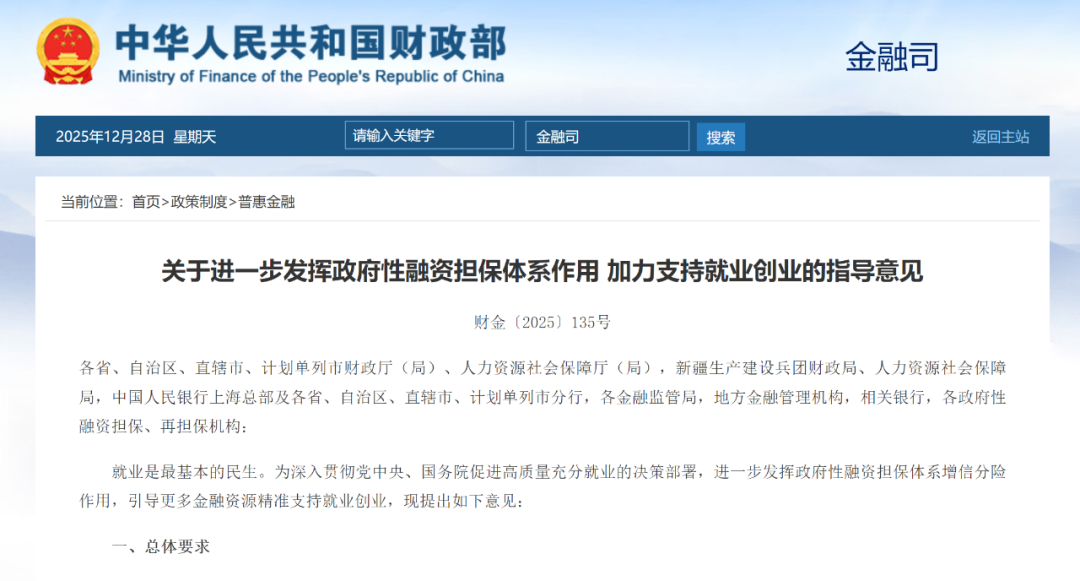
四部门联合发文,万亿级利好精准支持就业创业→
Jin Rong Shi Bao· 2025-12-28 23:22
Core Viewpoint - The core viewpoint of the news is the issuance of the "Guiding Opinions" by the Ministry of Finance, aimed at enhancing the role of government financing guarantee systems to support employment and entrepreneurship, thereby stabilizing employment and expanding domestic demand [3]. Group 1: Government Financing Guarantee System - The guiding opinions emphasize increasing the contribution of government financing guarantees to employment, serving as a crucial policy tool for supporting small and micro enterprises, promoting employment, and expanding domestic demand [3]. - The Ministry of Finance has led the development of a government financing guarantee system, which has involved over 1,500 guarantee institutions, with a cumulative re-guarantee business scale exceeding 6.7 trillion yuan, growing at an annual rate of approximately 40% [3][4]. - The average guarantee fee rate for cooperating institutions has dropped to below 1%, while the comprehensive financing cost for small and micro enterprises has decreased to below 5% [3]. Group 2: Employment Support - It is estimated that every 100 million yuan in guarantees can stabilize employment for over 800 people, with the financing guarantee system having served over 5.7 million small and micro enterprises, stabilizing approximately 59 million jobs [4]. - The guiding opinions establish a quantitative evaluation and incentive mechanism to enhance the employment contribution of government financing guarantees, including a key indicator for employment contribution and two linkage mechanisms [4][5]. Group 3: Support for Key Groups - The guiding opinions focus on enhancing entrepreneurial guarantee loan policies for key groups, including college graduates, migrant workers, and veterans, aiming to leverage fiscal funds to support approximately 1.75 million entrepreneurs for every 100 million yuan in central fiscal subsidies [4][5]. - The opinions propose a differentiated discount mechanism for re-guarantee fees based on employment contribution, with discounts of up to 20% for institutions with higher employment contributions [5]. - The government financing guarantee institutions will gradually reduce or eliminate collateral requirements for labor-intensive small and micro enterprises, thereby lowering the financing entry threshold [5][6].