
Jin Rong Shi Bao

Search documents
商业火箭,上天也上市
Jin Rong Shi Bao· 2025-12-29 15:01
Core Viewpoint - The Shanghai Stock Exchange has released guidelines to support commercial rocket companies in listing on the Sci-Tech Innovation Board, marking a significant step for China's commercial space industry as it seeks to enhance its competitiveness and technological capabilities [1][2]. Group 1: Guidelines Overview - The guidelines consist of 14 provisions focusing on four main areas: technological advantages, phased achievements, necessary approvals from relevant authorities, and significant market potential [2]. - The guidelines emphasize the importance of "hard technology" attributes for companies, requiring them to have relevant qualifications in research and manufacturing, and to obtain launch permits before commercial rocket launches [3]. - Companies must demonstrate significant technological advantages and have achieved specific milestones, such as successfully launching a reusable medium to large rocket payload into orbit [3][4]. Group 2: Industry Context and Support - The guidelines aim to enhance the inclusivity and adaptability of the capital market, supporting the development of commercial rockets as a key component of China's space industry [2][6]. - The commercial space sector is seen as a vital force in advancing the aerospace industry and achieving national strategic goals, with a projected market potential reaching trillions [6][7]. - The guidelines are part of a broader trend of increasing support for commercial space enterprises, with several companies already preparing for IPOs under the new standards [7][8]. Group 3: Market Position and Commercialization - Companies seeking to list must hold a prominent position in the industry, have a clear target market, and demonstrate a competitive edge over rivals [5]. - The guidelines also require companies to have a clear commercialization plan from technology validation to large-scale operations [5]. - The capital market's support is crucial for overcoming challenges in technology complexity, funding, and long development cycles, which are currently hindering the large-scale commercialization of commercial rockets [7][8].


前11个月国企实现利润超2万亿元,私企1.93万亿元
Jin Rong Shi Bao· 2025-12-29 14:01
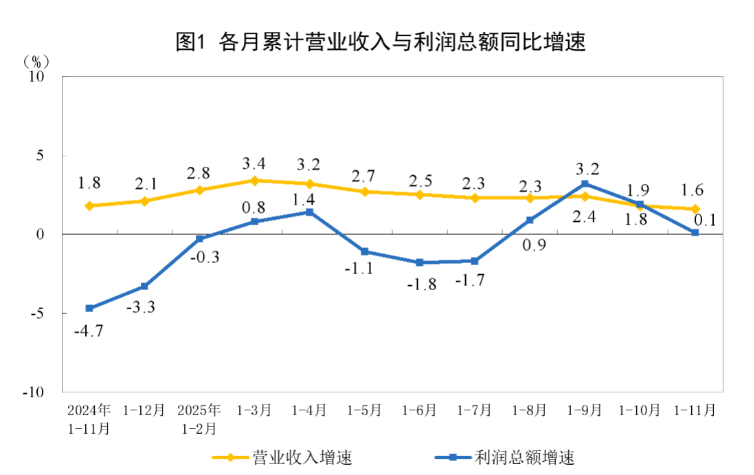
Core Insights - In the first eleven months of 2025, the total profit of large-scale industrial enterprises in China reached 66,268.6 billion yuan, reflecting a year-on-year growth of 0.1% [1] By Enterprise Type - State-owned enterprises reported a total profit of 20,083.6 billion yuan, a decrease of 1.6% year-on-year [4] - Shareholding enterprises achieved a total profit of 49,565.6 billion yuan, down by 0.4% [4] - Foreign and Hong Kong, Macao, and Taiwan-invested enterprises saw a profit of 16,355.3 billion yuan, an increase of 2.4% [4] - Private enterprises recorded a total profit of 19,319.9 billion yuan, a slight decline of 0.1% [4] By Industry Type - The manufacturing sector generated a total profit of 50,317.9 billion yuan, marking a growth of 5.0% [6] - The mining industry reported a profit of 7,896.3 billion yuan, down by 27.2% year-on-year [6] - The electricity, heat, gas, and water production and supply sector achieved a profit of 8,054.4 billion yuan, increasing by 8.4% [6] Key Industries - The computer, communication, and other electronic equipment manufacturing industry experienced a profit increase of 15.0% [7] - The automotive manufacturing sector saw a profit growth of 7.5% [7] - The agricultural and sideline food processing industry grew by 4.8% [7] - The oil and natural gas extraction industry faced a profit decline of 13.6% [7] - The coal mining and washing industry suffered a significant drop of 47.3% [7] Monthly Performance - In November, the profits of large-scale industrial enterprises fell by 13.1% year-on-year [8]
连休三天!元旦假期攻略来了→
Jin Rong Shi Bao· 2025-12-29 10:22
Group 1 - The travel market is expected to show characteristics of "having fun and doing more" during the New Year's holiday in 2026, with a significant increase in consumer travel willingness [1] - Popular long-distance routes such as Shenzhen-Harbin, Beijing-Kunming, and Beijing-Xishuangbanna are seeing a surge in travelers, with numbers exceeding those on December 31 [1] - Cities with unique features like "immersive experiences," "nearby micro-vacations," and "high-cost performance ski resorts" are emerging as unexpected popular destinations for the New Year's holiday [1] Group 2 - The trend of "new entrants expanding and main players upgrading" is evident, with a 130% year-on-year increase in bookings from travelers born after 2005, indicating strong growth potential among younger demographics [2] - Travelers aged 1990-1999, known as the "post-90s," represent 40% of New Year's holiday bookings, with an average order value increasing by 17% year-on-year, reflecting a willingness to pay for high-quality services and experiences [2] - Hotel bookings in popular areas for New Year's Eve, such as Changsha, Xi'an, and Chongqing, have seen significant year-on-year growth, with some locations experiencing increases of up to 5 times [2]
刷新今年纪录!沪指“9连阳”
Jin Rong Shi Bao· 2025-12-29 08:48
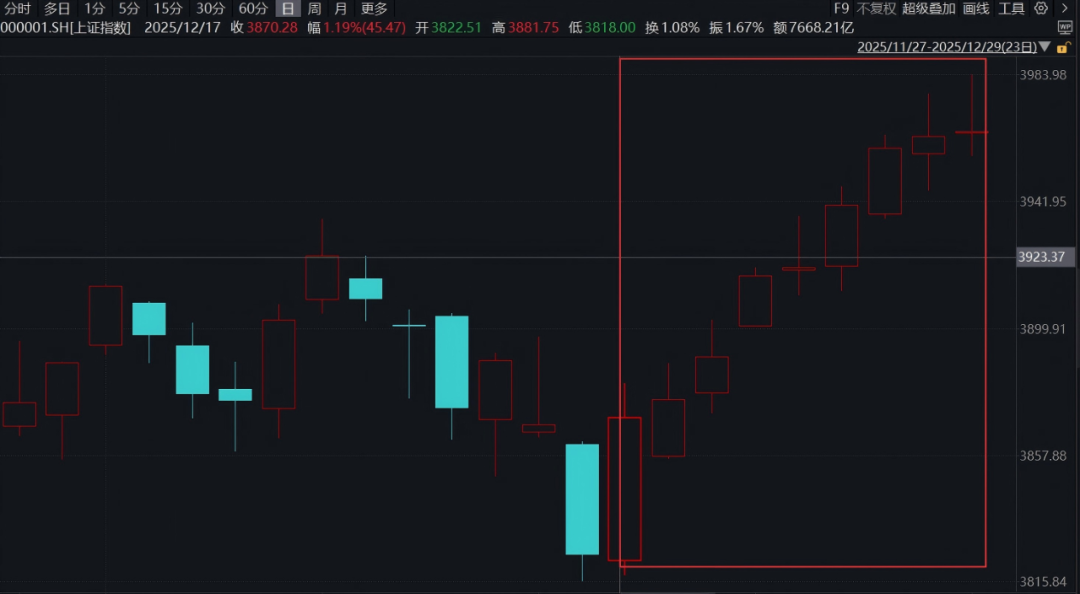
Market Performance - The Shanghai Composite Index has achieved a "9 consecutive days of gains," marking the longest streak of the year [1] - As of the market close on December 29, the Shanghai Composite Index rose by 0.04%, closing at 3965.28 points, while the Shenzhen Component Index and the ChiNext Index fell by 0.49% and 0.66%, closing at 13537.10 points and 3222.61 points respectively [3] Trading Volume - The total trading volume for the Shanghai and Shenzhen markets reached 21,393 billion yuan, showing a slight decrease compared to the previous trading day [3] Sector Performance - The top-performing sectors included PEEK materials (+3.23%), carbon fiber (+2.52%), and military restructuring concepts (+1.94%) [4][5] - Conversely, the sectors with the largest declines were dairy industry (-1.90%) and lithium extraction from salt lakes (-1.89%) [4][5] Weekly Market Overview - For the week of December 22 to December 26, major indices continued to show strength, with the Wind All A, CSI 300, and CSI 2000 indices increasing by 2.78%, 1.95%, and 3.06% respectively [6] - The average daily trading volume for the Wind All A reached 1.97 trillion yuan, surpassing 2 trillion yuan on December 26 [6]
央行副行长陆磊:新一代数字人民币计量框架、管理体系、运行机制和生态体系将于2026年1月1日正式启动
Jin Rong Shi Bao· 2025-12-29 06:01
SHMET 网讯:党的二十届四中全会审议通过的《中共中央关于制定国民经济和社会发展第十五个五 年规划的建议》提出"加快建设金融强国""稳步发展数字人民币",为今后一个时期数字人民币发展和 完善提供了行动指南。面向经济社会数字化、智能化发展趋势,为深入贯彻习近平总书记关于金融工 作的重要论述,顺应实体经济和金融体系对数字人民币发行、流通、使用的新需求,把握国际货币体 系演进的历史趋势,切实提升数字人民币管理质效和服务能力,在总结十年研发试点经验基础上,中 国人民银行将出台《关于进一步加强数字人民币管理服务体系和相关金融基础设施建设的行动方案》 (以下简称"《行动方案》"),新一代数字人民币计量框架、管理体系、运行机制和生态体系将于 2026年1月1日正式启动实施。 一、坚持与时俱进把握数字人民币定位和发展方向 习近平总书记明确要求,"坚持在市场化法治化轨道上推进金融创新发展。金融的安全靠制度、活力在 市场、秩序靠法治"。随着2008年国际金融危机爆发,数字资产、加密货币和新型支付工具层出不穷。 这既是经济数字化、智能化在金融领域的客观反映,也带来了影子银行、金融脱媒等一系列微观宏观金 融风险挑战。面对新形势,主 ...

上市公司倍轻松及实控人被立案!
Jin Rong Shi Bao· 2025-12-29 03:39
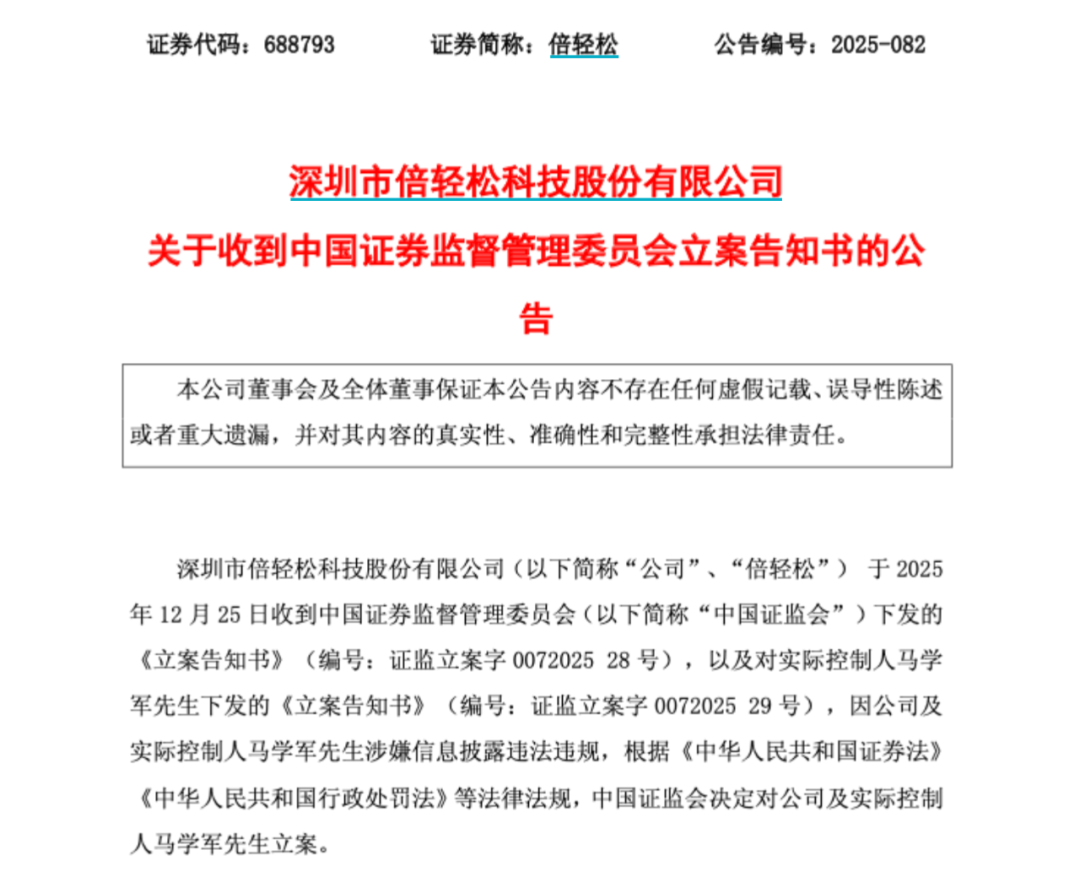
Core Viewpoint - Shenzhen Beiqing Technology Co., Ltd. (referred to as "Beiqing") is under investigation by the China Securities Regulatory Commission (CSRC) for suspected violations of information disclosure laws, which has led to a significant drop in its stock price and raised concerns about its internal governance and financial practices [1][3][7]. Group 1: Company Operations and Financial Performance - Beiqing's business operations are reported to be normal despite the ongoing investigation, and the company is committed to cooperating with the CSRC and fulfilling its disclosure obligations [3]. - The company went public on the STAR Market in July 2021, with a first-day surge of over 340%. In its first year, it achieved a revenue of 1.19 billion yuan, a year-on-year increase of 43.93%, and a net profit of 91.86 million yuan, up 29.92% [4]. - However, Beiqing has faced continuous financial pressure since its second year post-IPO, reporting losses of 124 million yuan in 2022 and 50.87 million yuan in 2023. In 2024, it briefly returned to profitability with a net profit of 10.25 million yuan, but the first three quarters of 2025 saw further deterioration, with losses exceeding 65 million yuan [4]. Group 2: Marketing and R&D Expenditure - Beiqing has been criticized for its heavy focus on marketing over research and development (R&D). From 2021 to 2025, R&D expenses as a percentage of revenue were only 3.97% to 7.02%, while sales expenses accounted for 40.75% to 56.03% of revenue [5]. - The company has invested heavily in advertising, with over 50% of sales expenses attributed to this area. Additionally, over 60% of its workforce is dedicated to sales, significantly higher than the industry average of less than 24% [5]. Group 3: Quality and Customer Complaints - Beiqing's focus on marketing has led to issues with product quality and after-sales service, resulting in numerous consumer complaints regarding product defects and poor service [6]. - The company is currently involved in a patent infringement lawsuit, with a claim amount of 10 million yuan, although it asserts that the products in question are not its core offerings [6]. Group 4: Internal Governance and Financial Issues - Beiqing has faced scrutiny for internal governance issues, including violations related to guarantees and the misuse of funds by its controlling shareholder, Ma Xuejun. Notably, there were instances of fund occupation amounting to 54 million yuan in 2024 [7][8]. - The company has acknowledged these issues and has implemented internal management measures to prevent recurrence. However, further inquiries from the stock exchange have raised questions about the effectiveness of these measures [8]. - In November 2025, Ma Xuejun sold shares worth over 64.7 million yuan, reducing his ownership stake from 40.48% to 37.51%, which has raised additional concerns about the company's governance [9].

深学细悟笃行习近平总书记在福州金融论述与实践启示 牢记中小银行初心使命 聚焦服务实体主责主业
Jin Rong Shi Bao· 2025-12-29 02:33
Core Viewpoint - The development of urban commercial banks in China over the past 30 years has positioned them as key players in supporting the local real economy, guided by the strategic direction set forth in the 15th Five-Year Plan, which emphasizes the importance of a modern industrial system and the role of various financial institutions in promoting high-quality development [1][2]. Group 1: Leadership and Governance - Strengthening the leadership of the Communist Party is essential for ensuring effective financial services that align with economic development goals, as emphasized by Xi Jinping during his tenure in Fuzhou [3]. - The integration of party leadership with market principles is crucial for the healthy operation of financial institutions, highlighting the need for a collaborative approach between government and financial sectors [3]. Group 2: Strategic Planning - Strategic planning is vital for guiding high-quality economic development, with Xi Jinping advocating for long-term planning to avoid significant errors in local development [4]. - The "3820" strategic initiative, which incorporates financial reforms into urban development planning, serves as a model for aligning financial institutions with local economic needs [4]. Group 3: People-Centric Financial Services - A focus on serving the people is fundamental to financial institutions, with an emphasis on balancing economic and social benefits to enhance the quality of life for citizens [5]. - Financial services should be designed to meet the diverse needs of the population, ensuring accessibility and inclusivity [5]. Group 4: Risk Management - Risk prevention is a continuous theme in financial operations, with a need for a robust risk management framework to support the stability of the real economy [6]. - Xi Jinping's emphasis on the relationship between financial stability and national economic health underscores the importance of effective risk management practices [6]. Group 5: Cultural Development - The cultivation of a distinctive financial culture rooted in Chinese traditions is essential for fostering ethical practices and enhancing public trust in financial services [7]. - Emphasizing integrity and responsibility in financial operations is crucial for building a reliable banking image [7]. Group 6: Future Directions for Urban Commercial Banks - Urban commercial banks are encouraged to align their operations with national and local development goals, focusing on differentiated and specialized services to enhance their competitive edge [8][9]. - Continuous innovation and reform are necessary for adapting to changing market conditions and improving service delivery to the real economy [10][11].
2025年三季度末 我国金融业机构总资产531.8万亿元
Jin Rong Shi Bao· 2025-12-29 02:22
本报讯记者马梅若报道中国人民银行日前发布的数据显示,初步统计,2025年三季度末,我国金融业机 构总资产为531.76万亿元,同比增长8.7%,其中,银行业机构总资产为474.31万亿元,同比增长7.9%; 证券业机构总资产为17.05万亿元,同比增长16.5%;保险业机构总资产为40.4万亿元,同比增长 15.4%。 金融业机构负债为485.85万亿元,同比增长8.8%,其中,银行业机构负债为435.95万亿元,同比增长 8%;证券业机构负债为13.25万亿元,同比增长19.2%;保险业机构负债为36.65万亿元,同比增长 15.3%。 ...
延续适度宽松基调 护航经济高质量发展
Jin Rong Shi Bao· 2025-12-29 02:22
12月18日,中国人民银行货币政策委员会召开2025年第四季度例会。 会议认为,今年以来,宏观调控力度加大,货币政策适度宽松,持续发力、适时加力,强化逆周期调 节,综合运用多种货币政策工具,服务实体经济高质量发展,为经济稳中向好创造适宜的货币金融环 境。 对于下一阶段货币政策主要思路,会议认为,要继续实施适度宽松的货币政策,加大逆周期和跨周期调 节力度,更好发挥货币政策工具的总量和结构双重功能,加强货币财政政策协同配合,促进经济稳定增 长和物价合理回升。"这与中央经济工作会议确定的货币政策基调保持高度一致,显示2026年货币政策 会延续支持性立场,在稳增长方向上进一步发力。"东方金诚首席宏观分析师王青如是分析。 更好发挥货币政策工具的总量 和结构双重功能 畅通货币政策传导机制 本次会议提到,强化央行政策利率引导,完善市场化利率形成传导机制,发挥市场利率定价自律机制作 用,加强利率政策执行和监督,并提出要"畅通货币政策传导机制,提高资金使用效率"。 此前,央行在三季度货币政策执行报告中也详细介绍了央行政策利率通过金融体系传导至不同细分市场 的利率传导机制。在业内专家看来,保持合理的利率关系,正是未来畅通利率传导 ...
以耐心资本赋能“硬科技”创新 国家创业投资引导基金正式启航
Jin Rong Shi Bao· 2025-12-29 02:05
Core Viewpoint - The establishment of the National Venture Capital Guidance Fund aims to mobilize over one trillion yuan in funding to support strategic emerging industries and future industries through a three-tiered investment structure [1][2][5]. Group 1: Fund Structure and Objectives - The National Venture Capital Guidance Fund features a three-tier structure: "Fund Company - Regional Fund - Sub-Fund," designed to leverage central government funds to attract social capital [2][3]. - The fund aims to achieve a market "blood production" of one trillion yuan by effectively utilizing central funds to stimulate private investment [2]. - The fund will focus on early-stage investments, targeting seed and startup companies, with at least 70% of investments directed towards these stages [3]. Group 2: Investment Strategy - The fund emphasizes four investment principles: investing early, investing small, investing long-term, and investing in hard technology [3]. - Investments will be limited to companies with valuations below 500 million yuan, ensuring funds reach the grassroots level of various industries [3]. - The fund will have a 20-year lifespan, allowing for longer investment horizons, particularly in sectors like innovative pharmaceuticals that require extended return periods [3]. Group 3: Management and Oversight - A management model combining online monitoring and offline observers will be established to identify and mitigate risks early [4]. - The fund will implement a diversified exit strategy to ensure that investments can be recouped effectively, reducing reliance on IPOs [4][6]. - Performance evaluation will focus on overall effectiveness and post-investment support rather than the success of individual projects [4][6]. Group 4: Regional Funds and Initial Operations - Three regional funds have been established: Beijing-Tianjin-Hebei, Yangtze River Delta, and Guangdong-Hong Kong-Macao Greater Bay Area, each with a target scale exceeding 50 billion yuan [7][8]. - These regional funds are designed to implement national strategies and facilitate the flow of capital into local innovation and technology sectors [7][8]. - As of December 26, the regional funds have signed investment intentions with 49 sub-funds and 27 direct investment projects, indicating readiness for operational deployment [8].
