Jin Rong Shi Bao

Search documents
商保创新药目录落地 老百姓如何受益?
Jin Rong Shi Bao· 2025-12-25 02:48
Core Viewpoint - The Commercial Health Insurance Innovative Drug Directory aims to provide a list of high-value innovative drugs that exceed basic medical insurance coverage, effective from January 1, 2026 [1][2]. Group 1: Overview of the Innovative Drug Directory - The directory includes 19 drugs focusing on three key areas: high-priced cancer treatments (5 Car-T cell therapy drugs), rare disease medications, and new targeted therapies for severe cancers [1]. - The directory is intended for reference by commercial health insurance and medical mutual aid systems, highlighting the importance of these drugs for patients with limited treatment options [1]. Group 2: Policy Implications - Drugs listed in the directory are not eligible for reimbursement under basic medical insurance, but the National Healthcare Security Administration has implemented a "three exclusions" policy to facilitate their use in hospitals [2]. - This policy alleviates concerns for hospitals regarding the use of innovative drugs, allowing for direct prescription and reimbursement through commercial insurance, thus bypassing previous complexities [2]. Group 3: Insurance Product Adaptation - Some commercial insurance products, such as certain惠民保 plans, have begun to incorporate drugs from the directory, offering increased reimbursement rates for hospital use of these drugs [2]. - Insurance companies are currently assessing how to integrate the directory's drugs into existing medical insurance products, with some already including specific innovative drugs as optional or mandatory coverage [3]. Group 4: Consumer Guidance - Consumers are advised to carefully review insurance contracts for coverage details, including specific drug lists, reimbursement rates, and any limitations on pharmacies or hospitals [4]. - Understanding the reimbursement process for innovative drugs is crucial, as it often involves specific purchasing locations, prescriptions from specialists, and prior authorization from insurance companies [4]. - Consumers should balance the cost of premiums with the level of coverage provided, considering personal health conditions and financial capabilities when deciding on insurance products that include innovative drug coverage [5].



12月份MLF延续加量续作 央行“组合拳”呵护流动性
Jin Rong Shi Bao· 2025-12-25 02:48
央行12月24日宣布,将于12月25日开展4000亿元MLF操作。本月有3000亿元MLF到期,12月份央 行MLF净投放为1000亿元,为连续第十个月加量续作,符合市场预期。考虑到本月央行已开展了2000 亿元买断式逆回购净投放,这意味着12月份中期流动性净投放总额达到3000亿元,较上月减少3000亿 元。 维持流动性充裕 "在5月份降准之后,央行连续第七个月开展中期流动性净投放。"王青对《金融时报》记者表示, 一是前期安排5000亿元地方政府债务结存限额,用于化解存量债务及扩大有效投资,这意味着12月还会 有一定规模的政府债券发行。二是10月5000亿元新型政策性金融工具投放完毕,12月会带动配套中长期 贷款较快投放。三是12月银行同业存单到期量明显增加,以上都会在一定程度上收紧银行体系流动性, 需要央行给予流动性支持。由此,央行通过MLF和买断式逆回购向银行体系持续注入中期流动性,能 够保持资金面处于较为稳定的充裕状态,也有助于年底前后稳增长、稳预期。 不过,相较11月,12月份MLF与买断式逆回购合计净投放中期流动性规模减少3000亿元。对此, 业内专家认为,这是因为12月政府债券净融资规模较前期有 ...
中国人民银行等八部门联合发布 《关于金融支持加快西部陆海新通道建设的意见》
Jin Rong Shi Bao· 2025-12-25 02:48
《意见》从完善金融组织协作体系、构建高质量资金融通体系、推进制度性改革创新、建设数字金 融服务平台、完善金融开放合作体系、深化跨省跨境金融监管协作等方面提出21条重点举措,推动发挥 好"融资"和"结算"两项金融核心功能,支持西部陆海新通道高质量发展。 下一步,中国人民银行、重庆市人民政府将会同相关部门推动《意见》各项举措落实落地,充分发 挥金融服务大通道、大物流、大产业、大平台、大市场的优势和作用,助力形成"陆海内外联动、东西 双向互济"对外开放新格局。 本报讯 记者马梅若报道 为深入贯彻落实习近平总书记关于西部陆海新通道建设的重要讲话精神和 党中央、国务院关于加快西部陆海新通道建设的重大决策部署,完善西部陆海新通道金融服务体系,近 日,中国人民银行、国家发展改革委、财政部、交通运输部、商务部、金融监管总局、中国证监会、国 家外汇局联合印发《关于金融支持加快西部陆海新通道建设的意见》(以下简称《意见》)。 责任编辑:袁浩 ...
求真探索 | 重塑行业,回归本源:解读金融租赁业务新规
Jin Rong Shi Bao· 2025-12-25 02:39
Core Viewpoint - The newly released "Management Measures for Financing Lease Business of Financial Leasing Companies" aims to standardize the financing lease industry in China, emphasizing a return to the core business of "financing" and "leasing goods" [2][3] Policy Background - The financial leasing industry plays a crucial role in connecting finance with the real economy, supporting equipment upgrades and industrial transformation. However, some companies have deviated from their core business, leading to risks such as inadequate due diligence and poor asset management [3] - The central financial work conference has called for high-quality financial services for economic development, and the new measures respond to the dual needs of industry transformation and risk control [3] Policy Content Analysis - The measures focus on "leasing goods," emphasizing their management as a core standard for distinguishing financing leases from ordinary credit [5] - A standardized operational framework is established, detailing every step from due diligence to post-lease management, with specific requirements for different types of leases [6][7] - Risk management is embedded throughout the business process, with a focus on operational risk control, employee behavior management, and proactive risk response [8] Expected Effects of Policy Implementation - The implementation of the measures is expected to reshape industry competition, favoring companies with strong industrial backgrounds and robust risk management systems [9] - By enhancing the management of leasing goods and preventing fund misuse, the measures aim to sever the transmission of risks from leasing to credit, thereby improving the overall stability of the financial leasing sector [10] - Financial leasing companies that focus on leasing goods will be better positioned to serve the real economy, providing tailored financial solutions for technology-driven enterprises [11] Implementation Outlook and Challenges - The measures signify the end of the "wild growth" era in the financial leasing industry, ushering in a period of meticulous management [12] - Challenges include the need for companies to rebuild talent and knowledge systems, address existing issues in current contracts, and rebalance profit models towards more sophisticated asset management [12]
网联平台绘就网络支付新图景
Jin Rong Shi Bao· 2025-12-25 02:36
Core Insights - The article highlights the significant role of the National Payment Network (NPN) in supporting China's digital economy through a robust payment clearing service, connecting over 3,000 commercial banks and payment institutions, and achieving record transaction volumes [1][2]. Group 1: Payment Ecosystem and Growth - China's online payment penetration rate has exceeded 85%, showcasing its global leadership and deep integration into daily life and market activities [2]. - NPN's transaction volume reached a historical high, with daily transaction counts surpassing 3.8 billion, doubling since the beginning of the 14th Five-Year Plan [1][2]. Group 2: Product Innovation and Consumer Experience - NPN has introduced innovative products like "Innovative Signing," which has improved signing success rates by nearly 10 percentage points, processing around 4 million transactions daily [3]. - The "One-Click Clearance" product addresses user account issues, handling over 100 million transactions daily, thereby reducing consumer loss [3]. Group 3: Open Payment and QR Code Interoperability - NPN is enhancing service quality by promoting QR code interoperability, acting as a "scene regulator" and contributing to unified standards [4]. - The "Three-in-One" barcode product allows merchants to accept various wallets, fostering a more inclusive market ecosystem [4]. Group 4: Inclusive Payment Services - NPN is focused on improving payment services in rural areas, enhancing accessibility for long-tail financial institutions and increasing online sales for local farmers [5]. - The network's efforts have led to a growing penetration rate of online payments among consumers across the country [5]. Group 5: Security and Operational Stability - NPN ensures the secure and efficient operation of the payment system, processing over 80,000 transactions per second during peak times [7]. - The distributed cloud computing architecture of NPN allows for seamless operation and risk management, maintaining a 100% core performance metric [7][8]. Group 6: Regulatory Support and Risk Management - NPN plays a crucial role in risk prevention and regulatory compliance, utilizing transaction data to support effective monitoring and governance [9][10]. - The organization actively collaborates with regulatory bodies to enhance industry standards and prevent financial risks [9][10]. Group 7: Global Expansion and Cross-Border Payment Solutions - NPN is addressing the payment challenges faced by foreign personnel in China by launching solutions that integrate international payment methods [11]. - The establishment of a joint venture with Mastercard aims to enhance China's financial openness and support cross-border payment services [12]. Group 8: Future Development and Strategic Goals - NPN is committed to building a secure, efficient, and self-controlled financial infrastructure, focusing on risk management and technological innovation [13][14]. - The organization aims to optimize the industry ecosystem, enhance payment service quality, and support the internationalization of the Renminbi [14].
现在,我们银行更敢贷了!
Jin Rong Shi Bao· 2025-12-24 12:49
Core Insights - The article emphasizes the importance of financial support in fostering technological innovation and high-quality development in industries, particularly in Guangdong province, as highlighted by President Xi Jinping's directives [1] Group 1: Company Evolution - Global Digital Technology Co., Ltd. transitioned from a traditional tourism company to a technology enterprise, recognizing the high demand for information services in the tourism sector and establishing a research and development center in 2011 [2] - The company underwent a second strategic transformation in 2016, expanding its focus from smart tourism to smart ecology and urban services, and significantly upgraded its core products to cloud-native solutions [3] - Post-2021, the company pivoted towards integrating AI with industry, launching initiatives in "vertical large models + AI full-stack cloud" [3] Group 2: Financial Innovations - The "Tengfei Loan" 3.0 model was introduced to address the funding challenges faced by technology companies, focusing on current loans combined with future excess profit sharing, allowing for a more flexible financial solution [3][7] - As of now, the "Tengfei Loan" has provided credit to 146 companies, totaling 8.63 billion yuan, demonstrating its effectiveness in supporting high-growth technology firms [8] Group 3: Industry Trends - The article highlights the emergence of the bond market's "Technology Board," which aims to attract long-term capital into hard technology sectors, addressing the high R&D costs faced by companies like Shenzhen Zhujidong Technology Co., Ltd. [9][11] - The "Technology Board" has successfully issued over 87 billion yuan in technology innovation bonds, facilitating funding for projects in AI, semiconductors, and biomedicine [11] Group 4: Collaborative Financing Models - In Dongguan, a collaborative financing model integrating equity, debt, and guarantees has been implemented, providing comprehensive financial support to technology companies at various development stages [12][13] - This model has effectively combined bank credit with investment and guarantee resources, enhancing the scientific decision-making process for credit allocation [14] Group 5: Cross-Border Financial Solutions - The "Kehui Tong" initiative in the He Tao Shenzhen-Hong Kong Technology Innovation Cooperation Zone aims to facilitate the cross-border flow of research funding, enhancing collaboration between Shenzhen and Hong Kong [16][17] - The initiative has already enabled several research institutions to secure funding exceeding 77 million yuan, promoting technological advancements and commercialization [18]
北京楼市新政来了!
Jin Rong Shi Bao· 2025-12-24 10:03
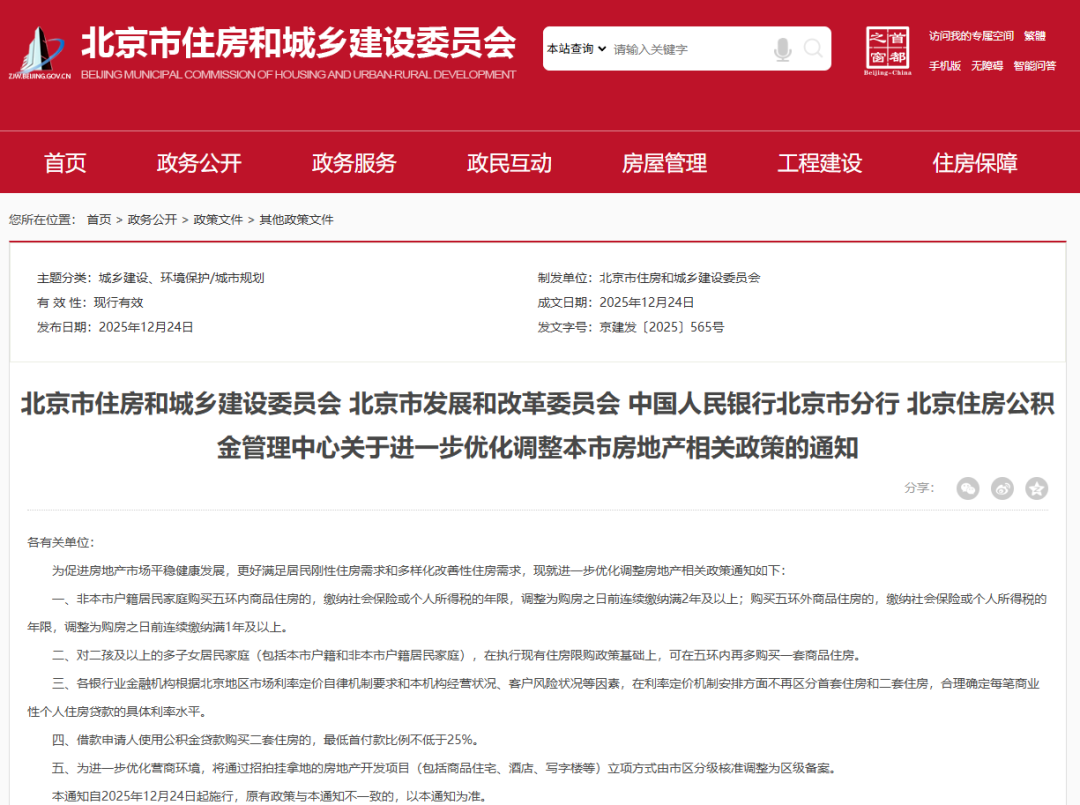
12月24日,为促进房地产市场平稳健康发展,更好满足居民刚性住房需求和多样化改善性住房需求,北京市住房城乡建设委、市发展改革委、中国北京市 分行、北京住房公积金管理中心等4部门联合印发《关于进一步优化调整本市房地产相关政策的通知》(以下简称《通知》),自2025年12月24日起施 行。 优化个人住房信贷政策 优化住房限购政策 《通知》显示,非本市户籍居民家庭购买五环内商品住房的,缴纳社会保险或个人所得税的年限,调整为购房之日前连续缴纳满2年及以上;购买五环外 商品住房的,缴纳社会保险或个人所得税的年限,调整为购房之日前连续缴纳满1年及以上。此外,对二孩及以上的多子女居民家庭(包括本市户籍和非 本市户籍居民家庭),在执行现有住房限购政策基础上,可在五环内再多购买一套商品住房。这一举措体现了对改善型住房需求的支持,尤其是对一些平 衡性住房需求的支持。 "此次北京出台的房地产政策,进一步响应了中央经济工作会议精神,充分发挥了地方在房地产政策方面的调整优化作用。同时在去库存等方面进一步发 挥政策的支撑作用,有助于守牢底线,更好促进房地产交易市场的活跃。"上海易居房地产研究院副院长严跃进在接受采访时如是表示。 从全国范 ...
浙商银行行长人选落定!
Jin Rong Shi Bao· 2025-12-24 09:52
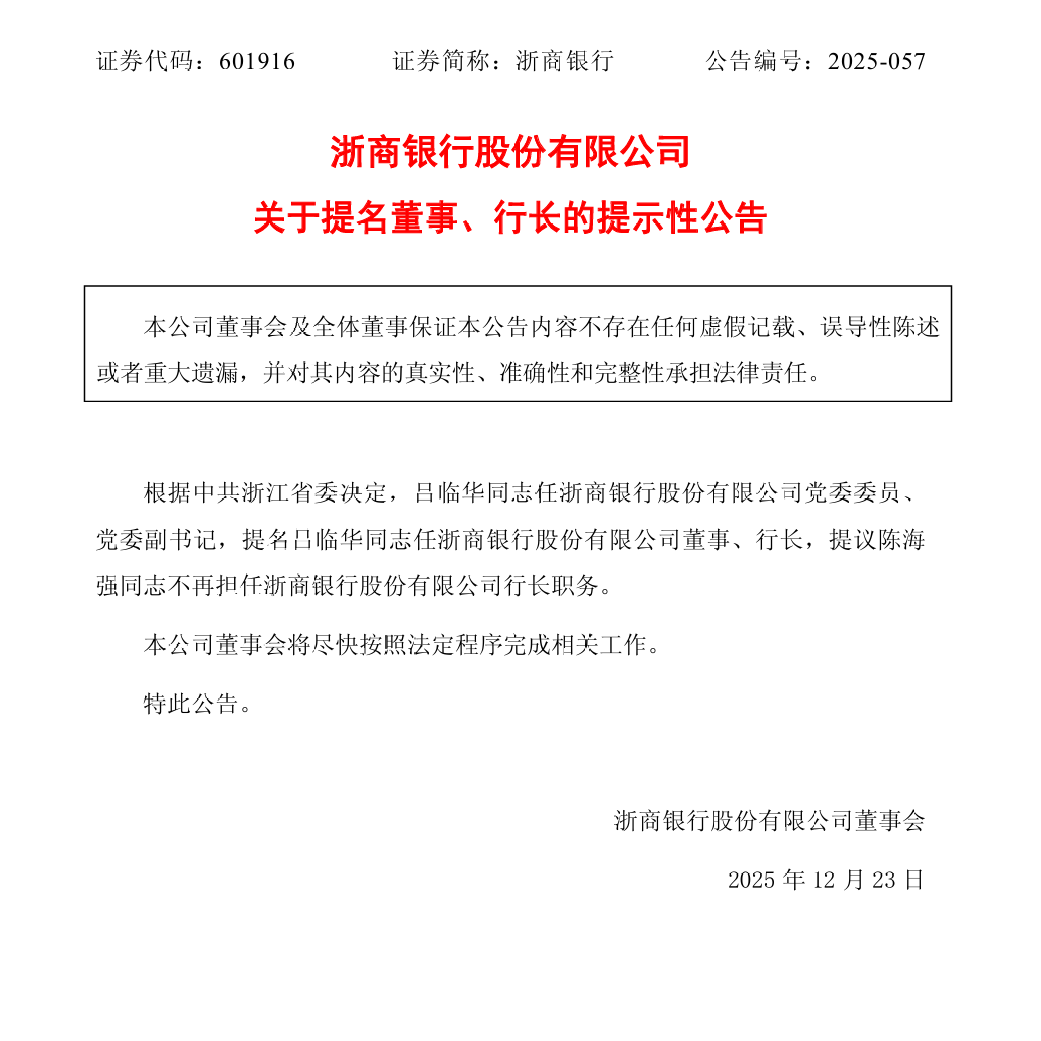
Group 1 - The core point of the news is the appointment of Lü Linhua as the Deputy Secretary of the Party Committee and the proposed appointment as the President of Zhejiang Zheshang Bank, following the decision by the Zhejiang Provincial Committee of the Communist Party of China [1] - Chen Haiqiang is no longer serving as the President of Zhejiang Zheshang Bank, and the board will complete the necessary procedures for this transition [1] - Lü Linhua has a background in financial management, having previously held positions in the Zhejiang Insurance Regulatory Bureau and the Zhejiang Banking and Insurance Regulatory Bureau [3] Group 2 - In 2022, Lü Linhua was appointed as the Vice President of Zhejiang Rural Commercial Bank shortly after its establishment [3] - This year, Zhejiang Zheshang Bank has experienced multiple significant personnel changes, including the promotion of Chen Haiqiang to Deputy Secretary of the Party Committee and the resignation of Lu Jianqiang as Chairman due to age [3] - As of now, the executive team of Zhejiang Zheshang Bank is fully in place, including the Party Secretary and Chairman Chen Haiqiang, Deputy Secretary and President Lü Linhua, and three Vice Presidents [3] Group 3 - As of September 30, 2023, Zhejiang Zheshang Bank reported total assets of 3.39 trillion yuan, reflecting a year-on-year growth of 1.91% [4] - The bank achieved an operating income of 48.931 billion yuan and a net profit attributable to shareholders of 11.668 billion yuan during the reporting period [4] - The asset quality has improved, with a non-performing loan ratio of 1.36%, a decrease of 0.02 percentage points compared to the end of the previous year [4]

政策给劲儿吗?工作到位吗?发展合规吗?他们这么说……
Jin Rong Shi Bao· 2025-12-24 08:55
Core Viewpoint - Consumption is seen as the "ballast" for economic growth, while finance acts as the "lifeblood" that supports aspirations for a better life across various scenarios and urban-rural divides. Consumer finance companies play a crucial role in driving consumption and supporting new urban residents and county-level consumption upgrades [1] Policy Insights - By 2025, multiple policies related to consumption and consumer finance will be implemented, making it essential for consumer finance companies to adapt to regulatory changes and convert policy benefits into consumption potential [2] - Policies such as the "Special Action Plan to Boost Consumption" and "Guidance on Financial Support for Expanding Consumption" have provided a solid foundation and market confidence for the consumer finance industry [2] - Companies like China Post Consumer Finance are actively responding to new lending regulations by implementing a dynamic management whitelist for lending partners to ensure compliance and consumer protection [2] Development Strategies - The implementation of various policies has injected stronger momentum into consumption and provided clear directions for the standardized development of consumer finance companies [4] - Companies are leveraging technology to enhance compliance management and have established systems for fraud detection and risk control [4] - Strict regulatory requirements are viewed as a stabilizing force that can eliminate poor industry participants and create a fair competitive environment for compliant businesses [4] Technological Advancements - Technology remains a core competitive advantage for the consumer finance industry, with companies accelerating their digital transformation to provide more accessible financial services [7] - Ant Consumer Finance has upgraded its risk control system using AI to better match consumer needs and enhance the efficiency of credit decisions [7] - Companies like Xinyu Consumer Finance are focusing on standardizing their technology and processes to support the entire lifecycle of consumer credit services [7] Financial Focus Areas - Consumer finance companies are committed to serving the real economy through five key areas: technology finance, green finance, inclusive finance, pension finance, and digital finance [9] - Companies are developing tailored products for different consumer segments, such as flexible personal loans for younger consumers and enhancing financial education for the elderly [9] - Haier Consumer Finance has initiated the first ESG-linked syndicated loan in the industry, directing funds to green consumption scenarios [9]
这家大行将迎来领导人员调整
Jin Rong Shi Bao· 2025-12-24 08:26
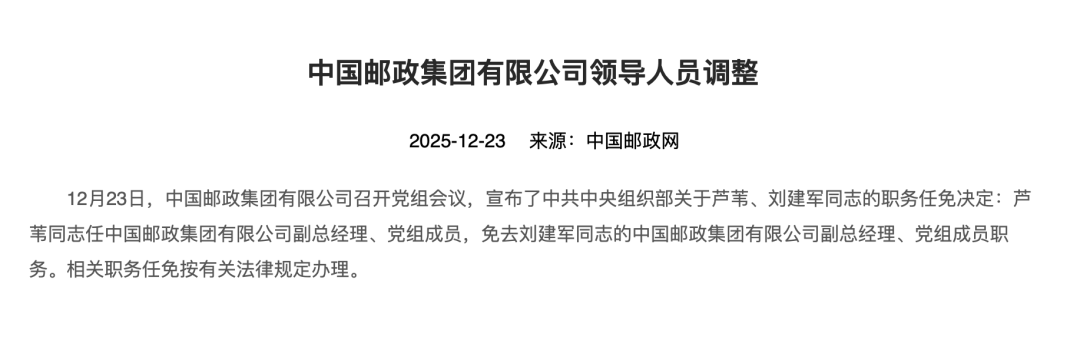
12月23日,中国邮政集团有限公司(以下简称"中国邮政集团")发布《中国邮政集团有限公司领导人员调整》公告,集团召开党组会议,宣布中共中央组 织部的任免决定:芦苇任中国邮政集团副总经理、党组成员,免去刘建军的中国邮政集团副总经理、党组成员职务。芦苇后续拟出任邮储银行(601658) 行长一职。 2022年10月,因工作调整,芦苇辞任中信银行副行长,同时赴任中信信托,2023年3月起任中信信托总经理,2024年5月升任中信信托董事长。 今年2月,芦苇回归中信银行,接任行长职位,中信银行原行长刘成赴任中信建投(601066)证券出任董事长。 也就是说,芦苇此次加入邮储银行,距离其重返中信银行仅过去10个月。 据了解,刘建军出任邮储银行党委书记、行长职位近4年半,目前已年满60岁。 刘建军担任邮储银行行长期间,该行围绕打造"一流大型零售银行"战略目标,推动邮储银行"更加普惠、更加均衡、更加稳健、更加智慧、更具活力"。零 售业务方面,截至2025年9月末,该行客户资产管理(AUM)规模达17.89万亿元,较上年末增长超7%。 截至2025年9月末,邮储银行资产规模为18.61万亿元,较上年末增长8.90%。今年前三季 ...