
Jin Rong Shi Bao

Search documents
美国GDP公布后,美元、美债走低,黄金收涨!
Jin Rong Shi Bao· 2025-12-24 08:00
Group 1 - The core viewpoint of the articles indicates that the U.S. GDP grew at an annualized rate of 4.3% in Q3, surpassing the 3.8% growth rate of Q2, driven by increased consumer spending, exports, and government spending [1][2] - Consumer spending, which accounts for about 70% of the U.S. economy, increased by 3.5% in Q3, up from 2.5% in Q2, contributing 2.39 percentage points to GDP growth [2] - Exports rose by 8.8%, contributing 1.59 percentage points to GDP growth, while government consumption and investment added 0.39 percentage points [2] Group 2 - Non-residential fixed investment grew by only 2.8% in Q3, significantly lower than the 7.3% growth in the previous quarter, indicating potential concerns regarding business investment [1] - Despite the strong GDP growth figures, financial markets reacted calmly, with the U.S. dollar index falling by 0.35% and U.S. Treasury yields showing mixed movements [1] - Economists suggest that while the economy maintained growth momentum in Q3, potential pressures from a federal government "shutdown" could lead to a slowdown in Q4, with projections for 2025 GDP growth possibly dropping to 2% or lower [2]
住建部:保交房任务全面完成
Jin Rong Shi Bao· 2025-12-24 05:13
Core Insights - The national housing and urban construction work conference highlighted the achievements during the "14th Five-Year Plan" and outlined key tasks for the "15th Five-Year Plan," emphasizing the need for high-quality development in housing and urban construction by 2025 and the stabilization of the real estate market by 2026 [1][6] Group 1: Urban Renewal Progress - Significant progress has been made in urban renewal during the "14th Five-Year Plan," with over 240,000 old urban residential areas renovated, benefiting more than 41 million households and 110 million people [2] - 130,000 elevators were added, and 167,000 old elevators were updated, along with the addition of 3.5 million parking spaces and 65,000 community service facilities [2] - 840,000 kilometers of underground pipelines for water, gas, and heating were updated, and over 20,000 pocket parks and 2,700 kilometers of urban greenways were created [2] Group 2: Housing Delivery and Improvement - The completion of housing delivery tasks during the "14th Five-Year Plan" was emphasized, with approximately 5 billion square meters of new residential properties sold and over 11 million units of various types of affordable housing constructed, benefiting over 30 million people [3] - A total of 6.5 trillion yuan in personal housing loans from the housing provident fund were issued, supporting 9.4 trillion yuan in withdrawals for housing consumption [3] - The meeting stressed the importance of addressing housing issues as both a livelihood and development concern, aiming to stabilize the real estate market and improve housing conditions [3] Group 3: Construction Industry Status - The construction industry is recognized as a crucial pillar of the national economy, maintaining a GDP contribution of over 6.5% during the "14th Five-Year Plan," with a focus on modernization and international projects [4] - The need for systemic reforms in the construction industry was highlighted, aiming to enhance the quality of building products and cultivate a modern workforce [4] Group 4: Real Estate Market Dynamics - The meeting acknowledged significant changes in the supply-demand relationship in the real estate market, with ongoing urbanization and rising expectations for quality housing [5] - The importance of viewing the new and second-hand housing markets as a whole was emphasized, with a call for tailored policies to ensure sustainable development [5] Group 5: Stabilization of the Real Estate Market - The focus for 2026 includes stabilizing the real estate market through city-specific policies, inventory reduction, and optimizing supply [7] - The meeting called for the effective use of local government powers in real estate regulation and the support of both rigid and improved housing demands [7] - A new model for real estate development is to be established, emphasizing transparency in property sales and the protection of buyers' rights [7]
“贷”动“非遗之花”在高原绽放
Jin Rong Shi Bao· 2025-12-24 05:11
Core Viewpoint - The news highlights the revitalization of traditional crafts in Qinghai, particularly Thangka painting and Tuzu embroidery, through financial support and innovative credit products, enabling cultural heritage to thrive in modern times [2][10]. Group 1: Thangka Art - Thangka art, a significant part of Tibetan culture, has a complex production process that can take months or years to complete, and it is facing challenges such as high material costs and a declining number of young artists willing to learn the craft [3][4]. - Financial institutions, particularly Postal Savings Bank, have provided tailored financial solutions, such as a 294,000 yuan "express loan," to support artists like Zashi Jiancuo in acquiring necessary materials for their work [3][4]. - As of September 2023, the loan balance for the cultural industry in Huangnan Prefecture reached 86.05 million yuan, reflecting a 29.53% increase since the beginning of the year, indicating a growing financial support for the Thangka industry [5]. Group 2: Tuzu Embroidery - Tuzu embroidery, recognized as a national intangible cultural heritage, has faced challenges such as rising material costs and limited market access, leading to a need for financial support to sustain the craft [6][7]. - The establishment of Su Long Gu Company has created a production model that integrates companies, workshops, and farmers, significantly improving the economic situation of local artisans [6][8]. - By October 2023, the local financial institutions had issued 16.35 million yuan in loans to support the Tuzu embroidery industry, demonstrating the effectiveness of financial initiatives in promoting cultural heritage [7][10]. Group 3: Financial Support and Initiatives - The People's Bank of China in Qinghai has implemented various financial products tailored to the needs of traditional crafts, such as "Thangka loans" and "Embroidery loans," to alleviate funding challenges faced by artisans [10][11]. - The "Qingxinrong" platform has facilitated connections between banks and small enterprises, providing over 46.26 billion yuan in loans to 82,100 small businesses, showcasing the impact of data-driven financial solutions [10][11]. - The financial support has not only helped artisans sustain their crafts but has also contributed to the employment of over 2,000 impoverished individuals, enhancing the socio-economic landscape of the region [8][12].

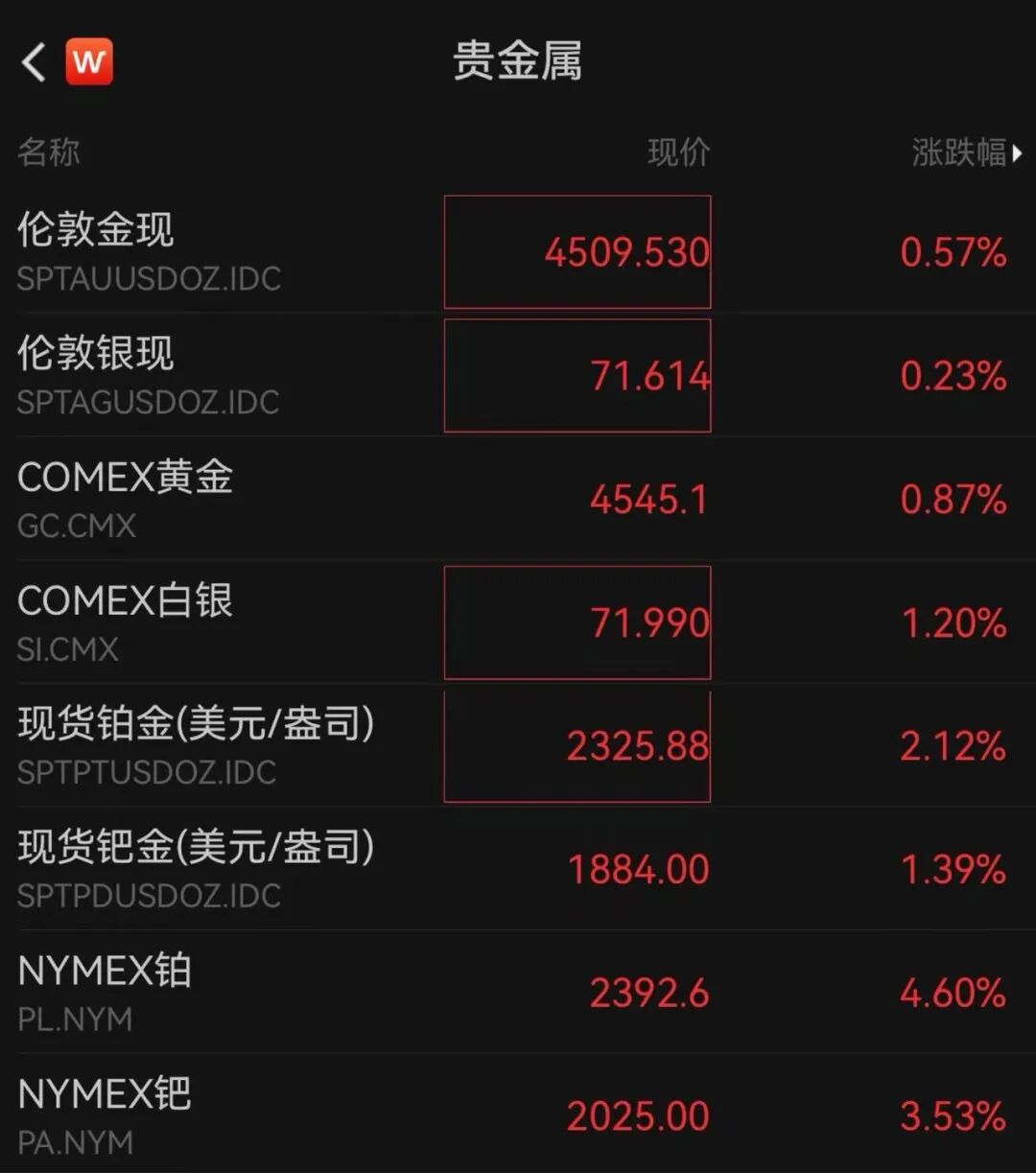
金价冲破4500美元!这三大品种年内涨幅超100%,发生了什么?
Jin Rong Shi Bao· 2025-12-24 03:50
Core Viewpoint - Precious metals such as gold, silver, platinum, and palladium have experienced significant price increases, with gold surpassing $4500 per ounce and silver approaching $72 per ounce, driven by macroeconomic factors and strong industrial demand [1][3][7]. Price Performance - As of December 24, 2025, spot gold reached $4509.53 per ounce, with a year-to-date increase of over 72%. Spot silver was at $71.614, up 149% for the year. Spot platinum hit $2325.88, marking a 162% increase, while palladium rose to $1884.00, up 111% [2][4][6]. Market Dynamics - The recent surge in precious metals is attributed to global macroeconomic conditions, including monetary easing and geopolitical uncertainties, which have heightened the demand for safe-haven assets [3][7]. - The market is reacting to expectations of a shift in U.S. Federal Reserve policy, with lower-than-expected employment data and inflation figures leading to increased speculation about interest rate cuts [7][10]. Supply and Demand Factors - Central banks have been increasing their gold reserves, with global gold demand reaching a record 1313 tons in Q3 2025, supported by significant net purchases from central banks [7][11]. - The supply of platinum and palladium is constrained due to high concentration in South Africa and Russia, with limited capacity expansion in recent years, contributing to upward price pressure [11]. Investment Sentiment - The strong performance of gold has bolstered market confidence in silver, platinum, and palladium, with these metals showing higher price elasticity due to industrial demand [8][10]. - Analysts suggest that while gold's price is influenced by macroeconomic factors, silver, platinum, and palladium are also driven by industrial applications, particularly in sectors like renewable energy and automotive [10][11].

金融活水浇灌 红色桐柏展新颜
Jin Rong Shi Bao· 2025-12-24 03:38
巍巍桐柏山,滔滔淮河源。河南省南阳市桐柏县作为革命老区,80年前,这里是鄂豫边区抗日根据地的 核心区域,也是民生凋敝、满目疮痍的贫困山区。今天,这片曾浸染着先烈热血的赤贫山乡,依托"七 山一水二分田"的地理优势和丰富的生态资源,在金融活水的浇灌下,逐步形成以"茶叶+文旅+新能 源"为支柱的产业体系,并培育出"两金一银一碱"四大重点龙头企业,实现了从革命老区到生态经济强 县的华丽蜕变。截至2025年6月末,桐柏县贷款余额为144.03亿元,同比增长17.59%,增速位居南阳市 各县第一。 金融赋能 助力特色农业产业发展 "多亏了农商行25万元的助农贷款,去年扩建的5座大棚今年就见了效益,预计能多赚15万元。"桐柏县 朱庄镇粉坊村香菇种植户王大姐高兴地说。她口中的助农贷款,正是金融机构深耕特色产业的生动实 践。作为远近闻名的香菇特色产业村,粉坊村的香菇产业金融需求总规模超500万元,传统的信贷模式 难以满足分散化、周期性的融资需求。针对这一问题,中国人民银行南阳市分行精准施策,积极引导金 融机构创新信贷投放模式,针对种植户推出"三步走"金融帮扶策略,联合村两委绘制产业图谱、按经营 规模分档授信、根据香菇生产周期动 ...
“中金+东兴+信达”合并重组预案出炉 增强资本实力和综合竞争力
Jin Rong Shi Bao· 2025-12-24 03:37
Core Viewpoint - The merger of China International Capital Corporation (CICC), Dongxing Securities, and Xinda Securities is expected to create a leading brokerage firm in terms of asset scale, net capital, and business coverage, potentially reshaping the competitive landscape of the industry and accelerating the development of a first-class investment bank [1][3]. Group 1: Merger Details - The merger involves a share swap with CICC as the surviving entity, with share prices set at 36.91 CNY for CICC, 16.14 CNY for Dongxing Securities, and 19.15 CNY for Xinda Securities, reflecting a 26% premium for Dongxing Securities [2]. - CICC is expected to issue approximately 3.096 billion new A-shares as part of the merger, with all A-shares of Dongxing and Xinda participating in the swap [2]. - Major shareholders, including Central Huijin and China Orient, have committed to lock their shares for 36 months, indicating confidence in the long-term development of the merged entity [2]. Group 2: Financial Projections - Post-merger, the total assets of the new entity are projected to reach 1,009.583 billion CNY, marking the emergence of a new trillion-level brokerage firm in China's securities industry [2]. - As of the third quarter of 2025, the individual total assets of CICC, Dongxing, and Xinda were 764.941 billion CNY, 116.391 billion CNY, and 128.251 billion CNY, respectively [5]. Group 3: Strategic Implications - The merger is seen as a strategic move to enhance the overall competitiveness and service capabilities of the new brokerage, with a focus on investment banking, private equity, and international business [4][3]. - The combined entity will benefit from a comprehensive service system that integrates institutional and retail services, enhancing its ability to withstand market fluctuations [4]. - The merger aligns with national strategies to build a strong financial sector and is expected to leverage the strengths of each firm to improve financial risk management and support economic development [3][5]. Group 4: Performance Metrics - For the first three quarters of 2025, the three firms reported revenues of 20.76 billion CNY, 3.61 billion CNY, and 3.02 billion CNY, with net profits of 6.567 billion CNY, 1.599 billion CNY, and 1.354 billion CNY, respectively [6].



三部门联合发布 《互联网平台价格行为规则》
Jin Rong Shi Bao· 2025-12-24 03:30
Core Viewpoint - The National Development and Reform Commission, the State Administration for Market Regulation, and the National Internet Information Office have jointly released the "Internet Platform Pricing Behavior Rules" to regulate pricing behaviors, enhance transparency, and build a healthy platform ecosystem [1] Group 1: Regulation and Compliance - The rules aim to standardize pricing competition order by detailing regulatory requirements based on existing laws, providing clear pricing behavior guidelines for platform operators and internal operators [1] - The rules protect the autonomous pricing rights of operators on platforms, stating that platform operators cannot impose unreasonable restrictions or conditions on the pricing behaviors of internal operators [1] Group 2: Consumer Protection - The rules enforce a clear pricing system and promote the transparency of dynamic pricing and differential pricing, while also regulating services like automatic payments and renewals to better protect consumers' rights to information and choice [1] Group 3: Implementation Timeline - The "Behavior Rules" will take effect on April 10, 2026, allowing operators sufficient time to adjust to the new regulations [1] - The three departments will organize major platform operators to conduct self-inspections against the regulatory requirements outlined in the "Behavior Rules" to ensure compliance [1]
“保险+信贷” 破题“小巨人”成长的“烦恼”
Jin Rong Shi Bao· 2025-12-24 03:18
Core Insights - The article discusses a comprehensive financial practice combining insurance and credit to address the dual challenges of financing difficulties and high risks faced by technology-based enterprises in Jiangxi province [1][2]. Group 1: Company Overview - A telecommunications company in Jiangxi, recognized as a national-level "specialized and innovative" small giant, focuses on the research and production of high-purity oxygen-free copper, a key new material essential for high-end electronics and communication [1]. - Despite holding core technology, the company faces typical challenges such as high R&D costs, risks in new product promotion, and tight liquidity, which hinder its innovation journey [1]. Group 2: Financial Solutions - China Life Property & Casualty Insurance in Jiangxi collaborated with Guangfa Bank Nanchang Branch to create a tailored "risk protection + funding support" solution for the telecommunications company [2]. - The insurance component includes a new materials comprehensive insurance that acts as a "safety lock" for the company's core technology and new products, effectively transferring potential liability risks and enhancing market confidence [2]. - The financial solution also provided the company with a special credit support of 10 million yuan at favorable interest rates, alleviating funding pressure and enabling continued R&D and raw material procurement [2]. Group 3: Industry Impact - The "insurance + credit" model breaks the siloed approach of financial institutions, fostering collaboration through product linkage, information sharing, and risk-sharing, thereby enhancing support for technology innovation [3]. - This approach demonstrates a multiplier effect in financial support for technological innovation, injecting sustained momentum into the development of new productive forces [3].
保研发、保人才、保产权 保险为科技创新提供全周期保障方案
Jin Rong Shi Bao· 2025-12-24 03:18
Core Insights - The article emphasizes the importance of providing systematic risk protection for innovation entities throughout the entire process of research and development, transformation, and industrialization in the context of technological innovation [1][2]. Group 1: Company Overview - Guangdong Xinsanjiang Electric Equipment Co., Ltd. is a high-tech enterprise specializing in the research and manufacturing of high and low voltage complete electrical equipment [1]. - The company faces significant challenges in its journey towards intelligent and high-end electrical equipment, including unclear R&D paths and high technical barriers, which can lead to substantial financial losses if projects fail [1]. Group 2: Insurance Solutions - In September, Ping An Property & Casualty Insurance provided the "Ping An Yueke Bao" product to Xinsanjiang Electric, covering various risks such as R&D property protection, patent protection, key personnel protection, R&D risk protection, cybersecurity protection, and public liability insurance [1][2]. - This insurance solution aims to address multiple risks faced by small and medium-sized technology enterprises during R&D innovation, transformation of results, and market expansion, including R&D failures, equipment damage, intellectual property infringement, and loss of core talent [1][2]. Group 3: Industry Trends - The insurance industry is evolving to deepen its service offerings, extending coverage from R&D to subsequent stages like transformation and market application, and shifting from standardized products to customized solutions [2]. - There is a growing need for comprehensive risk management services that not only focus on tangible asset protection but also emphasize the safeguarding of intangible assets such as talent, intellectual property, and data security [2][3]. - As technological innovation activities become more active, the demand for diverse and complex risk protection will increase, making insurance a crucial element in promoting technology transfer and supporting the upgrade of traditional industries [3].
人形机器人加速“上岗” 保险创新为“工伤”买单
Jin Rong Shi Bao· 2025-12-24 03:18
Group 1 - The core viewpoint of the articles highlights the rapid emergence and commercialization of humanoid robots and embodied intelligence in China, with significant market growth projected by 2025 [1][2] - The embodied intelligence market in China is expected to reach 5.295 billion yuan, accounting for approximately 27% of the global market, while the humanoid robot market is projected to reach 8.239 billion yuan, representing about 50% of the global market [1] - The insurance industry is actively developing specialized insurance products to mitigate risks associated with humanoid robots, addressing concerns over high repair costs and new types of risks such as network attacks and data breaches [1][3] Group 2 - Various local policies have been introduced to encourage the insurance sector to support the development of intelligent robots, including subsidies for insurance premiums [2] - Insurance companies like PICC Property and Casualty, Ping An Property and Casualty, and Taikang Property and Casualty have launched specialized insurance plans for humanoid robots, covering risks such as bodily damage, third-party liability, and employer liability [3] - Experts emphasize the need for collaboration among insurers, robot manufacturers, application enterprises, and research institutions to build a comprehensive risk database, which will aid in precise pricing and product innovation for insurance [4]
