
Jin Rong Shi Bao

Search documents
32.43万亿元!行业已触底回暖?
Jin Rong Shi Bao· 2025-12-21 03:45
Core Insights - The trust industry in China has shown signs of recovery, with total trust assets reaching 32.43 trillion yuan as of June 2025, marking a year-on-year growth of 20.11% [1] - The industry achieved operating income of 34.36 billion yuan and total profit of 19.68 billion yuan in the first half of 2025, indicating a slight increase compared to the previous year [1] Group 1: Asset Management Trusts - Asset management trusts are the primary growth engine, with a balance of approximately 24.43 trillion yuan, accounting for 75.33% of total trust assets, reflecting a year-on-year increase of 22.46% [2] - The trust industry's market position in the overall asset management sector has improved, with total assets in the asset management industry reaching 174.50 trillion yuan, where trust assets rank third after insurance and public funds [2] - Securities investment trusts have become the dominant product type, growing to 12.48 trillion yuan and representing 51.09% of the total asset management trust scale [2] Group 2: Non-standard vs. Standard Assets - The allocation ratio between non-standard and standard assets is shifting, with non-standard assets decreasing from 54.52% in 2022 to 39.70% in the first half of 2025 [3] Group 3: Asset Service Trusts - Asset service trusts are steadily growing and have become an important growth engine for the trust industry, with various applications in wealth management and social services [4] - As of June 2025, the scale of wealth management, administrative management, risk disposal, and asset securitization service trusts reached 4.37 trillion yuan, 2.80 trillion yuan, 2.60 trillion yuan, and 1.43 trillion yuan respectively [4] - Despite current limitations in the asset service trust business, there is potential for future growth, particularly in family trusts, as regulatory barriers are gradually addressed [4] Group 4: Future Directions - Industry experts suggest that trust companies should focus on their core business, improve governance, and develop clear strategic plans to establish sustainable business models in the new era [5]
国产GPU第一股,周末大动作!
Jin Rong Shi Bao· 2025-12-21 02:19
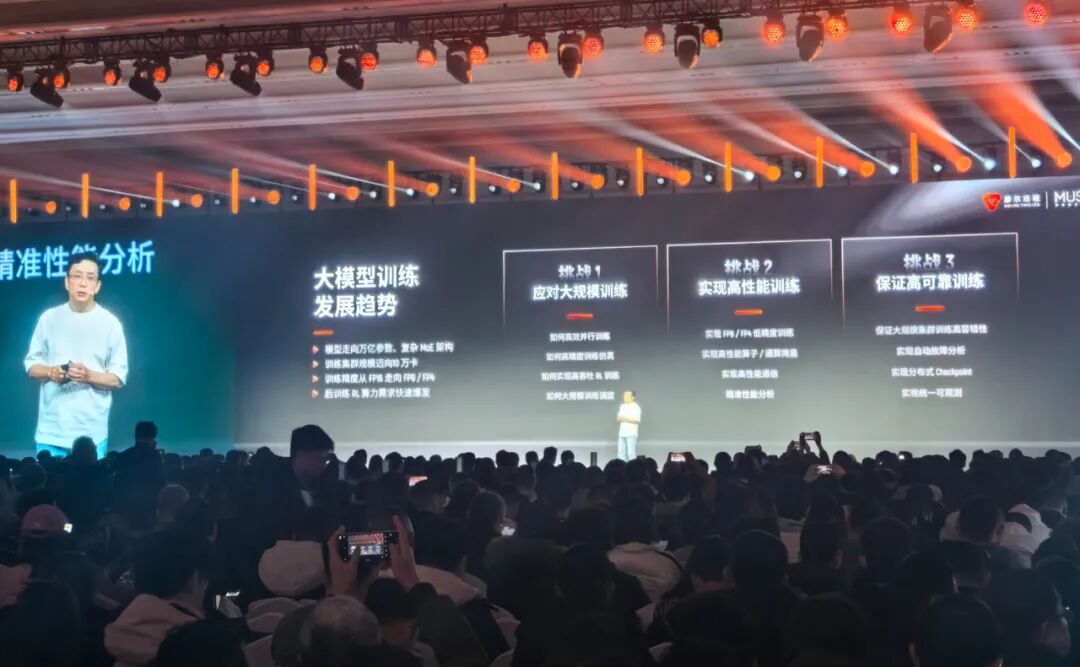
Core Insights - The focus on "Mole Thread," the first domestic GPU stock, is shifting from its high valuation to its technological advancements, product iterations, and operational performance following its debut on the Sci-Tech Innovation Board [1] Group 1: Technological Developments - Mole Thread held its first MUSA Developer Conference on December 20, showcasing its full-function GPU technology roadmap and announcing a series of technological and product advancements, including the new GPU architecture "Huagang" [1] - The new architecture boasts a 50% increase in density and a 10-fold improvement in efficiency, supporting intelligent computing clusters of over 100,000 cards [1] - Future products based on this architecture will include the high-performance AI training and inference chip "Huashan" and the graphics rendering-focused chip "Lushan" [1] - The company also introduced the AI computing power notebook "Changjiang," equipped with an intelligent SoC chip, serving as a core entry point for developers into the MUSA ecosystem [1] Group 2: Industry Context - The development of "sovereign AI" is deemed crucial for enhancing national competitiveness, focusing on achieving a complete system of "autonomous computing power, self-reliant algorithms, and independent ecosystems [2] - The performance gap between domestic graphics cards and foreign mainstream products is narrowing, although building ultra-large-scale intelligent computing systems remains a significant challenge [2] - The current Chinese GPU industry is in the early stages of constructing a core technology stack and a complete ecosystem, facing challenges such as high R&D difficulty and the construction of computing ecological barriers [2] Group 3: Market Performance - Mole Thread's stock has seen recent adjustments, with a 5.9% drop on December 19, closing at 664.10 yuan per share, marking a cumulative decline of 29.4% from its peak of 941.08 yuan on December 11 [2] - Despite the recent decline, the stock remains over 480% higher than its issue price, with a total market capitalization exceeding 300 billion yuan [2]

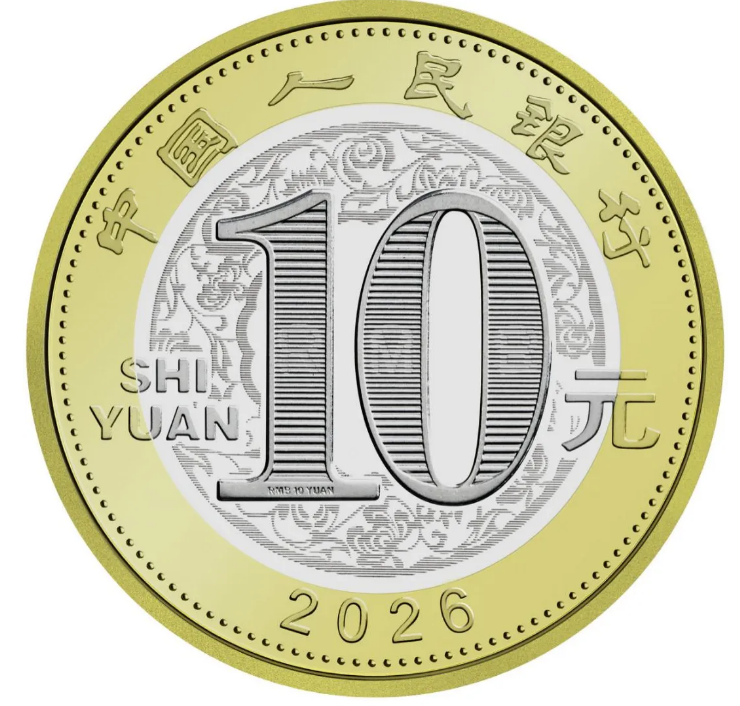
哒哒哒!“马年贺岁纪念币、纪念钞”来啦→
Jin Rong Shi Bao· 2025-12-20 03:09
Core Viewpoint - The People's Bank of China announced the issuance of the 2026 New Year commemorative coins and banknotes starting from December 22, 2025, including a copper alloy commemorative coin, a banknote, a gold commemorative coin, and a silver commemorative coin, all of which are legal tender in the People's Republic of China [1] Group 1: Commemorative Coin and Banknote Details - The copper alloy commemorative coin has a face value of 10 yuan, a diameter of 27 mm, and a total issuance of 100 million pieces (including 10,000 for historical archives) [2] - The commemorative banknote has a face value of 20 yuan, dimensions of 145 mm by 70 mm, made of plastic, with a total issuance of 100 million pieces (including 20,000 for historical archives) [5] Group 2: Issuance and Reservation Process - The issuance will be conducted through a reservation system managed by several banks, including Industrial and Commercial Bank of China, Agricultural Bank of China, Bank of China, and others [7] - By January 12, 2026, local branches of the People's Bank of China will announce the distribution quantities of the commemorative coins and banknotes [8] - Reservations will be accepted from January 13 to January 14, 2026, through online channels or designated bank branches, with a limit of one reservation per person for each item [9] Group 3: Verification and Exchange Arrangements - The verification period for reservations is set from January 17 to January 19, 2026, allowing individuals to rectify any issues with their reservations [10] - The exchange period for the commemorative coins and banknotes will be from January 20 to January 26, 2026, requiring individuals to present valid identification [11] - Each person is limited to a reservation and exchange of 20 commemorative coins and 20 banknotes [12] Group 4: Identification Requirements - Valid identification for the reservation, exchange, and verification must be the original second-generation resident ID card, with provisions for proxy handling under certain conditions [14] Group 5: Gold and Silver Commemorative Coins - The gold commemorative coin weighs 1 gram, has a face value of 10 yuan, and a maximum issuance of 150,000 pieces [15] - The silver commemorative coin weighs 8 grams, has a face value of 3 yuan, and a maximum issuance of 1,000,000 pieces [19] - The coins will be minted by Shenzhen Guobao Mint Co., Ltd., with distribution managed by China Gold Coin Group [23]
无人驾驶板块强势活跃!L3级自动驾驶正式上路意味着什么?
Jin Rong Shi Bao· 2025-12-19 13:40
Core Viewpoint - The Ministry of Industry and Information Technology of China has officially announced the first batch of L3 autonomous driving vehicle permits, marking a significant step towards the commercialization of L3 autonomous driving in the country [1] Group 1: Industry Developments - The first two models to receive permits are Changan Automobile's Deep Blue SL03 and BAIC's Arcfox Alpha S6, which will conduct pilot tests in designated areas of Beijing and Chongqing [1] - This approval follows the framework established in November 2023, which outlined the pilot program for L3/L4 vehicles, with 29 consortiums participating in the application process [2] - The selection of Changan and BAIC was based on comprehensive assessments of their R&D, testing, and emergency response capabilities, as well as third-party evaluations of safety and network security risks [2] Group 2: Vehicle Specifications - The Deep Blue SL03 utilizes Changan's self-developed "Tianshu Intelligent" technology, while the Arcfox Alpha S6 is equipped with Huawei's Qiankun driving system [3] - Both models have undergone extensive real-world testing and are classified as sedans, which offer better stability and precision in maneuvering compared to SUVs [3] - The permitted models can only operate under specific conditions: the Deep Blue SL03 is limited to a maximum speed of 50 km/h in congested traffic environments, while the Arcfox Alpha S6 can reach up to 80 km/h on highways and urban expressways [3] Group 3: Future Outlook - The approval of these two vehicles is expected to lead to a gradual expansion of L3 vehicle permits, rather than a blanket release, with further approvals anticipated as the regulatory framework develops [3] - Currently, the permitted vehicles are restricted to operation by ride-hailing service companies, indicating a focus on professional operation and strong monitoring rather than immediate consumer access [3]


央行等三部门发布新规!
Jin Rong Shi Bao· 2025-12-19 11:18
Core Viewpoint - The People's Bank of China, along with other regulatory bodies, has established the "Regulations on Cash Payment and Service" to enhance the cash circulation environment amidst the growing trend of digital payments, ensuring that cash remains a viable payment option for all demographics [1][2]. Group 1: Regulations Overview - The new regulations aim to clarify the cash service obligations of various charging units, business entities, and banking institutions, promoting a collaborative effort to maintain a cash-friendly environment [1][2]. - The regulations emphasize the importance of cash as a fundamental payment tool that supports the real economy and financial stability [1]. Group 2: Principles of the Regulations - The regulations are based on five fundamental principles: financial service for the public, problem-oriented approach, comprehensive measures, collaborative governance, and legal accountability [2]. - The principle of financial service for the public focuses on respecting consumer payment choices and meeting diverse payment needs while encouraging the development of various payment methods [2]. Group 3: Payment Scenarios - The regulations specify that cash payments must be supported in scenarios involving face-to-face services and transactions that can be completed in person, ensuring reasonable cash availability [3]. - For automated services and locations with unified management, businesses must clearly indicate accepted payment methods and provide contact information for cash-related inquiries [3]. Group 4: Banking Sector Requirements - Banking institutions are required to facilitate cash deposit and withdrawal services, ensuring that their network and self-service machines cater to the needs of different customer groups [5]. - Banks must also manage cash collection effectively to prevent the circulation of unfit currency and mitigate various business risks [5].
电子支付遇争议?别慌,这份指南请收好→
Jin Rong Shi Bao· 2025-12-19 07:45
Core Viewpoint - The rapid growth of electronic payment services in China has led to the establishment of a comprehensive regulatory framework aimed at protecting user rights and ensuring the healthy development of the industry. Group 1: Responsibility in Electronic Payments - In cases of unauthorized or erroneous electronic payments, the payment service provider is responsible for losses if the user is not at fault. If the user is at fault, such as through password leakage, they bear the loss [1] - Payment institutions must ensure proper authorization verification for transactions, including password and verification code checks, and must adhere to transaction limits to mitigate risks [2] Group 2: Modifying or Revoking Payment Instructions - Users can modify or revoke payment instructions for "ordinary" or "next-day" transactions before the funds are credited. However, for "real-time" transactions, direct revocation is not possible, but service providers must prompt users to confirm the accuracy of their instructions [3][4] Group 3: Dispute Resolution with Service Providers - Users have a sufficient time window to raise disputes, as transaction records must be retained for at least 10 years. Service providers are obligated to respond promptly to complaints and keep users informed of the progress [5][6] - The regulatory framework mandates that electronic payment service providers establish a non-litigious third-party dispute resolution mechanism and provide clear channels for users to file complaints [7]
400亿元!央行公告:下周一招标发行
Jin Rong Shi Bao· 2025-12-19 06:55
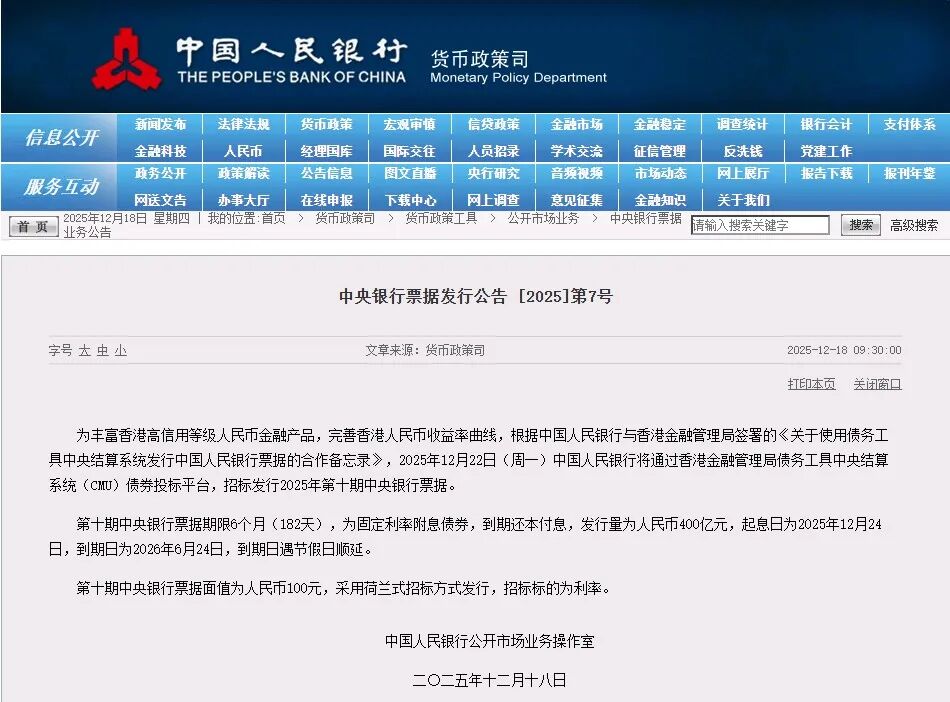
Group 1 - The People's Bank of China announced the issuance of the 10th Central Bank Bill through the Hong Kong Monetary Authority's debt instrument central settlement system to enhance the RMB yield curve in Hong Kong [1] - The issuance date is set for December 22, 2025, with a maturity period of 6 months (182 days) [5] - The total issuance amount is RMB 40 billion, with a face value of RMB 100 per bill, and it will be issued via a Dutch auction method [5] Group 2 - The interest payment will be made at maturity, which is scheduled for June 24, 2026, with the maturity date adjusted for public holidays [5]
多家银行年末加速“甩包袱”→
Jin Rong Shi Bao· 2025-12-19 06:37
Group 1 - The core viewpoint of the articles highlights a significant increase in the transfer of non-performing retail assets by banks as they approach year-end, driven by financial optimization and risk clearance [1][2] - The number of non-performing asset packages listed for transfer has surged, with over 30 announcements made in just two days, indicating a rapid acceleration in the pace of asset disposals by major banks [1][2] - Retail non-performing loans have become the primary type of assets being transferred, as banks aim to optimize year-end financial statements by reducing non-performing loan ratios and improving capital indicators [2][3] Group 2 - The trend of transferring retail non-performing assets is supported by data showing a 761.4% year-on-year increase in the scale of personal non-performing loan batch transfers, with personal consumption loans making up over 70% of these transfers [2] - The current phase of retail banking is characterized by a shift from rapid expansion to structural adjustment and refined management, with a focus on high-quality customer operations and wealth management [3][4] - Experts predict that the wave of non-performing loan disposals may continue until mid-2026, with an expected increase in the scale of disposals and a shift towards regional small and medium-sized banks as the primary entities involved [3]






全票通过!日本央行加息→
Jin Rong Shi Bao· 2025-12-19 04:49
Group 1 - The Bank of Japan raised its policy interest rate by 25 basis points to 0.75%, marking a 30-year high, with a unanimous 9-0 vote supporting the decision, indicating strong consensus among policymakers [1] - The Bank of Japan's monetary policy statement suggests the possibility of further rate hikes, contingent on economic activity and inflation forecasts, as actual interest rates remain significantly low [1][2] - Japan's inflation rate in November was 2.9%, slightly below October's 3%, while the core CPI remained stable at 3%, supporting the rationale for the rate hike [2] Group 2 - Japan's real GDP contracted by 2.3% year-on-year in Q3, exceeding the predicted decline of 2%, primarily due to decreased corporate investment amid uncertainties from U.S. tariff policies [2] - The government, led by Prime Minister Fumio Kishida, appears to favor a loose monetary policy environment, which may pose challenges for the Bank of Japan's future rate hikes [3] - A weaker yen could compel the Bank of Japan to accelerate rate increases to support the currency's performance [3]
从“服务者”到“共建者” 大连金融机构助力文体旅融合发展样本调查
Jin Rong Shi Bao· 2025-12-19 03:37
Core Insights - Dalian is positioning itself as a national "football city" with significant investments in football infrastructure and events, including hosting the 2024 International Sports Federation Football World Cup and the 2025 International University Sports Federation Football World Cup [1][5] - The establishment of the first football-themed bank branch by Shanghai Pudong Development Bank in Dalian aims to integrate financial services with the sports industry, enhancing the local football ecosystem [1][3] Financial and Sports Integration - The partnership between Shanghai Pudong Development Bank and Dalian Yingbo Football Club, initiated in August 2025, focuses on creating a "financial + sports" ecosystem, offering comprehensive financial services tailored to the sports industry [3][10] - The bank's new branch features a unique design that incorporates football culture, aiming to provide a blend of financial services and fan experiences [1][3] Youth Development and Community Engagement - Dalian Yingbo Football Club's U21 team won the 2025 China Youth Elite League (U21 group), showcasing the effectiveness of the city's youth training system [2] - Financial institutions are actively involved in supporting youth football training programs, with initiatives that include insurance coverage and financial products aimed at fostering young talent [4][8] Economic Impact of Sports Events - The hosting of major football events has significantly boosted local attendance and consumption, with the Dalian Shoyu Bay Football Stadium attracting over 934,000 attendees in the 2025 season, making it the most attended venue in Asia [2][7] - The integration of sports events with local tourism and consumption has led to increased economic activity, benefiting various sectors such as hospitality and retail [7][9] Innovative Financial Products - Dalian's financial institutions are launching innovative products to support the sports and tourism sectors, including specialized loans for hospitality and restaurant businesses [9] - The introduction of themed credit cards and membership systems aims to enhance the financial experience for fans while supporting the football club's financial needs [4][10] Future Directions - The financial sector in Dalian is exploring new avenues for collaboration with the sports industry, including the establishment of a sports industry innovation development fund to attract social capital for promising sports technologies and events [13] - The ongoing development of a comprehensive financial service ecosystem is expected to support the growth of the sports industry, aligning with national goals to enhance sports consumption and industry quality [11][12]