
Qi Huo Ri Bao Wang

Search documents
两部门:治理价格无序竞争
Qi Huo Ri Bao Wang· 2025-10-09 18:22
据国家发展改革委官网9日消息,近日,国家发展改革委、市场监管总局联合发布《关于治理价格无序 竞争维护良好市场价格秩序的公告》(下称《公告》)。 《公告》提出,价格竞争是市场竞争的重要方式之一,但无序竞争会对行业发展、产品创新、质量安全 等造成负面影响,不利于国民经济健康发展。国家支持公平、公开、合法的市场竞争,维护正常的价格 秩序。实行市场调节价的商品和服务,经营者应当按照价格法规定,遵循公平、合法和诚实信用的原 则,以生产经营成本和市场供求状况为基本依据,依法行使自主定价权,自觉维护市场价格秩序,共同 营造公平竞争、有序竞争的市场环境。 国家发展改革委有关负责同志就《公告》答记者问时表示,国家发展改革委、市场监管总局将指导各地 按照《公告》提出的基本思路和重点举措,依法依规治理企业无序竞争。一是开展政策宣贯。二是推动 行业自律。三是强化市场监测。密切监测市场价格运行情况和行业竞争状况,及时发现价格无序竞争问 题线索。四是加强监管执法。 (文章来源:期货日报网) 《公告》根据现行法律法规,按照事前引导和事中事后监管相结合的思路,提出多项治理举措。调研评 估行业平均成本。对价格无序竞争问题突出的重点行业,指导行 ...
宏源期货董事长谢鲲:提升综合实力 助力期市高质量发展
Qi Huo Ri Bao Wang· 2025-10-09 18:20
Core Viewpoint - The article discusses the positive changes in China's futures market following the release of the regulatory guidelines aimed at promoting high-quality development, highlighting the growth in market scale, business transformation of futures companies, and improvements in regulatory frameworks [1][4]. Group 1: Market Development - The futures market in China has seen continuous growth in scale and an improved variety system since the release of the guidelines [1]. - The total funds in China's futures market are expected to exceed 20 trillion yuan by the end of this year, indicating a new record high [4]. - The number of futures varieties has increased, with 157 types of futures options now available, contributing to a healthier and more regulated market environment [4]. Group 2: Business Transformation - Futures companies are focusing on transforming their business models, with asset management and international business becoming significant profit growth points [1][3]. - The company has provided risk management services to over 1,000 industrial clients and has supported more than 150 small and micro enterprises with financial assistance totaling nearly 5 million yuan [2]. - The company aims to enhance its core competitiveness by offering diversified and customized service solutions to meet the risk management needs of clients [3]. Group 3: Regulatory Improvements - The regulatory framework has been strengthened, with new systems for classification evaluation, internet marketing management, and investor suitability management being introduced [1]. - The company is actively improving its internal control and compliance management mechanisms in response to the evolving regulatory environment [3]. Group 4: Competitive Landscape - The competition in the futures industry is expected to intensify, with market concentration increasing as top firms leverage capital advantages to expand their market share [5]. - Differentiated competition is becoming more pronounced, as the brokerage business remains the primary revenue source for futures companies, necessitating the exploration of unique development models [6]. - The internationalization of futures companies is accelerating, with overseas business expected to become a significant growth area driven by policy support and external demand [6].
外资独资控股期货公司队伍不断壮大 将对我国期货市场发展产生积极影响
Qi Huo Ri Bao Wang· 2025-10-09 18:10
Core Viewpoint - The internationalization of China's futures market is advancing, with foreign-owned futures companies making significant progress, exemplified by Goldman Sachs acquiring control of QianKun Futures [1][2]. Industry Development - The China Securities Regulatory Commission (CSRC) approved the change of actual controller for QianKun Futures to Goldman Sachs Group, which is now wholly owned by Goldman Sachs (China) Securities Co., Ltd. with an investment of 317 million yuan [1]. - As of now, there are four foreign wholly-owned futures companies in China: QianKun Futures, JPMorgan Futures, Morgan Stanley Futures, and UBS Futures [1]. - The removal of foreign ownership limits for futures companies in China took effect on January 1, 2020, ahead of similar changes in the securities and fund industries [1]. Business Expansion - Morgan Stanley Futures has recently been granted qualifications for financial futures brokerage, expanding its business scope to include both commodity and financial futures brokerage [2]. - The entry and development of foreign wholly-owned futures companies are expected to positively impact the internationalization, innovation, liquidity, and regulatory framework of China's futures market [2]. Market Impact - The presence of foreign wholly-owned futures companies is anticipated to diversify trading participants and investment strategies, enhancing market activity and liquidity, and improving price discovery efficiency [3]. - These companies' global commodity business strategies will help establish more representative price benchmarks for Chinese futures in international markets [3]. - The increased participation of foreign institutions is expected to enhance the authority of renminbi-denominated assets in international pricing [3]. Regulatory Considerations - The influx of international clients necessitates stronger compliance and regulatory measures, particularly in cross-border supervision, to prevent systemic risks while promoting the internationalization and high-quality development of China's futures market [3][4]. - The entry of foreign institutions is seen as a key driver for optimizing market structure, improving regulations, and enhancing international influence [4].

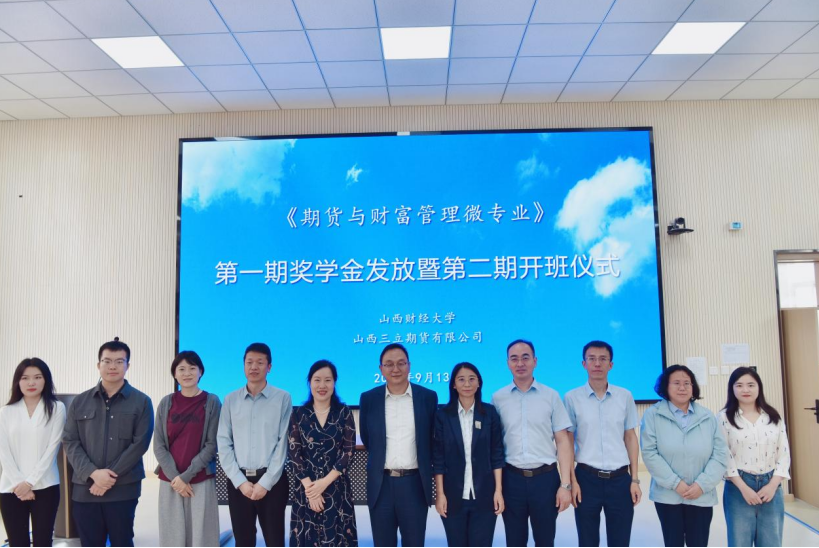
三立期货与山西财经大学微专业第一期奖学金发放暨第二期开班仪式典礼圆满举行
Qi Huo Ri Bao Wang· 2025-10-09 03:48
Core Viewpoint - The collaboration between Shanxi Sanli Futures Co., Ltd. and Shanxi University of Finance and Economics marks a significant advancement in the integration of education and industry, focusing on the development of high-quality financial talent through specialized programs [1][3][13]. Group 1: Event Overview - The first scholarship award ceremony and the opening of the second phase of the micro-major program were held at Shanxi University of Finance and Economics, attended by key figures from both the university and Sanli Futures [1][3]. - The event was hosted by the Dean of the Financial College, Li Jingping, who expressed gratitude for Sanli Futures' support and highlighted the importance of the micro-major program in enhancing talent cultivation [3]. Group 2: Program Highlights - The micro-major program includes a core course titled "Futures Investment Theory and Practice," which is supported by the Dalian Commodity Exchange and aims to integrate theoretical knowledge with practical market experience [3]. - The first phase of the program has shown significant success, with students improving their financial practical skills through a combination of theory and practice [3]. Group 3: Company Commitment - Sanli Futures' Deputy General Manager, Shi Haibing, emphasized the company's commitment to talent development and social responsibility, viewing the micro-major program as a key initiative for promoting collaborative development between academia and industry [5]. - The company plans to continue providing resources and support for the program, encouraging students to explore the potential of futures and financial markets [5]. Group 4: Recognition and Student Engagement - A scholarship award ceremony recognized outstanding students in the micro-major program, with awards ranging from excellent awards to first prizes, aimed at motivating students and acknowledging their academic and practical achievements [7]. - Student representatives shared their experiences, highlighting the professional growth and expanded perspectives gained from the program, and expressed their commitment to excel in the upcoming phase [11]. Group 5: Future Collaboration - Sanli Futures and Shanxi University of Finance and Economics will deepen their cooperation by optimizing the curriculum, enhancing practical teaching, and exploring diverse collaboration models to cultivate innovative and practical financial talent [13].

大商所大豆期货受到巴西相关产业关注
Qi Huo Ri Bao Wang· 2025-10-09 00:49
Core Insights - The article discusses the need for more risk management options in the global soybean trade, particularly in light of changing market dynamics and the shift from U.S. to Brazilian soybean exports [1][2][3] Group 1: Market Dynamics - The Chicago Board of Trade (CBOT) soybean futures prices have traditionally been the core pricing benchmark for global soybean trade, especially in Brazil [1] - Brazil's soybean exports to China accounted for 74.6% of its total soybean exports in the first half of the year, amounting to $19 billion [3] - The correlation between South American soybean offshore prices and CBOT futures prices has significantly decreased since 2018, indicating a growing price divergence [3] Group 2: Challenges Faced by Brazilian Farmers - Brazilian farmers are facing increased costs due to drought conditions and high labor costs, which have kept local soybean purchase prices elevated [2] - Political changes, particularly U.S. presidential policies, have introduced significant market price volatility, prompting Brazilian farmers to use derivatives for hedging [2] Group 3: Interest in Dalian Commodity Exchange (DCE) - The DCE's Yellow Soybean No. 2 futures contract has garnered attention from Brazilian representatives as it closely matches the quality of soybeans exported to China and allows for foreign participation [3] - The DCE's pricing in Renminbi reflects the procurement costs of Chinese crushing enterprises, making it a potentially more relevant pricing tool for Brazilian exporters [3] - Brazilian industry representatives are beginning to consider the DCE's products for pricing reference and potential arbitrage opportunities between U.S. and Chinese markets [3]
天津市期货协会召开会员大会暨换届大会
Qi Huo Ri Bao Wang· 2025-10-09 00:49
本报讯(记者 曲德辉 见习记者 肖佳煊)9月29日,天津市期货协会举行2025年会员大会暨换届大会, 审议《天津市期货协会章程(草案)》,选举一德期货总经理吕拥华任新一届会长,选举山金期货董事 长宫雪、和融期货董事长朱雨良、财达期货总经理王蒙任副会长。 天津证监局期货处相关负责人在会上表示,当前和今后一个时期,辖区期货行业要重点做好三方面工 作:一是深入学习党中央、国务院决策部署,认真领会证监会重点监管工作;二是深刻认识辖区期货行 业发展面临的问题,积极有效应对各类困难挑战;三是扎实推进辖区期货行业改革创新,勇担金融支持 实体经济高质量发展的重任。 ...
利率整体呈现短降长升格局
Qi Huo Ri Bao Wang· 2025-10-09 00:47
Core Viewpoint - The domestic funding market interest rates are showing a pattern of short-term decline and long-term rise ahead of the National Day holiday, with short-term rates weakening due to the release of short-term funding demand, while medium to long-term rates are stabilizing and rising due to overall financing demand recovery [1] Group 1: Interest Rate Trends - As of September 30, the Shanghai Interbank Offered Rate (Shibor) for overnight and 1-week rates were reported at 1.379% and 1.405%, respectively, down by 3.4 and 5.7 basis points from September 23 [1] - The 2-week, 1-month, 3-month, 6-month, 9-month, and 1-year rates were reported at 1.702%, 1.57%, 1.58%, 1.64%, 1.67%, and 1.68%, respectively, with increases of 13.5, 1.9, 1.8, 1, 0.7, and 0.8 basis points from September 23 [1] Group 2: Central Bank Operations - During the National Day holiday, the central bank has a total of 20,633 billion yuan in reverse repos maturing, with 6,000 billion yuan in 14-day reverse repos maturing on October 9 [1] - The central bank is expected to implement significant reverse repo operations to absorb funds during the holiday period [1] Group 3: Future Expectations - It is anticipated that after the holiday, funding rates will continue the trend of short-term decline and long-term rise, as the peak of short-term funding demand has ended, potentially leading to further declines in short-term rates [1] - Increased investment enthusiasm and a recovery in medium to long-term funding demand are expected to result in stable increases in medium to long-term rates [1]
中粮期货副总经理杨英辉:落实《意见》要求 推动期市对外开放
Qi Huo Ri Bao Wang· 2025-10-09 00:45
Core Viewpoint - The article highlights the significant progress made in China's futures market over the past year, driven by the implementation of the regulatory opinions aimed at enhancing risk management and supporting high-quality development in the sector [1]. Group 1: Market Development and Structure - The number of futures varieties has reached 157, with a more comprehensive product system that includes active green futures like industrial silicon and lithium carbonate, directly serving the risk management needs of the new energy industry [2]. - The approach to risk management among enterprises has evolved from simple hedging to a more sophisticated model that integrates futures, options, and basis trading, enhancing stability and risk resilience [2]. - The degree of openness in the futures market has increased, with qualified foreign investors able to trade 104 varieties, including 95 listed futures products, thereby enhancing the international influence of Chinese pricing [2]. Group 2: Company Initiatives and Strategies - The company has focused on strengthening its service capabilities to better support the real economy, emphasizing a proactive approach to client engagement and enhancing service quality [3]. - The company is actively promoting financial futures and derivative hedging transactions to support the stable growth of medium- and long-term funds, facilitating their entry into the market [4]. - The company has been expanding its international presence, leveraging existing licenses to provide tailored risk management solutions and attract foreign investors to domestic markets [5]. Group 3: Future Outlook and Industry Trends - The company aims to transition from traditional futures services to a comprehensive model that includes domestic brokerage, international business, risk management, and wealth management, focusing on customer-centric value creation [6]. - The futures industry is undergoing a profound transformation, with its role evolving from a mere facilitator of transactions to a comprehensive risk management service provider, driven by policy, technology, and market forces [7]. - The industry is expected to experience a Matthew effect, leading to a clearer tiered structure where leading firms become comprehensive service providers, while smaller firms may need to specialize or face consolidation [7].
“上期大学堂—从业人员强化班”走进深圳
Qi Huo Ri Bao Wang· 2025-10-09 00:43
Group 1 - The core viewpoint of the news is the launch of a training program by the Shanghai Futures Exchange (SHFE) aimed at enhancing the ability of futures companies to serve the real economy, with a focus on familiarizing participants with exchange business rules and practices [1] - The training series consists of three sessions, with the first session held in Shenzhen, a key city in the Guangdong-Hong Kong-Macao Greater Bay Area, emphasizing financial openness and high-quality development of listed companies [1] - Participants showed significant interest in the internationalization process of SHFE and the application of hedge accounting for listed companies during the training [1] Group 2 - The internationalization of SHFE's business rules has garnered considerable market attention, with new management measures and revised rules implemented in August 2023 [2] - The overall strategy for the internationalization of rules includes enhancing the SHFE platform for international participants, promoting the internationalization of the Renminbi, and exploring a unique regulatory framework for futures [2] - Key changes in the business rules include the addition of one management measure, the revision of 15 management measures, and 19 product specifications, focusing on market access, trading, risk control, settlement, and delivery systems [2] Group 3 - SHFE is committed to implementing regulatory measures to prevent risks and promote high-quality development in the futures market, ensuring a stable market operation while gradually opening up eligible commodity futures and options [3] - The importance of hedge accounting has increased as more listed companies engage in hedging activities, which allows for the recognition of changes in fair value or cash flows in the same accounting period to reduce performance volatility [4] - Companies must meet specific criteria before applying hedge accounting, including clear documentation and ongoing assessment of the hedging relationship [4][5] Group 4 - The choice of hedging instruments typically includes derivatives such as forward contracts, futures contracts, swaps, and options, with careful consideration of their potential to offset risks [4] - Companies are advised to integrate hedge accounting requirements into their management systems and processes to facilitate the use of hedge accounting, indicating a high level of management in hedging activities [5][6]
弘扬公正担当的吹哨人文化
Qi Huo Ri Bao Wang· 2025-10-09 00:43
Core Points - The China Securities Regulatory Commission (CSRC) and the Ministry of Finance have released a draft regulation aimed at enhancing the whistleblower reward system for reporting violations in the securities and futures markets, promoting a culture of accountability and integrity [1][2][3] Group 1: Regulation Highlights - The regulation's name has been changed from "Interim Provisions on Reporting Violations in Securities and Futures" to "Whistleblower Reward Regulations for Securities and Futures Violations," emphasizing the spirit of justice and professional characteristics [1] - The criteria for rewards have been expanded to include major cases that severely disrupt market order, threaten financial security, or infringe on investors' rights, with the minimum penalty amount for rewards increased from 100,000 yuan to 1 million yuan [2] - The reward percentage has been raised from 1% to 3% of the penalty amount, with caps on rewards for significant cases increased from 100,000 yuan to 500,000 yuan, and for cases with major national impact, the cap has been raised to 1 million yuan [2] Group 2: Protection Mechanisms - The regulation includes measures for anonymous management of whistleblower identities and strict protocols for handling personal information of internal informants [2] - It prohibits any form of retaliation against whistleblowers, including violence, coercion, defamation, or breach of privacy, ensuring that whistleblowers can report violations without fear [2] Group 3: Market Impact - The introduction of this regulation is seen as a significant step towards legal governance in the securities and futures market, providing a structured and anonymous channel for reporting violations, which is expected to deter market manipulation and insider trading [3] - The regulation aims to connect external supervision with internal self-regulation through a reward mechanism, enhancing market transparency and credibility, which is crucial for the long-term stability of the securities and futures market [3]