Di Yi Cai Jing Zi Xun

Search documents
商业航天概念再度爆发,近20家公司最新回应→
Di Yi Cai Jing Zi Xun· 2026-01-12 15:26
►不涉及商业航天相关业务 北方导航:公司在商业航天领域无相关业务,也未取得相关订单; 星环科技:公司并不实际开展商业航天业务且与上海星环聚能科技有限公司无关; 航天动力:公司主营业务不涉及商业航天,仅配合加工火箭发动机零部件; 航天长峰:目前公司未实际开展脑机接口等相关业务、不从事商业航天相关业务; 航天工程:不涉及商业航天及航天相关业务,股东减持计划尚未实施完毕; 1月12日,商业航天板块持续火热,多股连板。今日盘后,多只概念股发布异动公告回应相关业务布局 情况。其中,北方导航、航天长峰、航天工程等公司明确表示不涉及商业航天相关业务。 铂力特:商业航天对公司总营业收入贡献有限; 豪能股份:航天零部件业务主要包括阀门和钣金等产品,但该部分业务收入规模极小; 中科星图:当前公司股价涨幅与商业航天业务实际业绩支撑不匹配,存在显著脱离基本面的风险; 航天晨光:公司主营业务涉及特种装备、专用车改装等板块,收入结构预计短期内不会发生重大变化; 电科数字:前期未开展商业航天业务,智能计算、星载通信等卫星通信产品占公司整体业务比重不足 0.1%; 智明达:截至2025年底商业航天嵌入式计算机在手订单(含口头)约2000万元 ...
A股放量走高,热点轮动逐步加快|市场观察
Di Yi Cai Jing Zi Xun· 2026-01-12 15:07
Core Viewpoint - The A-share market has reached a historical high in trading volume, indicating increased market activity and investor optimism, driven by expectations of long-term capital inflow [1][2][3] Group 1: Market Performance - On January 12, the Shanghai Composite Index rose by 1.09% to close at 4165 points, with a total trading volume of 3.64 trillion yuan, surpassing the previous record of 3.48 trillion yuan set on October 8, 2024 [1][4] - The current market rally is characterized by structural and thematic trading rather than a broad-based increase, with significant capital flowing into sectors like AI applications and commercial aerospace [4][6] Group 2: Investor Sentiment - Investors are optimistic about the entry of long-term capital into the market, which is expected to drive further growth, although some sectors may experience overheating [2][3] - Institutional investors, including social security funds and insurance capital, are showing confidence in the Chinese economy and capital market, contributing to stable incremental funding [3][4] Group 3: Market Dynamics - The market is experiencing a rapid rotation of capital between high and low-performing sectors, with notable adjustments in previously strong sectors like optical modules and insurance [3][5] - Analysts suggest that the current spring rally is likely to continue, with a focus on structural rebalancing as certain sectors become overheated [5][6] Group 4: Future Outlook - The market is expected to maintain an upward trend, supported by favorable macroeconomic conditions and ongoing policy reforms aimed at enhancing market quality and stability [4][6] - Analysts highlight that the current market environment is distinct from previous bull markets, with complexities in the global economic landscape and a shift towards quality-focused domestic policies [4][7]
美股低开,中概股逆势走强
Di Yi Cai Jing Zi Xun· 2026-01-12 14:56
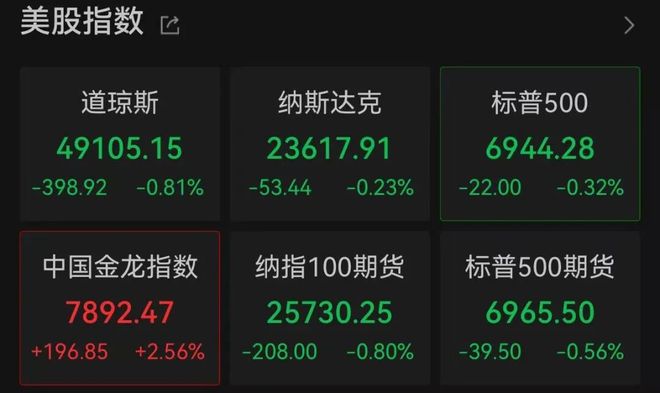
Market Overview - The three major U.S. stock indices opened lower on January 12, with the Dow Jones down 0.81%, the Nasdaq down 0.23%, and the S&P 500 down 0.32% [1][2]. Index Performance - Dow Jones: 49,105.15, down 398.92 points (-0.81%) [2] - Nasdaq: 23,617.91, down 53.44 points (-0.23%) [2] - S&P 500: 6,944.28, down 22.00 points (-0.32%) [2] - China Golden Dragon Index: 7,892.47, up 196.85 points (+2.56%) [2] - Nasdaq 100 Futures: 25,730.25, down 208.00 points (-0.80%) [2] - S&P 500 Futures: 6,965.50, down 39.50 points (-0.56%) [2] Sector Performance - Technology stocks experienced a broad decline, with Intel falling over 3% and Nvidia down nearly 1% [2]. - Banking stocks collectively dropped, with American Express down over 4% and JPMorgan Chase down more than 2% [2]. Chinese Stocks - Chinese stocks surged against the trend, with the China Golden Dragon Index rising over 2% [2]. - Notable performers included Kingsoft Cloud, which rose over 16%, Zhihu up over 15%, Alibaba up nearly 5%, Xpeng up over 4%, and Baidu up over 3% [2].



黄金、白银,进一步上涨
Di Yi Cai Jing Zi Xun· 2026-01-12 14:54
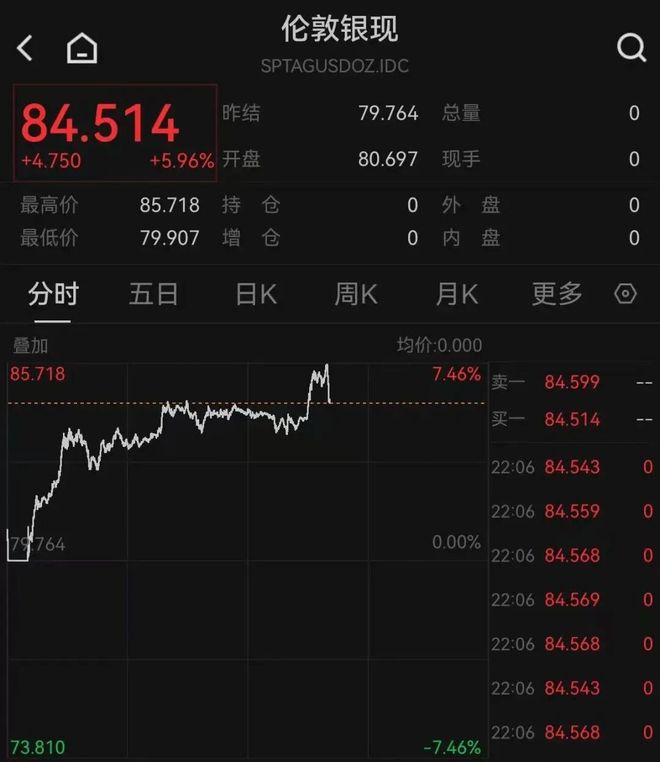
1月12日晚间,黄金、白银再度走高。截至发稿,现货 白银 涨近6%,报84.514美元/盎司,此前一度涨 超7%。纽约期银大涨超7%,沪银期货主力合约涨超5%。 编辑 | 钉钉 | < 白 | 伦敦银现 | | | | | | | | | | --- | --- | --- | --- | --- | --- | --- | --- | --- | --- | | | SPTAGUSDOZ.IDC | | | | | | | | | | 84.514 | 昨年 | | | 79.764 | | 总量 | | | 0 | | +4.750 | +5.96% 开盘 | | | 80.697 | | 现手 | | | 0 | | 最高价 | 85.718 得 | | ロ> | | 0 | 2 | | | 0 | | 最低价 | 79.907 博 仓 0 | | | | | 内 | | | 0 | | 分时 | EK | 五月 | | 国K | | 月K | | 中文 | | | 叠加 | | | | | | 均价:0.000 | | | | | 85.718 | | | | | | 7.46% | | 84.599 ...
投资“国家队”首个投向规范出台
Di Yi Cai Jing Zi Xun· 2026-01-12 14:47
Core Insights - The government investment funds in China have received a structured "roadmap" and "guidance" for their investment directions, focusing on nurturing emerging pillar industries and emphasizing early, small, long-term, and hard technology investments [2][3] Group 1: Government Investment Fund Guidelines - The National Development and Reform Commission (NDRC) and other departments have issued the "Work Method" to systematically regulate the layout and investment direction of government investment funds for the first time at the national level [2][5] - The "Work Method" aims to address issues such as mismatched fund establishment and operation with local resources and industrial foundations, unclear fund positioning, and homogenized investment [2][5] - The "Management Method" was also introduced to complement the "Work Method," marking a shift from extensive management to refined management of government investment funds [2][5] Group 2: Investment Focus and Strategy - The newly launched National Venture Capital Guidance Fund is expected to leverage a trillion-scale investment, focusing on cutting-edge fields such as artificial intelligence, biopharmaceuticals, quantum technology, and 6G, with a lifespan of 15 to 20 years to match the long-term R&D needs of hard technology [3][4] - The government investment funds are designed to support major strategies, key areas, and weak links where the market cannot effectively allocate resources, promoting deep integration of technological and industrial innovation [7][8] - The "Work Method" emphasizes that funds should align with national major plans and encourage industries while avoiding investments in restricted or eliminated sectors [7][9] Group 3: Evaluation and Management Mechanisms - The "Management Method" establishes a comprehensive evaluation system for fund operations, combining quantitative and qualitative assessments to ensure alignment with national strategic planning and effective market intervention [10][11] - Funds that perform well according to the evaluation will receive preferential treatment in project promotion and financing, while poorly performing funds may face restrictions and corrective measures [10][11] - The evaluation results will be linked to future budget arrangements and management team incentives, creating a mechanism that encourages fund management institutions to adhere to policy missions [11]

卫星ETF一个月最高涨74%
Di Yi Cai Jing Zi Xun· 2026-01-12 14:18
Group 1 - The core theme of the article is the explosive growth of the A-share market focused on the "space theme," particularly in the commercial aerospace and satellite industries, with significant trading volumes and stock price increases [2][4][5] - On January 12, 2026, the total trading volume of the two markets exceeded 3.64 trillion yuan, setting a new historical record, with the satellite industry index rising over 76% in the past month [2][5] - The satellite industry index and commercial aerospace index saw daily gains of 10.28% and 8.45%, respectively, with over 4100 stocks rising and more than 200 stocks hitting the daily limit [5][6] Group 2 - Six satellite-themed ETFs attracted nearly 13 billion yuan in inflows over the past month, with several products doubling in size, leading to the emergence of the first 100 billion yuan satellite ETF [2][6][7] - The total fund size of six satellite-themed ETFs surpassed 22.1 billion yuan, doubling from 10.46 billion yuan at the end of December 2025 [7] - Institutional interest in the sector has surged, with over 100 institutions engaging with companies like Superjet Co., Ltd. in just one month [7] Group 3 - The strong performance of the satellite and commercial aerospace sectors is attributed to the release of policy dividends and advancements in low-orbit satellite launches, significantly increasing market attention [8] - The International Telecommunication Union (ITU) reported that China submitted applications for frequency and orbital resources for an additional 203,000 satellites, indicating a competitive landscape in space resource allocation [8] - The commercial aerospace sector is characterized by a focus on market-driven mechanisms for the large-scale application of aerospace technology, differing from traditional aerospace and military sectors [8][9] Group 4 - Concerns about potential "hot money" risks have emerged, with some analysts warning of high valuations in the sector, particularly for companies lacking clear business applications [10][11] - The current market interest and trading activity in the commercial aerospace sector are at high levels, with significant price volatility expected in the secondary market [10][11] - Investors are advised to focus on companies with actual business contributions and technological capabilities, avoiding those that merely chase trends without solid fundamentals [11]

投资“国家队”首个投向规范出台:投早投小投长期投硬科技
Di Yi Cai Jing Zi Xun· 2026-01-12 13:02
Core Insights - The government investment funds in China have established a systematic framework for investment direction and planning, focusing on nurturing emerging pillar industries and emphasizing early, small, long-term, and hard technology investments [1][4] Group 1: Government Investment Fund Framework - The National Development and Reform Commission (NDRC) and other departments have released the "Work Method" to systematically regulate the layout and direction of government investment funds for the first time at the national level [1][3] - The "Work Method" aims to address issues such as mismatched fund establishment and operation with local resources and industry foundations, unclear fund positioning, and homogenized investment directions [1][3] - The "Management Method" was also introduced to complement the "Work Method," marking a shift from extensive management to refined management of government investment funds [1][3] Group 2: Investment Focus and Strategy - The newly launched National Venture Capital Guidance Fund is expected to mobilize trillions in investment, focusing on cutting-edge fields such as artificial intelligence, biopharmaceuticals, quantum technology, and 6G, with a lifespan of 15 to 20 years to match the long-term R&D needs of hard technology [2][5] - The government investment funds are required to support major strategies, key areas, and weak links where the market cannot effectively allocate resources, promoting deep integration of technological and industrial innovation [6][7] - The funds must align with national major plans and encourage industries listed in the national industrial directory while avoiding investments in restricted or eliminated sectors [6][7] Group 3: Evaluation and Management Mechanisms - The "Management Method" establishes a comprehensive evaluation system for fund operations, combining quantitative and qualitative assessments to ensure alignment with national strategic planning and effective market intervention [8][9] - Funds that perform well in evaluations will receive preferential treatment in project promotion and financing, while poorly performing funds may face restrictions and corrective measures [8][9] - The evaluation results will be linked to future budget arrangements and management team incentives, creating a mechanism that encourages fund management institutions to adhere to policy missions [9][10]
上海发布脑机接口重磅文件,5年内全面实现临床应用
Di Yi Cai Jing Zi Xun· 2026-01-12 12:28
他对记者解释,在脑机接口系统中,"硬件"如同肉体,由脑虎科技、景昱医疗等公司提供的电极或外设 构成;"灵魂"则是介于大脑与外设之间的算法系统,脑电分析解码是它们专注研究的领域。 作为我国脑机接口技术发展的前沿阵地,上海已形成覆盖侵入式、半侵入式和非侵入式技术的完整研发 体系。未来五年,上海将多层次培育更多脑机接口技术和产品应用落地。 日前公布的《上海市脑机接口未来产业培育行动方案(2025-2030年)》(下称"方案")提出,2027年 前,实现高质量脑控,半侵入式脑机接口产品在国内率先实现临床应用,侵入式脑机接口研发取得突 破,脑机接口创新生态初步构建。具体围绕加速脑机接口产品化、构建共性技术研发服务平台、推动临 床试验与应用示范、健全产品标准与检测体系、培育产业创新生态等方面展开。 2024年6月以来,上海围绕强化科技创新策源功能,聚焦脑机接口等未来产业新赛道,健全"比选寻优、 动态优化"未来产业培育机制,建立专业化项目经理队伍,实施全生命周期项目管理。 去年12月举行的"2025脑机接口大会"上,多项新技术和产品首发,并揭牌了"脑机接口产业联盟长三角 分联盟"。"上海在脑机接口技术领域取得了系列阶段性突 ...

加仓率新高!
Di Yi Cai Jing Zi Xun· 2026-01-12 11:32
2026.01.12 2026阿驴「躺赢日历」限量发售中12个月,12个我,陪你轻松一整年~ 2026,不一定每天都是晴天 和一个始终在你这边、陪你向前走的阿驴 戳这里直达购买 (限量200本,售完即止) 微信编辑| 生产队的驴 第一财经持续追踪财经热点。若您掌握公司动态、行业趋势、金融事件等有价值的线索,欢迎提供。专 用邮箱:bianjibu@yicai.com (注:我们会对线索进行核实。您的隐私将严格保密。) 但希望每月翻到新一页的你 都能看到一份不一样的祝福 ...
新“易中天”引领GEO概念股涨停
Di Yi Cai Jing Zi Xun· 2026-01-12 09:59
Core Viewpoint - The AI application sector in the A-share market has seen a significant surge, driven by the concept of AI marketing GEO (Generative Engine Optimization), which aims to enhance brand visibility in AI-generated content [2][4]. Group 1: Market Performance - After the A-share market opened on January 12, stocks in the AI application sector, including 易点天下 (301171.SZ), 中文在线 (300364.SZ), and 天龙集团 (300063.SZ), surged by 20%, with several stocks hitting the daily limit [2]. - The Media ETF 华夏 (516190.SH) rose over 8%, while 恒生互联网ETF (513330.SH) increased by nearly 3% [2]. Group 2: Future Projections - Institutions predict that the digital marketing GEO will capitalize on AI dividends, with 2026 expected to be a pivotal year for AI application commercialization [4]. - According to 华鑫证券, the dual drivers of AI applications and domestic demand remain promising, with various sectors like digital marketing and e-commerce being favorable for AI commercialization [4]. Group 3: Consumer Behavior and Trends - As consumers increasingly turn to AI assistants like 豆包, DeepSeek, and 元宝 for inquiries, brand visibility in AI search results is becoming crucial for influencing consumer decisions [4]. - QuestMobile's statistics show that 豆包 leads the native AI market with 155 million weekly active users, followed by DeepSeek with over 80 million and 元宝 with over 20 million [4]. Group 4: Industry Insights - The investment logic in the AI industry is shifting from a "computing power competition" to focusing on "application value" [5]. - The head of a consulting firm warns that while GEO presents commercial opportunities, it also faces challenges, including the risk of misuse leading to the generation of false information [5]. - A rational understanding and application of GEO is essential, as the greatest monetization opportunities will belong to brands that effectively convey real value to consumers using AI technology [5].