
Zhong Guo Dian Li Bao

Search documents
这笔消费 哪变了?
Zhong Guo Dian Li Bao· 2025-10-16 06:24
Core Viewpoint - The article highlights the significant changes in energy consumption and infrastructure in China, reflecting the country's energy transition during the "14th Five-Year Plan" period, with a focus on high-quality development in the energy sector [1] Group 1: Energy Consumption Changes - The presence of "green electricity" labels on electric vehicle charging stations indicates a shift towards renewable energy sources [1] - The installation of solar-powered streetlights that automatically turn on at dusk showcases advancements in energy-efficient technologies [1] - The number of charging stations in residential areas has increased several times compared to five years ago, indicating a growing infrastructure to support electric vehicles [1]
“负电价”是电力市场改革的“信号灯”
Zhong Guo Dian Li Bao· 2025-10-16 06:24
Core Viewpoint - The emergence of negative electricity prices in Sichuan is a reflection of the supply-demand imbalance in the electricity market, driven by an oversupply of electricity from renewable sources and a decrease in demand due to seasonal and economic factors [1][2][3] Supply and Demand Dynamics - Negative electricity prices in Sichuan reached -48.74 yuan/MWh and -49.26 yuan/MWh on September 20 and 21, respectively, with a cumulative duration of -50 yuan/MWh lasting 45 hours [1] - The supply structure in Sichuan is heavily reliant on hydropower, which accounts for 73% of installed capacity, while electricity demand has decreased by 18.1% year-on-year due to lower temperatures and economic adjustments [1] - Similar instances of negative pricing occurred in Shandong and Zhejiang, attributed to significant drops in electricity demand during holidays, despite high renewable energy generation [2] Industry Implications - The occurrence of negative prices is seen as a natural outcome of supply-demand dynamics, not a sign of market failure, and can serve as a signal for necessary adjustments within the industry [3] - Power generation companies are not necessarily losing money during negative pricing periods due to existing subsidies and mechanisms that provide financial stability [3] - The phenomenon encourages power generation companies to innovate, such as integrating energy storage solutions and enhancing flexibility in coal-fired power plants [3] Consumer Impact - Current residential electricity prices are not directly linked to market fluctuations, ensuring stability for consumers despite negative pricing in the wholesale market [4] - Experts caution that frequent occurrences of negative pricing could indicate structural issues within the energy system that need to be addressed through policy and market mechanisms [4] Recommendations for Improvement - Suggestions include promoting the synergy between energy storage and renewable energy, enhancing inter-provincial electricity transmission capabilities, and refining market governance mechanisms to mitigate the frequency of negative pricing [5] - The overall sentiment is that negative pricing should be viewed as a temporary challenge that can lead to positive industry transformation if managed effectively [5]
国家发改委《油气管网设施公平开放监管办法》第33号令
Zhong Guo Dian Li Bao· 2025-10-16 01:59
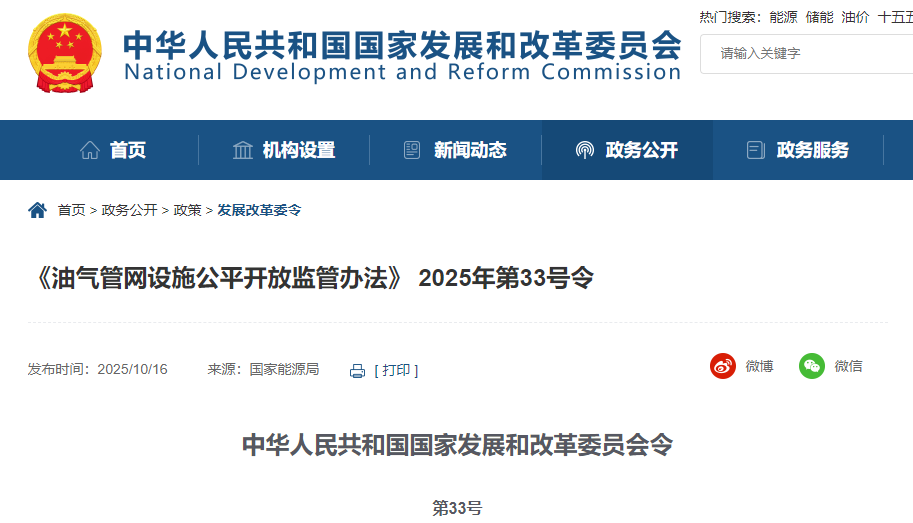
Core Points - The "Regulations on Fair and Open Supervision of Oil and Gas Pipeline Facilities" have been approved and will take effect on November 1, 2025, aiming to ensure fair and non-discriminatory access to oil and gas pipeline services for qualified users [1]. Group 1: Fair and Open Access Principles - The regulations define fair and open access as the obligation of pipeline operators to provide services such as transportation, storage, and unloading to qualified users without discrimination [2]. - The principles guiding the fair access include coordinated planning, safety assurance, stable operation, fair service, and effective supervision [2][3]. Group 2: Responsibilities of Pipeline Operators - Pipeline operators are responsible for establishing systems to ensure fair access and must not refuse service to qualified users without valid reasons [5]. - Operators are required to maintain financial independence for their operations and adhere to national pricing policies when charging for services [6][9]. Group 3: User Registration and Service Application - Operators must create clear procedures for user registration and service applications, ensuring a fair and non-discriminatory process [8][12]. - The regulations encourage the use of online platforms for user registration to streamline the process [9]. Group 4: Contractual Obligations - Operators must sign service contracts with users based on fair principles and cannot delay or refuse to sign without just cause [17][18]. - Users are required to fulfill their obligations under the contract, including timely delivery and withdrawal of oil and gas resources [14]. Group 5: Information Disclosure and Reporting - Operators must regularly report information related to fair access, including user registration and service execution, to the relevant authorities [22][23]. - Information must be disclosed proactively and upon request, ensuring transparency in operations [16]. Group 6: Regulatory Measures and Legal Responsibilities - Regulatory authorities have the power to conduct inspections and require compliance from operators, with penalties for non-compliance [25][30]. - Users also face penalties for providing false information or failing to comply with contractual obligations [32].

中国大唐集团推动在蒙资产整合
Zhong Guo Dian Li Bao· 2025-10-16 01:55
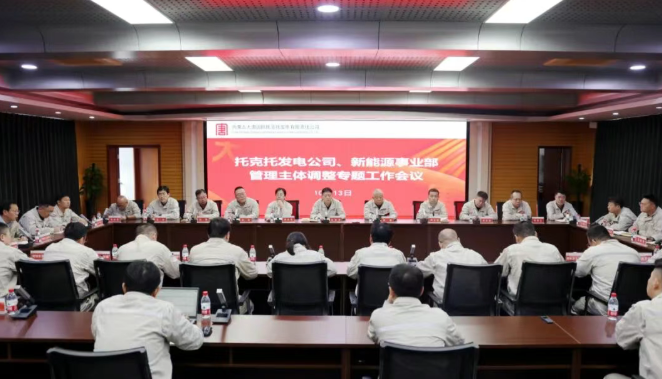
Core Viewpoint - China Datang is restructuring its power generation assets in Inner Mongolia, with the management of the world's largest operational thermal power plant, the Tuo Ke Tuo Power Plant, being transferred to Datang Inner Mongolia Company [1] Group 1: Strategic Development - Datang Inner Mongolia Company is identified as a key regional power generation company for Datang Group, emphasizing the need to seize strategic development opportunities and enhance major project construction such as "Mengdian into Su" [4] - The restructuring of power generation assets in Inner Mongolia is a strategic measure to create scale advantages and enhance Datang's core competitiveness in the region [4] Group 2: Management and Operational Transition - Specific requirements for a smooth transition of management responsibilities have been outlined, including the clear transfer of safety production responsibilities and seamless integration of management functions [5] - The Tuo Ke Tuo Power Company held a special meeting to discuss the management adjustment, emphasizing the importance of this strategic change and the role of Datang Inner Mongolia Company in supporting major energy projects [5]
浙江开展新型主体市场化负调节响应
Zhong Guo Dian Li Bao· 2025-10-15 07:18
Core Viewpoint - Zhejiang's market-based negative regulation response during the National Day and Mid-Autumn Festival holidays has effectively supported renewable energy consumption and ensured stable electricity supply [1] Group 1: Market Activity - On October 2, Zhejiang organized a market-based negative regulation response transaction with participation from 29 virtual power plant operators [1] - The transaction was structured in 8 half-hour trading periods, with an average declared capacity of 383.4 megawatts per period [2] - The maximum declared capacity reached 480.25 megawatts, while the minimum was 310.55 megawatts, with a clearing price of 300 yuan per megawatt [2] Group 2: Impact on Electricity Consumption - During the holidays, overall electricity load in Zhejiang significantly decreased due to factory shutdowns and reduced production [1] - Concurrently, the pressure on the power system to absorb renewable energy surged, necessitating market-based solutions [1] Group 3: Virtual Power Plant Development - As of now, the Zhejiang trading platform has registered a total of 36 virtual power plants, aggregating 4,806 load-side resources [2] - The maximum adjustable capacity of these resources is 1.48 million kilowatts, and they have participated in market responses 12 times, cumulatively adjusting over 10 million kilowatt-hours of electricity [2]
人工智能赋能电力行业新未来
Zhong Guo Dian Li Bao· 2025-10-15 06:44
Core Insights - The integration of AI technology in the power industry is a significant trend, enhancing network security through intelligent analysis, decision-making, and operational efficiency [1] - AI applications in the power system focus on classification and prediction, enabling fault diagnosis and proactive protection against anomalies [2][3] - The collaboration between Huaneng Lancangjiang Company and Deepin Technology has led to the establishment of a cybersecurity maturity model, improving overall network security management [3] Group 1: AI Technology in Power Industry - AI technology enhances network security by providing high-value support for intelligent analysis, decision-making, and operational efficiency [1] - The application of AI in the power system includes machine vision for fault diagnosis and neural networks for anomaly detection [2][3] - AI enables a comprehensive approach to fault management, including prevention, real-time identification, and post-incident analysis [3] Group 2: Cybersecurity Practices - Huaneng Lancangjiang Company has implemented a unified security monitoring platform covering 39 units, improving overall situational awareness and reducing management pressure [4] - The company's cybersecurity strategy emphasizes minimizing exposure, concealing network asset information, detailed asset management, and talent development [5] - Yunnan Electric Power Company utilizes the Cloud Shield platform for comprehensive network security awareness, characterized by rapid perception and accurate alerts [5] Group 3: Future Prospects - Experts agree on the broad prospects of AI technology in the industry, emphasizing the need for deep integration with industry network structures and asset characteristics [6]
能源智库深耕电碳协同的可行性路径
Zhong Guo Dian Li Bao· 2025-10-15 06:44
Core Insights - The research indicates that industrial users are most sensitive to cost, energy consumption, and carbon emissions constraints [1] - The Anhui Economic Research Institute has made carbon research a norm, focusing on supporting the "dual carbon" goals and accelerating the construction of a new power system in the province [1][2] - The institute's research has provided significant intellectual support for the green transformation of the energy and power industry [1][2] Policy and Implementation - In early 2024, the Anhui Provincial Development and Reform Commission issued plans to transition from energy consumption control to carbon emission control, providing a clear path for local green and low-carbon development [2] - The Anhui Economic Research Institute organized expert interpretations of these policies and proposed solutions such as increasing green electricity sources and enhancing the application of "coal power + CCUS" [2] Industry Challenges - The rapid development of the "new three types" industries, particularly in power batteries and electric vehicles, faces challenges from green trade barriers due to new EU regulations [2][3] - The EU's draft rules for calculating the carbon footprint of electric vehicle batteries have prompted the institute to analyze their impact on the energy and power sector [3] Carbon Emission Accounting - The current static method for calculating power carbon emissions is inadequate for guiding energy structure optimization and needs improvement [4] - The Anhui Economic Research Institute proposed a seasonal power carbon emission factor and explored methodologies for promoting low-carbon electricity usage among residents [4] Research and Recommendations - The institute's research team initiated a study on the impact of the national carbon market expansion on power supply and demand, focusing on the allocation of carbon reduction costs [4] - The team provided targeted policy recommendations to facilitate the development of the power market and carbon market [4] Knowledge Dissemination - The Anhui Economic Research Institute actively builds communication platforms with government, enterprises, and industries to translate research into practical benefits [5][6] - The institute's proposal on advancing the carbon trading market was selected as a key proposal by the National Committee of the Chinese People's Political Consultative Conference, highlighting its significance [5][6]
新疆首台带能量构网型SVG投用
Zhong Guo Dian Li Bao· 2025-10-15 06:33
Core Insights - The successful expert review of the Huaneng Honghe Valley energy-coupled SVG demonstration project marks a significant advancement in Xinjiang's grid equipment development, contributing critical technological support for the construction of a new power system [1] Group 1: Project Overview - The project is the first energy-coupled SVG in Xinjiang, serving as a core "active stabilizer" for the power grid [1] - The deployment of this equipment addresses voltage fluctuation issues in renewable energy bases, enhancing the grid's disturbance resistance and improving regional renewable energy absorption levels [1] Group 2: Technical Standards and Implementation - State Grid Xinjiang Electric Power Company has proactively developed and implemented the "Technical Specifications for Energy-Coupled SVG in Xinjiang Power Grid," establishing clear technical standards for energy configuration, voltage support strength, and active power regulation [1] - The project ensures efficient and precise engineering progress through these defined technical standards [1] Group 3: Testing and Validation - A dual verification testing model combining "laboratory semi-physical simulation + on-site measurement" has been innovatively constructed to validate the performance of the equipment [1] - The testing encompasses eight categories and 323 sub-items, thoroughly verifying the reliability of the control strategies and optimizing core control parameters [1]
粤港澳大湾区抽水蓄能在运规模突破千万千瓦
Zhong Guo Dian Li Bao· 2025-10-15 06:33
笔者从中国南方电网有限责任公司了解到,10月2日,"十四五"粤港澳大湾区首个抽水蓄能工程——梅 州抽水蓄能电站(以下简称"梅蓄电站")二期工程第二台机组投产发电,推动大湾区在运抽水蓄能规模 突破1000万千瓦,达到1028万千瓦,接近全国在运总量的六分之一,较"十三五"末增长40%,在运规模 和发展增速均位居世界四大湾区之首。与此同时,广东也成为我国首个抽水蓄能在运规模、调节能力分 别超过1000万千瓦和2000万千瓦的经济大省。 抽水蓄能装备向高端化升级 在位于广州的我国首座抽水蓄能多厂站集控中心内,中控平台实时控制着大湾区6座抽水蓄能电站的启 停,这种"一人多站"的运行集约化模式不仅把设备的控制效率提高2~3倍,还把过去"一座电站调节一地 电源"转化为"多座电站集中服务区域电力系统"。 而在与该集控中心仅"一墙之隔"的我国首个抽水蓄能人工智能数据平台,算力正高效运转。通过接入大 湾区33台抽水蓄能机组的40多万个信息数据,平台600套算法模型和9400多个算法对机组运行状态实时 分析,帮助运维人员足不出户地对机组设备进行"远程体检"。 "目前,平台在机器自主学习的驱动下,已迭代至第三代,替代超95%的设备 ...
科技引领电力装备 高端化、智能化、绿色化发展
Zhong Guo Dian Li Bao· 2025-10-14 06:55
Core Viewpoint - The Chinese government emphasizes the importance of self-sufficiency in energy and has introduced new requirements for high-quality energy development, focusing on the transition from resource control to equipment manufacturing and supply capabilities in the power sector [1] Group 1: Current State of Power Equipment Industry - The power equipment industry in China has evolved from "following" to "running together" and has achieved "leading" positions in multiple fields through independent innovation and the assimilation of foreign technologies [2] - Significant advancements have been made in core technologies, with projects like the Shandong Yuncheng 630℃ ultra-supercritical thermal power demonstration project achieving world-leading coal consumption and efficiency levels [2] - China has established a comprehensive power equipment industry system that supports domestic energy transition and plays a crucial role in global green and low-carbon energy development [2] Group 2: Challenges Facing the Power Equipment Industry - The industry faces three main challenges: a gap in high-end equipment technology to meet green energy transition needs, reliance on imports for some core components and materials, and insufficient digital intelligence capabilities [3] - These challenges hinder the high-quality development of the power equipment sector [3] Group 3: Future Directions and Guidelines - The "Guiding Opinions" provide a scientific blueprint for the high-quality development of power equipment, focusing on enhancing equipment technology levels, developing key components, and promoting digital and green advancements [4][5][6] - The guidelines emphasize the need for improved quality and efficiency in power equipment, particularly as the energy structure shifts from coal to renewable sources [4] - There is a strong push for the large-scale application of energy storage equipment to address the volatility of renewable energy and ensure grid stability [5] Group 4: Digital and Green Transformation - The digital transformation of power equipment is essential for modernizing the industry and enhancing operational efficiency through technologies like digital twins and predictive maintenance [6][7] - The "Guiding Opinions" advocate for a comprehensive approach to green development, addressing challenges related to waste management and resource security throughout the equipment lifecycle [7][8] Group 5: Implementation and Innovation Ecosystem - To implement the guidelines effectively, the industry must strengthen the innovation ecosystem, encouraging enterprises to take on comprehensive innovation responsibilities [8] - Establishing industry self-regulation mechanisms is crucial to prevent homogenization and unhealthy competition, ensuring a structured development environment [8]