Zhong Guo Huan Jing Bao

Search documents
以“书记项目”破题,释放党建赋能治理的强劲动能
Zhong Guo Huan Jing Bao· 2026-01-14 23:32
在实践中,一些地方依托"书记项目"有效推动了管理方式的革新。例如,安徽省宣城市生态环境局创新 实施"'无感'执法+'有感'服务助力营商环境向'优'而进"2025年基层党建"书记项目",实现"无感监 管"与"精准执法"有机统一,营商环境持续优化,企业满意度达95%以上。江苏省宿迁市生态环境局 以"书记项目"为重要抓手,大力推动实施"非现场执法"党员先锋队伍培育工程,有力推动了宿迁非现场 执法工作的提质增效。 还有一些地方,将"书记项目"作为破解环境污染疑难问题的重要抓手。在深圳罗湖,面对大气治理的严 峻形势,深圳市生态环境局罗湖管理局党组书记主动揭榜挂帅,将扬尘污染长效管控列为"书记项 目""微克必争",有力推动了空气质量稳步提升。在江苏无锡,围绕太湖治理的"硬骨头",宜兴生态环 境局各党支部书记领办攻坚项目,通过精准立项、过程管控、整合资源,为太湖治理交上了令人满意的 答卷。这些案例都共同彰显了"书记抓、抓书记"机制超强的行动力与执行力。 近年来,各地积极创新工作机制,以"书记项目"为牵引,推动党建工作与业务实践深度融合,在生态环 境治理、提升监管效能、服务企业发展等方面取得显著成效。 "书记项目"之所以能取 ...
精管善治助力农村生活垃圾治理提质增效
Zhong Guo Huan Jing Bao· 2026-01-14 01:58
Core Viewpoint - The article emphasizes the need for tailored approaches in rural waste management to improve efficiency and effectiveness, highlighting the challenges faced due to inadequate planning and infrastructure [1] Group 1: Waste Management Strategies - The current rural waste management model involves "household collection, village aggregation, town transportation, and county processing," but many areas still lag behind in meeting community expectations due to poor planning and infrastructure [1] - Approximately 60% of rural waste can be reduced through source classification, with effective methods like the "two-stage four classification" approach in Zhejiang Province significantly simplifying the waste sorting process [2] - The "1/3 method" implemented in Hubei Province's rural areas demonstrates effective local waste management by composting organic waste, recycling materials, and processing the remainder, thus reducing transportation and processing costs [3] Group 2: Resource Integration and Financial Solutions - A unified operational system for rural waste management is essential, requiring coordinated funding from various departments to ensure the maintenance of waste collection facilities [4] - Encouraging social investment in rural infrastructure and establishing reasonable payment systems for households can enhance community participation and provide necessary funding for waste management [4] Group 3: Governance and Oversight - Establishing a collaborative governance model involving government, market entities, village collectives, and residents is crucial for effective waste management [5] - Implementing a mechanism for identifying and addressing rural environmental issues, including waste management, can enhance community engagement and improve living conditions [5]
天津扎实推进绿色低碳发展行动
Zhong Guo Huan Jing Bao· 2026-01-14 01:08
Core Viewpoint - Tianjin is committed to promoting green low-carbon development and improving ecological environment governance, achieving significant progress in environmental protection since 2025 [2][7]. Group 1: Green Development Initiatives - Tianjin aims to establish a green development highland and a beautiful China pilot area, focusing on comprehensive green transformation of economic and social development [2][7]. - The city has completed the elimination of sintered brick and coke production capacity, achieving a complete clearance of related capacity [8]. - The number of A and B-level environmental performance enterprises reached 575, with an increase of 59 compared to 2024 [8]. Group 2: Energy and Emission Reduction - Renewable energy sources such as solar and wind power have been significantly developed, with a reduction of coal consumption on schedule [8]. - The city has implemented measures to reduce green electricity emissions by 333 million megawatt-hours, a year-on-year increase of 123%, equivalent to a reduction of approximately 2.78 million tons of carbon emissions [9]. - The total number of new energy heavy trucks reached 8,104, with an addition of 4,930 trucks [9]. Group 3: Environmental Quality Improvement - The annual average concentration of PM2.5 is 36.2 micrograms per cubic meter, a decrease of 5% year-on-year [9][13]. - The proportion of good water quality at national control sections of surface water reached 55.6%, an increase of 2.8 percentage points year-on-year [9][13]. - The city is actively pursuing high standards in air, water, and soil protection, implementing deep governance in key industries and enhancing pollution control measures [9]. Group 4: Future Plans and Strategies - Tianjin plans to accelerate green low-carbon high-quality development and enhance ecological environment governance with higher standards and more effective measures [10]. - The city will focus on collaborative regional green development, improving ecological environment protection mechanisms, and advancing key technologies for pollution reduction and carbon reduction [10][11]. - Future efforts will include integrated protection of natural resources and enhancing the resilience of ecosystems while promoting a circular economy [11].

赣鄱青山涵碧水 美丽江西展新颜
Zhong Guo Huan Jing Bao· 2026-01-14 00:41
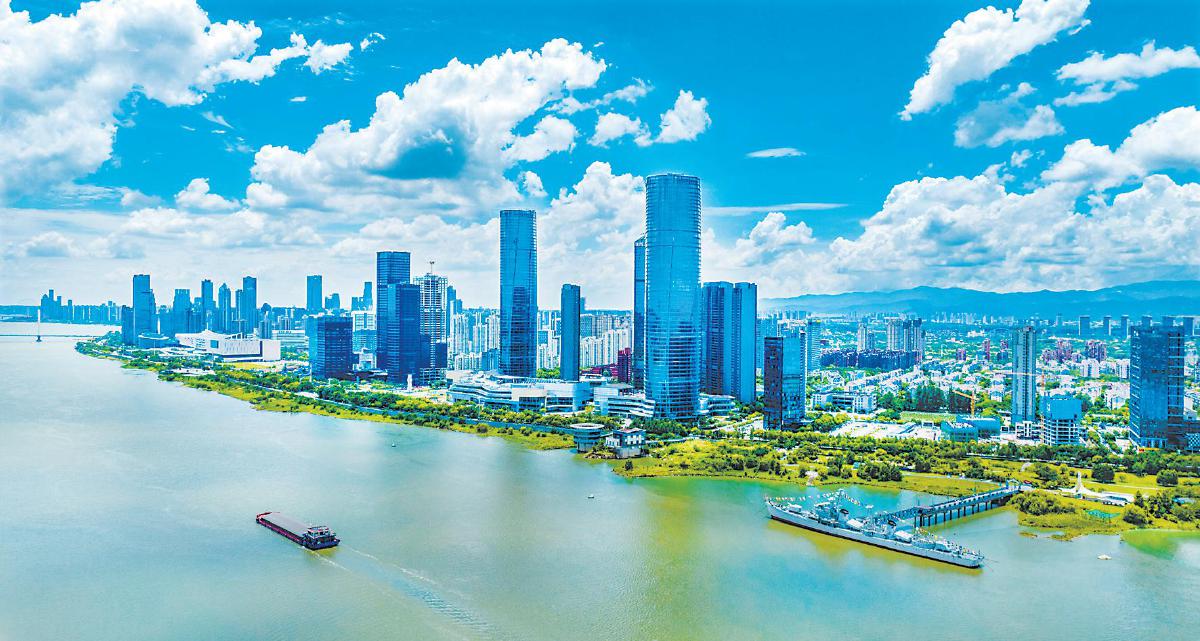
Core Viewpoint - Jiangxi Province has made significant progress in ecological and environmental protection, achieving notable improvements in air and water quality, and is committed to sustainable development and green transformation by 2025 [3][6][21]. Environmental Quality Improvement - By 2025, Jiangxi's PM2.5 average concentration is projected to be 27.4 micrograms per cubic meter, with a good air quality days ratio of 95.5%, ranking first among six central provinces [3][6]. - The provincial surface water quality excellent rate is expected to reach 97.7%, with 100% of the Jiangxi section of the Yangtze River and Gan River maintaining Class II water quality [7][21]. Pollution Control Initiatives - Jiangxi has implemented 30 special actions focusing on pollution prevention, emphasizing precise and scientific pollution control, with a goal of maintaining PM2.5 levels below 20 micrograms per cubic meter for five consecutive years [6][21]. - The province has seen a significant increase in the number of A and B grade enterprises, with A grade enterprises increasing 2.5 times and B grade enterprises increasing 34.5 times compared to the previous year [6]. Water Resource Management - A comprehensive mechanism for water resource management has been established, focusing on the treatment of black and odorous water bodies and the control of total phosphorus pollution in Poyang Lake [7][21]. - The drinking water source quality compliance rate has remained at 100% for five consecutive years [7]. Soil and Waste Management - Jiangxi has conducted extensive soil pollution prevention measures, achieving safety utilization rates for contaminated farmland and key construction land that exceed national assessment requirements [8][21]. - The province has established a waste management system, with 1715 "waste-free" cells created, and has recycled 477,000 units of electronic waste [8]. Green Development and Economic Growth - Jiangxi is promoting green finance and ecological product value realization, with green financial loans reaching 4.681 billion yuan by the third quarter of 2025 [17]. - The province is focusing on integrating ecological resources with economic development, with significant growth in ecological agriculture and tourism [17][18]. Governance and Regulatory Framework - Jiangxi has improved its ecological governance framework, introducing regulations for automatic monitoring of pollution sources and enhancing law enforcement capabilities [21][22]. - The province has established a comprehensive monitoring network, significantly increasing the capacity for groundwater quality monitoring and heavy metal pollution detection [22].
牢牢把握环境应急演练中的“一核两轴三联动”
Zhong Guo Huan Jing Bao· 2026-01-14 00:35
情景库源于对本辖区生态环境风险源的全面评估和对近年突发生态环境事件应急响应经验的总结,需要 涵盖交通事故、危化品泄漏、重金属污染、尾矿库溃坝、流域水污染等可能发生的场景。在演练中,要 通过高度拟真、复杂多变甚至带有"突发状况"的情景设计,倒逼各方在信息不完备、时间紧张的情况下 进入实战状态,暴露真实问题。比如某市在开展应急演练中,把近年发生的槽罐车翻车交通事故和企业 火灾应急响应事件作为蓝本进行复盘。在此基础上,设置了同一天先后发生交通事故导致二氯乙烷泄漏 和园区农药企业着火导致含有仲丁灵农药的污水从雨水管网溢出两个应急响应情景,同步检验"一河一 策一图"和化工园区"一园一策一图"两个项目成果。 在当前生态环境风险隐患依然存在的背景下,开展突发生态环境事件应急演练,提升应急响应处置能 力,是筑牢生态环境安全底线、保障人民群众生命财产安全的必然要求。根据多年从事一线生态环境应 急工作经验,笔者认为开展好应急演练应牢牢把握"一核两轴三联动"。"一核"就是科学设置演练情 景;"两轴"就是处置时间轴和监测时间轴相互贯通;"三联动"就是坚持流域协同治理"一盘棋",实现上 下游响应处置联动、应急监测联动、应急物资联动。 ...
排污许可制度改革应推行五维协同的系统性升级
Zhong Guo Huan Jing Bao· 2026-01-13 04:16
Core Viewpoint - The article discusses the pilot implementation of AI-assisted review of pollution discharge permits in Suzhou Industrial Park, highlighting the need for a comprehensive reform of the pollution discharge permit system in Jiangsu Province to enhance environmental governance and management efficiency [1][2]. Group 1: Current Practices and Challenges - Jiangsu Province is characterized by high volume, high requirements, and high pressure in pollution discharge permit management, showcasing both exploratory experiences and challenges in further improving management measures [1]. - Since the 14th Five-Year Plan, Jiangsu has implemented practices such as limit and quota management in industrial parks and established a total reserve library [1]. - The integration of 16 forms into a collaborative approval system and the promotion of "form-based approval" have been initiated, along with a proposal for a unified approval of two certificates [1]. - However, issues such as mismatches between enterprise capabilities and regulatory requirements, low-quality competition in the third-party market, and weak linkage between permit volumes and environmental quality have been identified [1]. Group 2: Recommendations for Reform - The top-level institutional design should integrate environmental assessment, permits, enforcement, taxes, and credit into a single coherent framework to ensure stability and predictability of rules [2]. - Standards and methods should be aligned to ensure that selection criteria are clear, compliance is interpretable, and judgments are executable [2]. - A tiered review process for changes and filings should be established to enhance efficiency, alongside regular quality audits and lifecycle management [2]. - The organizational framework should strengthen corporate responsibility, regulate the third-party market, and ensure that all parties are accountable and can be evaluated [2]. - A supportive platform should enable seamless data sharing and reuse, enhancing non-site supervision through intelligent tools [2]. Group 3: Goals and Future Directions - The improvement of the pollution discharge permit system is a dynamic process aimed at linking environmental quality with enhanced corporate responsibility [2]. - The reform during the 15th Five-Year Plan should focus on a five-dimensional collaborative upgrade, shifting the management focus from permit issuance to governance effectiveness [2]. - The ultimate goal is to establish a modern environmental governance framework characterized by regulation, simplification, stability, capability, and intelligence, promoting self-discipline among enterprises, market regulation, and precise government oversight [2].
固定点源排放管理应与区域环境目标挂钩
Zhong Guo Huan Jing Bao· 2026-01-13 02:43
"我国已初步形成了以生态环境分区管控为基础、环境影响评价为主体、固定源排污许可管理为约束的 全链条管理制度体系。"近日,在"持续推进环评'全链条'改革 加快落实排污许可制度"专题研讨会上, 清华大学教授刘毅围绕以排放管控为主线推动环评全链条管理改革作了发言。 刘毅介绍,污染物排放管控是当前推动环评全链条改革的主线之一。围绕这一内容,其团队也开展了相 关研究。 在分区管控政策强度评估与关键单元识别方面,通过构建产业链、污染流等多要素空间网络模型,可识 别具有区域重要影响的关键管控单元。在京津冀地区,识别出25个关键管控单元,虽然数量有限,却承 载了约30%的区域污染排放总量,覆盖70%的区域面积和80%以上人口,是提升管理效能的重要抓手。 在工业生产排放模拟与分区管控成效评估方面,通过研发工业企业多主体建模与政策评估模型,实现了 对7700家企业的排放动态模拟,误差小于3%。 同时,他还建议,支撑环评全链条管理改革的研究,应构建基于最佳可行技术的差异化管控限值确定方 法与规范,开发环评与排放管理中枢智能体及应用场景功能智能体群,研发"区域/流域—管控单元—固 定源"排放管控标准化模型。 在质量目标约束下污染排放 ...
“精彩射门,精准分类”,湘超何以成为环保课堂?
Zhong Guo Huan Jing Bao· 2026-01-13 01:48
大型体育赛事不仅是竞技拼搏的舞台,更是生态价值融入社会生活的良好契机。推进生态文明建设,不 仅需要政策规制与技术创新,更依赖于社会公众广泛而自觉的实践。然而,传统自上而下的宣导模式, 往往因单向灌输、与日常生活情境脱节而效果有限。在此背景下,湖南省足球协会超级联赛(以下简称 湘超)这一草根赛事,却意外地成为一个规模宏大的生态公民培育实践课堂,为创新环境治理的社会参 与路径提供了鲜活范本。 湖南省构建了"省—市—区—街道—社区"五级联动工作体系,借助赛事影响力,推动垃圾分类宣传,打 造绿色环保湘超。各市州城市管理部门与赛事主办方精心组织每一场活动,社工部门、区县相关部门、 街道社区与赛事主办方形成合力,实现了垃圾分类宣传从"面上覆盖"到"精准滴灌"的转变。截至2025年 12月14日首轮淘汰赛结束,湘超联赛已累计开展垃圾分类宣传94场,吸引61.57万人次参与,并带动 463.2万人次加入垃圾分类行动。 生态行为从理念到实践的第一步,是使其在特定时空背景下变得具体、可行。组委会发布的《文明观赛 倡议书》没有简单复述抽象规范,而是进行了高度情境化的转译,将"爱护公共环境"具体化为"离场时 自觉清理座位",将"践行 ...
如何理解以制度协同改革引领排污许可优化?——专访中国工程院院士王金南
Zhong Guo Huan Jing Bao· 2026-01-13 01:24
Core Viewpoint - The article emphasizes the importance of reforming the three core systems of ecological environment zoning control, environmental impact assessment (EIA), and pollutant discharge permits to enhance ecological governance and support high-quality development [1][5]. Summary by Sections Ecological Environment Zoning Control - Ecological environment zoning control provides the "bottom line" and "framework" for various development activities, serving as a foundational system for ecological management [2]. - It is essential for ensuring the construction of a beautiful China, with ecological protection red lines, environmental quality bottom lines, and resource utilization upper lines as key components [2][3]. Environmental Impact Assessment (EIA) - EIA acts as a primary system for source prevention, crucial for controlling environmental access for planning and projects [2]. - The EIA system has developed over 40 years but faces challenges that require reform to reduce burdens on local levels while maintaining strict access controls [2][3]. Pollutant Discharge Permits - Pollutant discharge permits are the core system for regulating fixed pollution sources, linking source control with end-of-pipe treatment [2][3]. - The permits are essential for precise lifecycle management of fixed pollution sources [2]. Interconnections Among the Three Systems - The three systems are interconnected, forming a logical closed loop of "spatial control—access control—emission regulation" [3]. - Each system focuses on improving environmental quality through precise management, supporting the overall ecological environment system [3]. Distinctions Among the Systems - Different control dimensions: zoning control focuses on spatial dimensions, EIA on decision-making, and discharge permits on emission dimensions [3][4]. - Different target objects: zoning control covers all spatial units, EIA focuses on specific projects, and discharge permits target fixed pollution sources [3][4]. Reforming Ecological Environment Zoning Control - Zoning control is seen as a basis for the synergy of the three systems, requiring reforms to enhance its scientific and operational effectiveness [5]. - Key areas for reform include strengthening multi-factor collaborative management, supporting precise standard formulation, and improving the institutional guarantee system [5][6][7]. Future Directions for Pollutant Discharge Permits - The vision for pollutant discharge permits is to establish a comprehensive, scientifically sound, and efficient regulatory system [8]. - Core reform tasks include full-factor coverage, integrated management, full-cycle control, quality standards, and reinforcing corporate responsibility [8][9][10]. Implementation Pathways for Optimizing Discharge Permits - Establishing a permit emission volume determination system based on environmental quality goals is crucial [9]. - Promoting interlinked management across zoning control, EIA, and discharge permits is necessary for effective governance [9]. - Implementing a "one certificate" management approach for coordinated pollution and carbon reduction is essential [10].
从运河明珠到生态标杆 扬州广陵“两山”基地建设谱写高质量发展新篇章
Zhong Guo Huan Jing Bao· 2026-01-13 00:51
Core Viewpoint - The Guangling District of Yangzhou has successfully integrated ecological protection, cultural heritage, and economic growth through the "Two Mountains" concept, demonstrating a model for sustainable development in the context of the South-to-North Water Diversion Project and the Grand Canal [2][19]. Group 1: Ecological and Economic Integration - Guangling District has been recognized as a national "Two Mountains" practice innovation base since 2021, focusing on ecological protection and economic growth [2]. - The district has developed a comprehensive implementation plan for the "Two Mountains" concept, emphasizing ecological product value realization and cultural heritage [4]. - The establishment of a mechanism for ecological asset value assessment aims to quantify the value of ecological services, providing a scientific basis for ecological compensation and green development decisions [5]. Group 2: Environmental Protection Initiatives - Guangling District has implemented a multi-layered ecological safety barrier, ensuring the protection of water quality as a political responsibility [7]. - The district has established a high-efficiency air quality management system, utilizing advanced technologies for precise pollution control [8]. - A series of initiatives targeting rural waste, sewage, and sanitation have been launched, significantly improving local living conditions [9]. Group 3: Biodiversity and Ecological Restoration - The district has made significant progress in biodiversity restoration, with over 180 bird species recorded and a notable increase in the population of the endangered Yangtze River dolphin [10]. - The ecological restoration efforts have resulted in the completion of 355.13 hectares of ecological protection and restoration projects [10]. Group 4: Infrastructure and Community Development - The completion of the Ringzhou No. 1 Road has improved connectivity among towns, enhancing the local living environment and promoting rural tourism [11]. - The district has adopted an EOD (Ecological Environment-Oriented Development) model, integrating environmental governance with industrial development [17]. Group 5: Green Manufacturing and Smart Governance - Guangling District is fostering a green manufacturing ecosystem, with several enterprises achieving national and provincial recognition for their sustainable practices [14]. - The introduction of smart governance technologies, such as unmanned cleaning vehicles and drones, has improved urban management efficiency [15]. Group 6: Cultural and Economic Revitalization - The district's approach to urban renewal emphasizes small-scale, gradual improvements that preserve historical character while enhancing living conditions [17]. - The integration of ecological agriculture and rural tourism has generated significant economic benefits, with projections of over 10 million yuan in revenue from eco-tourism in 2025 [16]. Group 7: Overall Environmental Quality Improvement - The water quality in the district has consistently met high standards, with no inferior water bodies reported, and air quality has shown overall improvement [18].