
Zhong Guo Huan Jing Bao

Search documents
推动生态环境共保联治从“内部协作”走向“内外融通”
Zhong Guo Huan Jing Bao· 2025-11-06 00:14
Group 1 - The core viewpoint emphasizes the need for enhanced regional development coordination and collaboration in ecological protection strategies, as outlined in the 15th Five-Year Plan proposal by the Central Committee [1] - The article highlights the importance of regional collaborative governance to address cross-regional environmental issues, advocating for a shift from internal cooperation to external integration for comprehensive ecological protection [2][3] - It stresses that regional collaboration is essential for balancing high-level environmental protection with high-quality economic development, promoting resource optimization and effective environmental management [3][4] Group 2 - The article discusses the necessity of managing relationships between internal and external regions, government and market roles, and the balance between targeted breakthroughs and systematic governance in ecological protection efforts [4] - It outlines four key areas of integration: planning, regulation, market, and institutional frameworks, to enhance collaborative environmental governance across regions [5][6][7] - The article calls for a unified approach to ecological protection, leveraging major strategic regions to explore new models and mechanisms for cross-regional cooperation in environmental protection [7]
构建深度脱碳体系,破解钢铁行业转型困境
Zhong Guo Huan Jing Bao· 2025-11-05 23:23
Core Viewpoint - The steel industry in China faces significant challenges in achieving a green and low-carbon transformation, with carbon emissions accounting for approximately 15% of the national total, necessitating a comprehensive approach to overcome resource constraints, technological bottlenecks, and rising cost pressures [1][2]. Group 1: Current Status and Challenges - The steel industry has made progress in green low-carbon transformation through digitalization and ultra-low emission projects, with around 600 million tons of crude steel capacity undergoing ultra-low emission upgrades by July this year [2]. - Despite these efforts, the carbon emissions per ton of steel in China remain higher than international advanced levels, and the existing reduction potential is diminishing, requiring fundamental technological breakthroughs for deep decarbonization [2][3]. - The implementation of the EU's Carbon Border Adjustment Mechanism (CBAM) in 2026 may increase export costs for Chinese steel products, impacting the competitiveness of certain enterprises [2]. Group 2: Technological and Policy Bottlenecks - Low-carbon technologies such as hydrogen metallurgy and electric furnace processes are still in the early stages of commercialization, with high production costs and challenges in market promotion [3]. - The regulatory framework supporting deep decarbonization in the steel industry is not yet fully developed, with issues in quota allocation, market activity, and carbon pricing mechanisms that hinder effective incentives for low-carbon technology adoption [3]. - There are structural challenges in resource allocation, including difficulties in green electricity consumption and the large-scale application of carbon capture, utilization, and storage (CCUS) technologies [3][5]. Group 3: Recommendations for Acceleration - Strengthening technological innovation and industry-wide collaboration is essential, focusing on key technologies like hydrogen metallurgy and efficient electric furnace processes, while promoting the establishment of near-zero carbon emission demonstration plants [4]. - Innovating market mechanisms and stimulating demand for green products by integrating low-carbon steel procurement into green certification systems and reforming the carbon market to support companies adopting deep decarbonization technologies [4][5]. - Optimizing policy coordination and institutional support by implementing differentiated policies for long and short process steel mills, enhancing financing mechanisms for hydrogen metallurgy projects, and establishing cross-departmental coordination [4][5].
公园里的臭水塘也得有人管
Zhong Guo Huan Jing Bao· 2025-11-05 06:45
经了解,这样的情况并非个例。近年来,各地为了优化城乡人居环境,陆续建设了许多生态主题公园。 在一些面积较大的公园内,往往设有人工湖、人工河、人工瀑布等人工水体。日积月累,水中污染物不 断累积、腐败、发酵,水质便逐渐变差。由于公园管理部门缺少水质监测能力和污水治理经验,部分人 工水体水质长期超标,并持续渗入地下,威胁了地下水安全。 笔者认为,人工水体环境问题也得有人管。针对人工水体处于生态环境部门管不了、公园管理部门管理 难的境况,亟须创新举措,堵住这一监管漏洞。 建立部门协作机制。应由地方政府牵头加强辖区内人工水体监管,建立健全生态环境部门和公园管理部 门协作机制,如水环境信息沟通机制、水污染防治联动机制等,使公园内的人工水体环境也能及时得到 维护。 强化宣传,使人工水体环境问题得到关注。要加大生态环保宣传力度,使公园管理人员充分认识到超标 水体潜藏的生态环境危害,改变在一些管理人员中存在的"只要水不臭,便是好景观"的思想认识,促使 他们积极行动起来,密切关注公园内人工水体的水质。一旦发现水质有变差趋势,第一时间采取应对措 施,降低后续治理成本。 采取针对性的治理措施。经监测发现人工水体水质超标后,公园管理部 ...
家风故事|评估中心赵明月:“把方便留给别人,把困难留给自己”,这句家训父亲用一生来践行
Zhong Guo Huan Jing Bao· 2025-11-05 03:12
Group 1 - The article highlights the dedication and bravery of a father who has served as a party member for 28 years, emphasizing his commitment to public service in challenging environments [1] - It describes a significant forest fire incident in 2006 where the father took decisive action to control the fire, showcasing his leadership and selflessness [1] - The article also recounts a severe flood in 2010, where the father led efforts to protect lives and property, demonstrating his courage and quick thinking in crisis situations [2] Group 2 - The narrative includes a personal loss, as the father was unable to attend his grandmother's funeral due to the flood, highlighting the emotional toll of his responsibilities [3] - A key family value is presented through the grandmother's advice to prioritize others' convenience over one's own difficulties, which has influenced the father's actions and serves as a guiding principle for future generations [3]
湘西州生态环境保护的“绿色密码”
Zhong Guo Huan Jing Bao· 2025-11-05 01:11
Core Viewpoint - Xiangxi Prefecture has prioritized ecological protection and green development, achieving significant improvements in environmental quality, including a 100% compliance rate for drinking water sources and a 94.5% average of good air quality days in the capital city, Jishou [1][8]. Group 1: Ecological Protection Initiatives - The local government has implemented a strict "Party and government responsibility" system, integrating ecological protection into annual work priorities and ensuring accountability at all levels [2][11]. - A comprehensive responsibility framework has been established, including the formation of the Xiangxi Ecological Environment Protection Committee, which coordinates key ecological protection efforts [2][11]. - Enhanced supervision and accountability measures have been put in place, with a focus on addressing significant ecological issues and holding responsible parties accountable for failures [3][12]. Group 2: Systematic Governance and Actions - Xiangxi has launched various initiatives such as the "Spring Breeze Action" to support 87 key enterprises with tailored ecological guidelines and expert assistance [4][14]. - The "Summer Offensive" targeted major pollution sources, completing 928 key ecological tasks related to air, water, and soil quality [4][14]. - The "Sword Action" focused on identifying and mitigating risks associated with heavy metals and hazardous materials, successfully addressing 595 risk points [4][14]. Group 3: Legal and Regulatory Framework - Xiangxi has enacted multiple local regulations to enhance ecological protection, including specific laws for nature reserves and biodiversity [16][17]. - The implementation of a dual mechanism for administrative penalties and ecological compensation has led to the initiation of 508 ecological damage compensation cases, with a resolution rate of 92.5% [17][18]. - The region's commitment to legal frameworks supports the ecological restoration efforts, particularly in areas affected by mining activities [17][18].

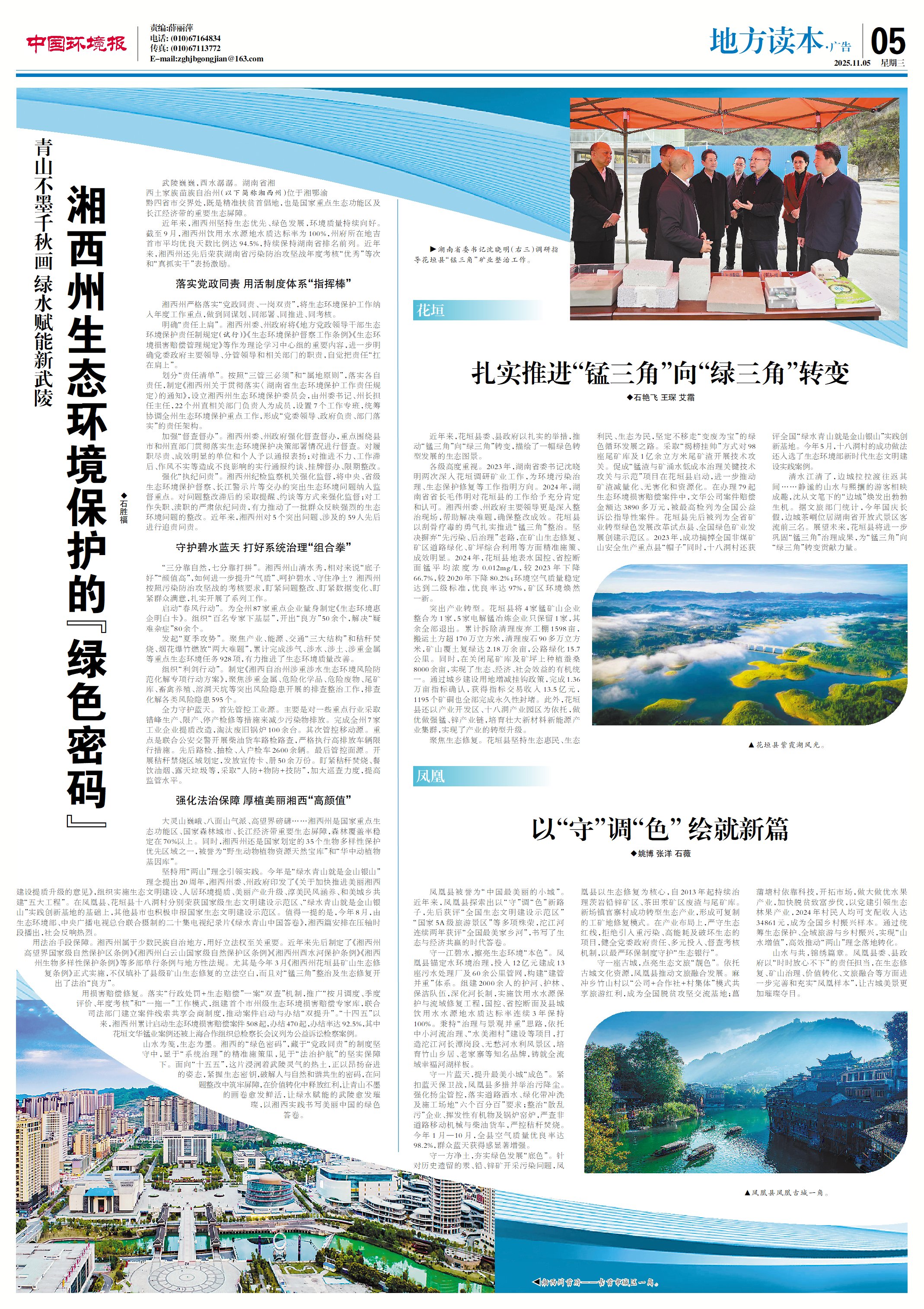
湘西州花垣县扎实推进“锰三角”向“绿三角”转变
Zhong Guo Huan Jing Bao· 2025-11-05 01:11
Core Viewpoint - Hunan Province's Huayuan County is transitioning from a "Manganese Triangle" to a "Green Triangle" through effective measures aimed at ecological transformation and sustainable development [2][3][4] Group 1: Government Initiatives - The Hunan Provincial Party Secretary and Governor have conducted multiple inspections in Huayuan County to guide environmental pollution control and ecological restoration efforts [2] - Local leaders are actively involved in on-site remediation efforts to ensure effective results in environmental governance [2] Group 2: Industrial Transformation - Huayuan County has consolidated four manganese mining companies into one and reduced five electrolytic manganese smelting companies to one, leading to the dismantling of 1,598 acres of abandoned structures [3] - The county has achieved significant land reclamation, with over 21,800 acres of land restored and 15.7 kilometers of roads greened [3] - The implementation of land use policies has generated 1.35 billion yuan in revenue from land indicator trading [3] Group 3: Ecological Restoration - The county is committed to a "waste-to-resource" approach, focusing on the technological remediation of tailings and mining waste [4] - Huayuan County has been recognized as a pilot county for green development in the mining sector and has successfully removed its designation as a key safety production county for non-coal mines [4] - The local tourism sector has seen a boost, with significant visitor numbers reported during the National Day holiday, indicating a positive impact from ecological improvements [4]

湘西州凤凰县以“守”调“色”绘就新篇
Zhong Guo Huan Jing Bao· 2025-11-05 01:11
Core Viewpoint - Fenghuang County has successfully integrated ecological preservation with economic development, earning multiple accolades such as "National Ecological Civilization Construction Demonstration Zone" and "National 5A Tourist Attraction" [2][3]. Group 1: Ecological Environment Management - Fenghuang County has invested 1.2 billion yuan to build 13 sewage treatment plants and over 60 kilometers of pipelines, establishing a "construction and management" system [2]. - The county has formed a team of over 2,000 personnel for river, forest, and cleanliness protection, ensuring that water quality standards have been met for three consecutive years [2]. - Projects like the "Water Beautiful Xiang Village" and the management of small rivers have been implemented to enhance the ecological landscape [2]. Group 2: Air Quality Improvement - The county has adopted multiple measures to combat air pollution, achieving an air quality good rate of 98.2% from January to October this year [3]. - Strict controls have been placed on dust emissions, including road watering and the regulation of construction sites [3]. Group 3: Green Development Initiatives - Since 2013, Fenghuang County has focused on ecological restoration, particularly addressing pollution from historical mining activities [3]. - The county has established a model for the restoration of mining sites, ensuring that no high-pollution or high-energy-consuming projects are introduced [3]. Group 4: Cultural and Tourism Development - Fenghuang County promotes the integration of culture and tourism, with initiatives like the "company + cooperative + village collective" model to share tourism benefits [3]. - The county aims to enhance rural income through ecological agriculture, with projected per capita disposable income reaching 34,861 yuan in 2024 [3]. Group 5: Comprehensive Development Strategy - The county government is committed to ecological restoration, mining governance, and cultural tourism integration, further enriching the "Fenghuang model" [4].

网红打卡地要想红得久不能毁生态
Zhong Guo Huan Jing Bao· 2025-11-05 00:13
Core Insights - The rise of internet-famous check-in spots has led to both opportunities for local tourism development and challenges such as noise pollution, traffic congestion, and environmental degradation [1][2] Group 1: Governance Challenges - The governance issues faced by internet-famous check-in spots are not merely due to the behavior of visitors but highlight the lag in public management systems in responding to sudden influxes of tourists [1] - Problems such as inadequate waste disposal, lack of traffic management plans, and insufficient noise control measures contribute to the "growing pains" of these popular locations [1][2] Group 2: Ecological Protection Measures - It is essential to maintain ecological boundaries and implement comprehensive management strategies that involve community participation and multi-departmental collaboration [2][3] - Effective governance requires coordinated efforts in organization, spatial planning, and time management to mitigate the impact on local residents while accommodating tourists [2] Group 3: Community Engagement - Encouraging community involvement in the management and planning of check-in spots can foster a symbiotic relationship between local life and tourism [3] - Initiatives such as interactive check-in experiences and reward systems can transform visitors from passive observers into active participants in ecological protection [3] Group 4: Infrastructure and Technology - Proactive infrastructure development, including the installation of viewing platforms and waste management facilities, is crucial for sustainable tourism [3][4] - Utilizing information technology for monitoring and regulation can enhance environmental protection efforts and deter violations [4] Group 5: Long-term Sustainability - The longevity of internet-famous check-in spots depends on preserving their unique ecological and cultural attributes rather than sacrificing them for short-term popularity [4] - Establishing a balance between attracting visitors and maintaining ecological integrity is vital for creating enduring public spaces that are both popular and environmentally friendly [4]
如何破解省际边界地区污染治理难题?强化省际合作下好治污“一盘棋”是破解之道
Zhong Guo Huan Jing Bao· 2025-11-04 23:20
Core Viewpoint - The implementation of the "Implementation Plan for Cooperative Development in the Border Areas of Anhui and Henan Provinces" aims to enhance ecological cooperation and environmental governance between the two provinces, transitioning from isolated efforts to a collaborative approach in addressing environmental issues [1][2]. Group 1: Ecological Cooperation - The plan expands the scope of ecological cooperation between Anhui and Henan, promoting a unified approach to environmental governance rather than isolated actions [1]. - The establishment of a regulatory cooperation mechanism is essential for addressing the unique challenges posed by different regional development needs and environmental standards [1][2]. - Previous coordination efforts during flood seasons have shown effectiveness in managing water quality issues, indicating a foundation for ongoing collaboration [2]. Group 2: Mechanism and Innovation - The plan emphasizes the need for a permanent cooperation mechanism, moving beyond temporary measures to ensure continuous ecological monitoring and data sharing [2]. - The focus on joint monitoring, emergency response, and ecological compensation reflects a comprehensive strategy to tackle cross-border environmental challenges [2][3]. - The transformation of ecological advantages into developmental benefits is highlighted through initiatives in circular economy and green industries, showcasing a shift towards high-quality regional development [3]. Group 3: Regional Impact and Best Practices - Successful examples from other regions, such as the reduction of PM2.5 levels in the Beijing-Tianjin-Hebei area, demonstrate the effectiveness of collaborative environmental governance [4]. - The establishment of local standards for comprehensive emissions in river basins signifies a significant step towards coordinated ecological protection efforts [4]. - The ongoing practices across various provinces illustrate the importance of cross-regional cooperation in enhancing ecological governance and addressing environmental challenges effectively [4][5].
既守护绿水青山,又实现生态产品价值转化,安徽六安是这样治水的|水征文选登
Zhong Guo Huan Jing Bao· 2025-11-04 03:10
Core Viewpoint - Liu'an City is enhancing its water source protection and ecological environment management to ensure sustainable development and ecological safety for downstream areas [1][2][3] Group 1: Water Source Protection - Liu'an has completed the adjustment and delineation of drinking water source protection areas, which has been approved by the Anhui provincial government [1] - Regular environmental assessments of drinking water sources are conducted at both city and county levels, with a focus on establishing a long-term rectification plan for issues that cannot be immediately resolved [1] Group 2: Pollution Control and Water Quality Management - Strict approval processes for river discharge outlets are in place, with on-site evaluations for new, modified, or expanded discharge points [2] - Liu'an is implementing comprehensive pollution control projects in the Chaohu Lake basin, including integrated management of urban sewage and agricultural runoff [2] - A water quality compensation incentive mechanism has been established to address fluctuations in water quality at specific monitoring points [2] Group 3: Ecological Restoration and Cultural Integration - Liu'an is enhancing law enforcement on sewage treatment plants and monitoring pollution sources, while also providing technical support to enterprises for pollution control [3] - The city is integrating water ecological protection with cultural tourism, developing eco-tourism routes and educational bases that attract significant visitor numbers [3] - In 2024, Liu'an expects to receive 68.69 million tourists, generating approximately 52.2 billion yuan in tourism revenue [3]