Zhong Guo Huan Jing Bao

Search documents
生态保护+特色产业,杭州山区这样推进绿色发展
Zhong Guo Huan Jing Bao· 2025-11-04 01:48
Core Insights - The article emphasizes the successful integration of ecological protection and economic development in the mountainous areas of Hangzhou, Zhejiang Province, under the guiding principle of "Green Mountains and Clear Water are as Valuable as Mountains of Gold and Silver" [1][4]. Group 1: Green Development Practices - Hangzhou's mountainous areas have achieved a forest coverage rate of 65.74% and reduced the annual average PM2.5 concentration to 30 micrograms per cubic meter over the past 20 years [1]. - The region has maintained GDP and farmer income growth rates of over 7% and 5%, respectively, demonstrating a positive interaction between ecological protection and economic growth [1]. - The implementation of the "Ten Thousand Project" has significantly improved forest coverage and water quality through afforestation and water source protection initiatives [2]. Group 2: Industry Transformation - The establishment of ecological protection red lines has compelled the elimination of high-pollution and high-energy-consuming traditional industries, promoting the development of efficient ecological agriculture and green tourism [2]. - The region has successfully created tourism spots focused on ecological sightseeing and leisure, converting ecological resources into economic value [2]. Group 3: Innovation and Technology - The promotion of smart agricultural technologies and the development of clean energy have been pivotal in enhancing efficiency and reducing emissions [2]. - Hangzhou has maintained a 100% excellent water quality rate for key water monitoring sections for four consecutive years, with all county-level drinking water sources meeting quality standards [2]. Group 4: Unique Industry Development - The mountainous areas leverage their natural resources and cultural advantages to develop distinctive ecological industries, such as the West Lake Longjing tea and Hangbai chrysanthemum, enhancing their market competitiveness [3]. - The integration of ecological and cultural elements has led to the creation of high-value ecological products and tourism experiences [3]. Group 5: Systematic Governance - The successful experience of Hangzhou can be summarized in a theoretical framework that includes ecological protection as the foundation, unique industries as the core, innovation mechanisms as the engine, and systematic governance as the guarantee [4][5]. - The establishment of a sustainable development community involving government, market, and society has been crucial in ensuring the long-term stability of the region's transformation [5].
一片茱萸红 带富千万家
Zhong Guo Huan Jing Bao· 2025-11-04 00:48
Core Viewpoint - The article highlights the green transformation and ecological development practices in Foping County, Shaanxi Province, emphasizing the integration of ecological preservation with economic growth through the cultivation of the Chinese cornelian cherry. Group 1: Ecological and Economic Development - Foping County is recognized as the "Hometown of Chinese Cornelian Cherry," with 106,000 acres of the fruit being cultivated, showcasing a successful model of ecological and economic integration [2][11][12] - The county's green circular industry is driving rural revitalization, transforming cornelian cherry into a significant economic resource [2][11] Group 2: Historical and Current Production - The history of cornelian cherry cultivation in Foping dates back to the Southern Dynasties, and it is now one of the top three production areas in China, with an annual output of 1,200 tons, capturing one-sixth of the national market share [12][17] - The county has invested nearly 10 million yuan in modern processing facilities, significantly improving production efficiency and reducing costs [13][14] Group 3: Product Development and Market Expansion - Foping County has developed over 20 products from cornelian cherry, including health drinks and enzyme products, achieving an annual output value exceeding 120 million yuan and increasing farmers' income [14][16] - The county has established a public brand "Cornelian Cherry + Panda," integrating agriculture, culture, and tourism, attracting over 500,000 visitors annually [16][17] Group 4: Employment and Community Impact - The cornelian cherry industry has created over 12,000 jobs, accounting for 40% of the rural labor force in Foping County, demonstrating the socio-economic benefits of ecological industry [17][19] - Future plans include enhancing product quality and developing high-value-added products through collaboration with innovation platforms [19]

绘就荆楚生态新画卷 美丽湖北建设迈出坚实步伐
Zhong Guo Huan Jing Bao· 2025-11-04 00:37
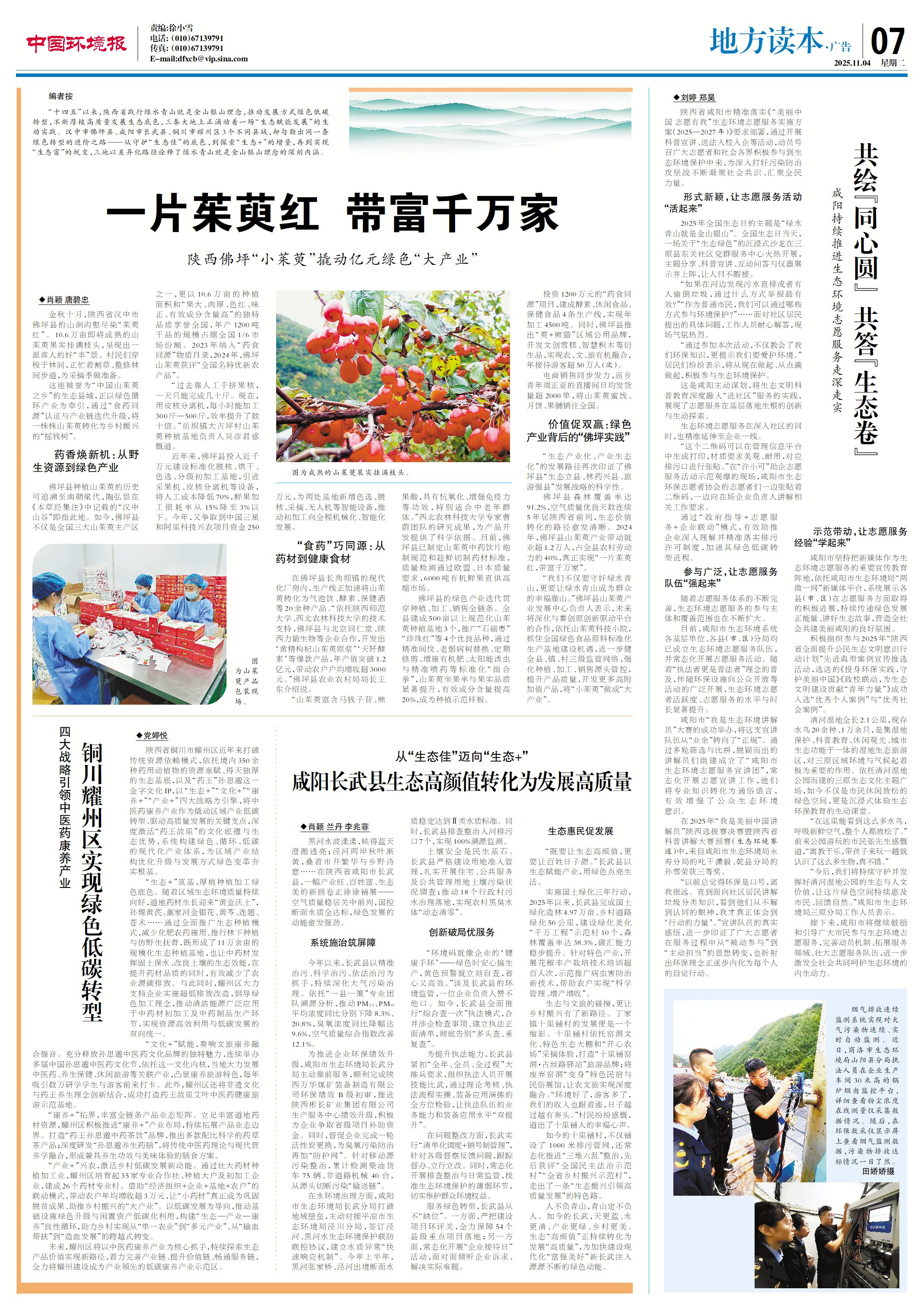
通过综合治理后的宣恩龙洞水库波光荡漾。 全省生态环境质量大幅改善,国考城市优良天数比例达到83.7%,比2015年提高13.6个百分点。全 省森林覆盖率提高到42.45%,高于全国18个百分点。长江干流湖北段水质连续6年稳定在Ⅱ类,国控断 面水质优良比例达95.8%,高于国家考核目标2.7个百分点,县级城市饮用水水源水质达标率达100%。 建设美丽城市:低碳社区里的绿色革新 在宜昌市土街头社区,居民提着分好类的垃圾走向智能回收驿站。将饮料瓶投入对应回收箱,手机 会立即收到"碳币到账"的提示音。"塑料垃圾分类后回收价格超过1元钱一斤,不分类的话只有0.2 元。"社区工作人员范莉芹介绍,垃圾智能回收设备会自动称重、拍照对比,投放垃圾的类别、减碳量 等信息一目了然。 在这里,居民通过分类投放塑料瓶、纸张等可再生碳密集型材料以领取虚拟"碳币",如参与厨余垃 圾精准投放每次获得10碳币,定时定点分类投放获得3碳币,交付可回收物价值达到1元获得1碳币,每 日上限10碳币。这些碳币可用于兑换生活必需品或服务,100个碳币能买10元商品。截至目前,平台已 经发放了约1350万枚碳币。 2023年以来,宜昌市城区约60个小区设 ...
“无废园区”怎么建?这四个着力点要抓好
Zhong Guo Huan Jing Bao· 2025-11-04 00:28
Core Concept - The "Zero Waste Park" is a cellular engineering model of the "Zero Waste City," aimed at efficient waste management through source reduction, resource utilization, and harmless disposal, promoting a harmonious coexistence between humans and nature [1] Group 1: Source Reduction - Source reduction is the foundational project for building "Zero Waste Parks," with significant progress in the green and low-carbon transformation of industries, yet still in a critical upgrading phase [2] - Emphasis on technological innovation to empower source reduction, including increased investment in clean production technology and support for green upgrades in production processes [2] - Encouragement for enterprises to explore green alternatives for raw materials and establish a refined, green production management system to minimize waste generation [2] Group 2: Industrial Collaboration - The need to break down industry barriers for waste utilization, allowing waste from one enterprise to become raw materials for another, thus achieving resource circulation [3] - Integration of the zero waste concept into overall park development planning, focusing on industrial positioning and attracting complementary waste utilization enterprises [3] - Promotion of collaboration among upstream and downstream enterprises to form a circular economy industrial chain through resource sharing and mutual advantages [3] Group 3: Hazardous Waste Management - Improvement of hazardous waste management measures, including pilot programs for point-to-point disposal exemptions within designated industrial park areas [4] - Encouragement for regional enterprises to innovate in hazardous waste utilization and disposal methods, fostering collaborative utilization and disposal facilities [4] - Establishment of cooperative mechanisms among different industries to enhance collaboration and reduce marginal costs of waste treatment [4] Group 4: Smart Regulation - Addressing waste management challenges, particularly for small and medium-sized enterprises, through the use of information technology and smart regulation [5] - Development of an integrated intelligent regulatory platform for real-time monitoring of waste types, quantities, and flows, ensuring effective pollution control [5][6] - Implementation of dynamic monitoring and early warning mechanisms for waste generation and disposal rates, enhancing regulatory foresight and adaptability [6] Group 5: Cultural Development - Establishment of a governance framework involving party leadership, park management, enterprise participation, and social involvement to cultivate a "zero waste culture" [7] - Encouragement for leading enterprises to take the initiative in zero waste construction, promoting gradual development through demonstration [7] - Engagement of educational institutions and environmental organizations to provide tailored zero waste transformation solutions, reducing costs and improving efficiency [7]
应对气候变化,提升适应能力迫在眉睫
Zhong Guo Huan Jing Bao· 2025-11-03 23:20
Core Viewpoint - The Chinese government has set a target for 2035 to establish a climate-adaptive society, emphasizing the importance of adapting to climate change as a key component of its strategy to address climate challenges [1][3]. Summary by Sections Importance of Climate Adaptation - The urgency of adapting to climate change has significantly increased, with the Chinese government recognizing it as a critical task since the 2007 national plan, which highlighted the need for both mitigation and adaptation [2]. - Previous national contributions have included proactive adaptation measures, and various strategies and guidelines have been developed to support climate adaptation efforts [2]. Goals and Strategies - The "National Climate Change Adaptation Strategy 2035" aims for significant progress by 2030 and the establishment of a climate-adaptive society by 2035 [3]. - Recent government documents reiterate the importance of enhancing climate adaptation capabilities as part of the broader goal of building a beautiful China [3]. Current Challenges - There are notable gaps in understanding the importance and necessity of climate adaptation, including insufficient localized research on climate impacts and risks [3][4]. - The focus on mitigation over adaptation remains prevalent, with a lack of awareness and education on the importance of adaptation strategies [3]. Policy and Action Gaps - The current policies and actions for climate adaptation are not sufficiently aligned with the increasing risks and impacts of climate change [4]. - The development of a comprehensive policy framework for climate adaptation is still in its early stages, with many regions lacking adequate policies and actions [4]. Recommendations for Improvement - The "14th Five-Year Plan" period is seen as a crucial time for advancing the climate-adaptive society, with recommendations to prioritize adaptation alongside mitigation [5]. - A systematic governance framework for climate adaptation should be established, focusing on key areas and populations to enhance resilience [5]. Organizational Structure - Strengthening the national coordination of climate adaptation efforts and developing a robust organizational framework is essential for effective implementation [6][7]. - Local governments should enhance their capacity to address climate adaptation, fostering a network of support institutions and trained professionals [7]. Risk Identification and Public Awareness - Accurate identification and communication of climate risks are fundamental for effective adaptation actions [7]. - Enhancing public awareness and understanding of climate change risks through education and media engagement is crucial [7]. Regional Adaptation Actions - Different regions should explore tailored adaptation strategies based on their unique risks and development stages [8]. - Coastal areas should focus on risks from sea-level rise and storms, while urban areas need to address heatwaves and flooding [8]. Resource Mobilization - There is a need to develop standards and evaluation systems for climate adaptation projects to attract more investment [9]. - Encouraging public and organizational participation in climate adaptation initiatives is vital for building a collaborative approach [9].
安徽宣城深化排污权交易改革激活发展“绿色引擎”
Zhong Guo Huan Jing Bao· 2025-11-03 00:29
Core Insights - Anhui Province's Xuancheng City is pioneering the "monetization of environmental resources" to address resource scarcity and promote high-quality economic development, achieving five provincial firsts in pollution rights trading [1] Group 1: Trading Achievements - Xuancheng City has established the first pollution rights trading transaction in the province, leading in transaction volume, single transaction value, total transaction amount, and non-tax revenue [1] - The city has completed 15 secondary market transactions, with a total trading volume of 289.5 tons and a total transaction amount of 7.01 million yuan [3] Group 2: Reform Mechanisms - A "four-dimensional integrated" reform system has been established, linking environmental assessment, pollution rights determination, and pollution permits into a seamless process [2] - The city has invested nearly 500,000 yuan to engage third-party technical service providers for pollution rights ownership confirmation, transaction, and valuation services [2] Group 3: Market Dynamics - The city has identified 10 enterprises with surplus pollution rights and created a database for potential buyers and sellers to enhance market activity [3] - The first pollution rights mortgage loan has been completed, leveraging financial tools to stimulate energy-saving and emission-reduction efforts [3] Group 4: Cross-Regional Cooperation - Xuancheng is exploring cross-regional trading in the Yangtze River Delta, with two local enterprises completing the first cross-regional pollution rights transaction, totaling 26,800 yuan [4] Group 5: Economic and Environmental Synergy - The trading system is designed to enhance the economic viability and flexibility of emission reductions, encouraging voluntary reductions from enterprises [5] - The pricing signals from pollution rights trading are driving industrial structure transformation, compelling high-pollution industries to innovate and transition to greener practices [5]
重庆用实干守护山城绿水青山
Zhong Guo Huan Jing Bao· 2025-10-31 00:10
Core Viewpoint - The article highlights the recognition of 20 individuals as the "Most Beautiful Chongqing People" in the field of ecological civilization construction, showcasing their contributions to environmental protection, community engagement, and sustainable development in Chongqing [2][13]. Group 1: Environmental Protection Efforts - Chen Yandi, deputy head of the ecological environment protection team in Nanchuan District, emphasizes thorough investigations in environmental cases, demonstrating commitment to grassroots enforcement [3][14]. - Zhang Chun, head of soil and solid waste management in Fuling District, led a team to solve challenges in shale gas development, completing 19 research projects and achieving a soil pollution remediation compliance rate of 92.3% [3][14]. - Zeng Yu, director of the Forest Fire Prevention and Forestry Safety Production Department, has dedicated 18 years to forest fire prevention, significantly reducing fire incidents in Chongqing [3][14]. Group 2: Community Engagement and Economic Development - Long Tianzhen, the village head of Beiquan Village, has successfully introduced a local specialty brand and led ecological restoration efforts, resulting in increased income for villagers [5][16]. - Zhao Yong, deputy section chief in the Planning and Natural Resources Bureau of Banan District, transformed abandoned mines into 1,400 acres of fruit gardens, boosting local farmer incomes by 20,000 yuan per person [5][16]. Group 3: Disaster Response and Risk Management - Fu Guangqiong, deputy director of the Planning and Natural Resources Bureau in Wuxi County, played a crucial role in disaster response during severe weather events, helping to prevent economic losses of over 33 million yuan [6][17]. - She developed a disaster management application to enhance risk assessment and response strategies [6][17]. Group 4: Legal and Technological Innovations - Professor Yuan Xingzhong from Chongqing University has focused on wetland ecology and established a comprehensive ecological restoration system for the Three Gorges Reservoir area [7][18]. - Li Jiao, head of the Fifth Department of the Fuling District People's Procuratorate, has handled numerous environmental cases, promoting ecological restoration and legal accountability [7][18]. Group 5: Collaborative Initiatives - Zhao Jiurong, director of the River Affairs Center in Qijiang District, implemented a "three-in-one" mechanism for river management, enhancing transparency and accountability in environmental governance [7][19]. - The establishment of the "Community-Enterprise River Protection Alliance" has mobilized over 70 companies to participate in river conservation efforts [7][19].
用数据说话,用脚步丈量,中国环科院“四好”党员把论文写在祖国大地上
Zhong Guo Huan Jing Bao· 2025-10-30 23:21
自2024年中央和国家机关工委、生态环境部开展"四好"党员评选以来,中国环境科学研究院(以下简称 环科院)有21名同志获得"四好"党员荣誉。他们是环科院优秀党员的代表,以过硬的业务能力破解治理 攻坚难题,以科技力量支撑国家战略实施,以扎根一线的坚守服务基层群众,更以无私奉献的精神诠释 着共产党人的初心与使命。 潜心研究的科学家,筑牢生态环保科研根基 作为生态环保科研国家队的一员,做好科学研究是他们的立身之本和不懈追求。研究员刘晓玲从事流域 水环境污染控制工作10余年。2022年参加工业园区水环境监管项目时,为解决园区涉水污染防治技术难 题,她进行专题研究近200天,调研近100家工业园区,牵头编制40余份研究报告,建立了一套工业园区 水污染整治技术支撑工作方法,实现了工业污废水"产生—收集—处理—排放"全过程问题可查可治。 青年党员杨新平入职不久就坚定了移动源污染防治的科研方向,长期在工作一线采样、收集数据,进行 了大量数据分析研究,在机动车污染防治领域和标准制定方面不断突破和创新。4年时间里,她主持国 家级科研任务3项,以第一作者或通讯作者身份在NC、ES&T等期刊发表论文20篇,兼任国际期刊客座 编辑和青 ...
广西召开秋冬季大气污染防治攻坚推进会 着力解决结构性长期性根源性问题
Zhong Guo Huan Jing Bao· 2025-10-30 04:42
Core Points - The Guangxi Zhuang Autonomous Region held a meeting to advance air pollution prevention efforts for the autumn and winter of 2025, emphasizing the importance of implementing national policies and addressing air quality issues [1][2] Group 1: Air Quality Management - The region has faced significant air quality deterioration due to open burning of sugarcane leaves and fireworks during the Spring Festival, but effective measures have been taken to reverse this trend [1] - The autumn and winter seasons are identified as critical periods for pollution, necessitating a comprehensive approach to air quality management [1][2] Group 2: Action Plans and Strategies - The meeting highlighted the need to focus on the goals outlined in the "Guangxi 2025-2026 Autumn and Winter Air Pollution Prevention Action Plan," emphasizing a multi-faceted approach to pollution control [2] - Key strategies include improving the utilization of sugarcane leaves, enforcing regulations on fireworks, optimizing industrial and energy structures, and enhancing dust and cooking fume management [2] - The importance of early warning and coordinated responses to pollution events was stressed, along with the need to address heavy metal safety and livestock pollution [2]
潍坊奋力谱写人与自然和谐共生新篇章
Zhong Guo Huan Jing Bao· 2025-10-30 01:56
Core Viewpoint - The city of Weifang in Shandong Province is actively implementing the concept of "Lucid waters and lush mountains are invaluable assets," focusing on ecological protection and high-quality development, aiming to become a leader in green and low-carbon development in the province [2][19]. Group 1: Ecological Development Initiatives - Weifang has been recognized as one of the first national pilot cities for coordinated innovation in pollution reduction and carbon reduction, with several districts awarded as national ecological civilization demonstration areas [2][3]. - The city has achieved significant improvements in air quality, with PM2.5 average concentration improving by 30.6% compared to 2020, ranking first in the province [3][15]. - The city has completed the transformation of rainwater and sewage systems in counties, with the proportion of good water bodies in national and provincial controlled rivers reaching 71.4% and 60% respectively by 2024 [4][16]. Group 2: Pollution Control and Environmental Protection - Weifang has implemented a comprehensive approach to pollution control, focusing on air quality, water quality, and soil safety, with a commitment to achieving a "waste-free city" by 2024 [4][16]. - The city has completed the treatment of wastewater in 3,945 administrative villages, achieving dynamic clearance of rural black and odorous water bodies [17]. - The city has established a multi-dimensional governance system for pollution prevention, integrating air, water, soil, and solid waste management [12][18]. Group 3: Economic and Financial Support for Green Development - Since the 14th Five-Year Plan, Weifang has secured 1.22 billion yuan in pollution prevention funds and 20 million yuan in emission reduction subsidies, promoting green financial projects [18]. - The city has implemented an environmental performance rating system, with 82 enterprises rated as A or B, promoting self-driven transformation and upgrades among businesses [18]. - Weifang has pioneered a cross-city adjustment mechanism for environmental factor indicators, facilitating project acceleration and addressing resource bottlenecks [18].