
Zhong Guo Huan Jing Bao

Search documents
首获“大禹鼎”金鼎,宁波以数字化赋能水治理|水征文选登
Zhong Guo Huan Jing Bao· 2025-11-11 03:10
Core Points - Ningbo City has been awarded the highest honor "Dayu Ding" for its "Five Water Governance" initiative in 2024, marking a significant achievement in environmental management [1] - The city has implemented an innovative "1+8" water governance policy system, focusing on various specialized actions to enhance water quality and ecological protection [1] - A total investment of 8.6 billion yuan has been allocated for 174 water governance projects this year, emphasizing targeted management strategies [1] Group 1 - Ningbo's "Five Water Governance" initiative aims to improve water environment quality and marine ecological protection through coordinated efforts [1] - The city has introduced a feedback mechanism for river and lake governance, transitioning from individual management to collaborative management [2] - A "Green Water Bank" points system has been established to encourage public participation in water conservation efforts [2] Group 2 - Future plans include enhancing data connectivity for surface water and marine monitoring, aiming for a comprehensive digital management system [2] - The ongoing development of the "Yong You Bi Shui" digital water governance application will integrate data resources for better analysis and decision-making [2]
白银:守护黄河安澜 书写绿色转型新篇章
Zhong Guo Huan Jing Bao· 2025-11-11 01:45
Core Viewpoint - Gansu Province's Baiyin City is focusing on ecological protection and industrial transformation, guided by Xi Jinping's ecological civilization thought, to achieve high-quality economic and social development while safeguarding the Yellow River's ecological balance [1]. Group 1: Regulatory Innovations - Baiyin City is implementing a modern environmental regulatory system through "regulation + service" and "technology + enforcement," aiming for precise law enforcement and effective supervision [1]. - The city has adopted a credit classification and grading management system for environmental protection, reducing administrative inspections of enterprises by 710 times by 2025, a decrease of 44.13% year-on-year [1]. - The establishment of a comprehensive monitoring network has improved preemptive measures, with 23 automatic water quality monitoring points and 186 air quality monitoring devices installed, enhancing response efficiency by 60% compared to traditional methods [1]. Group 2: Collaborative Efficiency - Baiyin City is focusing on systematic governance to enhance environmental quality, with 24 organized emission upgrade projects and comprehensive coal boiler renovations completed [3]. - The city has constructed and renovated 115 kilometers of sewage pipelines, achieving a 98% urban sewage treatment rate, and all sewage treatment plants meet Class A discharge standards [3]. - The air quality in Baiyin has met secondary standards for eight consecutive years, with over 310 days of good air quality annually, while the water quality of the Yellow River has maintained Class II standards for nine years [3]. Group 3: Green Transformation - Baiyin City is promoting a "pre-emptive intervention + full guidance" service model to streamline environmental assessment processes, reducing approval times by over 50% [4]. - The city is developing a green environmental industry system focused on the comprehensive utilization of industrial solid waste, with 59 projects aimed at modernizing traditional industries [4]. - As of September 2025, Baiyin has handled 70 environmental damage compensation cases, amounting to 380 million yuan, reinforcing the principle of accountability for environmental damage [4].
江淮环保世纪行|蚌埠和美乡村建设迈入新篇章
Zhong Guo Huan Jing Bao· 2025-11-11 01:32
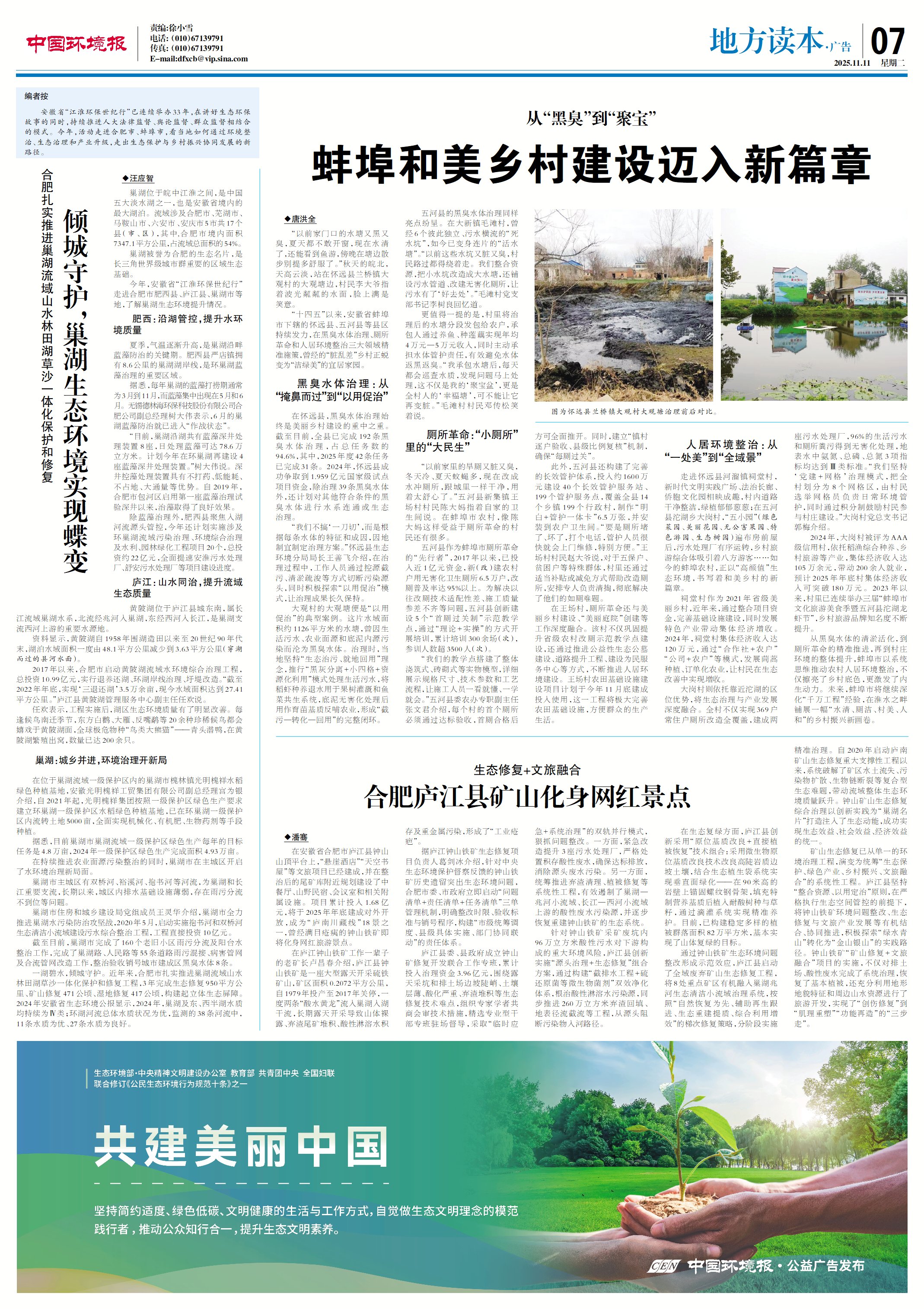
责编:徐小雪 电话:(010)67139791 传真:(010)67139791 E-mail:dfxcb@vip.sina.com G = = = 安徽省"江淮环保世纪行"已连续举办33年,在讲好生态环保 故事的同时,持续推进人大法律监督、舆论监督、群众监督相结合 的模式。今年,活动走进合肥市、蚌埠市,看当地如何通过环境整 治、生态治理和产业升级,走出生态保护与乡村振兴协同发展的新 路径。 守护 ﻟﻮﺻ lli 7K 木 H 湖 湖 官 =1)> 土标 杯境守 ◆汪应智 巢湖位于皖中江淮之间,是中国 五大淡水湖之一,也是安徽省境内的 最大湖泊。流域涉及合肥市、芜湖市、 马鞍山市、六安市、安庆市5市共17个 县(市、区),其中,合肥市境内面积 7347.1 平方公里,占流域总面积的54%。 巢湖被誉为合肥的生态名片,是 长三角世界级城市群重要的区域生态 基础。 今年,安徽省"江淮环保世纪行" 走进合肥市肥西县、庐江县、巢湖市等 地,了解巢湖生态环境提升情况。 肥西:沿湖管控,提升水环 境质量 夏季,气温逐渐升高,是巢湖沿畔 蓝藻防治的关键期。肥西县严店镇拥 有8.6公里的巢湖湖岸线,是环巢湖蓝 藻治理的重要区 ...

如何深入推进陕西生态环境保护督察工作?
Zhong Guo Huan Jing Bao· 2025-11-11 00:29
Core Viewpoint - The establishment of central ecological environment protection inspections is a significant institutional arrangement by the central government to promote ecological civilization and reform measures [1] Group 1: Implementation and Structure - Shaanxi Province has developed a series of supporting systems and measures for ecological environment protection inspections, including a leadership group for inspection rectification [2] - The province established a provincial ecological environment protection inspection agency in 2019, with a total of 59 personnel, including 4 deputy director-level inspectors and 11 municipal inspection bureaus [2][3] - A closed-loop management mechanism for inspection rectification has been implemented, which includes responsibilities for various levels and departments [2] Group 2: Inspection Methods and Coverage - Shaanxi Province has conducted three rounds of comprehensive inspections and special inspections on air and solid waste, achieving full coverage of 11 cities [3] - Innovative inspection methods have been adopted, utilizing satellite remote sensing and drone patrols for comprehensive monitoring of key ecological areas and large construction projects [3] Group 3: Challenges and Issues - Structural and fundamental issues are difficult to resolve, particularly in regions with a high proportion of energy and chemical industries [4] - The "last mile" problem in rectification remains, with slow progress due to multi-department coordination challenges [4] - There is a need for enhanced capacity building and long-term mechanisms, as the provincial inspection personnel are insufficient and lack modern equipment [4] Group 4: Recommendations for Improvement - Establish a long-term mechanism for tracking and evaluating rectification efforts, including regular reviews and assessments of the effectiveness of measures taken [5] - Strengthen the construction of the inspection team and clarify responsibilities among departments to improve coordination and efficiency [6][7] - Enhance public participation and social supervision by promoting reporting channels and increasing awareness of ecological protection [8]
“十五五”生态环保工作要抓住哪些关键点?2025年中国环境战略与政策学术年会提出建议
Zhong Guo Huan Jing Bao· 2025-11-10 23:20
Group 1: Core Perspectives - The construction of a Beautiful China is a long-term strategic task and systematic project, with a focus on achieving harmony between humans and nature by 2035 [2][5] - The "14th Five-Year Plan" period is identified as a critical window for comprehensive green transformation in China's economy and society, emphasizing the need for systemic solutions [3][5] Group 2: Green Development and Innovation - Green development is highlighted as a distinctive feature of Chinese modernization, necessitating the acceleration of green productivity and the promotion of systemic governance of ecological pollution [3][6] - The need for a high-level ecological environment technology innovation system is emphasized, focusing on integrating research, technology breakthroughs, and practical applications [12] Group 3: Pollution Prevention and Control - Continuous advancement in the governance of new pollutants is essential for pollution prevention and the construction of a Beautiful China, requiring a full lifecycle risk management approach [4][7] - The implementation of solid waste comprehensive governance actions is necessary to promote source reduction and address solid waste issues in key areas [7] Group 4: Climate Change and Carbon Neutrality - The "14th Five-Year Plan" period is a strategic period for achieving carbon peak and carbon neutrality goals, with a focus on transitioning the energy structure and promoting low-carbon development across various sectors [10][11] - The establishment of a carbon market is seen as a significant institutional innovation to control greenhouse gas emissions and facilitate a comprehensive green low-carbon transition [11] Group 5: Policy and Institutional Reforms - Deepening ecological civilization system reforms is crucial to address complex environmental challenges and enhance the ecological environment governance system [8][9] - The development of green finance is essential for supporting the construction of a Beautiful China, with an unprecedented demand for financing during the "14th Five-Year Plan" period [4][9]
多层次推动生态循环农业高质量发展
Zhong Guo Huan Jing Bao· 2025-11-10 05:46
Core Viewpoint - Ecological circular agriculture is a crucial aspect of green development in the agricultural sector, aiming to break through traditional flat agricultural production challenges and achieve a three-dimensional cycle in agricultural production [1] Group 1: Systematic Promotion and Innovation - Development of ecological circular agriculture requires a robust, targeted, and adaptive technical support mechanism [1] - Establishment of pilot projects to explore ecological circular agriculture models and the growth of new agricultural business entities to enhance demonstration effects [1] - Emphasis on cultivating high-quality application-oriented talents in ecological circular agriculture through categorized training and the establishment of educational bases [1] Group 2: System Improvement and Efficiency Integration - Expanding and extending the circular agricultural industry chain is essential for promoting ecological circular agriculture [2] - Encouragement of deep processing in agricultural product industries and comprehensive utilization of by-products [2] - Development of a complete agricultural product circulation system and exploration of new models like "Internet + ecological agricultural products" [2] Group 3: Mechanism Improvement and Strengthened Support - Development of ecological circular agriculture requires substantial support in tax incentives, ecological compensation, and infrastructure construction [3] - Increased public financial support for ecological circular agriculture, with a shift towards targeted funding policies [3] - Establishment of a multi-source investment mechanism involving government guidance, agricultural production entities, and social capital [3]
德州市生态环境局局长岳红星:美丽河湖是这样打造的
Zhong Guo Huan Jing Bao· 2025-11-10 03:13
Core Insights - The government of Dezhou City, Shandong Province, has prioritized water ecological environment governance since the 14th Five-Year Plan, focusing on addressing prominent water environment issues affecting local communities [1][2] - All six major national control sections of rivers in Dezhou have achieved water quality standards of Class IV or above, with the complete elimination of Class V water bodies [1] - The city has established a collaborative water management framework involving multiple departments to enhance water quality and environmental protection [1][2] Group 1 - Dezhou City has implemented a comprehensive governance approach, with the establishment of a special committee for watershed management that coordinates efforts across various departments [1] - The city has successfully promoted the "Three Waters Co-Governance" initiative in Le Ling City, which has been recognized as a model by the Shandong provincial government [1] - Mechanisms for information sharing and joint meetings have been established between ecological environment and water conservancy departments to facilitate water quality improvement [1][2] Group 2 - The city has intensified monitoring and inspection efforts, identifying and addressing pollution sources, with a total of 1,388 river discharge outlets investigated [2] - Dezhou has secured 304 million yuan in funding for water pollution prevention, which has been used to create wetlands that improve water quality and provide ecological benefits to local residents [2] - The city is enhancing its risk prevention capabilities by improving inter-city cooperation and enforcing strict penalties for illegal pollution activities [2] Group 3 - The 15th Five-Year Plan is seen as a critical period for advancing the construction of a beautiful China, with Dezhou committed to integrated management of water resources, environment, and ecology [3] - Continuous efforts will be made to protect and manage major rivers and small water bodies, aiming to improve water quality and enhance the well-being and safety of the population [3]
基层生态环境执法新思路:监管做“减法”,服务做“加法”
Zhong Guo Huan Jing Bao· 2025-11-10 00:15
Core Viewpoint - The grassroots ecological environment law enforcement is facing new challenges, necessitating a transformation to enhance enforcement effectiveness and service levels to support high-quality economic and social development [1] Group 1: Legal Awareness and Education - The traditional law enforcement approach primarily relies on post-incident penalties, which fails to fundamentally improve enterprises' compliance awareness. A comprehensive legal education approach is needed throughout the enforcement process [2] - A dual approach of "on-site + non-site" legal education should be established, targeting specific ecological and environmental pain points of different industries [2] - The "law enforcement + legal education" model should be promoted, where enforcement personnel actively explain relevant environmental regulations during inspections to guide enterprises in rectifying issues [2] Group 2: Integrated Supervision - The new requirements aim to reduce the frequency of inspections, promoting a comprehensive and streamlined inspection process to alleviate the burden on enterprises [3] - Utilizing online monitoring and non-contact supervision methods, such as drone surveillance, can help maintain oversight without disrupting normal business operations [3] - This "non-intrusive" inspection model aims to prevent environmental violations while creating a conducive environment for enterprises to operate [3] Group 3: Communication and Collaboration - Establishing a regular and diverse communication channel between enforcement agencies and enterprises is crucial to enhance understanding and cooperation [4] - Enforcement personnel should guide enterprises to appoint dedicated environmental contacts for ongoing communication and updates on policies and standards [4] - Engaging in face-to-face discussions through meetings can help gather enterprise feedback and ensure that enforcement aligns with actual business needs [4] Group 4: Proactive Conflict Resolution - Transitioning from a passive reception of complaints to proactive outreach is essential for resolving environmental disputes between enterprises and surrounding communities [5] - A mechanism for "on-site mediation + follow-up supervision" should be established to address key environmental complaints effectively [5] - This proactive approach aims to create a feedback loop that enhances understanding of environmental protection efforts among the public and promotes compliance among enterprises [5] Group 5: Balancing Enforcement and Support - The judicial department has developed standardized documents to regulate administrative enforcement processes, ensuring that enforcement actions are both authoritative and supportive of enterprise development [6] - Enforcement personnel must adhere to clear guidelines to avoid arbitrary inspections and ensure that checks are efficient and non-redundant [6] - A balance between regulation and support is necessary, with a focus on guiding enterprises to rectify non-intentional environmental issues rather than imposing penalties [6]
从“黑涌臭涌”到美丽河湖,广州东濠涌的变身带来哪些启示?
Zhong Guo Huan Jing Bao· 2025-11-09 23:24
Core Viewpoint - The successful restoration of Donghao Stream in Guangzhou serves as a model for urban river management and ecological restoration, showcasing a comprehensive approach to environmental governance and community engagement [1][4][7]. Group 1: Ecological Transformation - Donghao Stream, once a vital waterway, faced severe pollution due to urbanization, leading to its classification as a black and smelly river [2][3]. - The stream's water quality improved from Class V to Class III, with a daily replenishment of over 100,000 tons of water, meeting ecological and recreational needs [3][4]. - The restoration efforts included the construction of a deep-layer drainage system and a series of ecological measures, resulting in a healthier aquatic ecosystem with the return of fish and sensitive species [3][6]. Group 2: Governance and Management - Guangzhou adopted a systematic governance model for the entire river basin, emphasizing long-term planning and phased implementation of restoration projects [4][5]. - The city established a three-tier river management network, utilizing digital tools for real-time monitoring and efficient governance [6][7]. - Community involvement was prioritized, with public consultation committees ensuring local voices were heard in the decision-making process [5][6]. Group 3: Cultural and Economic Revitalization - The restoration project included the transformation of historical sites into cultural assets, such as a water-themed museum, enhancing the cultural significance of the area [3][7]. - New public spaces and recreational facilities along the stream have improved the quality of life for residents, promoting a vibrant local economy [3][5]. - The project has fostered a sense of community ownership and environmental stewardship, contributing to the long-term sustainability of the river's ecosystem [7][8].
秸秆禁烧效果不好?换个思路更有效
Zhong Guo Huan Jing Bao· 2025-11-07 05:44
Core Viewpoint - The article emphasizes the importance of promoting straw burning prohibition from the perspective of fire safety and traffic safety, rather than solely focusing on air pollution, to better resonate with farmers and the general public [1][2] Group 1: Hazards of Straw Burning - Straw burning creates smoke that reduces air visibility, affects transportation operations, and increases the risk of safety accidents [1] - The article highlights that straw burning can lead to uncontrollable fires, resulting in significant economic losses and threats to personal safety [1] - Burning straw near forests can easily trigger wildfires, while burning near roads and railways poses risks for traffic accidents [1] Group 2: New Approach to Promotion - The traditional approach to straw burning prohibition has focused on environmental protection, often emphasizing penalties for violations, which may overlook farmers' feelings and yield limited effectiveness [1] - A new promotional strategy that incorporates fire safety and traffic safety can evoke a sense of empathy and human concern, making the policy's fundamental goal of protecting public interests more apparent [2] - This approach may help alleviate farmers' concerns and improve the effectiveness of straw burning prohibition efforts [2]