
Guo Jia Tong Ji Ju

Search documents
11月份国民经济延续稳中有进发展态势
Guo Jia Tong Ji Ju· 2025-12-15 02:00
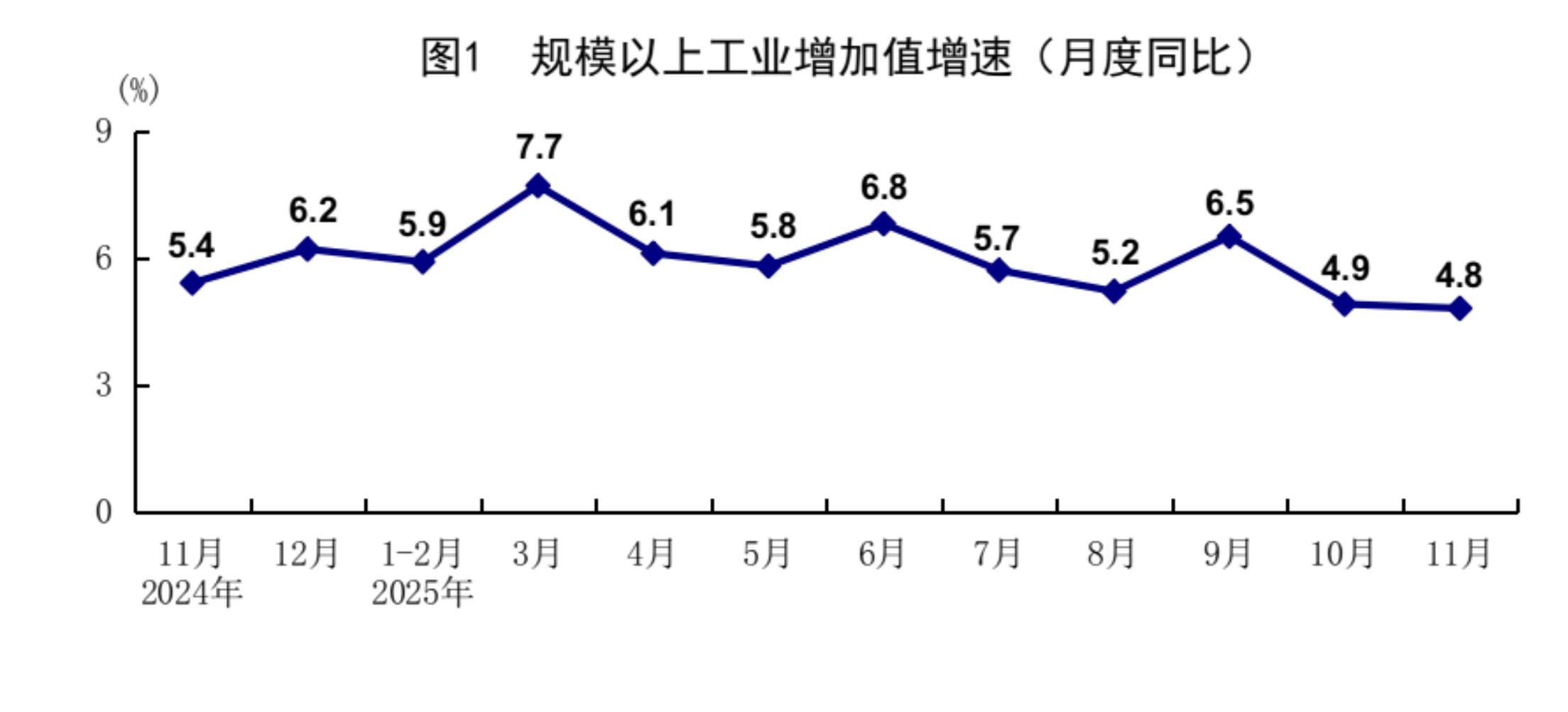
全年全国粮食产量14298亿斤,比上年增加167.5亿斤,增长1.2%,稳定在1.4万亿斤以上。其中,秋粮产量10732亿斤,比上年增加163.6亿斤,增长1.5%。全 国谷物产量13204亿斤,比上年增加158.4亿斤,增长1.2%。粮食播种面积增加、单产提高。全国粮食播种面积17.91亿亩,比上年增加134.8万亩,增长 0.1%;粮食单产399.1公斤/亩,每亩产量比上年增加4.4公斤,增长1.1%。 二、工业生产稳定增长,装备制造业和高技术制造业增长较快 11月份,全国规模以上工业增加值同比增长4.8%,环比增长0.44%。分三大门类看,采矿业增加值同比增长6.3%,制造业增长4.6%,电力、热力、燃气及水 生产和供应业增长4.3%。装备制造业增加值同比增长7.7%,高技术制造业增加值增长8.4%,分别快于全部规模以上工业增加值2.9和3.6个百分点。分经济类 型看,国有控股企业增加值同比增长4.2%;股份制企业增长5.2%,外商及港澳台投资企业增长3.4%;私营企业增长3.2%。分产品看,3D打印设备、工业机 器人、新能源汽车产品产量同比分别增长100.5%、20.6%、17.0%。1-11月份,全 ...

2025年11月份社会消费品零售总额增长1.3%
Guo Jia Tong Ji Ju· 2025-12-15 02:00
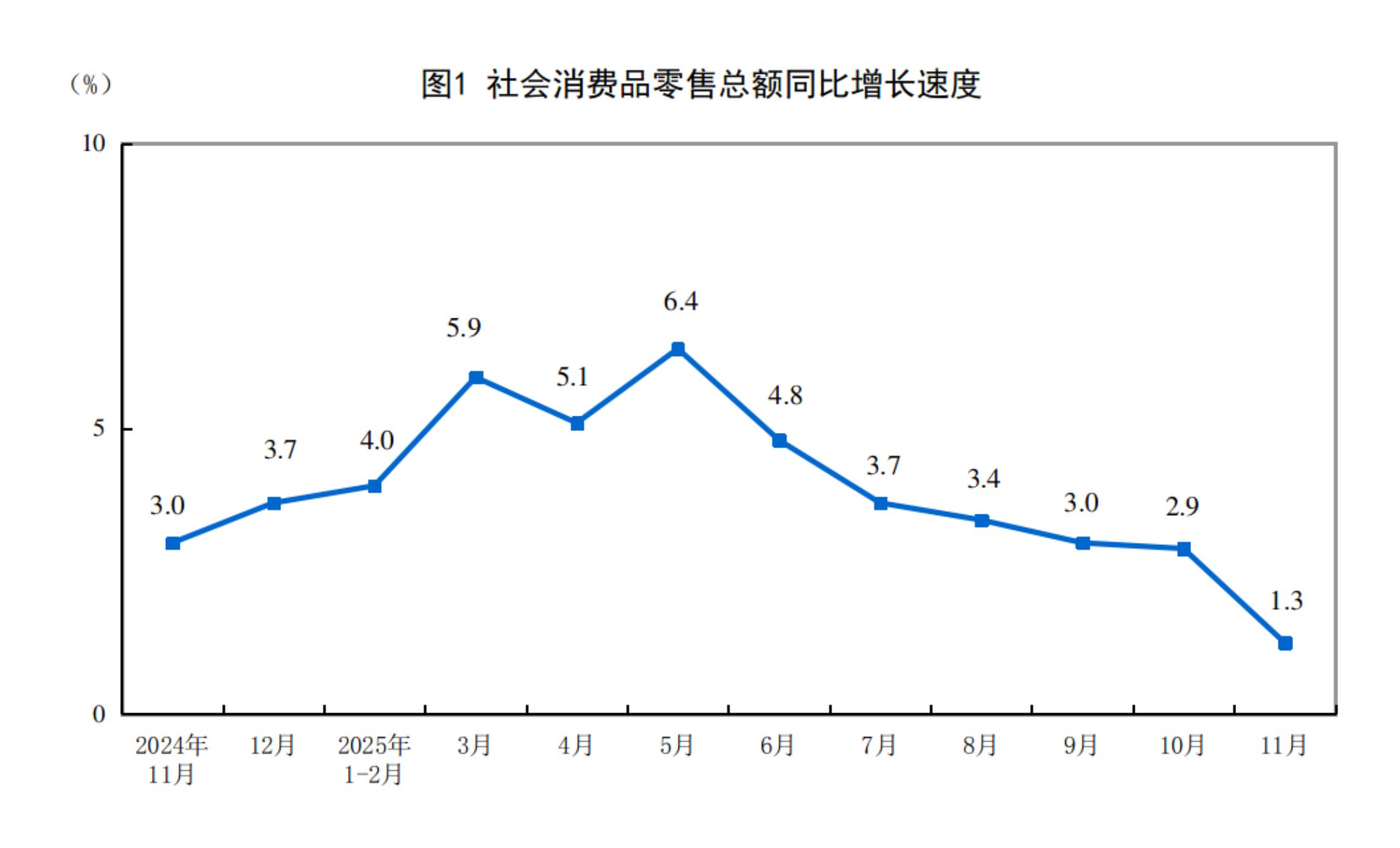
11月份,社会消费品零售总额43898亿元,同比增长1.3%。其中,除汽车以外的消费品零售额39444亿元,增长2.5%。1—11月份,社会消费品零售总额 456067亿元,增长4.0%。其中,除汽车以外的消费品零售额411637亿元,增长4.6%。 按经营单位所在地分,11月份,城镇消费品零售额37684亿元,同比增长1.0%;乡村消费品零售额6214亿元,增长2.8%。1—11月份,城镇消费品零售额 394544亿元,增长3.9%;乡村消费品零售额61523亿元,增长4.4%。 按消费类型分,11月份,商品零售额37841亿元,同比增长1.0%;餐饮收入6057亿元,增长3.2%。1—11月份,商品零售额403822亿元,增长4.1%;餐饮收 入52245亿元,增长3.3%。 按零售业态分,1—11月份,限额以上零售业单位中便利店、超市、百货店、专业店、品牌专卖店零售额同比分别增长6.0%、4.7%、0.7%、3.4%、0.1%。 1—11月份,全国网上零售额144582亿元,同比增长9.1%。其中,实物商品网上零售额118193亿元,增长5.7%,占社会消费品零售总额的比重为25.9%;在 实物商品网上 ...
2025年1—11月份全国固定资产投资基本情况
Guo Jia Tong Ji Ju· 2025-12-15 02:00
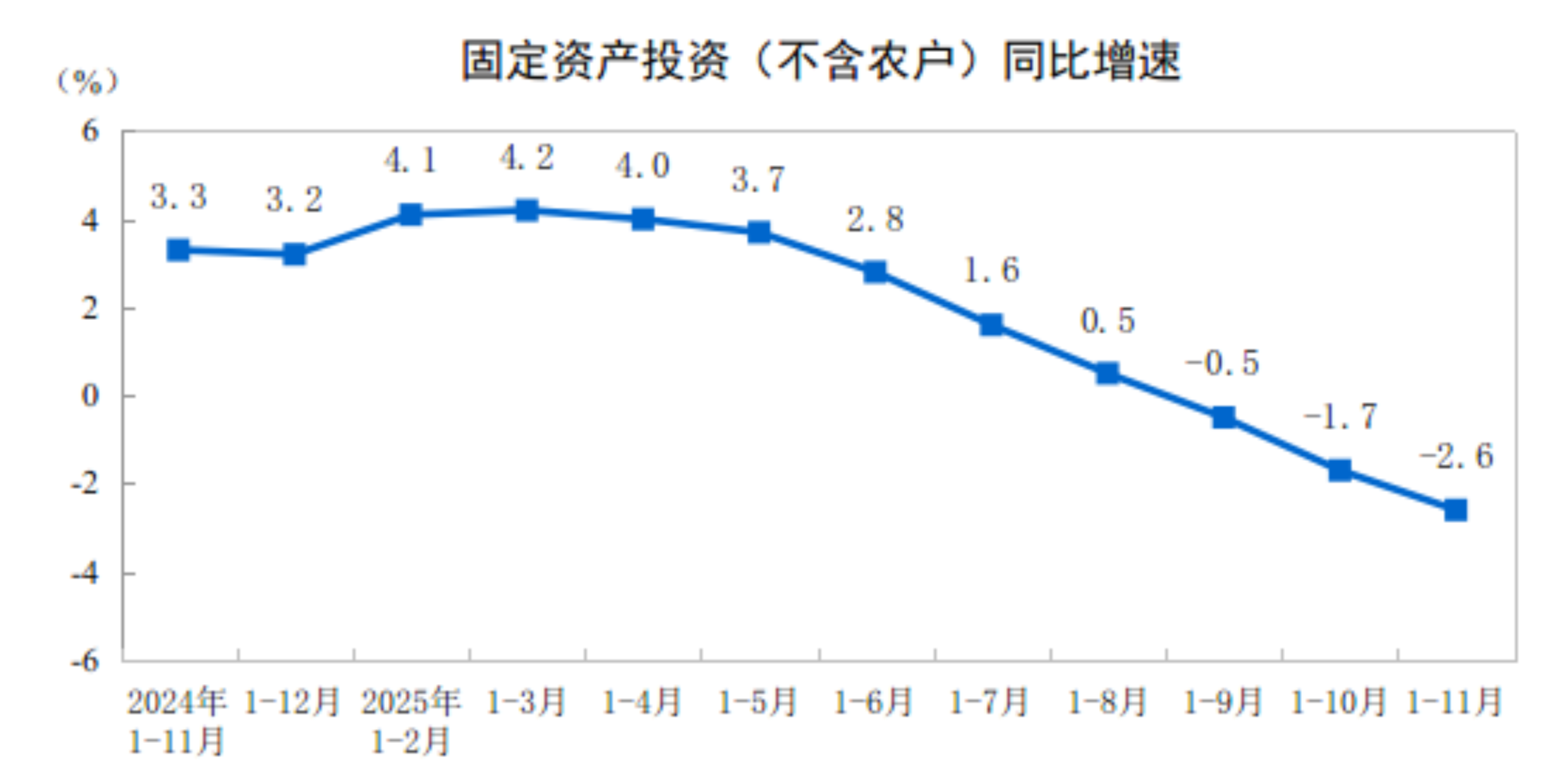
Core Insights - The total fixed asset investment (excluding rural households) in China for January to November 2025 reached 444,035 billion yuan, representing a year-on-year decline of 2.6% [1][5]. Investment by Industry - Investment in the primary industry was 8,770 billion yuan, with a year-on-year growth of 2.7% [3][6]. - The secondary industry saw an investment of 162,243 billion yuan, growing by 3.9% year-on-year, with industrial investment specifically increasing by 4.0% [3][6]. - The tertiary industry experienced a decline in investment to 273,022 billion yuan, down 6.3% year-on-year [3][6]. Secondary Industry Breakdown - Within the secondary industry, mining investment grew by 4.0%, manufacturing investment increased by 1.9%, and investment in the electricity, heat, gas, and water production and supply sector surged by 10.7% [3][6]. Tertiary Industry Breakdown - Infrastructure investment (excluding electricity, heat, gas, and water production and supply) in the tertiary sector decreased by 1.1% year-on-year [3][6]. - Notable growth was observed in pipeline transportation (16.8%), water transportation (8.9%), and railway transportation (2.7%) [3][6]. Investment by Region - Eastern region investments fell by 6.6%, central region by 1.7%, western region by 0.2%, and northeastern region by 14.0% [3][6]. Investment by Registration Type - Domestic enterprises' fixed asset investment decreased by 2.6%, while investments from Hong Kong, Macau, and Taiwan enterprises fell by 2.2%, and foreign enterprises saw a significant decline of 14.1% [4][6]. Summary of Key Data - The overall fixed asset investment (excluding rural households) showed a decline of 2.6% year-on-year, with state-owned holding investments down by 1.1% and private investments down by 5.3% [5][6]. - Specific components such as construction and installation projects decreased by 6.4%, while equipment purchases increased by 12.2% [5][6].
11月份70个大中城市商品住宅销售价格环比总体下降
Guo Jia Tong Ji Ju· 2025-12-15 01:39
11月份,一线城市二手住宅销售价格同比下降5.8%,降幅比上月扩大1.4个百分点。其中,北京、上 海、广州和深圳分别下降6.8%、4.6%、7.2%和4.8%。二、三线城市二手住宅销售价格同比分别下降 5.6%和5.8%,降幅分别扩大0.4个和0.1个百分点。 原标题:国家统计局城市司首席统计师王中华解读2025年11月份商品住宅销售价格变动情况统计数据 编辑:陈璐 责编:张松涛 11月份,一线城市二手住宅销售价格环比下降1.1%,降幅比上月扩大0.2个百分点。其中,北京、上 海、广州和深圳分别下降1.3%、0.8%、1.2%和1.0%。二线城市二手住宅销售价格环比下降0.6%,降幅 与上月相同。三线城市二手住宅销售价格环比下降0.6%,降幅收窄0.1个百分点。 二、一二三线城市商品住宅销售价格同比降幅扩大 11月份,一线城市新建商品住宅销售价格同比下降1.2%,降幅比上月扩大0.4个百分点。其中,上海上 涨5.1%,北京、广州和深圳分别下降2.1%、4.3%和3.7%。二、三线城市新建商品住宅销售价格同比分 别下降2.2%和3.5%,降幅分别扩大0.2个和0.1个百分点。 国家统计局消息,2025年11月份 ...
国家统计局:11月70个大中城市商品住宅销售价格环比总体下降
Guo Jia Tong Ji Ju· 2025-12-15 01:37
Group 1 - In November 2025, the sales prices of commercial residential properties in 70 major cities showed a month-on-month decline, with an expanded year-on-year decrease [1][2] - In first-tier cities, new commercial residential property prices decreased by 0.4% month-on-month, with Shanghai increasing by 0.1% while Beijing, Guangzhou, and Shenzhen saw declines of 0.5%, 0.5%, and 0.9% respectively [1] - Second-hand residential property prices in first-tier cities fell by 1.1% month-on-month, with Beijing, Shanghai, Guangzhou, and Shenzhen experiencing declines of 1.3%, 0.8%, 1.2%, and 1.0% respectively [1] Group 2 - Year-on-year, new commercial residential property prices in first-tier cities decreased by 1.2%, with Shanghai increasing by 5.1% while Beijing, Guangzhou, and Shenzhen saw declines of 2.1%, 4.3%, and 3.7% respectively [1] - Second-hand residential property prices in first-tier cities dropped by 5.8% year-on-year, with Beijing, Shanghai, Guangzhou, and Shenzhen experiencing declines of 6.8%, 4.6%, 7.2%, and 4.8% respectively [2] - In second and third-tier cities, new commercial residential property prices fell by 2.2% and 3.5% year-on-year, with the declines expanding by 0.2 and 0.1 percentage points respectively [1]
2025年11月份70个大中城市商品住宅销售价格变动情况
Guo Jia Tong Ji Ju· 2025-12-15 01:36
表 1:2025 年 1 1 月70个大中城市新建商品住宅销售价格指数 | 城市 | | | --- | --- | | 环比 | | | 同比 | | | 1-1 1月平均 | | | 城市 | | | 环比 | | | 同比 | | | 1-1 1月平均 | | | 上月=100 | | | 上年同月=100 | | | 上年同期=100 | | | 上月=100 | | | 上年同月=100 | | | 上年同期=100 | | | 北京 | | | | 99.5 | | | 97.9 96.0 | | 唐山 | | | | 99.4 | | | 94.3 | | | 93.2 | | 天津 | | | | 99.6 | | | 97.8 | | | 98.1 | | 秦 皇 岛 | | | | 99.6 | | | 95.5 | | | 94.0 | | 石 家 庄 | | | | 99.5 | | | 95.9 | | | 96.4 | | 包头 | | | | 99.4 | | | 93.9 | | 太原 | 93.9 | | | 99.3 | | | 99.3 | | | 100.8 | | 丹 ...
国家统计局:11月份70个大中城市商品住宅销售价格环比总体下降
Guo Jia Tong Ji Ju· 2025-12-15 01:32
Core Viewpoint - In November, the sales prices of commercial residential properties in 70 large and medium-sized cities in China experienced an overall month-on-month decline [1] Group 1: Price Trends - The month-on-month sales prices of commercial residential properties decreased across the board in November [1] - This decline indicates a continuing trend in the real estate market, reflecting potential challenges in demand and pricing stability [1] Group 2: Market Implications - The overall decrease in property prices may signal a cooling real estate market, which could impact investment strategies and market confidence [1] - Investors may need to reassess their positions in the real estate sector given the current pricing trends [1]
2025年12月上旬流通领域重要生产资料市场价格变动情况
Guo Jia Tong Ji Ju· 2025-12-14 01:30
Core Viewpoint - The monitoring of market prices for 50 important production materials across nine categories indicates a mixed trend, with 27 products experiencing price increases, 19 seeing declines, and 4 remaining stable in early December 2025 compared to late November 2025 [2][3]. Group 1: Price Changes in Major Categories - In the black metal category, rebar prices increased by 23.4 yuan per ton (0.7%), while wire rod prices rose by 47.3 yuan per ton (1.4%) [4]. - In the non-ferrous metal category, electrolytic copper saw a price increase of 4.7% (4059.8 yuan per ton), and aluminum ingots rose by 2.1% (449.2 yuan per ton) [4]. - Chemical products showed varied results, with sulfuric acid prices increasing by 7.9% (74.4 yuan per ton), while caustic soda prices decreased by 5.1% (-42.1 yuan per ton) [4]. Group 2: Energy and Coal Prices - In the petroleum and natural gas sector, liquefied natural gas prices fell by 2.9% (-121.5 yuan per ton), while liquefied petroleum gas prices increased by 1.6% (69.5 yuan per ton) [4]. - Coal prices generally declined, with anthracite coal dropping by 1.4% (-12.8 yuan per ton) and common mixed coal decreasing by 5.7% (-36.3 yuan per ton) [4]. Group 3: Agricultural Products and Fertilizers - In agricultural products, corn prices increased by 1.4% (29.9 yuan per ton), while soybean prices decreased by 0.3% (-11.6 yuan per ton) [5]. - Fertilizer prices showed an upward trend, with urea prices rising by 2.2% (36.5 yuan per ton) and compound fertilizer prices increasing by 2.2% (72.4 yuan per ton) [5]. Group 4: Monitoring Methodology - The price monitoring includes data from over 2,000 wholesalers, agents, and distributors across more than 300 trading markets in 31 provinces [7]. - The methodology for price collection involves on-site price sampling, telephone inquiries, and electronic communications [8].
国家统计局:2025年全国粮食实现丰收 粮食总产量增加167.5亿斤
Guo Jia Tong Ji Ju· 2025-12-12 10:20
2025年全国粮食实现丰收 ——国家统计局农村司司长魏锋华解读粮食生产情况 2025年,虽然部分地区遭遇干旱、洪涝和连阴雨天气,对粮食生产造成一定影响,但全国大部农区光温 水匹配良好,气象条件总体有利于粮食作物生长发育和产量形成。各地进一步扩大粮食单产提升工程实 施规模,加大合理增密、水肥一体化等技术推广力度,促进粮食单产水平持续提升。全国粮食单产 399.1公斤/亩,每亩产量比上年增加4.4公斤,增长1.1%。 (一)玉米、稻谷单产有所提高,小麦单产持平。2025年,全国谷物单产437.4公斤/亩,每亩产量比上年 增加4.6公斤,增长1.1%。其中,玉米单产446.7公斤/亩,比上年增加7.2公斤,增长1.6%;稻谷单产480.4 公斤/亩,比上年增加3.4公斤,增长0.7%;小麦单产396.0公斤/亩,与上年持平。 (二)豆类和薯类单产均有所增加。2025年,全国豆类单产135.4公斤/亩,每亩产量比上年增加2.2公斤, 增长1.6%。其中,大豆单产135.9公斤/亩,比上年增加2.5公斤,增长1.9%。全国薯类单产292.3公斤/ 亩,比上年增加2.7公斤,增长0.9%。 三、粮食总产量增加167.5亿 ...
国家统计局:2025年全国粮食总产量71488万吨 比2024年增长1.2%
Guo Jia Tong Ji Ju· 2025-12-12 01:35
(文章来源:国家统计局) 据国家统计局官网,根据对全国31个省(区、市)的调查,2025年全国粮食播种面积、单位面积产量和 总产量分别如下:全国粮食播种面积119409千公顷(179113万亩),比2024年增加90千公顷(135万 亩),增长0.1%。其中谷物播种面积100619千公顷(150928万亩),比2024年增加161千公顷(241万 亩),增长0.2%。全国粮食单位面积产量5987公斤/公顷(399公斤/亩),比2024年增加65.7公斤/公顷 (4.4公斤/亩),增长1.1%。其中谷物单位面积产量6561公斤/公顷(437公斤/亩),比2024年增加68.3 公斤/公顷(4.6公斤/亩),增长1.1%。全国粮食总产量71488万吨(14298亿斤),比2024年增加838万 吨(168亿斤),增长1.2%。其中谷物产量66021万吨(13204亿斤),比2024年增加792万吨(158亿 斤),增长1.2%。 ...