Guo Jia Tong Ji Ju

Search documents
国家统计局:9月制造业生产活动加快,PMI升至49.8%,景气水平继续改善
Guo Jia Tong Ji Ju· 2025-09-30 01:37
Group 1: Manufacturing PMI Insights - The manufacturing purchasing managers' index (PMI) rose to 49.8% in September, an increase of 0.4 percentage points from the previous month, indicating continued improvement in economic conditions [2][3] - The production index reached 51.9%, up 1.1 percentage points, marking a six-month high, while the new orders index increased to 49.7%, suggesting a slight improvement in market demand [3] - Key industries such as food and beverage, automotive, and aerospace showed production and new orders indices above 54.0%, indicating robust activity, while sectors like wood processing and non-metallic mineral products remained below the critical threshold [3][4] Group 2: Non-Manufacturing PMI Insights - The non-manufacturing business activity index stood at 50.0%, down 0.3 percentage points, indicating stability in overall business volume [5] - The service sector maintained expansion with a business activity index of 50.1%, while industries like postal and financial services reported indices above 60.0%, reflecting strong growth [5] - The construction sector saw a slight recovery with a business activity index of 49.3%, and the business activity expectation index rose to 52.4%, indicating improved confidence among construction firms [5] Group 3: Composite PMI Insights - The composite PMI output index increased to 50.6%, up 0.1 percentage points, suggesting a continued acceleration in production and business activities across sectors [6] - The manufacturing production index and non-manufacturing business activity index contributed to the composite PMI, standing at 51.9% and 50.0% respectively [6]
国家统计局:9月份装备制造业、高技术制造业和消费品行业PMI分别为51.9%、51.6%和50.6%
Guo Jia Tong Ji Ju· 2025-09-30 01:36
国家统计局服务业调查中心首席统计师霍丽慧解读2025年9月中国采购经理指数。9月份,制造业生产活 动加快,PMI升至49.8%,景气水平继续改善。装备制造业、高技术制造业和消费品行业PMI分别为 51.9%、51.6%和50.6%,均明显高于制造业总体,同时上述重点行业生产指数和新订单指数均位于扩张 区间,企业供需两端较为活跃;高耗能行业PMI为47.5%,比上月下降0.7个百分点。 (文章来源:国家统计局) ...
国家统计局:7月制造业PMI为49.8%
Guo Jia Tong Ji Ju· 2025-09-30 01:31
Core Viewpoint - The manufacturing Purchasing Managers' Index (PMI) for July is reported at 49.8%, indicating a contraction in the manufacturing sector as it falls below the neutral level of 50% [1] Group 1: Economic Indicators - The manufacturing PMI of 49.8% suggests a decline in manufacturing activity, as a reading below 50% typically signals a contraction in the sector [1]
2025年9月中国采购经理指数运行情况
Guo Jia Tong Ji Ju· 2025-09-30 01:30
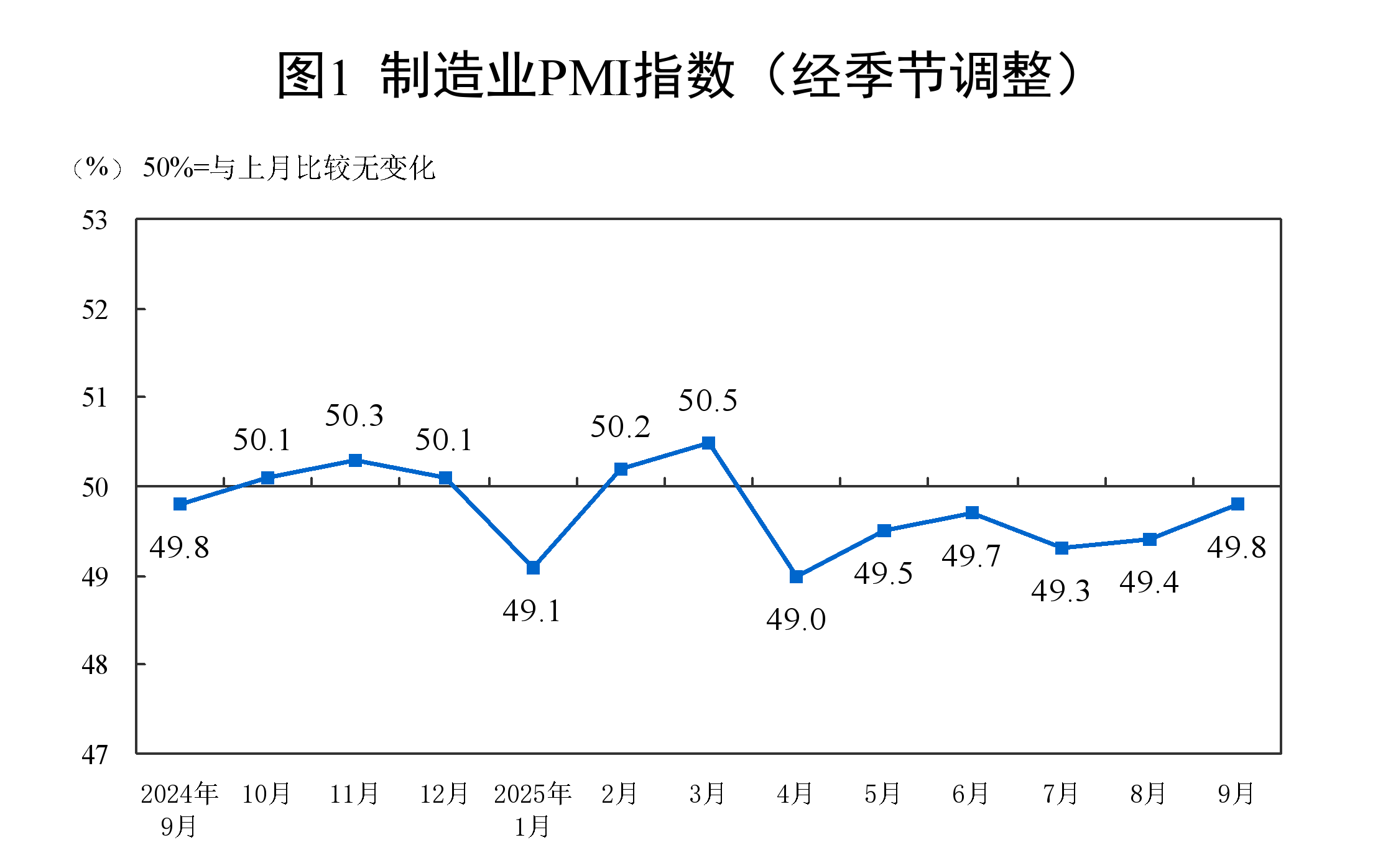
Group 1: Manufacturing PMI Overview - In September, the Manufacturing Purchasing Managers' Index (PMI) was 49.8%, an increase of 0.4 percentage points from the previous month, indicating continued improvement in manufacturing sentiment [1] - The PMI for large enterprises was 51.0%, up 0.2 percentage points, while medium-sized enterprises saw a PMI of 48.8%, down 0.1 percentage points, and small enterprises had a PMI of 48.2%, up 1.6 percentage points [4] - The production index was 51.9%, up 1.1 percentage points, indicating accelerated production expansion, while the new orders index was 49.7%, up 0.2 percentage points, suggesting improved market demand [4] Group 2: Manufacturing PMI Components - The raw material inventory index was 48.5%, up 0.5 percentage points, indicating a continued narrowing of the decline in raw material inventory levels [4] - The employment index was 48.5%, up 0.6 percentage points, reflecting improved employment sentiment in manufacturing [4] - The supplier delivery time index was 50.8%, up 0.3 percentage points, indicating faster delivery times from suppliers [4] Group 3: Non-Manufacturing PMI Overview - In September, the Non-Manufacturing Business Activity Index was 50.0%, a decrease of 0.3 percentage points from the previous month, indicating overall stability in non-manufacturing business volume [8] - The construction industry business activity index was 49.3%, up 0.2 percentage points, while the service industry index was 50.1%, down 0.4 percentage points [10] Group 4: Non-Manufacturing PMI Components - The new orders index for non-manufacturing was 46.0%, down 0.6 percentage points, indicating a decline in market demand [14] - The input prices index was 49.0%, down 1.3 percentage points, suggesting a decrease in the overall level of input prices for non-manufacturing enterprises [14] - The employment index for non-manufacturing was 45.0%, down 0.6 percentage points, indicating a decline in employment sentiment [16] Group 5: Composite PMI Overview - The Composite PMI Output Index was 50.6%, an increase of 0.1 percentage points from the previous month, indicating continued acceleration in overall production and business activities [19]

社会事业向好发展民生福祉不断增进
Guo Jia Tong Ji Ju· 2025-09-30 00:50
Core Viewpoint - The Chinese government emphasizes the importance of improving people's livelihoods as a key goal of modernization, focusing on high-quality population development and enhancing public services to ensure a better quality of life for citizens [1][20]. Group 1: Population Development - The total population of China is projected to be 1.40828 billion by the end of 2024, with a labor force of 857.98 million, representing 60.9% of the total population [2]. - Urbanization continues to rise, with the urban population reaching 943.50 million and an urbanization rate of 67.00%, an increase of 3.11 percentage points since 2020 [2]. - The average life expectancy is expected to reach 79.0 years by 2024, an increase of 1.07 years since 2020, and the average education level for the labor force is 11.21 years, up by 0.46 years [2]. Group 2: Employment Stability - The total employment in urban areas is projected to be 73.439 million by the end of 2024, with urban employment accounting for 64.5% of total employment [3]. - The unemployment rate in urban areas is expected to average 5.1% in 2024, a decrease of 0.5 percentage points since 2020 [3]. Group 3: Income Growth - The per capita disposable income is expected to reach 41,314 yuan in 2024, an increase of 9,125 yuan since 2020, with an average annual real growth rate of 5.5% from 2021 to 2024 [4]. - The income gap between urban and rural residents is narrowing, with the ratio of per capita disposable income between rural and urban residents at 2.34, down by 0.22 since 2020 [5]. Group 4: Public Services - The social security system is the largest globally, with 1.07 billion people covered by basic pension insurance, and the average monthly pension for retirees increased from approximately 2,900 yuan in 2020 to 3,162 yuan in 2023 [6]. - By the end of 2024, 1.33 billion people are expected to be covered by basic medical insurance, with the per capita financial subsidy for rural residents reaching 670 yuan, a 21.8% increase since 2020 [6]. Group 5: Education and Health - The gross enrollment rate for preschool education is projected to reach 92.0% by 2024, and the total number of higher education students is expected to be 48.46 million, an increase of 6.63 million since 2020 [8]. - The number of hospital beds per 1,000 people is expected to increase from 6.46 in 2020 to 7.23 in 2023, indicating improved healthcare resources [9]. Group 6: Cultural Development - By the end of 2024, the number of registered museums is expected to reach 7,046, a 21.7% increase since 2020, reflecting the growth of public cultural services [10]. - The cultural industry is projected to achieve a revenue of 191.423 billion yuan in 2024, a 37.7% increase since 2020 [11]. Group 7: Targeted Support for Vulnerable Groups - The per capita disposable income for residents in poverty-stricken counties is expected to rise from 12,588 yuan in 2020 to 17,522 yuan in 2024, with an average annual real growth rate of 7.8% [13]. - The number of migrant workers is projected to reach 29.973 million by 2024, an increase of 1.413 million since 2020, indicating a stable trend in urban integration [14]. Group 8: Safety and Quality of Life - The crime rate in China is decreasing, with public safety perception remaining above 98% since 2020, making it one of the safest countries globally [18]. - By 2024, the average number of household appliances per 100 households is expected to increase significantly, indicating an improvement in living standards [18].
2024年全国科技经费投入统计公报
Guo Jia Tong Ji Ju· 2025-09-29 07:00
R&D Funding Overview - In 2024, the total investment in research and development (R&D) reached 36,326.8 billion yuan, an increase of 2,969.7 billion yuan, representing a growth of 8.9% compared to the previous year [3] - The R&D investment intensity, measured as a percentage of GDP, was 2.69%, up by 0.11 percentage points from the previous year [3] - The per capita R&D funding, calculated based on full-time equivalent R&D personnel, was 480,000 yuan, an increase of 19,000 yuan from the previous year [3] R&D Funding by Activity Type - Basic research funding amounted to 2,500.9 billion yuan, growing by 10.7% year-on-year [3] - Applied research funding reached 4,305.5 billion yuan, with a growth rate of 17.6% [3] - Experimental development funding was 29,520.4 billion yuan, increasing by 7.6% [3] - The share of basic research funding in total R&D funding was 6.88%, up by 0.11 percentage points [3] R&D Funding by Entity - Enterprises accounted for 28,211.6 billion yuan in R&D funding, a growth of 8.8% [3] - Government research institutions contributed 4,231.6 billion yuan, increasing by 9.7% [3] - Higher education institutions provided 3,065.5 billion yuan, with an increase of 11.3% [3] - The proportions of R&D funding by entities were 77.7% for enterprises, 11.6% for government institutions, and 8.4% for higher education [3] R&D Funding by Industry - The high-tech manufacturing sector invested 7,668.9 billion yuan in R&D, marking a growth of 10.2% [4] - The R&D investment intensity in this sector was 3.35%, an increase of 0.24 percentage points [4] - Eight major industries in large-scale industrial enterprises invested over 100 billion yuan in R&D, accounting for 68.2% of total R&D funding in large-scale industrial enterprises [4] R&D Funding by Region - Six provinces and municipalities invested over 200 billion yuan in R&D: Guangdong (5,099.6 billion yuan), Jiangsu (4,597.5 billion yuan), Beijing (3,278.4 billion yuan), Zhejiang (2,901.4 billion yuan), Shandong (2,597.3 billion yuan), and Shanghai (2,343.7 billion yuan) [4] - Seven regions exceeded the national average R&D investment intensity, with Beijing at 6.58%, Shanghai at 4.35%, and Guangdong at 3.60% [4] Fiscal Science and Technology Expenditure - In 2024, national fiscal science and technology expenditure was 12,629.2 billion yuan, an increase of 633.3 billion yuan, representing a growth of 5.3% [5] - Central fiscal science and technology expenditure was 4,192.5 billion yuan, accounting for 33.2% of total national expenditure [5] - Local fiscal science and technology expenditure was 8,436.7 billion yuan, making up 66.8% of the total [5]
1-8月全国煤炭开采和洗选业营业收入下降20.8%
Guo Jia Tong Ji Ju· 2025-09-29 01:40
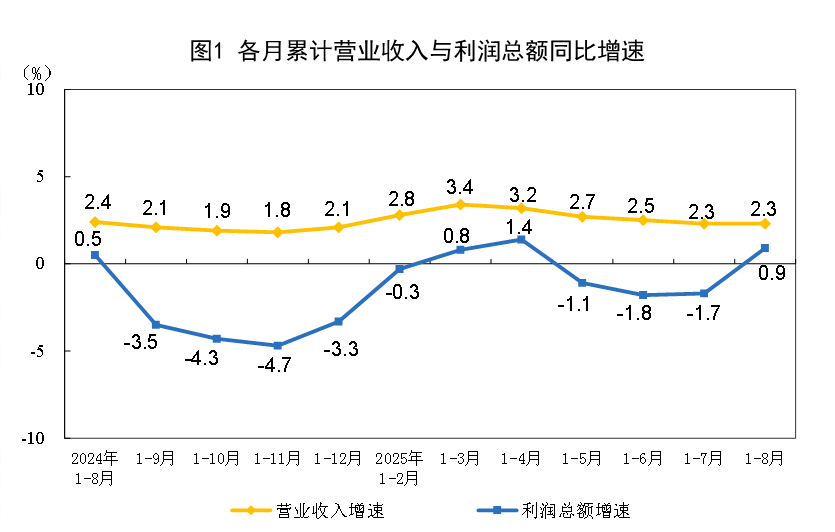
Core Insights - In the first eight months, the total profit of industrial enterprises above designated size reached 46,929.7 billion yuan, a year-on-year increase of 0.9% [1] - The profit performance varied among different types of enterprises, with state-owned enterprises experiencing a decline while private enterprises showed growth [1] Group 1: Profit Performance - State-owned enterprises achieved a profit of 15,156.5 billion yuan, down 1.7% year-on-year [1] - Joint-stock enterprises reported a profit of 34,931.9 billion yuan, up 1.1% year-on-year [1] - Foreign and Hong Kong, Macao, and Taiwan-invested enterprises made a profit of 11,723.6 billion yuan, an increase of 0.9% [1] - Private enterprises recorded a profit of 13,076.1 billion yuan, growing by 3.3% [1] Group 2: Revenue and Costs - The total revenue of industrial enterprises above designated size was 89.62 trillion yuan, a year-on-year increase of 2.3% [2] - Operating costs amounted to 76.70 trillion yuan, up 2.5% year-on-year [2] - The profit margin for operating revenue was 5.24%, a decrease of 0.06 percentage points year-on-year [2] Group 3: Mining Industry Performance - The mining industry reported a total profit of 5,661.1 billion yuan, down 30.6% year-on-year [2] - Coal mining and washing industry profits fell to 1,937.3 billion yuan, a decline of 53.6% [2] - The mining industry generated revenue of 33,727.7 billion yuan, down 13.1% year-on-year [2] - Coal mining and washing industry revenue was 16,559.1 billion yuan, a decrease of 20.8% [2] Group 4: Financial Metrics - The total assets of industrial enterprises reached 185.08 trillion yuan, a year-on-year increase of 5.0% [2] - Total liabilities amounted to 107.34 trillion yuan, up 5.4% year-on-year [2] - The equity of owners totaled 77.73 trillion yuan, growing by 4.4% [2] - The asset-liability ratio stood at 58.0%, an increase of 0.2 percentage points year-on-year [2] Group 5: Efficiency Metrics - The cost per 100 yuan of operating revenue was 85.58 yuan, an increase of 0.19 yuan year-on-year [3] - The average revenue per 100 yuan of assets was 74.0 yuan, a decrease of 2.0 yuan year-on-year [3] - The average collection period for accounts receivable was 70.1 days, an increase of 3.7 days year-on-year [3] - In August, the profit of industrial enterprises turned from a decline of 1.5% to a growth of 20.4% year-on-year [3]
1—8月全国规模以上纺织工业企业利润同比下跌7%
Guo Jia Tong Ji Ju· 2025-09-29 01:07
Core Insights - In the first eight months of the year, the total profit of industrial enterprises above designated size in the country reached 46,929.7 billion yuan, reflecting a year-on-year growth of 0.9% [1] Textile Industry - The total profit of the textile industry amounted to 42.64 billion yuan, showing a year-on-year decline of 7% [1] - The textile and apparel sector reported a total profit of 28.03 billion yuan, which represents a year-on-year decrease of 17.9% [1] Leather and Footwear Industry - The profit for the leather, fur, feather, and related products and footwear industry totaled 26.40 billion yuan, experiencing a year-on-year drop of 9.2% [1] Chemical Fiber Manufacturing - The chemical fiber manufacturing sector achieved a total profit of 16.52 billion yuan, marking a year-on-year decline of 2.6% [1]
2025年1-8月份全国规模以上工业企业利润增长0.9%
Guo Jia Tong Ji Ju· 2025-09-28 08:10
Core Insights - In the first eight months of the year, the total profit of industrial enterprises above designated size reached 46,929.7 billion yuan, reflecting a year-on-year increase of 0.9% [1][2][8] Group 1: Profit by Ownership Type - State-owned enterprises reported a total profit of 15,156.5 billion yuan, down 1.7% year-on-year [1][6] - Joint-stock enterprises achieved a profit of 34,931.9 billion yuan, up 1.1% [1][6] - Foreign and Hong Kong, Macao, and Taiwan-invested enterprises made a profit of 11,723.6 billion yuan, increasing by 0.9% [1][6] - Private enterprises saw a profit of 13,076.1 billion yuan, marking a growth of 3.3% [1][6] Group 2: Profit by Industry - The mining industry experienced a profit of 5,661.1 billion yuan, down 30.6% year-on-year [1][8] - The manufacturing sector generated a profit of 35,233.5 billion yuan, reflecting a growth of 7.4% [1][8] - The electricity, heat, gas, and water production and supply industry reported a profit of 6,035.1 billion yuan, up 9.4% [1][8] Group 3: Revenue and Costs - Total operating revenue for industrial enterprises above designated size was 89.62 trillion yuan, a year-on-year increase of 2.3% [2][8] - Operating costs amounted to 76.70 trillion yuan, growing by 2.5% [2][8] - The operating profit margin was 5.24%, a decrease of 0.06 percentage points year-on-year [2][8] Group 4: Financial Indicators - As of the end of August, total assets of industrial enterprises reached 185.08 trillion yuan, up 5.0% year-on-year [2][3] - Total liabilities were 107.34 trillion yuan, increasing by 5.4% [2][3] - Total equity stood at 77.73 trillion yuan, reflecting a growth of 4.4% [2][3] - The asset-liability ratio was 58.0%, up 0.2 percentage points year-on-year [2][3] Group 5: Accounts Receivable and Inventory - Accounts receivable amounted to 27.24 trillion yuan, a year-on-year increase of 6.6% [3] - Finished goods inventory was 6.73 trillion yuan, growing by 2.3% [3] - The average collection period for accounts receivable was 70.1 days, an increase of 3.7 days year-on-year [3]
2025年1-8月份全国房地产市场基本情况
Guo Jia Tong Ji Ju· 2025-09-28 08:09
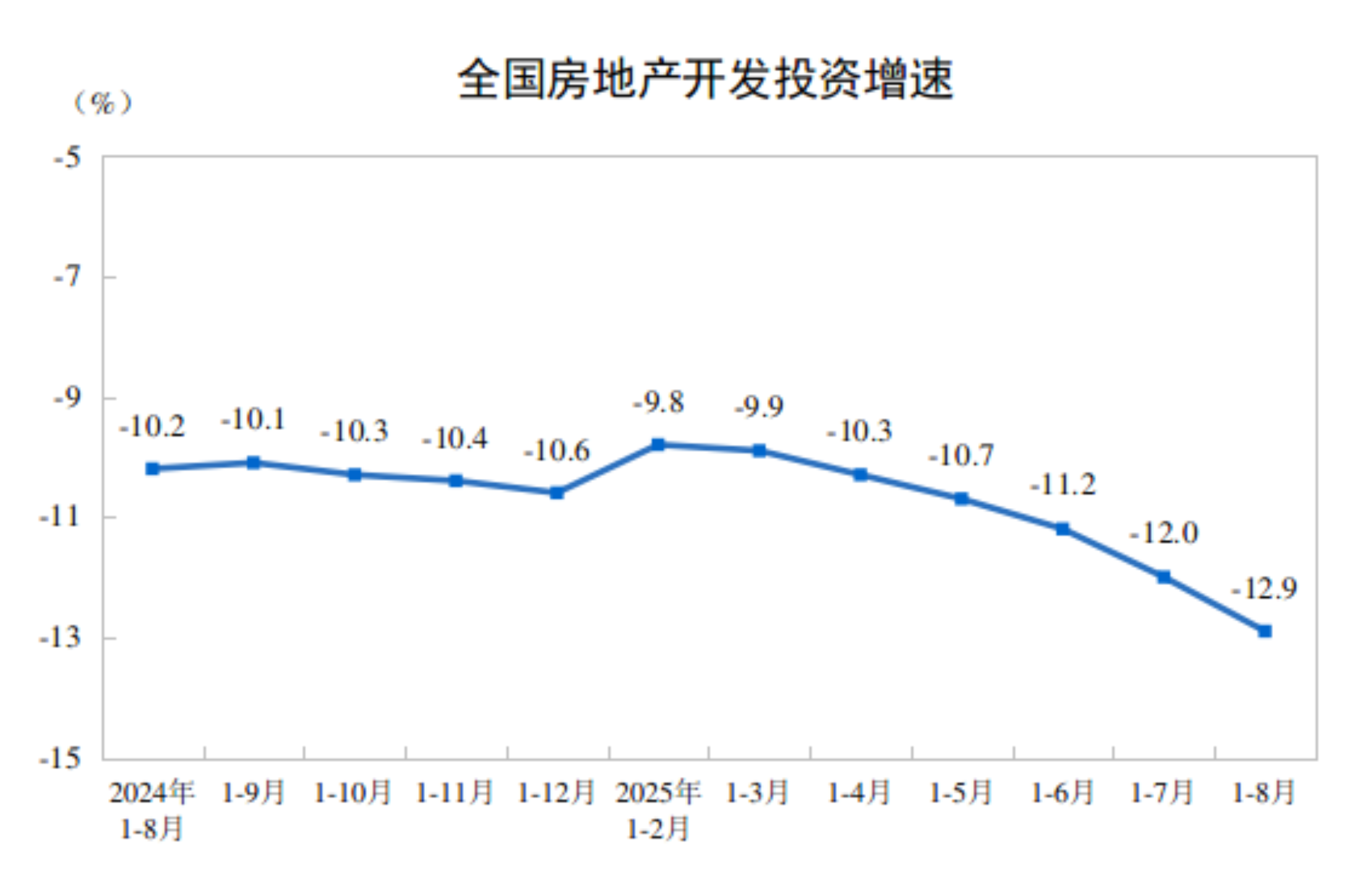
Real Estate Development Investment - In the first eight months, national real estate development investment reached 60,309 billion yuan, a year-on-year decrease of 12.9% [1][10] - Residential investment accounted for 46,382 billion yuan, down 11.9% [1][10] Construction Area and New Starts - The total construction area for real estate development was 643,109 million square meters, reflecting a 9.3% year-on-year decline [3][10] - New construction area was 39,801 million square meters, down 19.5%, with residential new starts at 29,304 million square meters, a decrease of 18.3% [3][10] Sales of New Commercial Housing - New commercial housing sales area was 57,304 million square meters, down 4.7%, with residential sales also decreasing by 4.7% [4][10] - The sales revenue from new commercial housing was 55,015 billion yuan, a decline of 7.3%, with residential sales revenue down 7.0% [4][10] Funding Situation for Real Estate Developers - Funding for real estate developers totaled 64,318 billion yuan, a decrease of 8.0% year-on-year [7][10] - Domestic loans increased slightly by 0.2% to 10,232 billion yuan, while foreign investment fell by 11.5% to 18 million yuan [7][10] Regional Performance - In the eastern region, new commercial housing sales area was 25,651 million square meters, down 7.1%, and sales revenue was 33,263 billion yuan, down 8.1% [12] - The central region saw a sales area of 15,099 million square meters, down 1.4%, with sales revenue of 10,076 billion yuan, a decrease of 6.1% [12]