
Guo Jia Tong Ji Ju

Search documents
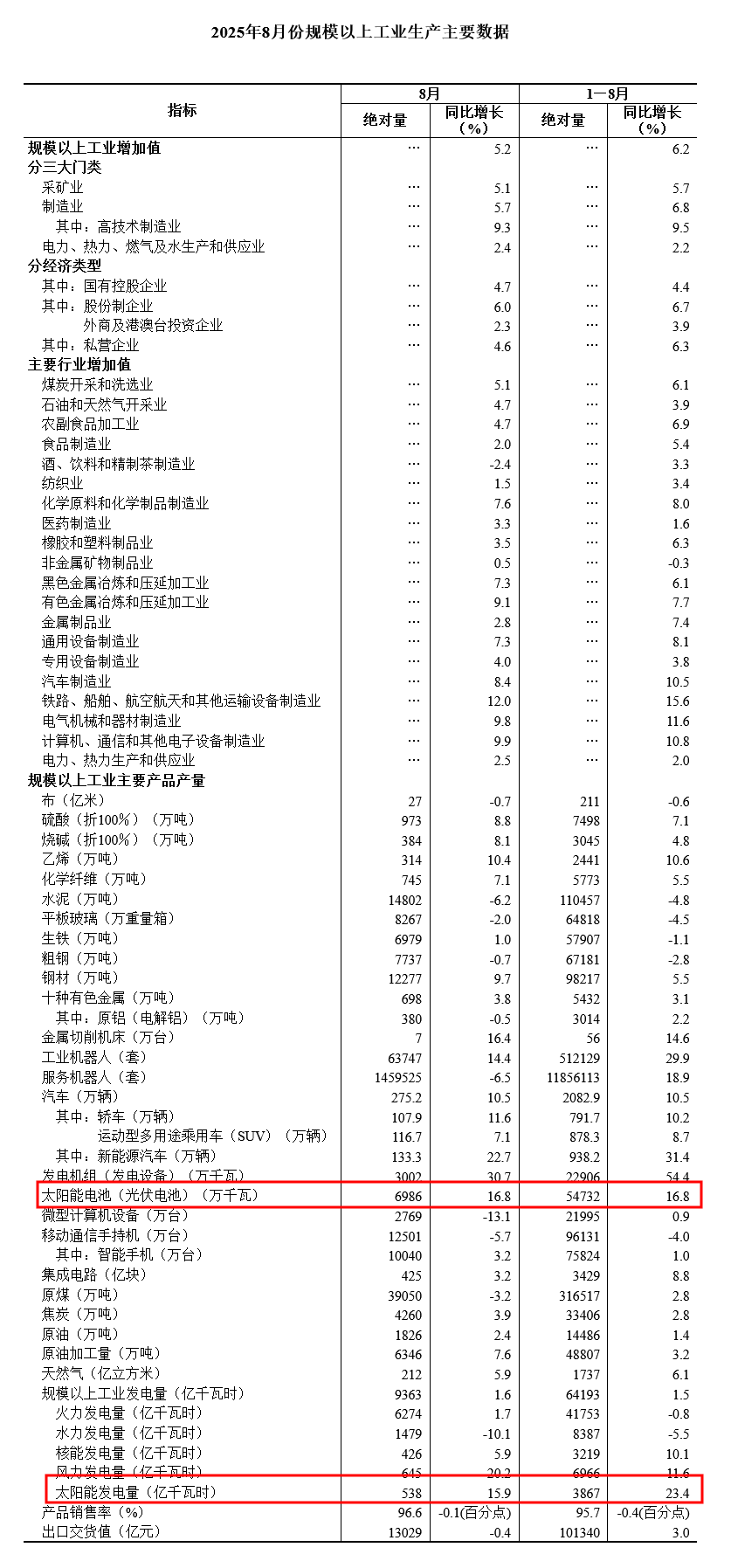
国家统计局:8月太阳能发电量538亿千瓦时,同比增15.9%
Guo Jia Tong Ji Ju· 2025-09-15 02:22
Core Insights - The solar battery (photovoltaic) production in August reached 69.86 million kilowatts, marking a year-on-year increase of 16.8% [1] - The total solar power generation in August was 53.8 billion kilowatt-hours, reflecting a year-on-year growth of 15.9% [2] - Cumulative solar power generation from January to August reached 386.7 billion kilowatt-hours, with a significant year-on-year increase of 23.4% [2] Production and Growth Metrics - The cumulative production of solar batteries from January to August was 547.32 million kilowatts, also showing a year-on-year increase of 16.8% [1] - The industrial added value for the manufacturing sector in August grew by 5.7% year-on-year, while the high-tech manufacturing sector experienced a growth rate of 6.8% [3] - The electricity, heat, gas, and water production and supply industry saw a year-on-year increase of 2.4% in August [3] Industry Performance - The coal mining and washing industry reported a year-on-year growth of 5.1% in August [3] - The chemical raw materials and products manufacturing industry experienced a growth of 7.6% year-on-year [3] - The automotive manufacturing sector grew by 8.4% year-on-year, with new energy vehicles seeing a notable increase of 22.7% [5]


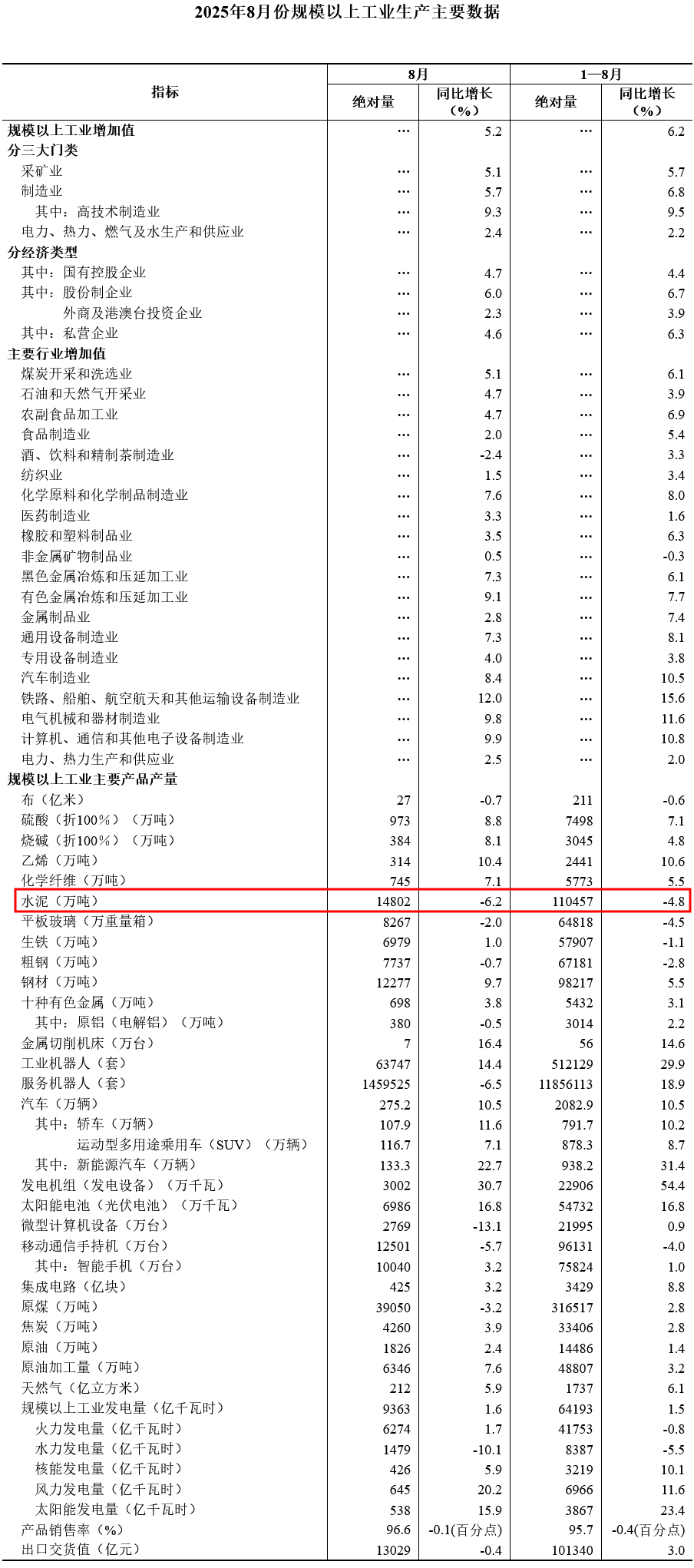
国家统计局:中国1-8月水泥产量11.05亿吨,同比降4.8%
Guo Jia Tong Ji Ju· 2025-09-15 02:22
Core Insights - The industrial value added in large-scale industries increased by 5.2% year-on-year from January to August, with a pure growth rate of 6.2% [2] Group 1: Industrial Performance - The mining industry saw a year-on-year growth of 5.1%, while the manufacturing sector grew by 5.7% [2] - High-tech manufacturing experienced a significant increase of 9.3% year-on-year [2] - The electricity, heat, gas, and water production and supply industry had a growth rate of 2.4% [2] Group 2: Economic Types - State-owned enterprises reported a growth of 4.7%, while joint-stock enterprises grew by 6.0% [2] - Foreign and Hong Kong, Macao, and Taiwan-invested enterprises had a growth of 2.3%, whereas private enterprises grew by 4.6% [2] Group 3: Major Industries - The coal mining and washing industry grew by 5.1%, while the oil and gas extraction industry saw a growth of 4.7% [2] - The chemical raw materials and chemical products manufacturing industry reported a growth of 7.6% [2] - The automotive manufacturing industry experienced a growth of 8.4%, with railway, shipbuilding, aerospace, and other transportation equipment manufacturing growing by 12.0% [2] Group 4: Industrial Output - The production of steel reached 77.37 million tons, showing a slight decrease of 0.7% year-on-year [3] - The output of ten non-ferrous metals was 1.04 million tons, with a growth of 3.8% [3] - The production of new energy vehicles increased significantly by 22.7% to 1.33 million units [3] Group 5: Energy Production - The total industrial power generation was 936.3 billion kWh, with a year-on-year increase of 1.6% [3] - Wind power generation saw a substantial increase of 20.2%, while solar power generation increased by 23.4% [3]
国家统计局:8月规模以上工业增加值同比增长5.2% 消费品零售总额增长3.4%
Guo Jia Tong Ji Ju· 2025-09-15 02:19
Economic Overview - In August, under the strong leadership of the Central Committee, the national economy maintained overall stability with a steady development trend, supported by macro policy adjustments and the promotion of a unified national market [1][9]. Industrial Production - In August, the industrial added value of large-scale enterprises increased by 5.2% year-on-year and 0.37% month-on-month. The mining industry grew by 5.1%, manufacturing by 5.7%, and electricity, heat, gas, and water production and supply by 2.4% [2][18]. - The equipment manufacturing industry saw an 8.1% increase, while high-tech manufacturing grew by 9.3%, outperforming the overall industrial growth by 2.9 and 4.1 percentage points respectively [2][18]. - From January to August, the industrial added value increased by 6.2% year-on-year [2][18]. Service Sector - The service production index rose by 5.6% year-on-year in August, with significant growth in information transmission, software, and IT services (12.1%), finance (9.2%), and leasing and business services (7.4%) [3][18]. - For the first eight months, the service production index increased by 5.9% year-on-year [3][18]. Retail Sales - In August, the total retail sales of consumer goods reached 39,668 billion yuan, a year-on-year increase of 3.4% [4][18]. - Online retail sales amounted to 99,828 billion yuan, growing by 9.6% year-on-year, with physical goods online retail sales at 80,964 billion yuan, a 6.4% increase [4][18]. Fixed Asset Investment - From January to August, fixed asset investment (excluding rural households) totaled 326,111 billion yuan, a year-on-year increase of 0.5% [5][18]. - Manufacturing investment grew by 5.1%, while real estate development investment fell by 12.9% [5][18]. Trade and Exports - In August, the total value of goods imports and exports reached 38,744 billion yuan, a year-on-year increase of 3.5%, with exports at 23,035 billion yuan (up 4.8%) and imports at 15,709 billion yuan (up 1.7%) [6][18]. - From January to August, the total value of goods imports and exports was 295,696 billion yuan, also a 3.5% increase year-on-year [6][18]. Employment - The urban surveyed unemployment rate in August was 5.3%, a slight increase of 0.1 percentage points from the previous month [7][18]. - The average working hours for employed persons were 48.5 hours per week [7][18]. Price Trends - In August, the Consumer Price Index (CPI) decreased by 0.4% year-on-year, with food prices down by 2.5% [8][18]. - The Producer Price Index (PPI) for industrial producers fell by 2.9% year-on-year, with the decline narrowing by 0.7 percentage points from the previous month [8][18].
国家统计局:8月中国原煤产量3.9亿吨
Guo Jia Tong Ji Ju· 2025-09-15 02:19
1—8月份,规上工业原油加工量48807万吨,同比增长3.2%。 天然气生产稳定增长。8月份,规上工业天然气产量212亿立方米,同比增长5.9%;日均产量6.9亿立方 米。 8月份,规模以上工业(以下简称规上工业)原煤生产降幅收窄,原油生产增速加快,天然气、电力生 产平稳增长。 一、原煤、原油和天然气生产及相关情况 原煤生产降幅收窄。8月份,规上工业原煤产量3.9亿吨,同比下降3.2%,降幅比7月份收窄0.6个百分 点;日均产量1260万吨。 1—8月份,规上工业原煤产量31.7亿吨,同比增长2.8%。 原油生产增速加快。8月份,规上工业原油产量1826万吨,同比增长2.4%,增速比7月份加快1.2个百分 点;日均产量58.9万吨。 1—8月份,规上工业原油产量14486万吨,同比增长1.4%。 原油加工较快增长。8月份,规上工业原油加工量6346万吨,同比增长7.6%;日均加工204.7万吨。 1—8月份,规上工业天然气产量1737亿立方米,同比增长6.1%。 二、电力生产情况 规上工业电力生产平稳增长。8月份,规上工业发电量9363亿千瓦时,同比增长1.6%;日均发电首次突 破300亿千瓦时,达302.0 ...
8月中国粗钢产量7737万吨
Guo Jia Tong Ji Ju· 2025-09-15 02:19
Core Insights - In August 2025, China's crude steel production reached 77.37 million tons, a year-on-year decrease of 0.7% [1] - In August 2025, pig iron production was 69.79 million tons, showing a year-on-year increase of 1.0% [1] - In August 2025, steel product output was 122.77 million tons, reflecting a year-on-year growth of 9.7% [1] Summary by Category Crude Steel Production - From January to August 2025, China's crude steel production totaled 671.81 million tons, down 2.8% year-on-year [1] Pig Iron Production - From January to August 2025, pig iron production was 57.91 million tons, a decrease of 1.1% year-on-year [1] Steel Product Production - From January to August 2025, steel product output reached 982.17 million tons, an increase of 5.5% year-on-year [1]
8月份各线城市商品住宅销售价格同比降幅总体继续收窄
Guo Jia Tong Ji Ju· 2025-09-15 02:19
2025年8月份,70个大中城市中,各线城市商品住宅销售价格环比下降,同比降幅总体继续收窄。 一、各线城市商品住宅销售价格环比下降 8月份,一线城市新建商品住宅销售价格环比下降0.1%,降幅比上月收窄0.1个百分点。其中,上海上涨 0.4%,北京、广州和深圳分别下降0.4%、0.2%和0.4%。二线城市新建商品住宅销售价格环比下降 0.3%,降幅收窄0.1个百分点。三线城市新建商品住宅销售价格环比下降0.4%,降幅扩大0.1个百分点。 8月份,一线城市二手住宅销售价格环比下降1.0%,降幅与上月相同。其中,北京、上海、广州和深圳 分别下降1.2%、1.0%、0.9%和0.8%。二线城市二手住宅销售价格环比下降0.6%,降幅扩大0.1个百分 点。三线城市二手住宅销售价格环比下降0.5%,降幅与上月相同。 二、各线城市商品住宅销售价格同比降幅总体继续收窄 8月份,一线城市新建商品住宅销售价格同比下降0.9%,降幅比上月收窄0.2个百分点。其中,上海上涨 5.9%,北京、广州和深圳分别下降3.5%、4.3%和1.7%。二、三线城市新建商品住宅销售价格同比分别 下降2.4%和3.7%,降幅分别收窄0.4个和0.5个百 ...
国家统计局:8月规模以上工业增加值增长5.2% 国民经济运行总体平稳、稳中有进
Guo Jia Tong Ji Ju· 2025-09-15 02:17
Economic Overview - In August, the national economy maintained overall stability and progressed steadily, with a focus on implementing the decisions of the central government and enhancing macro policy adjustments [30][38] - The industrial added value above designated size increased by 5.2% year-on-year in August, with a month-on-month increase of 0.37% [31][38] - From January to August, the industrial added value grew by 6.2% year-on-year [31][38] Industrial Performance - The mining industry saw a year-on-year increase of 5.1%, while the manufacturing sector grew by 5.7%, and the electricity, heat, gas, and water production and supply industry increased by 2.4% in August [31][38] - High-tech manufacturing and equipment manufacturing industries performed well, with growth rates of 9.3% and 8.1% respectively, surpassing the overall industrial growth [31][38] Product Output - Among 623 industrial products, 319 saw year-on-year output growth in August, including steel (12.3 million tons, +9.7%), ethylene (314,000 tons, +10.4%), and automobiles (2.752 million units, +10.5%) [7][31] - New energy vehicles experienced significant growth, with production increasing by 22.7% [31][38] Service Sector Growth - The service sector production index rose by 5.6% year-on-year in August, with notable growth in information transmission, software, and financial services [32][38] - The business activity index for the service sector was at 50.5, indicating expansion [32][38] Investment Trends - Fixed asset investment (excluding rural households) reached 326.111 billion yuan from January to August, with a year-on-year increase of 0.5% [34][38] - Manufacturing investment grew by 5.1%, while real estate development investment declined by 12.9% [34][38] Trade Performance - In August, the total value of goods imports and exports was 38,744 billion yuan, a year-on-year increase of 3.5%, with exports growing by 4.8% [35][38] - From January to August, the total value of goods imports and exports reached 295,696 billion yuan, with exports increasing by 6.9% [35][38] Employment and Price Trends - The urban survey unemployment rate was 5.3% in August, showing a slight increase from the previous month [36][38] - The Consumer Price Index (CPI) decreased by 0.4% year-on-year in August, while the industrial producer prices fell by 2.9% [37][38]
国家统计局:8月电力、热力、燃气及水生产和供应业增加值增长2.4%
Guo Jia Tong Ji Ju· 2025-09-15 02:16
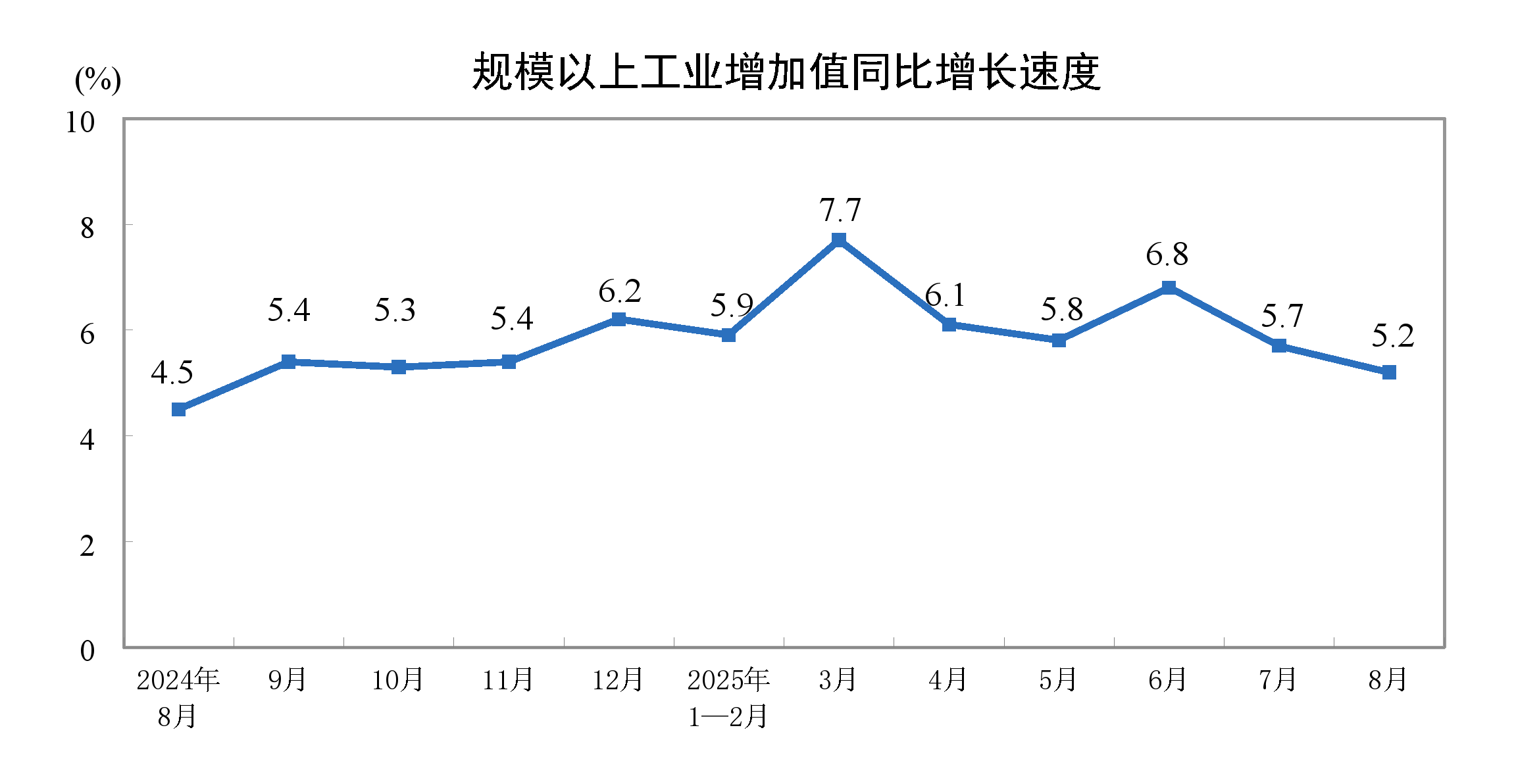
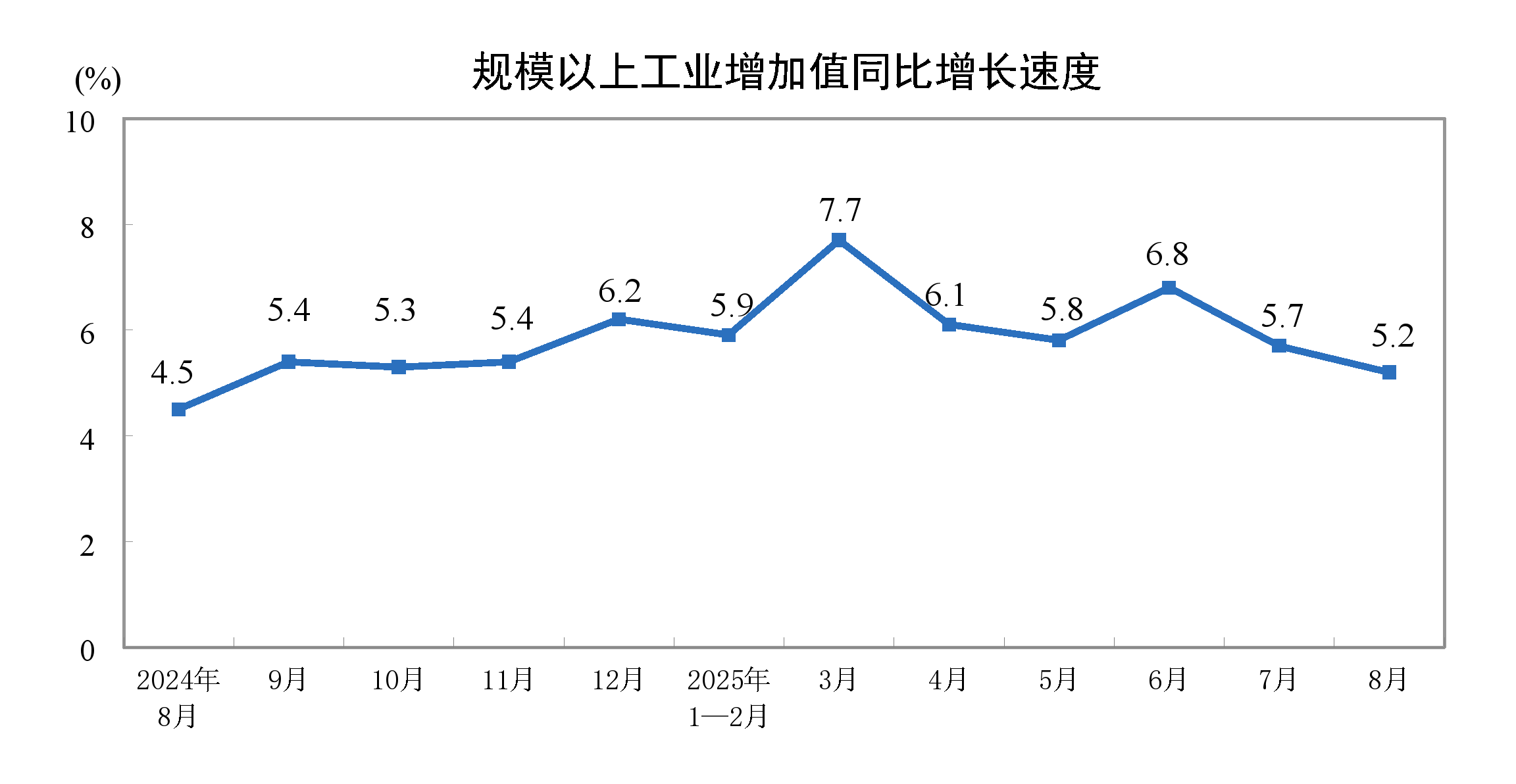
8月份,规模以上工业增加值同比实际增长5.2%(增加值增速均为扣除价格因素的实际增长率)。从环比看,8月份,规模以上工业增加值比上月增长 0.37%。1—8月份,规模以上工业增加值同比增长6.2%。 分三大门类看,8月份,采矿业增加值同比增长5.1%,制造业增长5.7%,电力、热力、燃气及水生产和供应业增长2.4%。 分经济类型看,8月份,国有控股企业增加值同比增长4.7%;股份制企业增长6.0%,外商及港澳台投资企业增长2.3%;私营企业增长4.6%。 分行业看,8月份,41个大类行业中有31个行业增加值保持同比增长。其中,煤炭开采和洗选业增长5.1%,石油和天然气开采业增长4.7%,农副食品加工业 增长4.7%,酒、饮料和精制茶制造业下降2.4%,纺织业增长1.5%,化学原料和化学制品制造业增长7.6%,非金属矿物制品业增长0.5%,黑色金属冶炼和压 延加工业增长7.3%,有色金属冶炼和压延加工业增长9.1%,通用设备制造业增长7.3%,专用设备制造业增长4.0%,汽车制造业增长8.4%,铁路、船舶、航 空航天和其他运输设备制造业增长12.0%,电气机械和器材制造业增长9.8%,计算机、通信和其他电子设备 ...
国家统计局:1-8月份电力、热力、燃气及水生产和供应业投资增长18.8%
Guo Jia Tong Ji Ju· 2025-09-15 02:16
Core Insights - National fixed asset investment (excluding rural households) reached 326.111 billion yuan from January to August 2025, showing a year-on-year growth of 0.5% [1][4] - Private fixed asset investment experienced a decline of 2.3% year-on-year [1][5] Investment by Industry - Investment in the primary industry was 64.61 billion yuan, with a year-on-year increase of 5.5% [3][5] - Investment in the secondary industry totaled 1182.46 billion yuan, growing by 7.6% [3][5] - Investment in the tertiary industry was 2014.04 billion yuan, reflecting a decrease of 3.4% [3][5] - Within the secondary industry, industrial investment rose by 7.7%, with mining investment increasing by 3.0%, manufacturing investment by 5.1%, and investment in electricity, heat, gas, and water production and supply rising by 18.8% [3][5] Infrastructure and Regional Investment - Infrastructure investment (excluding electricity, heat, gas, and water production and supply) in the tertiary industry grew by 2.0%, with water transport investment increasing by 15.9%, water conservancy management investment by 7.4%, and railway transport investment by 4.5% [3][5] - Investment in the eastern region declined by 3.5%, while the central region saw a growth of 2.5%, the western region increased by 2.3%, and the northeastern region experienced a decline of 6.0% [3][5] Investment by Registration Type - Domestic enterprises' fixed asset investment grew by 0.5%, while investment from Hong Kong, Macau, and Taiwan enterprises increased by 2.3%. In contrast, foreign enterprises' fixed asset investment fell by 15.4% [3][5]

国家统计局:中国1-8月基础设施投资同比增长2.0%
Guo Jia Tong Ji Ju· 2025-09-15 02:15
Core Insights - National Bureau of Statistics reported that from January to August, national infrastructure investment (excluding electricity, heating, gas, and water production and supply) increased by 2.0% year-on-year [1] Investment Breakdown - Investment in water transportation industry grew by 15.9% [1] - Investment in water conservancy management increased by 7.4% [1] - Investment in railway transportation rose by 4.5% [1]