Xin Lang Ji Jin

Search documents
继续反弹,哔哩哔哩涨超6%,机构料其三季度盈利增长175%!百亿港股互联网ETF(513770)续涨逾2%
Xin Lang Ji Jin· 2025-10-21 01:56
Market Overview - The Hong Kong stock market continued its rebound on October 21, with the Hang Seng Index and Hang Seng Tech Index both opening over 1% higher, driven by strong performances from tech giants [1] - Key internet stocks such as Bilibili-W, Alibaba-W, Kuaishou-W, Tencent Holdings, Meituan-W, and Xiaomi Group-W all saw gains, with Bilibili-W leading at a 6% increase [1] Stock Performance - Bilibili-W is projected to achieve a revenue of 7.6 billion yuan in Q3, marking a 4% year-on-year growth, with an adjusted net profit forecast of 650 million yuan, representing a 175% increase year-on-year and a 16% increase quarter-on-quarter [3] - The advertising segment is expected to generate 2.5 billion yuan in Q3, a 20% year-on-year increase, primarily driven by growth in performance-based advertising [3] ETF and Sector Analysis - The Hong Kong Internet ETF (513770) opened higher, increasing by 2.03% and surpassing the 60-day moving average, indicating strong market interest [2] - The ETF tracks the CSI Hong Kong Internet Index, with major holdings including Alibaba-W (18.11% weight), Tencent Holdings (16.16%), and Xiaomi Group-W (11.06%), collectively accounting for over 72% of the top ten holdings [4][5] - The index has shown significant resilience, outperforming the Hang Seng Tech Index, with a year-to-date increase of 55.11% compared to 45.79% for the Hang Seng Tech Index [6] Future Outlook - Analysts from Guotai Junan Securities suggest that short-term volatility will not alter the bullish outlook for the Hong Kong stock market in Q4, particularly in the tech sector, which is expected to benefit from AI narratives and potential foreign capital inflows [4] - The technology sector is seen as having a natural growth style, with low interest rates likely to enhance valuations, making it an attractive investment area [4]


北京公募基金高质量发展在行动 |中金基金走进中国人民大学
Xin Lang Ji Jin· 2025-10-21 01:27
Group 1 - The event titled "New Era, New Fund, New Value - High-Quality Development of Public Funds in Action" aims to implement the "Action Plan for Promoting High-Quality Development of Public Funds" and enhance Beijing's role as a national financial management center [1][3] - The event included a sharing session by CICC Fund's Deputy General Manager Li Yaoguang, who discussed the development and innovative practices of public REITs, helping students connect theoretical knowledge with practical industry insights [3] - The initiative emphasizes the importance of educating future professionals in the public fund sector, with a focus on enhancing investor education and supporting the high-quality development of the industry [3] Group 2 - The collaboration involves various stakeholders, including public fund managers, sales institutions, evaluation agencies, and mainstream media, to promote high-quality development in the public fund sector [1] - The event serves as a bridge between academia and the industry, fostering discussions on public fund-related topics and encouraging student engagement [3] - CICC Fund plans to continue its efforts in investor education and industry development in alignment with the "Action Plan for Promoting High-Quality Development of Public Funds" [3]
工银瑞信投教基地走进中国政法大学开展《SQL基础入门》之存储过程课程
Xin Lang Ji Jin· 2025-10-21 01:27
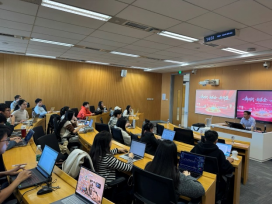
Group 1 - The event titled "New Era, New Fund, New Value" focuses on the high-quality development of public funds in Beijing, aiming to enhance financial knowledge among students [1][2] - The workshop held at China University of Political Science and Law on October 20, 2023, included a series of courses on SQL basics, emphasizing practical and professional knowledge in financial data processing [1] - The session covered key technical aspects such as stored procedures, functions, and cursors, demonstrating their applications in processing financial transaction data effectively [1] Group 2 - The ICBC Credit Suisse Investment Education Base aims to integrate investor education into national educational strategies, leveraging group advantages and collaborating with educational institutions [2] - The initiative focuses on cultivating financial talents with solid professional knowledge, high moral standards, and a sense of social responsibility, contributing to the sustainable development of the public fund industry [2]
嘉实基金:深度布局浮动费率产品 践行“以投资者为本”
Xin Lang Ji Jin· 2025-10-21 01:27
Core Viewpoint - The introduction of a new floating management fee model in China's public fund industry marks a significant shift from focusing on scale to prioritizing returns, aligning the interests of fund managers and investors [1][2][3] Group 1: Floating Fee Model Implementation - The China Securities Regulatory Commission released an action plan in May 2025 to promote high-quality development in the public fund sector, which includes 25 measures [1] - The first batch of new floating fee products was launched by 26 institutions, including Harvest Fund, on May 27, indicating a major step in implementing the floating management fee model [2] - The floating fee model features three tiers of management fees: 1.2% (base), 1.5% (upward), and 0.6% (downward), linking fees directly to investor returns [2] Group 2: Impact on Fund Management - The floating fee mechanism breaks the traditional fixed fee model, allowing management costs to dynamically match investment returns, thus promoting a win-win value-sharing concept [3] - This model encourages fund companies to focus on research and development, talent cultivation, and risk control, enhancing their competitive edge [3] - The shift to a floating fee model represents a transition from a scale-driven approach to a trust-driven and capability-driven paradigm in the public fund industry [3][4] Group 3: Future Outlook - Harvest Fund aims to leverage its integrated research and investment capabilities to reshape product design, investment management, and client service [5] - The maturation and widespread adoption of floating fee products are expected to foster a more resilient, responsible, and valuable public fund ecosystem [5]
刷屏朋友圈,华泰证券AI涨乐零成本营销:1句文案所有员工转发,还拿下苏超合作,网友称像员工人口普查
Xin Lang Ji Jin· 2025-10-20 14:52
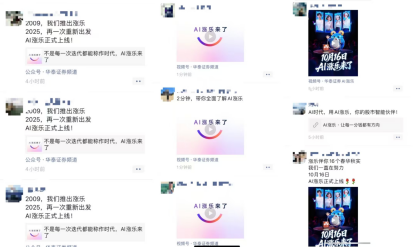
Core Viewpoint - Huatai Securities has launched "AI Zhangle" as a new initiative, marking a significant rebranding effort reminiscent of its previous launch in 2009, aiming to leverage social media for marketing and engagement [1][3][7]. Group 1: Marketing Strategy - The launch of "AI Zhangle" has led to a viral marketing campaign on social media, with many industry professionals sharing the news, resulting in a significant increase in visibility for Huatai Securities [3][5]. - Employees of Huatai Securities actively participated in promoting the initiative on their personal social media accounts, creating a unified message that emphasized the company's rebranding efforts [7][9]. - The marketing approach has been described as a "zero-cost marketing sample," highlighting the effectiveness of organic social media engagement without traditional advertising expenditures [7][11]. Group 2: Employee Engagement - The campaign has sparked a sense of community among Huatai employees, with many reconnecting and sharing the news, likened to a "population census" of the company's workforce [5][7]. - There is a humorous undertone in the employee engagement, with comments suggesting that the lack of traditional marketing efforts has led to a playful atmosphere among staff [7][11]. - The initiative has also prompted discussions about employee satisfaction, with some users humorously noting the absence of year-end bonuses while engaging in social media promotions [11].

上银基金沈丹莹参加工作3年跻身基金经理行列,手握上银3只债基总规模51亿
Xin Lang Ji Jin· 2025-10-20 14:43
Group 1 - The core point of the article is the rapid career advancement of Shen Danying, who will officially become a fund manager at Shangyin Fund in September 2025 after only three years in the industry [1][5]. - Shen Danying joined Shangyin Fund in July 2022 and has held various positions including assistant researcher, trader, and assistant fund manager [2][5]. - As of June 30, 2025, the total management scale of the fund she oversees, Shangyin Huixingying Bond Fund, is 3.352 billion yuan [2][3]. Group 2 - Shen Danying is currently managing three funds, including Shangyin Huixingying Bond Fund, Shangyin Jushunyi One-Year Open Fund, and Shangyin Juzengfu Regular Open Fund, with a total asset scale of 5.118 billion yuan [5]. - The announcement of her appointment as a fund manager was made on October 20, 2025, following the departure of the previous co-manager [3][4]. - Shen's rapid rise in the public fund industry is notable, as she has achieved significant responsibilities shortly after graduation [5].
ETF日报:结合基本面和社融走弱的大背景,目前点位的债券仍有配置价值。建议逢调整适当配置十年国债ETF
Xin Lang Ji Jin· 2025-10-20 12:52
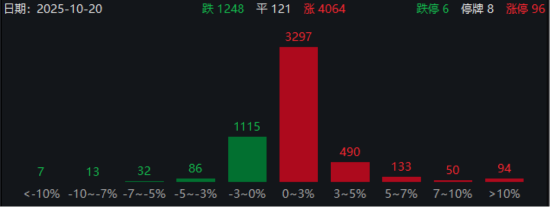
Market Overview - The Shanghai Composite Index rose by 0.63% to close at 3863.89 points, while the Shenzhen Component Index increased by 0.98% to 12813.21 points, with a noticeable decrease in trading volume, totaling only 1.75 trillion yuan, marking a two-month low [1] - The market saw over 4000 stocks rise, led by the telecommunications and coal sectors, while the non-ferrous metals sector faced declines due to gold and silver price corrections [1] Economic Data - Recent economic data for Q3 showed declines in investment, real estate, and consumption, indicating a weakening economic backdrop [1] - Fixed asset investment growth unexpectedly dropped to -0.5%, heavily impacted by real estate investment [4] Hong Kong Market Dynamics - The Hong Kong stock market opened higher and maintained a strong position, closing up 2.42% at 25858.83 points, following constructive discussions between Chinese and U.S. officials regarding trade relations [3] - The technology sector continues to show strong momentum, supported by fundamentals, while external liquidity remains favorable with continued inflows from foreign and southbound funds [3] Sector Performance - The communication ETF rose by 3.39%, and the AI sector within the ChiNext board saw a 3.70% increase, driven by positive demand forecasts from leading companies like NVIDIA [6] - The ongoing high demand cycle for optical modules is supported by supply constraints and price resilience, benefiting leading companies in the sector [7] Investment Recommendations - Investors are encouraged to focus on the Hong Kong Stock Connect 50 ETF and the Hong Kong Technology ETF, as favorable factors are expected to accumulate in Q4 [4] - The bond market is showing signs of returning bullish sentiment, with long-term bond yields stabilizing around 1.8% [5] Future Outlook - The outlook for the Hong Kong market remains positive, with potential upward movement driven by technological advancements, easing trade tensions, and improved external liquidity [4] - The dividend-focused investment strategy is highlighted as having significant value, especially in light of new policies encouraging dividend distributions among state-owned enterprises [10]
行情持续性如何?港股AI终于反弹,阿里巴巴涨近5%,百亿港股互联网ETF(513770)上探3%
Xin Lang Ji Jin· 2025-10-20 12:02
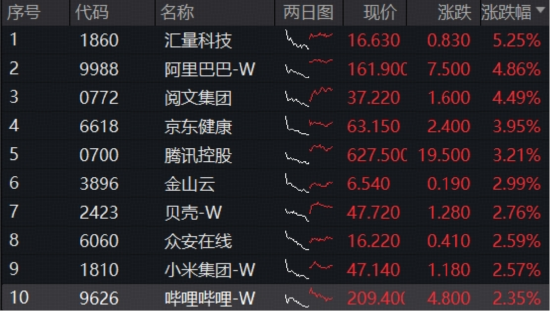
Core Viewpoint - The Hong Kong stock market has rebounded, with significant gains in major tech stocks, driven by positive sentiment around AI developments and potential monetary easing from the Federal Reserve [1][4]. Group 1: Market Performance - The Hang Seng Index and Hang Seng Tech Index rose by 2.42% and 3% respectively, with major tech companies like Alibaba, Tencent, Xiaomi, Bilibili, and Meituan all experiencing gains of over 2% [1]. - The Hong Kong Internet ETF (513770) opened high and maintained strong performance, closing up 2.25% with a trading volume exceeding 500 million HKD [2][3]. Group 2: Capital Flows - Southbound capital saw a net inflow of 45.089 billion HKD last week, marking the highest in five weeks, with year-to-date inflows surpassing 1.1 trillion HKD, indicating strong interest in the Hong Kong market [4]. - Major internet companies like Alibaba, Tencent, Meituan, and Xiaomi have been the primary beneficiaries of this capital inflow, leading the net buying in recent months [4][5]. Group 3: Industry Developments - Alibaba Cloud's new AI solution, "Aegaeon," has been recognized at a top academic conference, addressing GPU resource waste in AI model services [4]. - The technology sector is expected to lead the market's recovery, supported by favorable monetary policies and easing trade tensions [4][5]. Group 4: Valuation and Investment Sentiment - The current price-to-earnings (P/E) ratio of the Hong Kong Internet Index is 23.69, which is lower than both US and A-share tech valuations, suggesting potential for growth [9]. - Analysts believe that the technology sector will drive a revaluation in the Hong Kong market, particularly as the Federal Reserve signals possible monetary easing [5][6].

硬科技反攻,光模块领跑,高“光”159363放量冲击7%!港股不甘示弱,香港大盘30ETF、港股互联网ETF联袂拉涨
Xin Lang Ji Jin· 2025-10-20 11:55
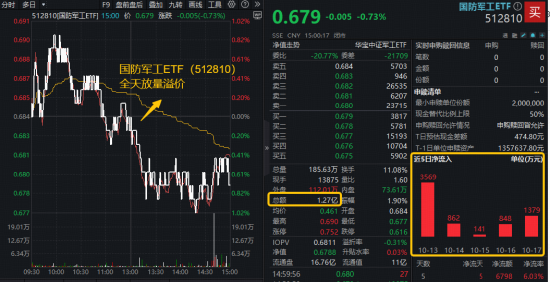
Market Overview - Technology stocks rebounded significantly, with the ChiNext Index rising by 1.98% and the Shenzhen Component Index increasing by 0.98% [1] - The Shanghai Composite Index also saw a rise of 0.63%, while trading volume in A-shares dropped to 1.75 trillion yuan, the lowest since August 8 [1] - The market is experiencing a "see-saw" effect between banking and technology sectors, with the top bank ETF achieving a record high in fund size, surpassing 20 billion yuan [1] Defense and Military Sector - Indonesia confirmed its procurement plan for the J-10 fighter jet, boosting confidence in the defense and military sector [2] - China Aviation Securities predicts a continued recovery in the third-quarter reports for the defense and military sector [2] - The defense and military ETF has attracted over 73 million yuan in inflows over six consecutive days, indicating strong interest from investors [1][2] AI and Technology Hardware - The demand for 1.6T optical modules has been revised upwards, leading to a strong performance in the optical module market [6][8] - The AI sector is experiencing a resurgence, with significant gains in related stocks, including a nearly 8% increase in Zhongji Xuchuang [6] - The leading AI ETF saw a trading volume increase of over 70%, reflecting heightened investor interest [1][6] Hong Kong Market Dynamics - The Hong Kong market saw a collective rebound, with the Hang Seng Index and Hang Seng Tech Index rising by 2.42% and 3%, respectively [1][4] - The Hong Kong Large Cap 30 ETF, which tracks the Hang Seng China (Hong Kong-listed) 30 Index, has been attracting significant capital inflows since its launch [4][11] - The ETF's strategy combines high-growth technology stocks with high-dividend yield stocks, appealing to a broad range of investors [4][16] Investment Sentiment - There is a notable increase in foreign capital inflows into Chinese technology stocks, with significant purchases from prominent investment firms [14][22] - The overall sentiment in the Hong Kong market remains optimistic, driven by AI advancements and favorable macroeconomic conditions [21][22] - Analysts suggest focusing on sectors with high earnings growth and low valuations, such as consumer discretionary and public utilities [15]
政策强压叠加深度亏损,农牧渔板块继续回调!生猪去产能+估值历史低位,布局时机或至?
Xin Lang Ji Jin· 2025-10-20 11:55
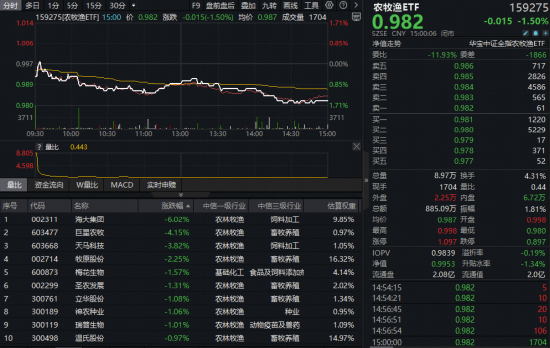
Core Viewpoint - The agricultural, animal husbandry, and fishery sector continues to show weakness, with the first agricultural ETF (159275) experiencing a decline of 1.5% by market close on October 20, 2023 [1][2] Market Performance - The agricultural ETF (159275) closed at 0.982, down 0.015 from the previous day, reflecting a 1.5% decrease [2] - Key stocks in the sector, including Haida Group, Juxing Agriculture, and Tianma Technology, saw significant declines, with Haida Group dropping over 6% and Juxing Agriculture falling over 4% [1][2] Industry Trends - The 14th World Pig Industry Expo opened on October 18, 2025, showcasing over 800 global enterprises and focusing on smart farming equipment and technology [1] - The Ministry of Agriculture and Rural Affairs, along with five other departments, issued guidelines to strengthen modern agricultural service centers, enhancing support for feed production and animal disease prevention [1] Regulatory Environment - From May to September 2023, multiple meetings were held regarding pig farming, with policies aimed at reducing production by 1 million heads by the end of the year [3] - The pig farming industry is entering a phase of capacity reduction, with a reported decrease of 50,000 breeding sows from July to August 2023 [3] Valuation Insights - The agricultural and fishery sector is currently at a relatively low valuation level, with the agricultural ETF's underlying index price-to-book ratio at 2.59, placing it in the 31.64 percentile over the past decade [3] - This suggests a favorable configuration opportunity for long-term investments in the sector [3] Future Outlook - The pig farming industry is expected to see a rise in price levels due to ongoing capacity reduction and regulatory policies [5] - The focus will be on improving quality and efficiency in the industry, with a gradual elimination of outdated production capacity [4]