Counterpoint Research

Search documents
Computex 2025 Day 1:NVIDIA、Qualcomm、Arm制定AI与计算议题
Counterpoint Research· 2025-05-22 09:41
Core Insights - The global computing landscape is undergoing a transformation, with NVIDIA collaborating with hyperscale cloud service providers, Qualcomm re-entering the data center market, and Arm solidifying its position in AI [1] Group 1: NVIDIA's Developments - NVIDIA announced the opening of its NVLink Fusion platform, allowing hyperscale cloud service providers to integrate their semi-custom chips into NVIDIA's ecosystem [2] - This initiative addresses the core challenge faced by hyperscale cloud providers in achieving vertical and horizontal scaling on NVIDIA systems, while also enabling NVIDIA to commercialize its NVLink technology [4] - NVIDIA is establishing a larger "NVIDIA Constellation" campus in Taiwan, positioning it as a second headquarters to strengthen partnerships with TSMC, Foxconn, and others, reflecting its strategy to build a robust commercial ecosystem [4] - The company launched the RTX Pro 6000 Blackwell server GPU, which supports diverse workloads and aims to transform enterprise IT architecture for the AI era [5] Group 2: Qualcomm's Strategy - Qualcomm showcased its Snapdragon X series processors, which have driven over 85 PC devices and are expected to exceed 100 designs by 2026, emphasizing efficiency and battery life [9] - The company is reinforcing its "end-cloud collaboration" AI strategy, focusing on the application of Agentic AI in productivity and creative scenarios [9] - Qualcomm plans to release the Snapdragon X2 platform in September, featuring 18 third-generation Oryon V3 cores and targeting a 12% market share in the Copilot PC segment by 2027 [10] Group 3: Arm's Position - Arm is enhancing its role in AI development through deep collaboration with Taiwan's industry ecosystem, launching the new Travis CPU with scalable matrix extension technology for improved performance [13] - The company has established strong partnerships with major hyperscale cloud providers like AWS, Google, and Microsoft, with 50% of new server chips for hyperscale data centers based on Arm architecture [13] - Arm predicts that over 40% of PCs and tablets will adopt Arm architecture by 2025, driven by the growth of Windows on Arm ecosystem [14]



东南亚正迅速成为全球电动汽车生产中心
Counterpoint Research· 2025-05-22 09:41
Core Insights - The Southeast Asian electric vehicle (EV) market is experiencing significant growth, with sales expected to increase by over 50% year-on-year in 2024, capturing 10% of new passenger vehicle sales [1][3] - Traditional automakers like Toyota, Honda, Nissan, and Mazda have been slow to respond to the surge in EV demand, allowing Chinese EV manufacturers to gain a substantial market advantage in the region [1] - By 2025, it is projected that EVs will account for over 13% of total passenger vehicle sales in Southeast Asia, with a year-on-year growth rate of 41%, and by 2035, it is anticipated that one in every two passenger vehicles sold will be electric [1][3] Market Dynamics - The growth of the Southeast Asian EV market is driven by three main factors: government incentives, abundant resources, and significant investments from Chinese automakers [3] - Southeast Asia is rapidly emerging as a global production hub for electric vehicles, supported by favorable market conditions and increasing consumer demand [3]

Computex 2025 Day 2:AI创新贯穿边缘计算、通信连接和基础建设
Counterpoint Research· 2025-05-22 09:41
Core Insights - The article emphasizes that AI is no longer a hollow concept, showcasing its real value in creating a complete ecosystem that encompasses cloud, edge, and everything in between [2] Group 1: Foxconn's Transformation - Foxconn is transitioning from a contract manufacturer to a builder of AI infrastructure, supported by the Taiwanese government, in collaboration with NVIDIA and TSMC to establish an AI supercomputer center with an initial scale of 20MW, expanding to 100MW [3] - The "3+3" strategy focuses on integrating AI with electric vehicles, digital health, and robotics, while reinforcing the technological foundations of semiconductors and next-generation communications [4] - Foxconn aims to achieve an 80% automation rate in its global manufacturing bases, reducing human involvement to 20%, aligning with its smart city strategy to enhance urban traffic and energy management through AI [5] Group 2: MediaTek's Strategic Moves - MediaTek announced a strategic partnership with NVIDIA, becoming one of the first partners to adopt the NVLink Fusion architecture, aiming to provide customized AI chip solutions for large-scale cloud service providers [9] - MediaTek's first 2nm chip is set to complete "tape-out" in September, marking a significant milestone in advanced process technology and solidifying its position among industry leaders [10] - In smart home applications, MediaTek showcased a gateway that combines 5G FWA and Gen AI, indicating potential for future killer applications by around 2026 [11] Group 3: Qualcomm's Innovations - Qualcomm introduced the Snapdragon FWA Gen 4 Elite platform, claiming to be the world's first of its kind, which enhances AI inference speed by 30% and improves network selection capabilities [20] - The company also launched products aimed at Wi-Fi networks and mixed reality, supporting maximum transmission speeds of 5.8Gbps and ultra-low latency, targeting enterprise applications and future connected vehicles [20] Group 4: Analyst Perspectives - Analysts from Counterpoint Research noted that Foxconn is evolving into a comprehensive AI and digital platform integrator, combining its diversified "3+3" strategy with deep AI integration across the entire industry chain [7] - MediaTek's collaboration with NVIDIA on NVLink Fusion technology is seen as crucial for expanding its presence in AI data centers, automotive, and edge computing markets [14] - Qualcomm is redefining the future of broadband and connectivity experiences across consumer, enterprise, and industrial applications [20]

GlobalFoundries 2025年Q1收入同比增长2%;汽车与数据中心部门将引领2025年收入增长
Counterpoint Research· 2025-05-15 09:50
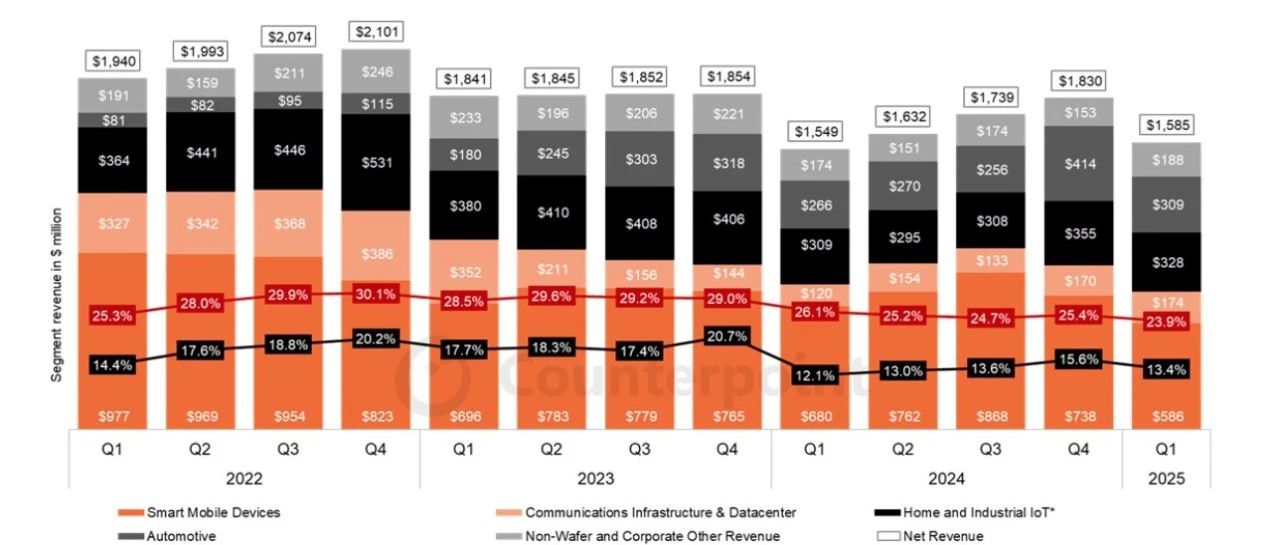
Core Viewpoint - GlobalFoundries (GF) reported a 2% year-over-year revenue growth in Q1 2025, reaching $1.59 billion, driven by contributions from communication infrastructure, data centers, home and industrial IoT, and automotive sectors [2][9]. Revenue Performance - Q1 2025 revenue growth was primarily supported by the automotive sector, which saw a 16% increase due to higher semiconductor content in vehicles and new design wins from key OEM customers [9][12]. - The communication infrastructure and data center segment experienced a significant 45% year-over-year revenue growth, fueled by increased investments in data centers and new design wins in satellite communications [12]. - The smart mobile devices segment faced a 14% decline in revenue year-over-year due to seasonal factors and customer inventory buildup, but is expected to recover with new design wins in audio, haptics, and display applications [12]. Strategic Initiatives - GF's COO emphasized the importance of manufacturing scale and technology diversification, with over $7 billion invested in facilities in the U.S., Germany, and Singapore since 2021 [2][3]. - Analysts noted that GF's diversified supply chain and global manufacturing footprint will help mitigate tariff impacts and provide customers with more options during macroeconomic uncertainties [3][4]. Future Outlook - The automotive and communication infrastructure sectors are projected to be the main revenue growth drivers in 2025, with expectations of double-digit growth in automotive due to market share gains and new design wins [12][14]. - The average selling price (ASP) is anticipated to decline in the mid-single digits percentage range in 2025 due to product mix changes [4][12]. - GF's gross margin is expected to improve to 30% in 2025, supported by enhanced capacity utilization, reduced depreciation costs, and structural cost optimization from diversified manufacturing and product line expansion [14].

2024年高端智能手机SoC营收同比增长34%,占据安卓SoC总营收的半壁江山
Counterpoint Research· 2025-05-15 09:50
Core Viewpoint - The global high-end smartphone SoC market is projected to grow by 34% year-on-year in 2024, driven by strong consumer preference for high-end models and improvements in average selling prices (ASP) [1][4]. Market Trends and Uncertainties - The high-end smartphone SoC revenue growth is attributed to increased demand for high-end models and advancements in AI performance platforms [4]. - Qualcomm maintains market dominance with a 6% annual growth rate, despite losing some market share to Exynos chips in the Samsung Galaxy S24 series, with a recovery expected in 2025 due to the Galaxy S25 series [4]. - Samsung's Exynos chips have quadrupled revenue in the Galaxy S/A series, but a potential decline is anticipated in 2025, indicating instability in the Exynos technology route [4]. - HiSilicon has made a strong comeback in the Chinese high-end market, capturing a 12% revenue share in 2024, supported by deep integration with the HarmonyOS and a loyal user base [4]. - Media Tek's high-end smartphone SoC revenue nearly doubled, benefiting from the market performance of the Dimensity 9300 series and the launch of the Dimensity 9400 [4]. Analyst Insights - The high-end smartphone SoC segment contributed 52% of total Android smartphone SoC revenue in 2024, with intensified competition due to HiSilicon's return and Media Tek's accelerated expansion [6]. - Qualcomm's continued dominance is supported by collaborations with Samsung and Chinese smartphone manufacturers, while Media Tek's growth is primarily focused on the Chinese market, leveraging partnerships with brands like vivo and OPPO [6][7]. - Samsung's high-end product revenue saw a fourfold increase in 2024, largely due to the Galaxy S24 series, but may face a decline in 2025 due to the Galaxy S25 series not using in-house chips [7][9]. - HiSilicon's market performance is bolstered by the Pura 70 and Mate 70 series, with expectations to maintain the third position in the Android high-end market revenue share in 2025 [7][9].

AMD 2025年Q1营收同比增长36%,出口管制新政预计将致2025年营收减少15亿美元
Counterpoint Research· 2025-05-15 09:50
动,部分未被充分跟踪的桌面渠道产品亦提供支撑。鉴于上半年开局强劲,公司预计下半年增速将 有所放缓,因此传统季节性趋势可能不再适用。 库存与销售成本(COGS)比率从2024年Q4的1.52攀升至2025年第一季度的1.73。库存积压可能导致 持续降价压力及毛利率下滑。 在笔记本市场,AMD指出本季度基于AMD处理器的笔记本实际销售表现非常亮眼。从新一代AI PC 处理器的销量攀升能看出需求旺盛,环比增长超过50%。首批搭载全新高端锐龙AI Max Plus处理器 的笔记本以及首款主流锐龙AI 7和5 300系列处理器的产品上市后收获高度好评。 AMD同时指出,本季度搭载AMD处理器的商用PC需求很大。锐龙Pro商用PC实际销量同比增长超 过30%,主要得益于新的终端客户订单,还有HP、Lenovo、Dell和Asus等厂商基于AMD方案的商用 系统数量较2024年增长80%。本季度AMD在汽车、能源、医疗、金融服务及电信行业头部企业斩获 多个订单。纵观PC市场全局,AMD对2025年客户端处理器收入增长远超行业平均水平充满信心, 驱动力来自桌面渠道的拓宽、消费级与商用笔记本产品组合的扩展以及产品结构持续优化。 ...

TSMC 先进制程产能利用率持续保持强劲
Counterpoint Research· 2025-05-15 09:50
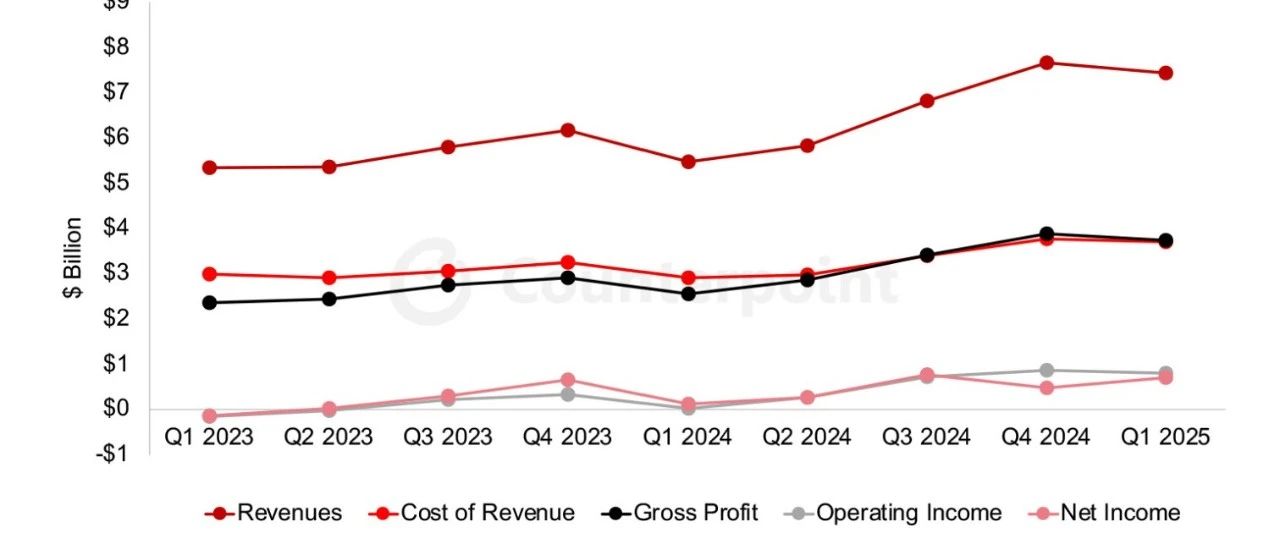
Core Viewpoint - TSMC has solidified its leading position in the global foundry market following inventory adjustments at the end of 2022, with high utilization rates in advanced process nodes showcasing its technological superiority [1][4]. Group 1: Advanced Process Utilization - The 3nm process node has achieved full utilization within five quarters of mass production, driven by strong demand for Apple A17 Pro/A18 Pro chips and other application processors, setting a new record for initial market demand in advanced processes [1]. - TSMC's 5/4nm process is experiencing a resurgence in demand, particularly due to the surge in AI accelerator chips like NVIDIA's H100 and B100, which has significantly boosted overall capacity [2][4]. - TSMC's advanced process utilization rates are projected to remain high, with expectations that the 2nm process will reach full capacity within four quarters of mass production, driven by dual demand from smartphones and AI applications [7]. Group 2: Future Developments and Investments - TSMC plans to allocate 30% of its 2nm process capacity to its Arizona facility, enhancing geopolitical resilience while ensuring capacity meets customer demand, especially in AI and high-performance computing [9]. - The company anticipates that the diverse customer base for the 2nm technology, including major players like Qualcomm, MediaTek, Intel, and AMD, will help maintain high utilization rates [7]. - TSMC's investment of $165 billion in its Arizona plant will support advanced process technologies, including 4nm, 3nm, and 2nm, ensuring the company remains at the forefront of the semiconductor industry [9].


Apple Watch出货量持续下滑:需靠新款机型与重大升级破局
Counterpoint Research· 2025-05-08 08:06
Core Viewpoint - Apple Watch shipments declined by 19% in 2024, marking the second consecutive year of decline, primarily due to the absence of new SE models [1][5]. Group 1: Shipment Performance - In 2024, Apple Watch shipments fell to 19 million units, with all regions except India experiencing a decline, particularly in North America, which accounts for over half of Apple Watch shipments [5]. - The decline in market share for Apple in the high-end smartwatch segment was 8 percentage points year-on-year [5]. - The fourth quarter of 2024 marked the fifth consecutive quarter of declining shipments for Apple smartwatches, while competitors in the high-end smartwatch market saw growth during the same period [5]. Group 2: Contributing Factors - The limited upgrade of the Series 10, intensified competition, absence of new Ultra models, and legal disputes collectively hindered growth [6]. - The last update for the SE series was in Q3 2022, and Apple is attempting to change the SE series' aluminum base to plastic, causing delays in the new SE model release [7]. Group 3: Future Outlook - To achieve a market rebound in 2025 and maintain market share, Apple needs to focus on introducing new features, launching new SE and Ultra series models, and potential design upgrades [7].


2025年Q1 Counterpoint宏观指数
Counterpoint Research· 2025-05-08 08:06
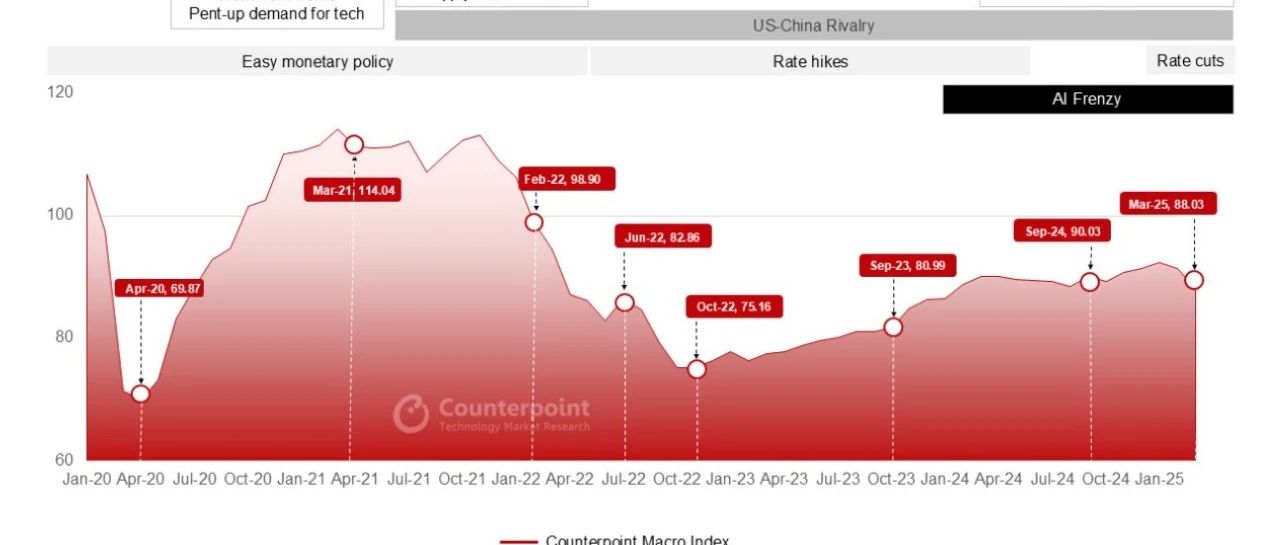
Core Insights - The Counterpoint macro index continuously monitors the global technology industry's monthly environment and market sentiment, covering four core dimensions [2] - The index aims to address key macro trend questions for technology industry decision-makers [2] Positive Factors - Economic Data: - GDP growth remains stable across most regions [4] - Inflation is generally controllable, though concerns about localized rebounds persist [4] - Consumer Sentiment: - Overall business sentiment is positive [4] - Technology Industry Sentiment: - The AI wave is expanding into energy, infrastructure, and other sectors [5] - Political and Policy Factors: - Interest rates in developed countries are on a steady decline, with a rate-cutting cycle underway [5] - China is expected to achieve its annual GDP target under stimulus policies [5] Risk Factors - Trade War: - The US-China tariff war has significantly heightened negative sentiment [7] - Supply Chain: - High tariffs are putting pressure on the technology and manufacturing supply chains [7] - Inflation: - Trade wars, tax cuts, and rising US Treasury yields are making the fiscal situation in the US increasingly unsustainable [7] - There is a high probability of inflation rebounding in the US [7] - Regulatory Environment: - Divergence in regulatory frameworks between the US and other countries is emerging [7] - The US is rapidly exiting the ESG (Environmental, Social, and Governance) agenda [7] - The index may experience declines similar to those seen from the second half of 2022 to the first half of 2023 [7] - Geopolitical Tensions: - Conflicts in Ukraine and Gaza may present turning points, but US-China tensions are expected to reach historical peaks [7]
XR显示市场将同比增长6%,AR智能眼镜发展势头强劲
Counterpoint Research· 2025-05-08 08:06
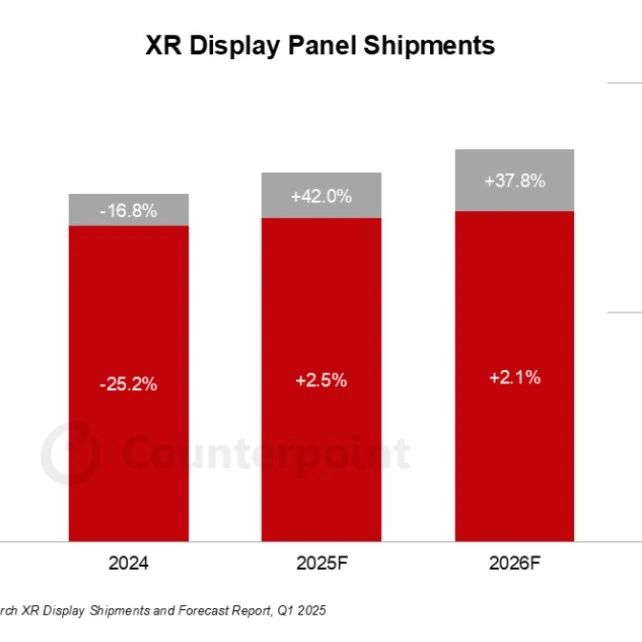
Core Insights - The global XR (AR/VR) display shipments are expected to grow by 6% year-on-year in 2025, with AR glasses projected to see a significant increase of 42%, while VR growth is limited to 2.5% [1][3] - The anticipated growth in 2025 is seen as a partial recovery following a substantial decline in display shipments in 2024, driven by inventory clearance and adjustments in business plans by XR device manufacturers [3][4] - LCD technology is expected to dominate VR display shipments, accounting for 87% of the total, while silicon-based OLED (OLED-on-Silicon) is projected to hold a 75% share in the AR segment, allowing more room for MicroLED and LCoS technologies [3][4] Market Dynamics - The release of the Meta Quest 3S, which utilizes a single LCD panel instead of a dual-panel design, contributed to the decline in display panel shipments [3] - Despite recent demonstrations of MicroLED smart glasses by companies like Meta and Google, commercial plans have not yet been disclosed, while several Chinese brands, including Even Realities, have begun selling lightweight AR glasses using MicroLED and waveguide technologies [4] - The recovery trend is expected to continue into 2026, with AR display panel shipments projected to grow by 38% and VR by 2.1%, although uncertainties surrounding U.S. tariffs on Chinese imports may impact XR device demand [4]