傅里叶的猫

Search documents
GPU和光模块的需求分析
傅里叶的猫· 2025-08-29 15:33
Core Viewpoint - The article discusses the increasing demand for optical modules in AI clusters, particularly in relation to the architecture and scale of the networks used in semiconductor and AI applications [2][5][10]. Group 1: Optical Module Requirements - In Huawei's CM384 super node, the ratio of NPU to optical modules is calculated to be 1:18, requiring a total of 6,912 optical modules for 384 NPUs [4]. - The comparison between Huawei and NVIDIA's server optical module usage reveals that CM384 has a significantly higher optical module requirement, indicating a trend towards "full optical interconnection" [5]. - The demand for optical modules increases non-linearly with the scale of AI clusters, with larger clusters requiring more complex network architectures [6][10]. Group 2: Network Architecture Impact - In a small cluster of 1,024 GPUs, the ratio of optical modules to GPUs is approximately 2.5, but this jumps to 3.5 when scaling to 4,096 GPUs due to the introduction of a third layer of core switches [6][8]. - For ultra-large clusters (e.g., 100,000 GPUs), the ratio of optical modules to GPUs can reach up to 4, indicating a significant increase in network complexity [6][10]. Group 3: Cost Differences Among Solutions - Different interconnect solutions exhibit notable cost differences; for instance, NVIDIA's InfiniBand solution is the most expensive at approximately $3.9 billion, with a ratio of 3.6 optical modules per GPU [11]. - Broadcom's Ethernet solution is the most cost-effective at around $3.5 billion, with a similar optical module ratio of 2.6, saving approximately $400 million compared to InfiniBand [11]. Group 4: Future Trends - As GPU clusters continue to grow, the network architecture may evolve to four or even five layers, potentially increasing the optical module to GPU ratio from 3.5 to 4.5 [10]. - Broadcom's Ethernet solution is expected to gain traction due to its cost advantages, particularly in large-scale deployments where budget constraints are a concern [10].


英伟达电话会议产品角度分析
傅里叶的猫· 2025-08-28 03:34
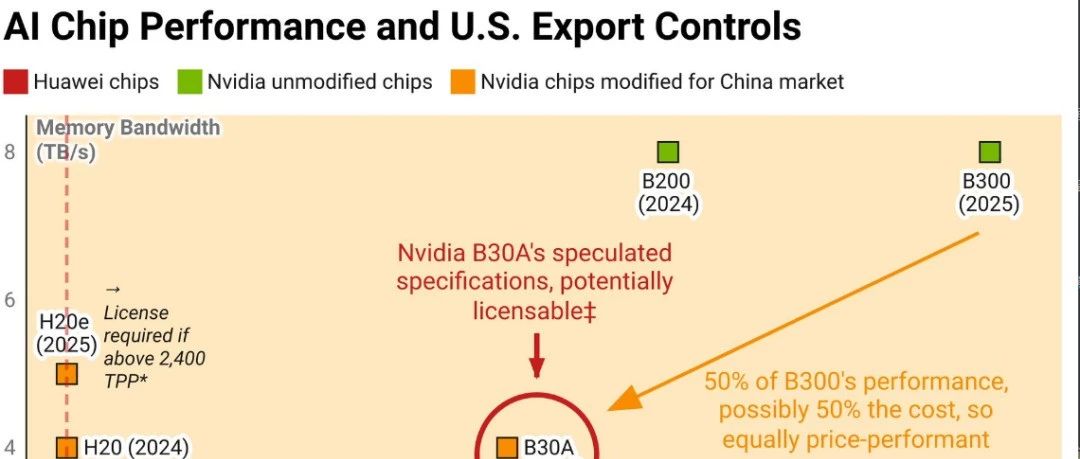
Core Insights - The article emphasizes the product perspective of NVIDIA's recent developments, particularly focusing on the GB300 and its implications for AI infrastructure and market opportunities. Group 1: Product Developments - The GB300 has begun mass production and is available for orders in China, although current volumes are primarily for testing [1] - The GB200 has seen significant shipments, and the GB300 shares architecture and software with it, allowing for seamless transition [1] - The NVL72 can generate approximately 1,000 racks weekly, with production expected to accelerate in Q3 [1] Group 2: Market Opportunities - AI infrastructure capital expenditures could reach $3-4 trillion by 2030, with the top four cloud service providers' spending doubling to around $600 billion in recent years, indicating that the $3 trillion figure is plausible [1] - The Chinese market is projected to provide NVIDIA with approximately $50 billion in opportunities this year, with an annual growth rate of 50% expected [6] Group 3: Financial Performance - The gaming business reported Q2 revenue of $4.3 billion, a 49% year-over-year increase, specifically referring to the GeForce RTX series [3] - The network business achieved a record revenue of $7.3 billion, driven by strong demand for SpectrumX network cards, InfiniBand, and NVLink product lines [4] Group 4: Future Technologies - Six new chips have been developed for the Rubin platform, all completed at TSMC [2] - The H20 has not yet shipped, with expected revenues previously estimated between $2-5 billion [3] - There is uncertainty regarding the maturity of CPO technology, as it was not mentioned in recent discussions, suggesting that optical modules will continue to be used for some time [3] Group 5: Efficiency Improvements - The GB300 NVL72 improves token processing efficiency by ten times per watt, with the B series showing a 50% increase in efficiency per token compared to the H series [1]

寒武纪炸裂财报,未来如何?
傅里叶的猫· 2025-08-26 15:18
Core Viewpoint - The article emphasizes that Cambricon is a leading player in the domestic AI chip market, despite previous misconceptions about its valuation and performance [2][6]. Financial Performance - In Q1 2025, revenue increased by 17.69 billion, representing a 59.19% quarter-on-quarter growth [3]. - For the first half of 2025, revenue reached 28.81 billion, a staggering 4347.82% year-on-year increase [4]. - Gross profit totaled 16.11 billion, up 3865.94% from the previous year [4]. - Net profit attributable to shareholders was 10.38 billion, reflecting a year-on-year growth of 15.68 billion [4]. - The net cash flow from operating activities turned positive, improving from -6.31 billion to 9.11 billion [4]. - Total assets increased by 25.34% compared to the end of the previous year [4]. - The weighted average return on equity rose by 27.06 percentage points to 17.31% [4]. Market Position and Client Relationships - Cambricon is firmly positioned in the first tier of the AI chip market, with strong client relationships, particularly with ByteDance [6]. - ByteDance's AI chip procurement is expected to reach 60 billion by 2025, with Cambricon potentially capturing 300-500 billion of that market share [6]. - The next-generation chip, 690, has received positive feedback from major clients and is crucial for future sales [6]. Profitability and Cost Structure - The company is expected to see significant profit growth due to fixed costs and minimal personnel increases, leading to higher profit margins as revenue rises [8]. - Compared to Nvidia's valuation, which is projected to decrease from 45 times to 40 times, the domestic AI chip market is anticipated to grow faster, suggesting a favorable valuation outlook for Cambricon [8]. Competitive Landscape - The AI chip market is highly competitive, with Cambricon facing challenges from other players like Huawei and emerging competitors [9]. - The market is showing a trend of concentration among leading firms, which may stabilize Cambricon's position in the short term [9]. Industry Impact - Cambricon's growth positively influences its partners, such as Inspur, enhancing their profitability through increased sales and revenue [13]. - The upcoming release of the 690 chip and Huawei's next-generation products are critical events that could reshape the domestic AI chip market [14].
Deepseek V3.1的UE8M0 FP8和英伟达的FP8格式有什么区别
傅里叶的猫· 2025-08-24 12:31
Core Viewpoint - The introduction of UE8M0 FP8 by Deepseek for the upcoming domestic chips signifies a strategic move to enhance compatibility and efficiency in the Chinese AI ecosystem, addressing the unique requirements of domestic hardware [5][10][12]. Group 1: UE8M0 and FP8 Concept - FP8 is an 8-bit floating-point format that significantly reduces memory usage by 75% compared to 32-bit formats, enhancing computational speed and efficiency for large model training and inference [7][13]. - UE8M0 is a specific encoding format for FP8 tensor data, designed to optimize compatibility with domestic chips, differing from Nvidia's E4M3 and E5M2 formats which focus on precision and dynamic range [9][10]. - The Open Compute Project (OCP) introduced UE8M0 as part of its MXFP8 formats, aiming to standardize FP8 usage across various hardware platforms [8]. Group 2: Strategic Importance of UE8M0 - The development of UE8M0 is crucial for ensuring that domestic chips can effectively utilize FP8 without relying on foreign standards, thus reducing dependency on Nvidia's technology [12]. - Deepseek's integration of UE8M0 into its model development process aims to ensure that models can run stably on upcoming domestic chips, facilitating a smoother transition from development to deployment [11][12]. - The focus of UE8M0 is not to outperform foreign FP8 standards but to provide a viable solution that allows domestic chips to leverage FP8 efficiency [14]. Group 3: Performance and Limitations - UE8M0 can save approximately 75% in memory usage compared to FP32, allowing for larger models or increased request handling during inference [13]. - The inference throughput using UE8M0 can be about twice that of BF16, making it particularly beneficial for large-scale AI applications [13]. - However, UE8M0 is not a one-size-fits-all solution; certain calculations still require higher precision formats like BF16 or FP16, and effective calibration is necessary to avoid errors in extreme value scenarios [15].

国内AI算力市场需求——云厂训练和推理投入分配情况解析
傅里叶的猫· 2025-08-24 12:31
Core Viewpoint - The AI training market in China is entering a competitive phase dominated by major companies, with a significant reliance on large orders from these firms to sustain market activity [2][3]. Group 1: AI Training Market Analysis - Tencent has sufficient training chip reserves and does not face chip shortage concerns, focusing on using the best available models from various suppliers [2]. - The training market is currently dominated by NVIDIA, with over 60% of training card demand driven by Alibaba, followed by ByteDance and Tencent [3]. - The "Six Little Dragons" are withdrawing from training resources, negatively impacting the overall training market, as these companies are still in the early stages of commercialization [3]. Group 2: Competition Among Major Players - The competition between Alibaba and ByteDance is intensifying, with both companies striving to excel in large model training, leading to a zero-sum game scenario [3]. - The demand for training resources is primarily concentrated among major companies, with Tencent continuing to invest in next-generation models despite the competitive landscape [3]. Group 3: Market Trends and Future Outlook - The demand for inference computing power has not seen the expected significant growth, despite initial optimism earlier in the year [4]. - The growth of AI applications, such as Yuanbao, has begun to slow down, with a modest increase in monthly active users and a significant drop in monthly downloads [4]. - The influx of second-hand A100 and H100 training devices into the domestic market is expected to lower prices significantly, impacting the compliance card market [4][5]. Group 4: Investment Allocation Among Companies - Alibaba allocates approximately 80% of its budget to training and 20% to inference, while ByteDance maintains a balanced 50:50 ratio [5][6]. - Tencent's investment distribution is approximately 20% for training and 80% for inference, indicating a product-oriented approach that has not yet yielded positive revenue [5][6].


华为Cloud Matrix 384中需要多少光模块?
傅里叶的猫· 2025-08-21 15:06
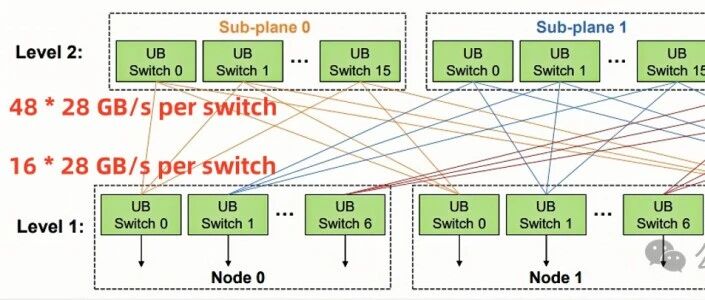
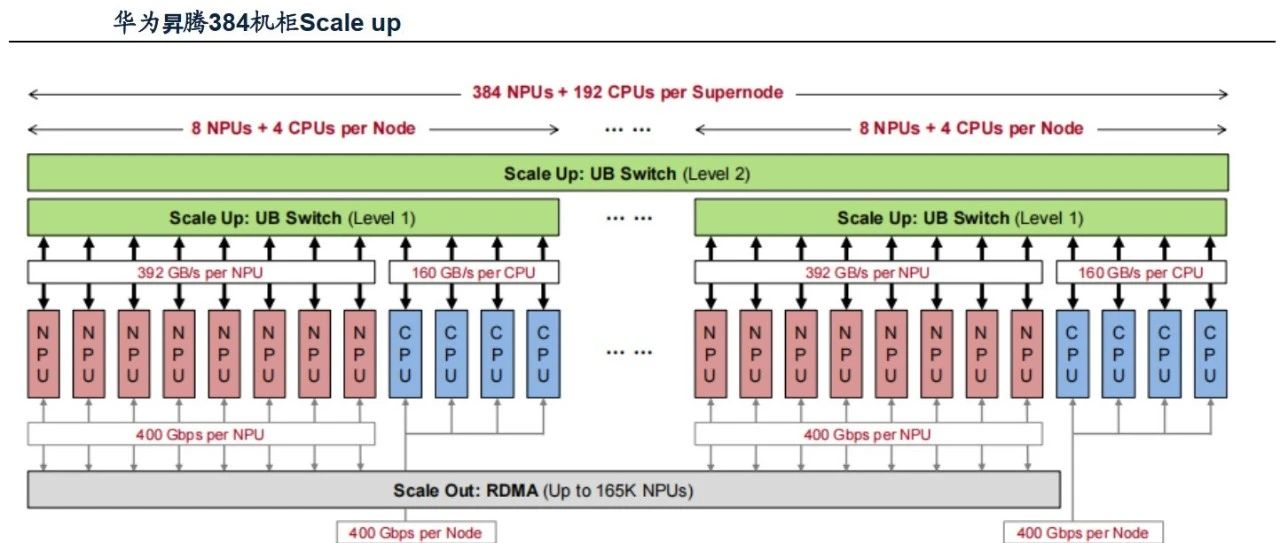
Core Viewpoint - The article discusses the architecture and data flow of Huawei's Cloud Matrix 384, emphasizing the integration of optical and electrical interconnections in its network design [2][3][9]. Group 1: Data Transmission Layers - The Cloud Matrix 384 includes three main data transmission layers: UB Plane, RDMA Plane, and VPC Plane, each serving distinct roles in data processing and communication [5][7]. - The UB Plane connects all NPU and CPU with a non-blocking full-mesh topology, providing a unidirectional bandwidth of 392GB/s per Ascend 910C [7]. - The RDMA Plane facilitates horizontal scaling communication between supernodes using RoCE protocol, primarily connecting NPUs for high-speed KV Cache transfer [7]. - The VPC Plane connects supernodes to broader data center networks, managing tasks such as storage access and external service communication [7]. Group 2: Optical and Electrical Interconnections - Although the Cloud Matrix 384 is often referred to as a purely optical interconnection system, it also utilizes electrical interconnections for short distances to reduce costs and power consumption [9]. - The article highlights the necessity of both optical and electrical connections in achieving efficient data flow within the system [9]. Group 3: Scale-Up and Scale-Out Calculations - For Scale-Up, each server's UB Switch chip corresponds to a bandwidth of 448GBps, requiring 56 400G optical modules or 28 800G dual-channel optical modules per server [12]. - The ratio of NPUs to 400G optical modules in Scale-Up is 1:14, and to 800G modules is 1:7 [12]. - For Scale-Out, a Cloud Matrix node consists of 12 Compute cabinets, and the optical module demand ratio is approximately 1:4 for NPUs to 400G optical modules [14].
GB200出货量上修,但NVL72目前尚未大规模训练
傅里叶的猫· 2025-08-20 11:32
Core Viewpoint - The article discusses the performance and cost comparison between NVIDIA's H100 and GB200 NVL72 GPUs, highlighting the potential advantages and challenges of the GB200 NVL72 in AI training environments [30][37]. Group 1: Market Predictions and Performance - After the ODM performance announcement, institutions raised the forecast for GB200/300 rack shipments in 2025 from 30,000 to 34,000, with expected shipments of 11,600 in Q3 and 15,700 in Q4 [3]. - Foxconn anticipates a 300% quarter-over-quarter increase in AI rack shipments, projecting a total of 19,500 units for the year, capturing approximately 57% of the market [3]. - By 2026, even with stable production of NVIDIA chips, downstream assemblers could potentially assemble over 60,000 racks due to an estimated 2 million Blackwell chips carried over [3]. Group 2: Cost Analysis - The total capital expenditure (Capex) for H100 servers is approximately $250,866, while for GB200 NVL72, it is around $3,916,824, making GB200 NVL72 about 1.6 to 1.7 times more expensive per GPU [12][13]. - The operational expenditure (Opex) for GB200 NVL72 is slightly higher than H100, primarily due to higher power consumption (1200W vs. 700W) [14][15]. - The total cost of ownership (TCO) for GB200 NVL72 is about 1.6 times that of H100, necessitating at least a 1.6 times performance advantage for GB200 NVL72 to be attractive for AI training [15][30]. Group 3: Reliability and Software Improvements - As of May 2025, GB200 NVL72 has not yet been widely adopted for large-scale training due to software maturity and reliability issues, with H100 and Google TPU remaining the mainstream options [11]. - The reliability of GB200 NVL72 is a significant concern, with early operators facing numerous XID 149 errors, which complicates diagnostics and maintenance [34][36]. - Software optimizations, particularly in the CUDA stack, are expected to enhance GB200 NVL72's performance significantly, but reliability remains a bottleneck [37]. Group 4: Future Outlook - By July 2025, GB200 NVL72's performance/TCO is projected to reach 1.5 times that of H100, with further improvements expected to make it a more favorable option [30][32]. - The GB200 NVL72's architecture allows for faster operations in certain scenarios, such as MoE (Mixture of Experts) models, which could enhance its competitive edge in the market [33].

国内外AI服务器Scale up方案对比
傅里叶的猫· 2025-08-18 15:04
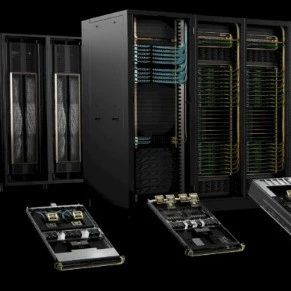
Core Viewpoint - The article discusses the comparison of Scale Up solutions among major domestic and international companies in AI data centers, highlighting the importance of high-performance interconnect technologies and architectures for enhancing computational capabilities. Group 1: Scale Up Architecture - Scale Up enhances computational power by increasing the density of individual servers, integrating more high-performance GPUs, larger memory, and faster storage to create "super nodes" [1] - It is characterized by high bandwidth and low latency, making it suitable for AI inference and training tasks [1] - Scale Up often combines with Scale Out to balance single-machine performance and overall scalability [1] Group 2: NVIDIA's NVLink Technology - NVIDIA employs its self-developed NVLink high-speed interconnect technology in its Scale Up architecture, achieving high bandwidth and low latency for GPU interconnects [3] - The GB200 NVL72 cabinet architecture integrates 18 compute trays and 9 NVLink switch trays, utilizing copper cables for efficient interconnect [3] - Each compute tray contains 2 Grace CPUs and 4 Blackwell GPUs, with NVSwitch trays equipped with NVSwitch5 ASICs [3] Group 3: Future Developments - NVIDIA's future Rubin architecture will upgrade to NVLink 6.0 and 7.0, significantly enhancing bandwidth density and reducing latency [5] - These improvements aim to support the training of ultra-large AI models with billions or trillions of parameters, addressing the growing computational demands [5] Group 4: Other Companies' Solutions - AMD's UALink aims to provide an open interconnect standard for scalable accelerator connections, supporting up to 1024 accelerators with low latency [16] - AWS utilizes the NeuronLink protocol for horizontal scaling, enhancing interconnect capabilities through additional switch trays [21] - Meta employs Broadcom's SUE solution for horizontal scaling, with plans to consider NVIDIA's NVLink Fusion in future architectures [24] Group 5: Huawei's Approach - Huawei adopts a multi-cabinet all-optical interconnect solution with its Cloud Matrix system, deploying Ascend 910C chips across multiple racks [29] - The Cloud Matrix 384 configuration includes 6912 optical modules, facilitating both Scale Up and Scale Out networks [29]
光模块数据更新:需求量、出货量、主要客户及供应商
傅里叶的猫· 2025-08-17 14:11
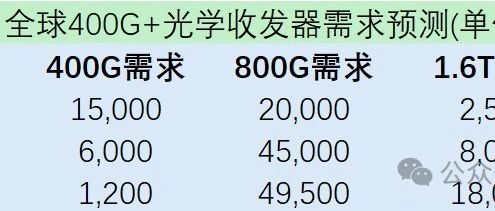
Demand Forecast - The global demand forecast for 400G, 800G, and 1.6T optical transceivers indicates a significant shift towards higher capacity modules, with total demand expected to reach 37,500 kUnits by 2025, driven primarily by 800G and 1.6T modules [1] - In 2025, the demand for 400G is projected at 15,000 kUnits, while 800G demand is expected to be 20,000 kUnits, and 1.6T demand at 2,500 kUnits [1] - By 2026, the demand for 800G is anticipated to surge to 45,000 kUnits, while 400G demand will drop to 6,000 kUnits, indicating a clear transition in market preference [1] - The trend shows that by 2027, 400G demand will significantly decline, while 800G demand stabilizes and 1.6T demand continues to grow [1] Major Clients and Suppliers - Major clients such as Amazon, Google, Meta, Microsoft, Nvidia, Oracle, and Cisco primarily source their optical transceivers from suppliers like 中际旭创 and 新易盛, with increasing proportions from AAOI and Fabrinet [2] - 中际旭创 is a key supplier for multiple major clients, indicating its strong position in the market [2] Newyi's Shipment Statistics - Newyi's projected shipments for 2025 include 4,500 kUnits of 400G, 4,000 kUnits of 800G, and 550 kUnits of 1.6T [2] - By 2026, Newyi's 800G shipments are expected to rise significantly to 10,000 kUnits, while 1.6T shipments will reach 1,760 kUnits [2] - The trend continues into 2027, with Newyi expected to ship 13,000 kUnits of 800G and 3,960 kUnits of 1.6T [2] Tianfu's Shipment Statistics - Tianfu's projected shipments for 2024 include 650 kUnits of 800G and 10 kUnits of 1.6T, with expectations for 2025 to reach 300 kUnits of 800G and 800 kUnits of 1.6T [3] - By 2026, Tianfu anticipates shipping 600 kUnits of 800G and 1,200 kUnits of 1.6T, maintaining a steady growth trajectory [3] Additional Information - More detailed data regarding the demand distribution for 800G and 1.6T, as well as financial data for the mentioned companies, is available for discussion in dedicated forums [3]


【8月28-29日上海】先进热管理年会最新议程
傅里叶的猫· 2025-08-15 15:10
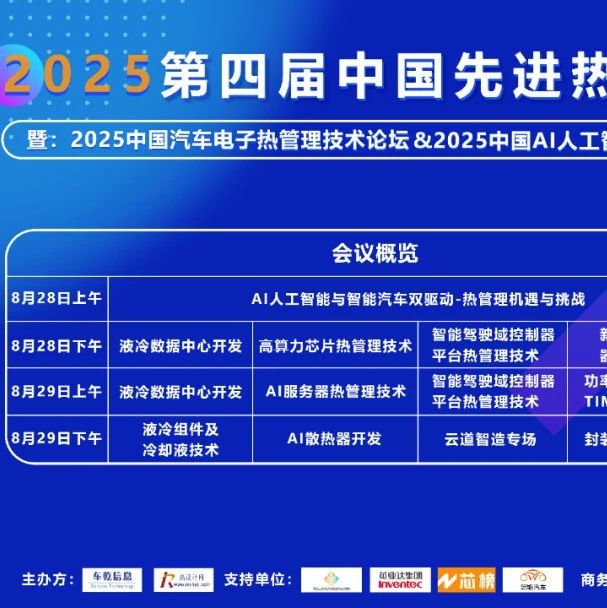
Core Viewpoint - The 2025 Fourth China Advanced Thermal Management Technology Conference will focus on thermal management technologies in the automotive electronics and AI server/data center industries, addressing challenges related to high-performance chips and high-power devices [2][3]. Group 1: Conference Overview - The conference will be held on August 28-29, 2025, in Shanghai, organized by Cheqian Information & Thermal Design Network, with support from various industry organizations [2]. - The event will feature over 60 presentations and more than 600 industry experts in attendance [2]. Group 2: Key Topics and Sessions - The morning of August 28 will cover opportunities and challenges in thermal management driven by AI and smart vehicles, with presentations from companies like Dawning Information Industry and ZTE Corporation [3][28]. - The afternoon sessions will focus on liquid cooling in data centers, featuring discussions on innovative solutions from companies such as Sichuan Huakun Zhenyu and Wacker Chemie [5][30]. Group 3: Specialized Sessions - On August 29, sessions will delve into liquid cooling technologies and their applications, including insights from companies like ZTE and New H3C [6][32]. - The conference will also address high-performance chip thermal management, with presentations from institutions like Fudan University and Zhongshan University [9][36]. Group 4: Emerging Technologies - The conference will explore advancements in thermal management for new energy high-power devices, with discussions on solutions from companies like Infineon Technologies and Hefei Sunshine Electric Power Technology [20][46]. - Topics will include the development of third-generation wide bandgap semiconductor devices and their thermal management techniques [48]. Group 5: Future Directions - The event will highlight the importance of thermal management in the context of digital economy and low-carbon development, emphasizing the role of innovative cooling technologies [28][29]. - The conference aims to foster collaboration and knowledge sharing among industry leaders to drive advancements in thermal management solutions [55].