傅里叶的猫

Search documents
英伟达H200如果放开,中国会接受吗?
傅里叶的猫· 2025-11-22 15:21
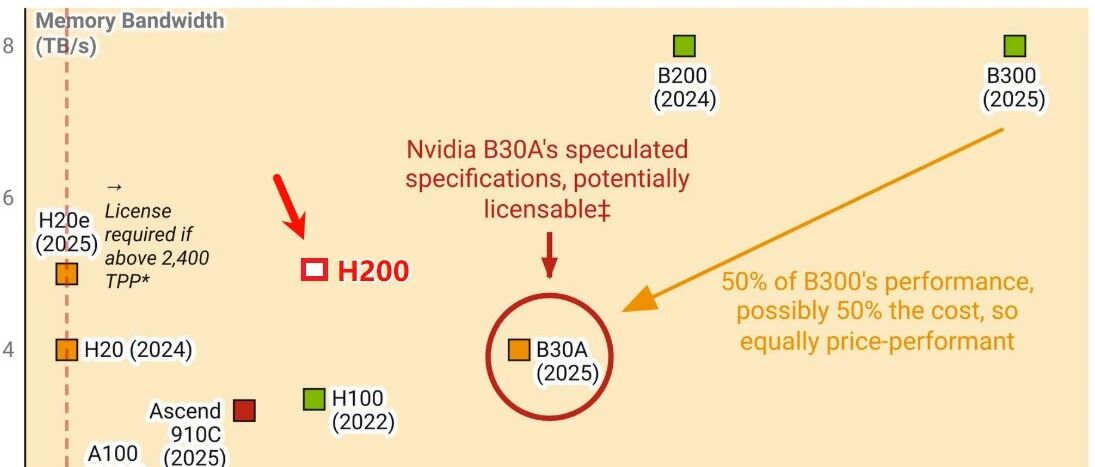
Core Viewpoint - The article discusses the potential release of the H200 GPU in China, highlighting the ongoing discussions and uncertainties surrounding this issue, as well as the implications for the domestic AI chip market [1][3][22]. Summary by Sections H200 GPU Specifications - The H200 GPU features significant improvements over the H100, including 141 GB of HBM3e memory and a memory bandwidth of 4.8 TB/s, compared to the H100's 80 GB and 3.35 TB/s [10][11]. Market Context and Usage - The H200's performance is currently superior to domestic AI chips, and its potential release could impact the Chinese market significantly. The article notes that the H200 is already widely used in overseas cloud services, with high utilization rates due to legacy workloads [13][20]. Pricing and Demand - In terms of rental pricing, the H200 is priced at $3.50 per GPU-hour, slightly lower than the B200 at $5.50, but higher than the H100 at $2.95. This pricing reflects its suitability for high-precision computing tasks [15][18]. Supply Chain Insights - The article provides insights into NVIDIA's domestic supply chain, detailing various companies involved in the production and supply of components related to liquid cooling and power supplies for GPUs [23][24]. Conclusion on Release Potential - The article concludes that if the U.S. does indeed release the H200, it is likely that China would follow suit, indicating a potential shift in the domestic AI chip landscape [22].


Gemini 3 发布后的几点思考
傅里叶的猫· 2025-11-21 10:52
Core Insights - The latest generation of AI models has significantly improved in reasoning capabilities and multi-modal understanding, making them more effective for complex tasks [5][6] - The pricing strategy of Google has shifted towards premium pricing for top-tier capabilities, contrasting with OpenAI's cost-cutting approach [7][8] - There remains a notable gap between domestic and international models, particularly in multi-modal capabilities, which may take 6-12 months to bridge [9] Group 1: Model Capabilities - The new generation of AI models excels in long-chain reasoning and multi-modal tasks, reducing hallucinations and improving coding capabilities [5] - Tools focused on coding, like Cursor, face significant pressure due to the advanced capabilities of Gemini 3, which outperforms in quality and speed [6] Group 2: Pricing and Market Strategy - Google's pricing has increased due to the higher computational costs associated with advanced reasoning and multi-modal capabilities, as opposed to a strategy of subsidizing market entry [7] - The company aims to monetize through advertising, subscription services, and enterprise solutions, leveraging its existing account systems for consumer tools [10] Group 3: Domestic vs. International Models - While text-based capabilities are nearing parity, significant gaps remain in dynamic interaction and 3D cognition, primarily due to differences in computational power and training experience [9] - For basic tasks, domestic models are sufficient, but for advanced applications like real-time UI and complex video understanding, international models like Gemini or Claude are still necessary [11]

AI的庞氏骗局?
傅里叶的猫· 2025-11-21 10:52
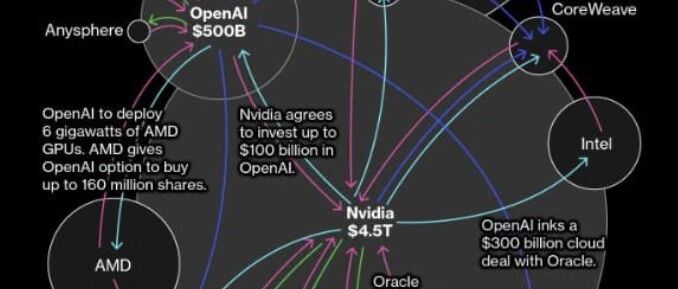
Core Insights - The article presents a bearish narrative on Nvidia, suggesting it exhibits signs of a Ponzi scheme due to alarming financial anomalies and unsustainable business practices [1][9]. Receivables Anomaly - Nvidia's accounts receivable surged by 89% to $33.4 billion, with Days Sales Outstanding (DSO) increasing from 46 to 53 days, indicating potential collection difficulties [2][3]. - The implication is that $10.4 billion may never be collected, a classic sign of financial distress [2]. Inventory Paradox - Inventory rose by 32% to $19.8 billion within three months, contradicting claims of high demand and sold-out capacity [2]. - The price of H100 rental dropped by 34% from $3.20 to $2.12 per hour, challenging the narrative of endless demand [2]. Cash Flow Signal - Nvidia's free cash flow conversion rate is only 75%, with a $4.8 billion gap between profits and actual cash flow, significantly lower than competitors like TSMC and AMD [3]. - This discrepancy suggests a façade of profitability while cash inflow remains weak [3]. Circular Financing Structure - The article details a complex flow of funds among Nvidia, Microsoft, OpenAI, and others, indicating a cycle where revenue is counted multiple times, creating an illusion of growth [3]. - CoreWeave alone owes Nvidia $5.9 billion, representing 18% of total receivables, contributing to a false sense of prosperity [3]. "Vibe Revenue" Admission - Executives from various AI companies reportedly acknowledge that current AI revenues are largely based on hype rather than actual product sales [6]. - OpenAI's projected revenue of $3.7 billion in 2025 against expenditures of $9.3 billion highlights a significant financial imbalance [6]. Historical Precedent - The article draws parallels between the current AI bubble and past financial frauds, such as the 2000 internet bubble and the Enron scandal, suggesting a similar trajectory for Nvidia [6]. Margin Compression Evidence - Despite Nvidia's reported gross margin of over 70%, the true margin is declining when accounting for one-time credits and increased competition [7]. - Future margins are expected to drop below 50%, undermining the company's valuation model [7]. Smart Money Exit - Notable investors, including Peter Thiel and SoftBank's Masayoshi Son, have recently sold significant Nvidia shares, indicating a lack of confidence in the stock [7]. - Major hedge funds have also established short positions following the earnings report [7]. Contagion Mechanism - The article warns that a decline in Nvidia's stock could trigger forced liquidations of Bitcoin collateralized loans, potentially leading to a significant drop in Bitcoin prices [7]. Regulatory Response - Anticipation of regulatory scrutiny from the SEC and Federal Reserve regarding circular financing and related transactions, which could result in mandatory restatements and penalties [8]. Conclusion - The article concludes that the current situation represents a significant financial bubble, with predictions of a market correction occurring between February and April 2026 [8].
英伟达预期中的“超预期”
傅里叶的猫· 2025-11-20 00:12
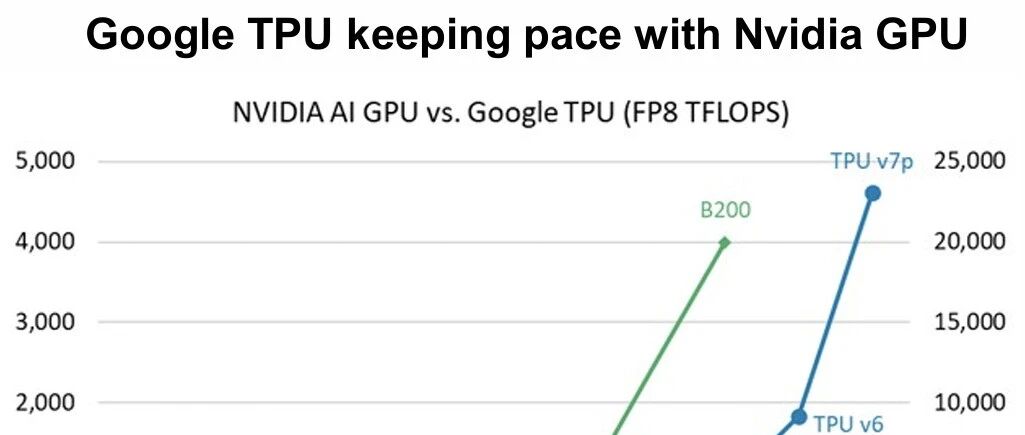
过去十个季度,英伟达就没让市场失望过,每次业绩都比分析师预期的好,这种习惯性超预期已经 成了支撑它股价的关键。 下面两个图分别是Q3业绩统计以及Q4业绩指引: 而这次业不例外:英伟达公布营收 570 亿美元,远高于市场普遍预期的 554 亿美元。毛利率 73.6%,略低于市场预期的 73.7% 。营业利润率 66.2%,略高于市场预期的 66.0%。营业每股收益 1.30 美元,高于市场预期的 1.26 美元。 写在英伟达业绩前、谷歌十年磨一剑 具体的业务来看: 对英伟达来说,这份财报不只是披露业绩,更要回应大家对 AI 泡沫的担心。 数据中心营收 512 亿美元,远高于市场预期的 497 亿美元。 游戏业务营收 43 亿美元,高于市场预期的 45 亿美元。 专业可视化业务营收 7.6 亿美元,远超市场预期的 6.19 亿美元。 汽车业务营收 5.92 亿美元,低于市场预期的 6.33 亿美元。 目前外网关于NV的这次财报的讨论,基本都是下面这种.. 第三季度游戏业务营收 33 亿美元,环比增长 14%,同比增长 15%。 庆祝全球首款 GPU——GeForce® 256 发布 25 周年,该产品为游戏行业带 ...

硅光CPO破局之道:2025第二届光电合封CPO及硅光集成大会12月重磅启幕!
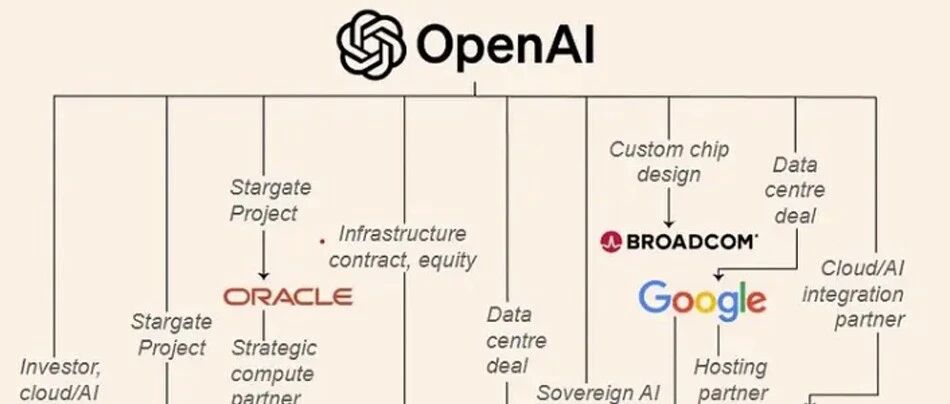
傅里叶的猫· 2025-11-19 14:56
Core Insights - Silicon photonics technology is rapidly reshaping the global information industry landscape, becoming a core development direction in optoelectronic technology due to its high integration, low cost, and large-scale manufacturing advantages [2] - The surge in procurement of 800G/1.6T optical modules by North American cloud giants is driving the demand for silicon photonics and Co-Packaged Optics (CPO) technology, which can significantly reduce power consumption by 30%-40% [2] - A conference on CPO and silicon photonics integration will be held on December 11-12 in Wuxi, Jiangsu, focusing on collaborative innovation in the industry-academia-research ecosystem [2] Conference Overview - The conference will feature discussions on key topics such as silicon chip design optimization, breakthroughs in CPO packaging yield, innovations in liquid cooling management, and the evolution of OIO technology [2] - Various companies will present their insights, including market forecasts for the CPO market from 2025 to 2030, and advancements in optical interconnect technologies for AI and quantum computing [5][6] Participating Companies and Topics - Notable participants include LightCounting, NVIDIA, Cisco, and TSMC, discussing topics ranging from CPO market analysis to high-speed optical signal transmission technologies [5][6] - Roundtable discussions will address challenges and opportunities in the CPO ecosystem, including overcoming memory wall limitations and exploring CPO applications in 6G networks [8][10] Event Format - The event will utilize a combination of keynote speeches, technical demonstrations, roundtable forums, and closed-door seminars to facilitate in-depth discussions on technological trends, market challenges, and innovative applications in the CPO and silicon photonics sectors [14]

写在英伟达业绩前、谷歌十年磨一剑
傅里叶的猫· 2025-11-19 14:56
Core Insights - The article highlights the impressive performance of Google's Gemini 3, which has received positive evaluations across various benchmarks, outperforming competitors like Claude Sonnet 4.5 and GPT-5.1 in multiple dimensions [1][3] Benchmark Performance - Gemini 3 Pro achieved significant scores in various benchmarks, such as: - 91.9% in scientific knowledge without tools [1] - 95.0% in mathematics without tools [1] - 100% in mathematics with code execution [1] - 87.6% in knowledge acquisition from videos [1] - 72.7% in screen understanding [1] - The model's performance in complex reasoning tasks showcases its superiority in high-difficulty scenarios, indicating a breakthrough in AI capabilities [4][3] Technological Advancements - The advancements in Gemini 3 are attributed to improvements in pre-training and post-training methodologies [3] - The model was trained using Google's own TPU, which is a strategic advantage over NVIDIA's GPUs, potentially impacting NVIDIA's market position negatively [7][8] Cost Efficiency - Training costs using TPU V7 are reported to be only half of that of NVIDIA's B200, highlighting a significant cost advantage for Google [8][12] - The article emphasizes that the performance improvements are based on substantial computational power, suggesting that scaling laws still have room for growth [15] NVIDIA's Market Outlook - NVIDIA has consistently exceeded market expectations, with forecasts for Q3 revenue ranging from $555.56 billion to $567 billion, driven by sustained AI demand [17][19] - The company is expected to maintain high gross margins, with estimates around 73.5% to 74% for Q3, despite rising component costs [22][24] Competitive Landscape - NVIDIA faces competition from AMD's MI300 and in-house chip developments by major cloud providers like Google and Amazon, which could impact its market share [26] - The article notes that while NVIDIA's software ecosystem remains a stronghold, the emergence of alternative solutions may challenge its pricing power [26] AI Capital Expenditure Trends - Global AI capital expenditure is projected to reach $204.6 billion by 2026, with a significant increase in enterprise adoption of generative AI expected [27][28] - The demand for AI infrastructure is anticipated to support NVIDIA's growth, even if some startups reduce their GPU purchases [28]
AI投资回报率大比拼:字节12%、阿里19.2%、腾讯7.1% VS 微软23%、谷歌26.3%、亚马逊6.4%
傅里叶的猫· 2025-11-17 13:04
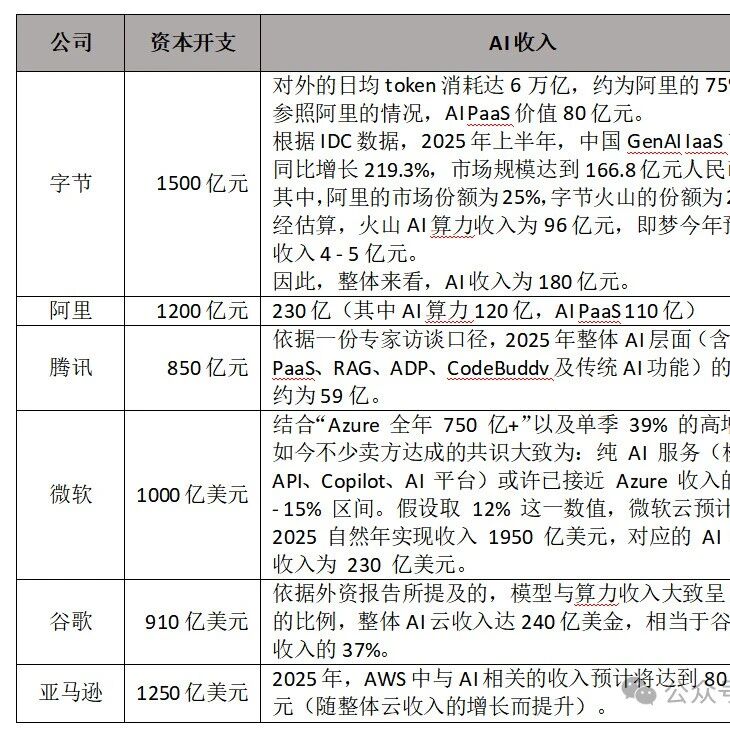
Core Viewpoint - The article discusses the investment return rates of major AI companies in China and abroad, questioning whether the current AI hype is a bubble based on the relationship between investment and output [2]. Group 1: Measurement Methodology - The calculation method involves dividing the projected AI-related revenue for 2025 (primarily from cloud services) by the current year's capital expenditure (Capex) based on market median estimates [4]. Group 2: Domestic and International Comparison - Alibaba's AI cloud revenue for 2025 is expected to reach 23 billion yuan, with a breakdown of 12 billion yuan from AI computing power and 11 billion yuan from AI PaaS, against a projected Capex of 120 billion yuan, resulting in a return rate of 19.2% [6]. - ByteDance's capital expenditure is 150 billion yuan, with an estimated AI revenue of 18 billion yuan, leading to a return rate of 12% [7]. - Tencent's projected AI revenue is approximately 5.9 billion yuan, with a Capex of 85 billion yuan, resulting in a return rate of 7.1% [7]. - Microsoft has a Capex of 100 billion USD, with an estimated AI revenue of 23 billion USD, yielding a return rate of 23% [7]. - Google's AI cloud revenue is projected at 24 billion USD, with a return rate of 26.3% [7]. - Amazon's AI-related revenue is expected to grow alongside overall cloud revenue, with a Capex of 125 billion USD [7]. Group 3: Conclusion - There is a significant gap in investment return rates between domestic companies and their international counterparts, with overseas giants achieving substantial revenue from external markets despite higher investment costs [8]. - Domestic companies face challenges in achieving external profitability, primarily using AI for internal purposes, while U.S. giants maintain a competitive advantage in revenue-to-investment ratios [9].



从英伟达转向谷歌?液冷产业出海信息更新
傅里叶的猫· 2025-11-17 13:04
Group 1: Nvidia vs Google - Nvidia is expected to report its earnings soon, with market sentiment indicating that only results exceeding expectations will be considered normal, while meeting expectations would be viewed negatively [2] - Notable investors like Masayoshi Son and Peter Thiel have sold their entire holdings in Nvidia, which is relatively minor compared to Nvidia's market capitalization of 4.6 trillion [4] - Discussions around an AI bubble are increasing, with significant investments like the $1.4 trillion from Altman raising concerns about the sustainability of the AI industry's growth [5][6] - OpenAI's role is critical in the AI ecosystem, and any issues it faces could impact the entire sector's valuation, leading to the notion that "OpenAI is too big to fail" [9][10] - In contrast, there is growing confidence in Google, with data suggesting that Google is expected to dominate the AI model market by the end of 2025, holding an 86% market share compared to competitors [11][12] Group 2: Liquid Cooling Industry - The liquid cooling market is projected to be worth hundreds of billions, with key players like Invec and others making significant strides in North America [15] - Invec's 2026 data center and energy storage business is expected to generate substantial orders, with Nvidia and Google being major clients [16] - Companies like Shiquan New Materials and Kexin New Source are also expanding their operations in the liquid cooling sector, with plans to secure direct supply orders from major tech firms [18][19]
巴菲特看上谷歌什么了?谷歌国内供应商梳理
傅里叶的猫· 2025-11-15 05:43
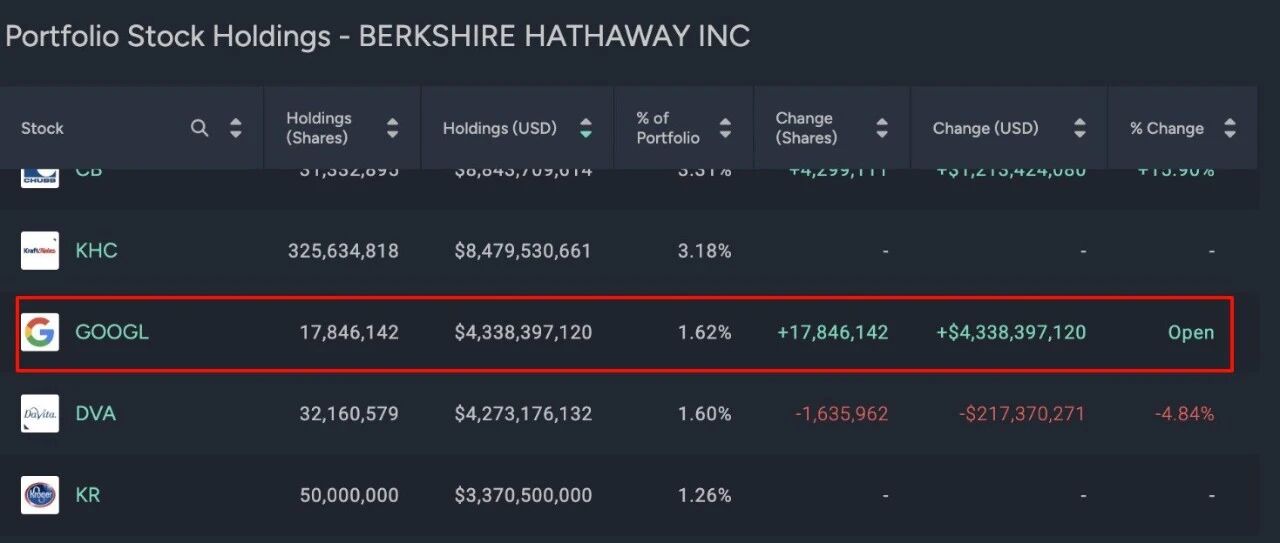
Core Insights - Warren Buffett's Berkshire Hathaway has made a rare investment in Google, increasing its stake by $4.3 billion while reducing holdings in Apple and eliminating DHI [1][2] - Google is investing $40 billion in Texas to build three new data centers, indicating strong confidence in its cash flow and AI capabilities [3][4] Group 1: Google AI Development - Google is one of the few companies with a clear plan to monetize AI, possessing data, proprietary chips, and models, making it a unique player in the AI landscape [4] - The AI-driven search revolution is expected to lead to gradual growth, with Google projecting search revenue growth of approximately 12% and 9% for 2025 and 2026, respectively [7] - Google's search business faces challenges from competitors like OpenAI's GPT series, raising concerns about the retention of commercial queries and long-term revenue [8] Group 2: Cloud Services and Growth Potential - Google Cloud Platform (GCP) is seen as an undervalued asset, with the potential for accelerated growth driven by innovations like the Gemini model and TPU [9] - GCP is projected to grow by approximately 31% to 36% by 2026, with optimistic scenarios suggesting even higher growth if TPU deployment exceeds expectations [10] - The adoption of Gemini has seen significant growth, with 9 million developers utilizing the platform and a notable increase in monthly active users [12] Group 3: Strategic Partnerships - Google has formed significant partnerships, including an $80 billion deal with Anthropic for AI chips, which is expected to generate incremental revenue for Google Cloud [15] - A collaboration with OpenAI allows OpenAI to utilize Google Cloud for model training, diversifying its infrastructure dependencies [15] - The partnership with Oracle enhances access to advanced models like Gemini 2.5, supporting digital transformation across various industries [16] Group 4: Supply Chain and Hardware Developments - Key suppliers for Google include Inveck for liquid cooling solutions and Zhongji Xuchuang for optical modules, both of which are critical for Google's data center operations [18][21] - Google is expected to significantly increase its OCS (Optical Circuit Switch) equipment shipments, with suppliers like Tengjing Technology providing essential optical components [23] - The company is also working with PCB suppliers like SNDL and HDGF to support the production of high-layer PCBs for TPU chips [24]

微软 AI 战略深度分析
傅里叶的猫· 2025-11-14 10:25
Core Insights - Microsoft, a leader in the AI industry from 2023 to 2024, paused its AI strategy due to concerns over return on investment (ROIC) and execution capabilities, but plans to reinvest in AI by 2025 as demand surges [3][10][19] Group 1: AI Strategy and Market Dynamics - Microsoft significantly increased its investment in OpenAI from $1 billion to $10 billion in early 2023, gaining exclusive access to OpenAI's models [3][11] - The company initiated an aggressive data center expansion plan to support OpenAI's computational needs, including a large-scale project named Fairwater [13][14] - By mid-2024, Microsoft faced a slowdown in data center construction and a shift in its commitment to OpenAI, leading to a strategic pause in its AI investments [5][19] Group 2: Competitive Landscape - In 2025, as global AI applications exploded, Microsoft resumed its AI investments, driven by a surge in demand for accelerated computing [7][19] - OpenAI diversified its partnerships, signing contracts with Oracle, Amazon, and Google, which diminished Microsoft's exclusive supply advantage [9][17] - Microsoft's market share in data center pre-leasing capacity dropped from over 60% to below 25% during the pause, indicating a loss of competitive edge [19] Group 3: Infrastructure and Execution Challenges - Microsoft encountered significant delays in its IaaS (Infrastructure as a Service) layer, particularly in the deployment of bare metal services, which are critical for AI training [20][21] - The company’s inability to meet OpenAI's growing computational demands led to the loss of key contracts, including a $100 billion project originally planned for Wisconsin [23][24] - Microsoft’s reliance on third-party cloud providers increased, with Neocloud's share of Microsoft's new computing capacity rising to nearly 50% [25][26] Group 4: PaaS Layer and Resource Allocation - Microsoft faced challenges in GPU resource allocation, prioritizing high-end GPUs for OpenAI and traditional enterprises, leaving AI startups with insufficient access [29][30] - The Azure platform's performance ratings declined due to stagnation in updates and features compared to competitors like CoreWeave [31][32] - Microsoft’s Azure Foundry aims to capture OpenAI API market share, leveraging its IP rights, but faces challenges in converting token usage into revenue [33][34] Group 5: Model and Application Development - Microsoft’s strategy involves leveraging OpenAI's IP while developing its own MAI models to reduce dependency [41][42] - The MAI series has seen rapid investment growth, with plans to increase annual spending to $16 billion, aiming for model independence [45] - GitHub Copilot, once a market leader, faces competition from new entrants, prompting Microsoft to integrate additional models to retain users [46][49] Group 6: Hardware and Chip Development - Microsoft’s self-developed ASIC chips, particularly the Maia series, have lagged behind competitors, impacting its hardware strategy [56][57] - The Maia 100 chip, released in late 2023, failed to meet industry standards, leading to delays in subsequent models [56][57] - Microsoft's strategic approach of synchronizing chip development with model readiness has resulted in missed opportunities compared to competitors who adopt asynchronous development [57]