
HANG LUNG PPT(00101)

Search documents
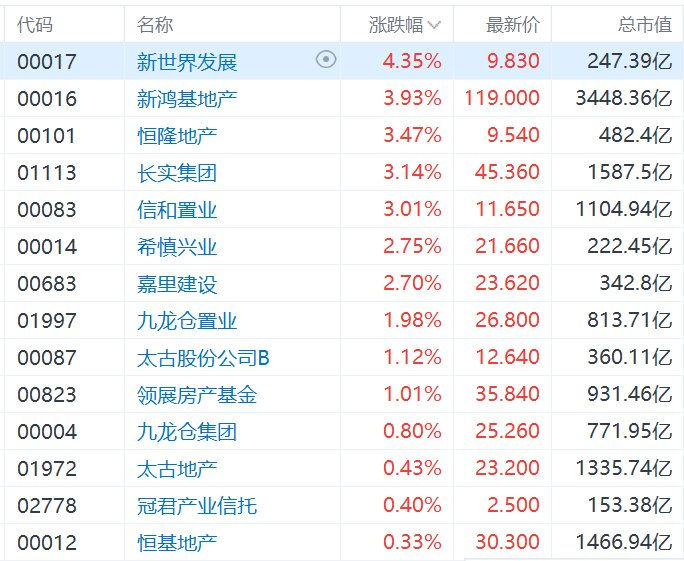
香港本地地产股集体收涨,新鸿基地产创历史新高
Ge Long Hui A P P· 2026-01-26 09:30
Group 1 - Hong Kong local property stocks collectively rose today, with New World Development increasing by over 4%, and other companies like Sun Hung Kai Properties, Hang Lung Properties, Cheung Kong Property, and Sino Land rising by over 3% [1] - Notably, Sun Hung Kai Properties reached a historical high [1] Group 2 - New World Development's latest price is 9.830, with a market capitalization of 24.739 billion [2] - Sun Hung Kai Properties' latest price is 119.000, with a market capitalization of 344.836 billion [2] - Hang Lung Properties' latest price is 9.540, with a market capitalization of 48.24 billion [2] - Cheung Kong Property's latest price is 45.360, with a market capitalization of 158.75 billion [2] - Sino Land's latest price is 11.650, with a market capitalization of 110.494 billion [2] - Hysan Development's latest price is 21.660, with a market capitalization of 22.245 billion [2] - Kerry Properties' latest price is 23.620, with a market capitalization of 34.28 billion [2] - Kowloon Development's latest price is 26.800, with a market capitalization of 81.371 billion [2] - Swire Properties B's latest price is 12.640, with a market capitalization of 36.011 billion [2] - Link Real Estate Investment Trust's latest price is 35.840, with a market capitalization of 93.146 billion [2] - Kowloon Warehouse Group's latest price is 25.260, with a market capitalization of 77.195 billion [2] - Swire Properties' latest price is 23.200, with a market capitalization of 133.574 billion [2] - Champion REIT's latest price is 2.500, with a market capitalization of 15.338 billion [2] - Henderson Land's latest price is 30.300, with a market capitalization of 146.694 billion [2]






大行评级|花旗:投资者对香港地产持正面态度,看好新鸿基地产、恒隆地产等
Ge Long Hui· 2026-01-26 02:16
Group 1 - Investors have a positive outlook on Hong Kong real estate, prioritizing real estate developers, Central office buildings, and luxury retail, while non-essential retail is disappointing [1] - There is an expectation that property prices will enter an upward cycle this year, with a significant increase of 5% to 10% anticipated [1] - Investors are optimistic about Central office buildings but have a lukewarm view on the retail sector, focusing on companies like Sun Hung Kai Properties, Hongkong Land, Hang Lung Properties, and Swire Properties [1]
小摩:料地产股下财年盈利大机会反弹 发展商偏好信和置业
Zhi Tong Cai Jing· 2026-01-21 07:42
Group 1 - Morgan Stanley reports that the earnings season for Hong Kong real estate stocks will begin at the end of January [1] - The bank expects most companies' profits to continue declining, with limited impact from the improvement in the Hong Kong residential market on the fiscal year 2025 statements [1] - The upcoming earnings reports may represent a low point for most companies, with a significant chance of profit rebound in the next fiscal year [1] Group 2 - Preferred stocks in the rental sector (shopping malls/office buildings) include Hang Lung Properties (00101) and Swire Properties (01972) [1] - For developers, the preference is for Sino Land Company (00083) [1] - The bank is also optimistic about the Land Development Company but suggests waiting for a better entry point [1]

小摩:料地产股下财年盈利大机会反弹 发展商偏好信和置业(00083)
智通财经网· 2026-01-21 07:38
Core Viewpoint - Morgan Stanley's report indicates that while the earnings of most Hong Kong real estate stocks are expected to continue declining, the upcoming earnings announcements may represent a low point for many companies, with a significant chance of earnings rebound in the next fiscal year [1] Group 1: Earnings Outlook - The earnings season for Hong Kong real estate stocks is set to begin at the end of January [1] - The impact of the improvement in the Hong Kong residential market on the fiscal year 2025 financial statements is expected to be limited [1] - Most companies are anticipated to report continued earnings decline [1] Group 2: Preferred Stocks - For rental stocks (shopping malls/office buildings), the preferred choices are Hang Lung Properties (00101) and Swire Properties (01972) [1] - For developers, the preferred stock is Sino Land Company (00083) [1] - The report also expresses a positive outlook on the Land Development Company but suggests waiting for a better entry point [1]
大行评级|小摩:香港收租股潜在上行空间更大,首选恒隆地产和太古地产
Ge Long Hui· 2026-01-20 02:15
Core Viewpoint - Morgan Stanley believes that the market has priced in the stable recovery of the Hong Kong property market over the next two years, as several Hong Kong real estate stocks have reached or are close to historical highs [1] Group 1: Market Analysis - The potential upside for rental stocks is greater, as improvements in their commercial real estate businesses have not yet been fully reflected in stock prices, with most stock prices still over 30% lower than their peaks [1] Group 2: Stock Recommendations - The preferred stocks are Hang Lung Properties and Swire Properties, due to the continuous improvement in their retail businesses in mainland China [1] - Kowloon Development could become a dark horse if management expresses a more positive outlook on tenant sales during the earnings release in March [1] - Among developers, the preference is for Sino Land and Henderson Land, but the overall recommendation is to wait for a better entry point [1]
房地产1-12月月报:投资和销售两端承压,政策面积极因素在积累-20260120
Shenwan Hongyuan Securities· 2026-01-20 02:07
Investment Rating - The report maintains a "Positive" rating for the real estate sector, focusing on high-quality real estate companies and commercial real estate [3][4][21]. Core Insights - The investment side of the real estate sector remains weak, with a year-on-year decline of 17.2% in total real estate development investment for 2025, and a significant drop of 35.8% in December alone [4][21]. - The sales side shows a narrowing decline in sales area, with a year-on-year decrease of 8.7% for 2025, and a 15.6% drop in December [22][32]. - The funding side indicates a continued decline in funding sources, with a 13.4% year-on-year decrease in total funding for real estate development in 2025, and a sharp 26.7% drop in December [37]. Summary by Sections Investment Side - Total real estate development investment for 2025 reached 828.8 billion yuan, down 17.2% year-on-year, with December's investment declining by 35.8% [4][21]. - New construction area decreased by 20.4% year-on-year, with December showing a 19.4% decline [20][21]. - The report adjusts 2026 forecasts, predicting a 7.7% decline in new construction and a 9.1% drop in investment [21]. Sales Side - The total sales area for 2025 was 880 million square meters, down 8.7% year-on-year, with December's sales area declining by 15.6% [22][32]. - The total sales revenue for 2025 was 8.4 trillion yuan, reflecting a 12.6% year-on-year decrease, with December's sales revenue down 23.6% [24][32]. - The average selling price of commercial housing for 2025 was 9,527 yuan per square meter, down 4.3% year-on-year [31][32]. Funding Side - Total funding sources for real estate development in 2025 amounted to 9.3 trillion yuan, a decrease of 13.4% year-on-year, with December's funding sources down 26.7% [37]. - Domestic loans saw a year-on-year decline of 7.3%, with a significant drop of 45% in December [37]. - The report anticipates that funding sources will gradually improve due to ongoing policy relaxations [37].



中金:恒隆地产(00101)经营延续积极态势 业绩边际企稳向好
智通财经网· 2026-01-19 07:17
Core Viewpoint - CICC forecasts that the retail sales growth of Hang Lung Properties (00101) in mainland China will continue to recover throughout the year, leading to a narrowing of the decline in property leasing income, which fell by 3% year-on-year in the interim [1] Group 1: Financial Performance - The expected year-on-year decline in basic net profit attributable to shareholders for the full year is projected to narrow to 4%, compared to a 9% decline in the interim [1] - The total annual dividend per share is expected to be 52 Hong Kong cents, consistent with 2024, with 12 Hong Kong cents already distributed in the interim [1] Group 2: Target Price and Ratings - CICC maintains a "outperform" rating for the group and raises the target price by 10% to HKD 10.4, reflecting a 17 times price-to-earnings ratio for 2026, a 5% dividend yield, and a 10% upside potential [1] Group 3: Profit Forecast Adjustments - The profit forecasts for 2025 and 2026 have been reduced by 3% and 4% to HKD 2.97 billion and HKD 3.04 billion, respectively, reflecting a 4% year-on-year decline and a 2% increase [1] - The introduction of the 2027 profit forecast is set at HKD 3.04 billion, remaining flat compared to 2026 [1] Group 4: Future Performance Outlook - If considering the adjusted capitalized interest for property leasing basic net profit, the company's operating performance and dividend capacity are expected to continue to recover at a single-digit percentage annual rate starting from 2026 [1]
中金:恒隆地产经营延续积极态势 业绩边际企稳向好
Zhi Tong Cai Jing· 2026-01-19 07:16
Core Viewpoint - CICC forecasts that the retail sales growth of Hang Lung Properties (00101) in mainland China will continue to recover throughout the year, leading to a narrowing of the decline in property leasing income, which fell by 3% year-on-year in the interim [1] Group 1: Financial Performance - The expected year-on-year decline in basic net profit attributable to shareholders for the full year is projected to narrow to 4%, compared to a 9% decline in the interim [1] - CICC has adjusted the target price upward by 10% to HKD 10.4, reflecting a 17 times price-to-earnings ratio for 2026 and a 5% dividend yield, indicating a 10% upside potential [1] - The forecasts for basic net profit attributable to shareholders for 2025 and 2026 have been reduced by 3% and 4% to HKD 2.97 billion and HKD 3.04 billion, respectively, reflecting a 4% year-on-year decline and a 2% increase [1] Group 2: Dividend and Capitalization - The company is expected to declare a total annual dividend of HKD 0.52 per share, maintaining the same level as in 2024, with HKD 0.12 already distributed in the interim [1] - If considering the adjusted capitalized interest for property leasing basic net profit, the company's operating performance and dividend capacity are expected to continue to recover at a single-digit percentage annual rate starting from 2026 [1]
研报掘金|中金:上调恒隆地产目标价至10.4港元,维持“跑赢行业”评级
Ge Long Hui· 2026-01-19 06:37
Core Viewpoint - CICC forecasts that the retail sales growth of Hang Lung Properties' mainland shopping malls will continue to recover throughout the year, leading to a narrowing of the decline in property leasing income, which is expected to decrease by 3% year-on-year in the mid-term [1] Group 1: Financial Performance - The expected year-on-year decline in the basic net profit attributable to shareholders is projected to narrow to 4% for the full year, compared to a 9% decline in the mid-term [1] - The total expected dividend per share for the year is 52 Hong Kong cents, with an interim dividend of 12 Hong Kong cents already distributed, maintaining the same level for 2024 [1] Group 2: Market Outlook - CICC maintains a "outperform the industry" rating for the group and raises the target price by 10% to HKD 10.4, reflecting a 17 times price-to-earnings ratio for 2026, a 5% dividend yield, and a 10% upside potential [1] - The adjustments in the target price primarily reflect changes in market risk appetite [1]
小摩:料香港收租股上行空间潜力更大 首选恒隆地产(00101)和太古地产
智通财经网· 2026-01-19 02:13
Core Viewpoint - The report from JPMorgan indicates that several brokerages have raised their forecasts for Hong Kong's property price growth to between 5% and 10%, contributing to an 11% rise in Hong Kong real estate stocks this year, outperforming the Hang Seng Index by 6% [1] Group 1: Market Analysis - The market appears to have priced in a solid recovery in Hong Kong's property market over the next two years, as many companies' stock prices have reached or are close to historical highs [1] - There is greater potential upside for rental stocks, as improvements in their commercial real estate businesses have not yet been fully reflected in stock prices, with most still trading over 30% below peak levels [1] Group 2: Stock Recommendations - JPMorgan's top picks include Hang Lung Properties (00101) and Swire Properties (01972), due to their ongoing improvements in retail operations in mainland China [1] - Kowloon Development (01997) could emerge as a dark horse if management expresses a more positive outlook on tenant sales during the earnings release in March [1] - Among developers, the preference is for Sino Land (00083) and Henderson Land (00012), but the overall recommendation is to wait for better entry points [1]