
GEELY AUTO(00175)

Search documents
早报|影石CEO回应年会送房送车/12306新增「低人一等座」提醒/OpenAI发布新模型,用英伟达对手芯片
Sou Hu Cai Jing· 2026-02-13 01:43
Group 1 - The State Administration for Market Regulation opposes manufacturers engaging in "involution" and selling cars at a loss, aiming to promote healthy competition in the automotive market [3] - The newly released guidelines clarify the boundaries of pricing behavior in the automotive industry, encouraging compliance and fair competition among manufacturers and sellers [3] - The guidelines specify that automotive manufacturers must not engage in pricing behaviors that aim to eliminate competitors or monopolize the market, which poses significant legal risks [3] Group 2 - OpenAI announced the release of a new real-time programming model, GPT-5.3-Codex-Spark, which is a more compact version of GPT-5.3-Codex, optimized for low-latency hardware [5][7] - The Codex-Spark model can generate over 1000 tokens per second and is currently available as a research preview for ChatGPT Pro users [5][7] - The model operates on Cerebras' Wafer Scale Engine 3, which features 40 trillion transistors and 900,000 AI cores, providing extremely low latency [7] Group 3 - Multiple automotive companies, including Geely, Chery, and BYD, have disclosed their plans for solid-state battery technology, with Geely aiming for small-scale production by 2027 and a long-term goal of mass production by 2030 [18][19][20] - Chery plans to start pilot production of solid-state batteries by 2026 and aims to validate the technology in real vehicles by 2027 [20] - BYD is focusing on sulfide solid-state batteries, expecting to achieve small-scale production by 2027 [23] Group 4 - Meizu's smartphone business is reportedly facing dissolution, with the Meizu 23 project allegedly halted [25][26] - The company has not officially responded to the rumors, and customer service has stated that no notifications regarding the business's status have been received [26] Group 5 - ByteDance is set to release the upgraded Doubao model on February 14, 2026, which will include significant enhancements to its foundational model capabilities [34][35] - The Doubao 2.0 model is expected to be a multimodal model with 1 trillion parameters, marking a substantial advancement in the company's AI capabilities [35] Group 6 - Xiaomi has launched its first-generation robot VLA model, which features 4.7 billion parameters and excels in visual language understanding and real-time execution capabilities [39][42] - The model has achieved state-of-the-art results in various benchmarks and is designed for high efficiency in real-world tasks [42] Group 7 - Lenovo reported a 72% year-on-year increase in AI-related revenue, which now accounts for 32% of the company's total revenue, driven by growth in AI PCs, smartphones, and servers [32][36] - The company has successfully navigated challenges in the global AI supply chain, maintaining its commitment to double-digit revenue growth and profitability [32]







全固态电池产业化,迈入关键验证期
DT新材料· 2026-02-12 16:04
Core Viewpoint - The solid-state battery industry is advancing rapidly, with multiple companies outlining their technological paths and industrial plans for commercialization by 2026 and beyond [1][2][3]. Group 1: Company Developments - Geely has established three technological routes for solid-state batteries, focusing on polymer, sulfide, and halide composite solutions, with a goal to launch prototype vehicles by 2026 and achieve small-scale production by 2027 [1]. - Chery plans to produce a 0.5GWh pilot line and commence continuous production of 60Ah solid-state battery cells by 2026, with vehicle demonstration work starting in 2027 [2]. - China FAW has successfully developed a prototype of its Hongqi solid-state battery, achieving significant breakthroughs in key performance metrics [2]. - BYD is focusing on sulfide solid-state batteries, aiming for small-scale production by 2027, while Sunwoda has announced plans for mass production of solid-state batteries by the same year [2]. Group 2: Policy and Industry Standards - The development of national standards for solid-state batteries is underway, with a draft expected to be completed by December 2025 and formal publication planned for July 2026 [3]. - The Ministry of Industry and Information Technology emphasizes enhancing the self-controllable capabilities of the supply chain and accelerating breakthroughs in core technologies, including solid-state batteries [3]. Group 3: Industry Challenges and Future Outlook - Despite the promising outlook for solid-state batteries, challenges remain, including unclear material systems and engineering difficulties that could impact safety and lifespan [4]. - The industry is expected to evolve from semi-solid to small-scale and then to mid-to-high-end solid-state battery production between 2026 and 2030, with potential risks related to technology iteration and raw material supply [4].
比亚迪、吉利竞购日产-奔驰墨西哥汽车工厂
Xin Lang Cai Jing· 2026-02-12 12:42
Core Viewpoint - BYD and Geely are among the final bidders for the Nissan-Benz factory in Mexico, with VinFast also making the shortlist [1] Group 1: Bidders - The final bidders include BYD, Geely, and VinFast [1] - Other companies that previously expressed interest include Chery and Great Wall Motors [1] - None of the companies, including BYD, Geely, Chery, Great Wall, and VinFast, have commented on the bidding process [1]
传比亚迪、吉利等多家国产车企竞购日产奔驰墨西哥汽车工厂,官方暂无回应
Xin Lang Ke Ji· 2026-02-12 12:07
Group 1 - BYD and Geely are reportedly bidding for the Nissan-Benz automotive plant in Mexico, with Chery and Great Wall Motors also expressing interest in the acquisition [1] - The plant is scheduled to close in May 2026, and BYD has been identified as a leading potential buyer since late last year [1] - The acquisition could leverage the benefits of the USMCA agreement, allowing localized production to avoid high tariffs in the US [1]

全固态电池产业化,迈入关键验证期
财联社· 2026-02-12 12:06
Core Viewpoint - The solid-state battery industry is advancing rapidly, with multiple companies outlining their technological paths and industrial plans for commercialization by 2026 and beyond [1][2][3]. Group 1: Company Developments - Geely has established three technological routes for solid-state batteries, focusing on polymer, sulfide, and halide composite solutions, with a goal to launch prototype vehicles by 2026 and achieve small-scale production by 2027 [1]. - Chery plans to produce a 0.5GWh pilot line and commence continuous production of 60Ah solid-state cells by 2026, with vehicle demonstration work starting in 2027 [2]. - FAW's Hongqi brand has successfully developed a solid-state battery prototype, achieving significant breakthroughs in key areas such as sulfide electrolyte performance and cell testing [2]. - BYD is focusing on sulfide solid-state batteries, aiming for small-scale production by 2027, while Sunwoda has already achieved mass production of its first and second-generation semi-solid batteries [2]. Group 2: Policy and Standards - The development of national standards for solid-state batteries is underway, with a draft expected to be completed by December 2025 and formal publication planned for July 2026 [3]. - The Ministry of Industry and Information Technology emphasizes enhancing the self-controllability of the supply chain and accelerating breakthroughs in core technologies, including solid-state batteries [3]. Group 3: Industry Challenges and Future Directions - Despite the recognized potential of solid-state batteries, challenges remain, including unclear material systems and engineering difficulties that could affect safety and lifespan [4]. - The domestic solid-state battery market is expected to evolve from semi-solid scale production to small-scale full solid-state production and then to mid-to-high-end large-scale production between 2026 and 2030 [4].
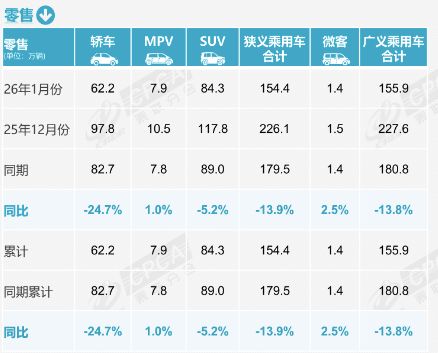
1月我国乘用车零售销量约154.4万辆 乘联分会:预期内的短期波动,不代表长期走势
Mei Ri Jing Ji Xin Wen· 2026-02-12 12:05
Core Viewpoint - The retail sales of passenger cars in China experienced a significant decline in January 2026, with a total of approximately 1.544 million units sold, representing a year-on-year decrease of 13.9% [1][2]. Retail Performance - In January 2026, retail sales for different vehicle categories were as follows: sedans at 622,000 units (down 24.7%), MPVs at 79,000 units (up 1.0%), SUVs at 843,000 units (down 5.2%), and microvans at 14,000 units (up 2.5%) [2]. - The total retail sales for narrow passenger vehicles were 1.544 million units, down 13.9% compared to the same month last year [2]. Market Analysis - The decline in the passenger car market is viewed as a short-term fluctuation rather than a long-term trend, attributed to the expiration of the new energy vehicle purchase tax exemption policy at the end of 2025 [3]. - The market is expected to face a low point in February 2026 due to the post-holiday consumption slowdown, which may help alleviate retail inventory pressure [3]. Brand Performance - In January 2026, retail sales for domestic brands were 890,000 units (down 18%), while mainstream joint venture brands sold 470,000 units (down 4%), and luxury vehicles sold 180,000 units (down 15%) [4]. - Major domestic brands like Geely, BYD, Changan, and Chery saw significant declines in retail sales, with Geely down 12.6%, BYD down 53%, Changan down 33.5%, and Chery down 41% [4][6]. Joint Venture Brands - Joint venture brands showed relatively stable performance, with FAW-Volkswagen down 3.5%, SAIC Volkswagen down 9.3%, and BMW Brilliance down 3.9% [6]. - Some joint venture brands, such as FAW Toyota and GAC Toyota, experienced year-on-year growth of 8.3% and 0.3%, respectively [6]. New Energy Vehicle Market - In January 2026, retail sales of new energy vehicles (NEVs) were 596,000 units, down 20% year-on-year, while wholesale sales were 864,000 units, down 3.3% [9]. - The A00-class pure electric vehicle segment saw a drastic decline, with wholesale sales dropping 62%, significantly impacting the overall performance of the new energy vehicle market [11]. Export Performance - New energy vehicles have become a major force in China's passenger car exports, with 139,000 units exported in January 2026, marking a year-on-year increase of 29.4% [13]. - The export of pure electric vehicles accounted for 66% of new energy vehicle exports, with A0 and A00-class vehicles making up 38% of the total new energy vehicle export volume [13]. Future Outlook - The market is expected to enter a recovery phase in February 2026, driven by the gradual implementation of vehicle replacement policies [16]. - However, rising costs due to increased prices of raw materials like lithium and copper may pressure automakers, potentially leading to cautious consumer behavior and affecting demand [16].

Exclusive-Seeking Mexico foothold, China's BYD and Geely bid to buy car plant
Yahoo Finance· 2026-02-12 11:07
Core Viewpoint - Chinese automakers, particularly BYD and Geely, are competing to acquire a Nissan–Mercedes-Benz plant in Mexico, indicating a significant shift in the Mexican automotive industry as they seek to establish a manufacturing presence amid U.S. tariffs impacting local factories [1][3]. Group 1: Chinese Automakers' Interest - BYD and Geely are among the finalists for the acquisition of the plant, alongside Vietnamese electric vehicle maker VinFast, emerging from a pool of nine interested companies [1][2]. - Other notable Chinese manufacturers expressing interest include Chery and Great Wall Motor, highlighting a broader trend of Chinese investment in the Mexican automotive sector [2]. Group 2: Market Dynamics - The interest from Chinese automakers marks a potential transformation in Mexico's car industry, which has historically been dominated by U.S., European, and Japanese manufacturers focused on vehicles for the U.S. market [3]. - Chinese automakers have increased their market share in Mexico from zero in 2020 to approximately 10% last year, with annual car sales in Mexico around 1.5 million [6]. Group 3: Economic Implications - The Mexican government is in a challenging position, as U.S. tariffs are negatively affecting the local auto sector, while Chinese investments could create essential jobs [4]. - However, there are concerns that increased Chinese production in Mexico could provoke tensions with the U.S. and complicate ongoing North American trade negotiations [4]. Group 4: Growth of Chinese Auto Industry - The ambitions of BYD and Geely reflect the rapid global expansion of China's auto industry, with BYD's vehicle sales increasing ten-fold since 2020 and Geely's sales doubling, both selling over 4 million vehicles last year [5]. - The collective market share of Chinese automakers in Mexico has significantly risen, indicating their growing influence in the region [6].
吉利汽车(00175.HK)2月12日耗资2792.75万港元回购165.6万股
Ge Long Hui· 2026-02-12 08:55
Group 1 - The core point of the article is that Geely Automobile announced a share buyback plan, spending HKD 27.9275 million to repurchase 1.656 million shares at a price range of HKD 16.77 to 17.04 per share [1]
吉利汽车2月12日斥资2792.75万港元回购165.6万股
Zhi Tong Cai Jing· 2026-02-12 08:46
Group 1 - The company, Geely Automobile (00175), announced a share buyback plan on February 12, 2026, involving an expenditure of HKD 27.9275 million to repurchase 1.656 million shares [1]
吉利汽车(00175)2月12日斥资2792.75万港元回购165.6万股
智通财经网· 2026-02-12 08:45
智通财经APP讯,吉利汽车(00175)发布公告,于2026年2月12日,该公司斥资2792.75万港元回购165.6万 股。 ...