
GEELY AUTO(00175)

Search documents
吉利汽车(00175) - 翌日披露报表
2026-02-12 08:37
FF305 翌日披露報表 (股份發行人 ── 已發行股份或庫存股份變動、股份購回及/或在場内出售庫存股份) 表格類別: 股票 狀態: 新提交 如上市發行人的已發行股份或庫存股份出現變動而須根據《香港聯合交易所有限公司(「香港聯交所」)證券上市規則》(「《主板上市規則》」)第13.25A條 / 《香港聯合交易所有限公司GEM證券 上市規則》(「《GEM上市規則》」)第17.27A條作出披露,必須填妥第一章節 。 | 第一章節 | | | | | | | | | --- | --- | --- | --- | --- | --- | --- | --- | | 1. 股份分類 | 普通股 | 股份類別 | 不適用 | | 於香港聯交所上市 | 是 | | | 證券代號 (如上市) | 00175 | 說明 | | | | | | | 多櫃檯證券代號 | 80175 | RMB 說明 | | | | | | | A. 已發行股份或庫存股份變動 | | | | | | | | | | | | 已發行股份(不包括庫存股份)變動 | | 庫存股份變動 | | | | 事件 | | 已發行股份(不包括庫存股份)數 目 | ...
汽车和汽车零部件行业周报20260208:地补出台+需求见底,建议关注汽车板块
Guolian Minsheng Securities· 2026-02-12 07:45
Investment Rating - The report maintains a "Buy" rating for the automotive sector [3] Core Insights - The automotive sector is expected to stabilize and recover due to the introduction of local subsidies for vehicle replacement and the upcoming launch of new models after the Spring Festival [2][12] - The report highlights key investment opportunities in various segments, including passenger vehicles, automotive parts, and motorcycles, with specific company recommendations [2][19][34] Summary by Sections 1. Passenger Vehicles - The introduction of the 2026 vehicle replacement subsidy is expected to stimulate domestic demand positively [14] - The subsidy structure will improve the model mix, with new energy vehicles receiving 12% of the vehicle price as a subsidy (up to 20,000 yuan) and fuel vehicles receiving 10% (up to 15,000 yuan) [15][16] - Recommended companies include Geely, Xpeng, and BYD, with a focus on the left side of the demand bottom [2][19] 2. Automotive Parts - The report emphasizes the growth potential in the automotive parts sector, particularly in intelligent driving and new energy vehicle supply chains [19][23] - Recommended companies include Bertel, Horizon Robotics, and Top Group, focusing on the H and T chains [2][19] 3. Motorcycles - The report suggests a focus on mid-to-large displacement motorcycle manufacturers, with companies like Chunfeng Power and Longxin General recommended [31][34] - The market for mid-to-large displacement motorcycles is expected to expand, driven by supply and export efforts from leading manufacturers [34] 4. Commercial Vehicles - The heavy truck market is projected to recover due to the continuation of the vehicle replacement subsidy policy, with recommendations for Weichai Power and China National Heavy Duty Truck [35][36] 5. Tires - The tire industry is expected to benefit from ongoing globalization and the optimization of production structures, with recommendations for Sailun Tire and Senqilin [37][39]



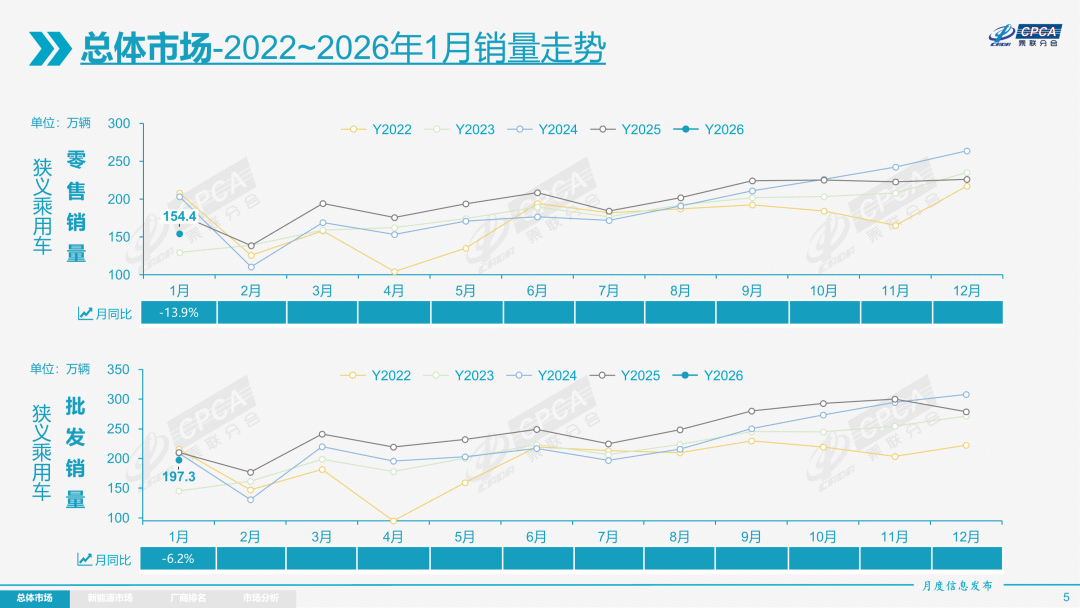
乘联分会:1 月全国乘用车市场零售 154.4 万辆,同比下降 13.9%
Xin Lang Cai Jing· 2026-02-12 07:27
Core Viewpoint - In January, the retail sales of passenger cars in China reached 1.544 million units, representing a year-on-year decline of 13.9% [1][7]. Group 1: Market Performance - The January retail sales decline is part of a historical trend where January sales have shown significant fluctuations, with previous years experiencing similar declines [3][9]. - The penetration rate of new energy vehicles (NEVs) in the overall passenger car market was 38.6%, down 3 percentage points from the previous year [3][9]. - Among domestic retail sales, the penetration rate of NEVs for independent brands was 61.7%, while luxury brands had a penetration rate of 16.1%, and mainstream joint venture brands only reached 4.3% [3][9]. Group 2: New Energy Vehicle Sales - In January, the retail share of NEVs for independent brands was 60.1%, a decrease of 12 percentage points year-on-year, while the share for mainstream joint venture brands increased to 3.9%, up 2 percentage points [3][9]. - The new forces in the market, including brands like Xpeng, Leap Motor, and Xiaomi, saw their share increase by 10 percentage points year-on-year, reaching 31.2% [3][9]. - Tesla's market share fell to 3.1%, a decrease of 1.5 percentage points compared to the previous year [3][9]. Group 3: Export Performance - In January, NEV exports reached 286,000 units, marking a year-on-year increase of 103.6%, accounting for 49.6% of total passenger car exports, up 12.5 percentage points from the previous year [4][10]. - Pure electric vehicles constituted 65% of NEV exports, while A00 and A0 class pure electric vehicles made up 50% of pure electric exports [4][10]. - The growth of NEV exports is attributed to the increasing recognition of Chinese brands in international markets, despite some external challenges [4][10]. Group 4: Manufacturer Performance - Leading manufacturers in NEV exports for January included BYD (96,859 units), Tesla China (50,644 units), and Geely (32,117 units) [5][11]. - The overall performance of NEV manufacturers remained strong, with 16 companies achieving monthly wholesale sales exceeding 10,000 units, accounting for 90.3% of total NEV sales [6][12]. - BYD led the market with 205,518 units sold, followed by Geely (124,252 units) and Tesla China (69,129 units) [6][12]. Group 5: Market Outlook - The outlook for February indicates a potential decline in sales due to the shorter effective production and sales time caused by the extended Spring Festival holiday [7][13]. - The rising costs of raw materials, driven by increased demand for electric power storage, are putting pressure on manufacturers [7][13]. - The anticipated decrease in promotional capabilities for NEV manufacturers may lead to a cautious consumer sentiment, potentially suppressing normal car purchase demand in the short term [7][13].


乘联分会:1月全国乘用车市场零售154.4万辆 新能源车渗透率为38.6%
智通财经网· 2026-02-12 06:41
Core Insights - The overall retail sales of passenger cars in January decreased by 13.9% year-on-year, with a total of 1.544 million units sold. The retail sales of new energy vehicles (NEVs) reached 596,000 units, representing a penetration rate of 38.6%, down 3 percentage points from the previous year [1][11]. Retail Market Overview - In January, the retail sales of self-owned fuel passenger cars were 250,000 units, up 17% year-on-year, while self-owned NEVs sold 226,000 units, marking a significant increase of 115%. NEVs accounted for 47.5% of self-owned exports, indicating growing international influence [2]. - The retail sales of self-owned brands totaled 890,000 units, down 18% year-on-year, with a domestic market share of 57.5%, a decrease of 3.5 percentage points [2]. - Mainstream joint venture brands sold 470,000 units, down 4% year-on-year, with German brands increasing their market share to 19.8%, up 1.4 percentage points [2]. Production and Wholesale Analysis - In January, the production of passenger cars was 2.003 million units, down 4.4% year-on-year. The wholesale volume was 1.973 million units, a decrease of 6.2% year-on-year [4]. - The wholesale of self-owned brands was 1.326 million units, down 8%, while luxury car wholesale increased by 4% to 228,000 units [4]. - The overall wholesale landscape is changing, with some mid-tier companies showing strong performance, such as SAIC-GM-Wuling and NIO [4]. New Energy Vehicle Insights - The production of NEVs reached 938,000 units, a slight decrease of 0.6% year-on-year, while wholesale sales were 864,000 units, down 3.3% [5][6]. - NEV retail sales were 596,000 units, down 20% year-on-year, with conventional fuel vehicles selling 948,000 units, down 10% [7]. - NEV exports reached 286,000 units, a remarkable increase of 103.6%, accounting for 49.6% of total passenger car exports [11][12]. Market Trends and Future Outlook - The new energy vehicle market is expected to face challenges in February due to the impact of the Spring Festival, which may lead to lower sales volumes [16]. - The transition from merely selling cars to exporting entire industrial chains is anticipated, indicating a shift towards quality growth in the automotive export sector [17].



【月度分析】2026年1月份全国乘用车市场分析
乘联分会· 2026-02-12 06:06
Overall Market - In January 2026, the retail sales of passenger cars reached 1.544 million units, a year-on-year decrease of 13.9% [14] - The decline in retail sales is attributed to complex market factors and a historical pattern of fluctuating sales in January [14] - The end of the new energy vehicle purchase tax exemption in December 2025 has led to a recovery period for the new energy vehicle market, with some consumers having made purchases in December to take advantage of the policy [14] - January 2026 saw a significant increase in exports, with passenger car exports reaching 576,000 units, a year-on-year increase of 52.0% [16] - The production of passenger cars in January 2026 was 2.003 million units, a year-on-year decrease of 4.4% [16] - The wholesale volume for January 2026 was 1.973 million units, a year-on-year decrease of 6.2% [17] New Energy Market - In January 2026, retail sales of new energy vehicles (NEVs) totaled 596,000 units, down 20.0% year-on-year [18] - The penetration rate of NEVs in the domestic market was 38.6%, while the export penetration rate was 49.6% [15] - The production of NEVs reached 938,000 units, a slight decrease of 0.6% year-on-year [18] - The wholesale volume of NEVs was 864,000 units, down 3.3% year-on-year [18] - The export of NEVs reached 286,000 units, a significant increase of 103.6% year-on-year, accounting for 49.6% of total passenger car exports [22] Company Performance - BYD, Geely, and Chery are leading in the new energy vehicle market, with BYD's sales reaching 205,518 units in January 2026 [24] - The market share of domestic brands in the new energy sector is increasing, with a notable rise in the export of new energy vehicles to Europe and Southeast Asia [15][22] - The new energy vehicle market is characterized by a shift towards higher quality products, with an increase in the proportion of high-end NEVs [15] Market Outlook - February 2026 is expected to see lower sales due to the shorter working days caused by the extended Spring Festival holiday [27] - The market is anticipated to stabilize post-holiday, with potential recovery in the entry-level electric vehicle segment [28] - The overall sentiment in the consumer market remains cautious, influenced by high costs and economic factors [28]



1月车市燃油车销量“抬头”多款车型价格降幅高于30%
Mei Ri Jing Ji Xin Wen· 2026-02-12 02:35
Core Viewpoint - The domestic automotive market is witnessing a shift as fuel vehicles are increasingly adopting intelligent features to compete with electric vehicles, driven by consumer demand for smart driving capabilities and the rising market share of electric vehicles [1][5]. Group 1: Market Trends - Consumers are showing a preference for fuel vehicles equipped with advanced intelligent configurations, leading to a notable change in purchasing behavior [1]. - The new Honda Fit, dubbed the "people's supercar," sold out its initial 3,000 units within 20 days, indicating a strong demand for competitively priced fuel vehicles [2]. - Many fuel vehicle models have seen price reductions of 30% to 40%, with some luxury models experiencing even greater discounts [2][3]. Group 2: Sales Performance - In January, fuel vehicle sales showed significant growth, with SAIC Group selling 242,000 units, a year-on-year increase of 19.19% [6]. - Geely's fuel vehicle sales reached 134,400 units in January, with over 100,000 units coming from the "Chinese Star" series [6]. - GAC Toyota also reported positive sales growth in January, with the Camry model achieving a 17% year-on-year increase [6]. Group 3: Strategic Initiatives - The "Oil-Electricity Co-Intelligence" strategy has been adopted by major automakers, aiming to enhance the competitiveness of fuel vehicles by integrating smart technologies [5][6]. - Companies like FAW-Volkswagen plan to launch multiple new models equipped with intelligent cockpit and driving assistance systems by 2026, showcasing the potential for fuel vehicles to be equally intelligent [6][7]. - The top five brands in the fuel vehicle market have increased their market share from 29% in 2020 to 37% in 2025, indicating a strengthening of leading brands in the sector [7].

港股开盘:恒指跌0.2%、科指跌0.47%,AI应用及芯片股走高,锂电池概念股活跃,科网股普遍回调
Jin Rong Jie· 2026-02-12 01:33
Market Overview - The Hong Kong stock market opened slightly lower, with the Hang Seng Index down 0.2% at 27,210.56 points, the Hang Seng Tech Index down 0.47% at 5,474.25 points, and the National Enterprises Index down 0.19% at 9,250.27 points [1] - Major tech stocks mostly opened lower, with Alibaba down 1.37%, Tencent down 2.01%, and Meituan down 2.48%, while AI application stocks showed strength, with Zhihui up 8.77% and MINIMAX-WP up 5.65% [1] Company Performance - NetEase reported strong performance, with a net revenue of approximately 112.63 billion yuan, a year-on-year increase of 6.96%, and a net profit of approximately 33.76 billion yuan, up 13.68% [2] - NetEase Cloud Music saw a significant profit increase of 75.4%, with a revenue of 7.76 billion yuan and a profit of 2.75 billion yuan, confirming a turning point in performance [2] Industry Trends - The hard technology and manufacturing sectors showed signs of recovery, with Qiu Tai Technology reporting a 22.8% year-on-year increase in camera module sales and an 18.4% increase in fingerprint recognition module sales, driven by demand in IoT and smart automotive sectors [3] - The renewable energy sector also saw growth, with China Resources Power reporting a 28.4% year-on-year increase in electricity sales, and solar power sales soaring by 72.3% [3] Biopharmaceutical Sector - The biopharmaceutical sector experienced significant positive developments, with Rebio Biotech announcing a global exclusive licensing agreement worth up to 4.4 billion USD, leading to a substantial increase in stock price [4] - Heng Rui Pharmaceutical's product was included in a breakthrough therapy list, with projected global sales exceeding 6.5 billion USD in 2024 [4] Capital Market Activity - Industrial capital is actively engaging in buybacks to stabilize the market, with Geely Automobile repurchasing shares worth approximately 20.30 million HKD and other companies like Kingsoft and Bai Rong Cloud also participating in buybacks [5] - Huili Group is expected to see a profit increase of over 20 times in 2025, indicating a strong performance reversal [5] Institutional Insights - There is a divergence in institutional views regarding market fluctuations, with some suggesting that the recent pullback is a liquidity shock, while others believe that valuation recovery is nearly complete [6] - Specific sectors like AI computing and surgical robots are highlighted for potential growth, with expectations for high performance in 2025 and 2026 [6]

极氪销量目标仅完成81%再战年销70万 电池存热失控隐患主动召回3.8万辆车
Chang Jiang Shang Bao· 2026-02-12 00:05
Core Viewpoint - Zeekr has initiated its first-ever recall, affecting 38,277 units of the Zeekr 001 WE model due to potential safety hazards related to high-voltage battery components [1][3][4] Group 1: Recall Details - The recall involves vehicles produced between July 8, 2021, and March 18, 2024, due to manufacturing consistency issues in high-voltage battery components, which may lead to increased internal resistance and potential thermal runaway [1][3] - Zeekr will provide free battery assembly replacements for affected vehicles and implement a cloud-based early warning system to alert users of potential issues [3][4] Group 2: Sales Performance and Targets - In 2025, Zeekr's sales target was set at 320,000 units, but the actual sales reached 574,600 units, achieving approximately 81% of the target, with a year-on-year growth of 13.21% [2][10] - For 2026, the sales target for Zeekr is set at 300,000 units, while the Lynk brand aims for 400,000 units, totaling 700,000 units [2][10] Group 3: Legal and Financial Context - The recall is linked to a legal dispute between Geely and A123 Systems, with Geely seeking compensation of 2.314 billion yuan due to quality issues with battery cells supplied by A123 [5][6] - A settlement agreement was reached, with A123 expected to pay Geely 608 million yuan for costs incurred up to December 31, 2025 [6] Group 4: Corporate Strategy - Zeekr is a joint investment by Geely Auto and Geely Holding Group, and in 2022, it exceeded its delivery target by delivering 71,900 units [7] - The company aims to enhance operational efficiency and resource utilization through the integration of Zeekr as a wholly-owned subsidiary of Geely, following a privatization transaction completed in December 2025 [11][12][13]
挺进极寒禁区,中国新能源车企的「北极远征」
36氪· 2026-02-11 13:35
Core Viewpoint - The article emphasizes that Geely Galaxy has successfully completed a comprehensive winter testing journey in extreme conditions, showcasing its engineering capabilities and readiness for global markets, particularly in harsh environments [1][10][27]. Group 1: Winter Testing Significance - Geely Galaxy's winter testing is the first of its kind in the automotive industry, involving a full range of vehicle types and powertrains, including electric, hybrid, and hydrogen vehicles [1]. - The testing aims to determine whether Chinese electric vehicles can reliably perform in the world's most challenging environments, rather than just measuring their ability to withstand low temperatures [1][10]. - The extreme conditions of the Nordic winter serve as a "variable amplifier," testing the vehicle's systems under multiple simultaneous challenges, which cannot be replicated in domestic testing environments [6][10]. Group 2: Engineering and Testing Methodology - The article critiques the automotive industry's trend of prioritizing front-end technology narratives over essential backend engineering capabilities, leading to insufficient real-world testing [5][10]. - Geely's approach combines virtual simulations with real-world testing, focusing on the most complex scenarios to ensure safety and reliability [19]. - The company has established a global testing network, with plans to create 16 testing bases worldwide, enhancing its ability to develop and validate products across various conditions [15][26]. Group 3: Market Strategy and Growth - Geely Galaxy's sales reached 1,235,807 units in 2025, marking a 150% year-on-year increase, with continued momentum into 2026 [12]. - The growth is attributed to a diverse product lineup and a strong foundation in reliability, safety, and consistency, rather than relying on a single blockbuster model [13][21]. - Geely's strategy emphasizes building a global brand through engineering excellence, with a focus on long-term reliability and performance in various markets [22][27].
华润电力1月发电量同比增近3成 丘钛科技1月摄像模组出货量增约22%
Xin Lang Cai Jing· 2026-02-11 12:28
Company News - Q Technology (01478.HK) reported a total sales volume of camera modules of 44.071 million units in January, representing a year-on-year increase of 22.8%. Fingerprint recognition module sales reached 19.741 million units, up 18.4% year-on-year, driven by increased overseas customer demand and a growing market share in the IoT and smart automotive sectors [2] - China Resources Power (00836.HK) achieved a sales volume of 23.78879 million megawatt-hours in January, a year-on-year increase of 28.4%. The sales from wind power plants increased by 7.2%, while solar power plant sales surged by 72.3% year-on-year [2] - NetEase-S (09999.HK) projected net revenue of approximately 112.626 billion yuan for 2025, a year-on-year growth of 6.96%, with net profit expected to be around 33.76 billion yuan, up 13.68% [2] - NetEase Cloud Music (09899.HK) anticipates revenue of about 7.759 billion yuan in 2025, with an expected profit of approximately 2.746 billion yuan, reflecting a significant year-on-year growth of 75.4%. The gross margin is expected to reach 35.7%, an increase from 33.7% in 2024, attributed to business scale growth, enhanced monetization capabilities, prudent cost management, and operational leverage [2] - Huitian Group (00806.HK) expects to achieve a consolidated profit attributable to shareholders of approximately 660 million HKD for the fiscal year 2025, a substantial increase from 31 million HKD in the previous year [2] Biotech Developments - Reborn Bio-B (06938.HK) entered into an exclusive global licensing agreement with Madrigal for several siRNA assets, receiving an upfront payment of 60 million USD, with potential cumulative payments of up to 4.4 billion USD upon achieving certain development, regulatory, and commercialization milestones, in addition to potential royalties on net sales [3] - Fuhong Hanlin (02696.HK) completed the first patient dosing in a Phase 1b/2 clinical study of HLX43 in combination with HLX07 or Hansizhuang® for patients with advanced or metastatic colorectal cancer in China [3] - Heng Rui Medicine (01276.HK) announced that its injection of Rukang Trastuzumab has been included in the list of breakthrough therapies, with global sales of similar products expected to reach approximately 6.557 billion USD in 2024 [3] - Saint Bella (02508.HK) made significant progress in its global strategic expansion plan, aiming to extend its reach to the eastern United States, the UK, France, Thailand, and Australia [3] - China National Biotech Group (08247.HK) signed a strategic cooperation agreement with Xiaoshou Medical to jointly promote the enhancement of quality medical resources and grassroots medical service capabilities [3] Buyback Activities - Geely Automobile (00175.HK) repurchased 1.201 million shares at a cost of 20.3042 million HKD, with repurchase prices ranging from 16.67 to 17.08 HKD [4] - Bairong Cloud-W (06608.HK) repurchased 1.66 million shares for 18.9051 million HKD, with share prices between 11.11 and 11.43 HKD [5] - Kingsoft (03888.HK) repurchased 355,200 shares at a cost of 9.9963 million HKD, with repurchase prices ranging from 27.9 HKD to 28.2 HKD [5]

