
EB ENVIRONMENT(00257)

Search documents
格隆汇个股放量排行榜 | 7月5日


Ge Long Hui· 2025-07-05 09:43
Core Insights - The data indicates significant trading volume increases for various companies, suggesting heightened investor interest and potential market movements [1][2][3][4][5] Group 1: Companies with Notable Volume Increases - 阳光能源 (00757) reported a volume ratio of 2.35, indicating strong trading activity [2] - 长城汽车 (02333) had a volume ratio of 2.21, reflecting increased investor engagement [2] - 郑煤机 (00564) showed a volume ratio of 1.92, suggesting a notable rise in trading [2] Group 2: Additional Companies with Increased Trading Activity - 万国数据-SW (09698) recorded a volume ratio of 1.83, indicating significant market interest [2] - 映恩生物-B (09606) had a volume ratio of 1.78, reflecting heightened trading activity [2] - 超盈国际控股 (02111) reported a volume ratio of 1.71, suggesting increased investor focus [2] Group 3: Companies with Moderate Volume Ratios - 中国能源建设 (03996) had a volume ratio of 1.70, indicating a solid level of trading activity [2] - 亚信科技 (01675) reported a volume ratio of 1.60, reflecting moderate investor interest [2] - 金宝通 (00320) showed a volume ratio of 1.53, suggesting a rise in trading volume [2] Group 4: Companies with Lower Volume Ratios - 中国水务 (00855) had a volume ratio of 1.52, indicating stable trading activity [2] - 广汽集团 (02238) reported a volume ratio of 1.52, reflecting consistent investor engagement [2] - 凯莱英 (06821) showed a volume ratio of 1.52, suggesting steady trading interest [2]
这一板块持续活跃!002579涨停
Zheng Quan Ri Bao Zhi Sheng· 2025-06-19 07:42
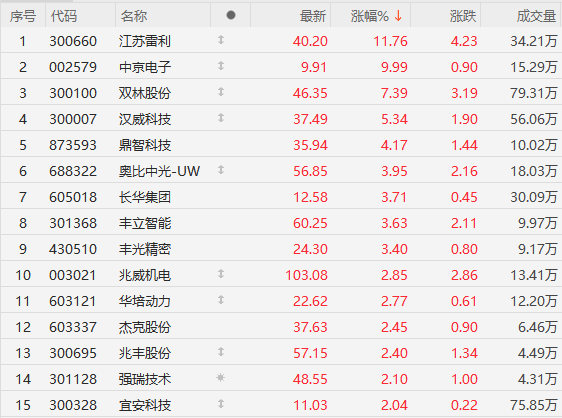
Group 1 - Human robot concept stocks surged on June 19, with notable gains in several companies, including Zhongjing Electronics, Jiangsu Leili, Shuanglin Co., and Hanwei Technology [1][2] - Jiangsu Leili's stock rose by 11.76% to 40.20, while Zhongjing Electronics hit the daily limit with a price of 9.91, reflecting a 9.99% increase [2] - The Ministry of Industry and Information Technology and the Ministry of Civil Affairs announced a pilot program for smart elderly care service robots, set to run from 2025 to 2027, requiring extensive application validations [1][2] Group 2 - The first professional exhibition for humanoid robots in China, the 2025 Hangzhou International Humanoid Robot and Robot Technology Exhibition, is set to take place, featuring major companies like Tesla [3] - Tesla's CEO Elon Musk revealed the development of the third-generation Optimus robot, expected to improve coordination and complex task execution, with a production target of 100,000 units next year [3] - China Mobile, in collaboration with partners, launched the world's first humanoid robot based on 5G-Advanced technology, enhancing connectivity and operational capabilities [3] Group 3 - Morgan Stanley predicts China's humanoid robot market will grow at a rate of 63% annually, from $300 million this year to $3.4 billion by 2030, with an expected 252,000 units by 2030 [4] - The report indicates that by 2050, China will have 302 million humanoid robots, accounting for 30% of the global total [4] - Analysts suggest that the humanoid robot sector is entering a golden cycle of technological breakthroughs, mass production, and market penetration, positioning it as a core investment theme by 2025 [5]




中国的垃圾,不够烧了
投资界· 2025-06-19 02:42
Core Viewpoint - The article discusses the transformation of waste management in China, highlighting the shift from a "garbage siege" to a situation where waste incineration plants are struggling to find enough waste to process, leading to a competitive environment for waste collection and management [3][10][20]. Group 1: Current State of Waste Incineration - Waste incineration plants in China are facing a shortage of waste, with an average operational load of about 60%, leaving 40% of capacity idle [7][11]. - In 2023, there were 83,467 planned shutdowns of waste incineration plants, indicating significant operational challenges [8]. - The number of waste incineration plants in China has reached approximately 1,010, accounting for nearly half of the global total [11][14]. Group 2: Historical Context and Development - The shift towards waste incineration began in 2003 when the government opened the sector to private investment and promoted the BOT model for waste-to-energy projects [14][15]. - From 2017 to 2021, China added an average of 103 new waste incineration plants annually, with significant projects launched in provinces like Henan and Hebei [15][17]. - By 2023, China's waste treatment capacity reached 1,035,000 tons per day, exceeding the targets set for the 14th Five-Year Plan [17][24]. Group 3: Industry Dynamics and Future Opportunities - The oversupply of incineration capacity has led to a decline in the number of landfills, as incineration becomes the preferred method of waste management [19][20]. - With domestic waste production insufficient to meet the needs of incineration plants, companies are exploring international markets, particularly in Southeast Asia and the Middle East [22][24]. - Chinese waste incineration companies are leveraging advanced technologies and complete industrial chains to enhance their competitiveness globally [23][24].

光大环境董事会主席王思联:绿色生产力引领环保产业高质量发展
Zhong Guo Huan Jing Bao· 2025-06-17 23:30
Core Viewpoint - The transformation and upgrade of the environmental protection industry are driven by green productivity, which is essential for achieving high-quality development and ecological governance [1][2][3]. Group 1: Industry Transformation - The environmental protection industry is undergoing a comprehensive transformation in positioning, logic, and connotation, moving beyond traditional end-of-pipe treatment to become a key player in promoting green transition [2][3]. - The strategic value of the environmental protection industry is reflected in three aspects: as a practical carrier for ecological civilization, a crucial support for economic transformation, and a strategic point for international competition [2][3]. Group 2: Economic and Policy Environment - The environmental protection industry is entering a golden period of innovation and upgrade, with annual revenue expected to exceed 2.2 trillion yuan by 2024, indicating significant scale benefits [4]. - A supportive policy environment is being established, with multiple ministries collaborating to enhance technological innovation in the ecological environment sector, providing financial and talent support for enterprises [5]. Group 3: Technological Advancements - New technologies and models are emerging, such as biogas production from organic waste and zero-carbon park solutions, which are facilitating the green transition of traditional manufacturing sectors [6]. - The industry has seen a rapid increase in R&D investment, with an average annual growth rate of 12% over the past five years, reaching over 80 billion yuan in 2023 [7]. Group 4: Talent Development - The environmental protection industry has seen a significant increase in workforce, with over 3.4 million employees by the end of 2024, indicating a growing talent pool [7]. - The structure of talent is improving, with a notable number of graduates entering the industry, enhancing the capacity for high-quality development [7]. Group 5: Collaborative Development - Developing green productivity requires a collaborative effort across society, with enterprises needing to enhance their role in market-driven innovation and actively participate in global environmental governance [8][9]. - A focus on common key technology breakthroughs is essential to reshape the technological system of the environmental protection industry, addressing new demands for pollution reduction and carbon neutrality [9].
研判2025!中国城市环保行业产业链、市场现状、竞争梯队及发展趋势分析:国内城市环保建设工程加速推进,行业规模加速扩容[图]
Chan Ye Xin Xi Wang· 2025-06-17 01:20
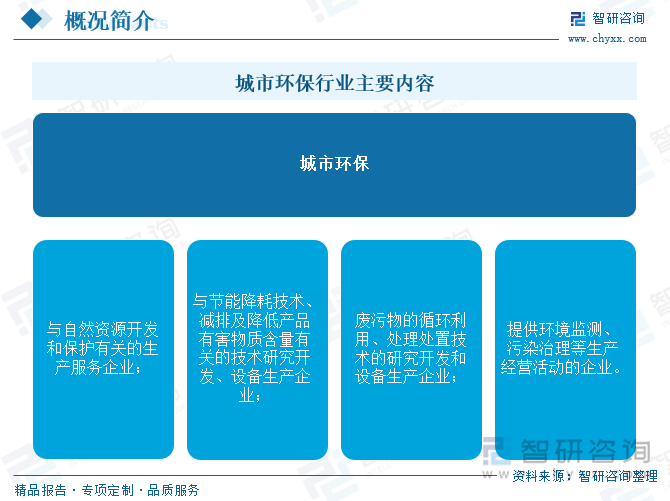
Industry Overview - The urban environmental protection industry focuses on solving urban environmental issues and improving ecological quality through technology and management measures [1][9] - The industry has seen significant growth, with the market size projected to increase from 1.01 trillion yuan in 2019 to 1.49 trillion yuan in 2024 [7][9] Industry Environment - Urban areas are densely populated and face severe environmental challenges, making urban environmental protection a priority for national development [5] - As of the end of 2023, there are 694 cities in China, with an urbanization rate of 67%, indicating ongoing urbanization and a growing demand for environmental services [5] Industry Status - The urban environmental protection industry is categorized into four segments: energy conservation and emission reduction (35.81%), pollution control (29.96%), recycling (20.91%), and natural resource protection (13.32%) [9] - Major companies in the industry include China Everbright Environment, Beijing Enterprises Water Group, and China Tianying, which are part of the leading competitive tier [11] Future Trends - Technological innovation is driving the industry towards smart environmental solutions, with advancements in IoT, AI, and big data enhancing operational efficiency [17] - Continuous policy support is expected to facilitate market reforms, with initiatives aimed at improving resource and environmental market mechanisms [18] - The international market is becoming increasingly important, with Chinese environmental companies expanding their presence in Southeast Asia and the Middle East [19]




中国垃圾,不够烧了
投中网· 2025-06-13 03:00
Core Viewpoint - The article discusses the transformation of waste management in China, highlighting the shift from a "garbage siege" to a situation where waste incineration plants are struggling to find enough garbage to process, leading to a competitive environment for waste collection and management [4][10][20]. Group 1: Industry Overview - Ten years ago, the issue of "garbage siege" was prevalent, but now it is widely recognized that there is not enough waste to incinerate in China [4][10]. - China has nearly half of the world's waste incineration plants, with over 1,010 facilities, making it the leader in waste incineration capacity globally [11][20]. - The average load rate of waste incineration plants in China is about 60%, indicating that 40% of capacity is underutilized [9]. Group 2: Market Dynamics - Waste incineration plants are resorting to extreme measures to secure waste, including paying kickbacks to property companies for waste collection [6]. - There is a trend of reopening landfills to excavate buried waste, with cities like Guangzhou and others participating in this underground competition [8]. - The number of planned shutdowns for waste incineration plants in 2023 reached 83,467 days, indicating significant operational challenges [9]. Group 3: Historical Context - The turning point for China's waste incineration industry was in 2003 when the government shifted to a model allowing private investment and operation [14]. - Policies promoting waste incineration have been introduced over the years, including increased subsidies for renewable energy projects and stricter pollution control standards [15][16]. - The rapid growth of waste incineration facilities has led to significant advancements in waste management technology and capacity [17][18]. Group 4: Future Opportunities - With domestic waste generation insufficient to meet the operational capacity of incineration plants, companies are looking abroad for opportunities [22]. - Chinese waste incineration companies have successfully established over 50 projects overseas, particularly in Southeast Asia and the Middle East [24]. - Advanced technologies developed in China for waste incineration, such as the FAST process for treating fly ash, are gaining international recognition and application [25].

中国垃圾,不够烧了
投中网· 2025-06-13 02:59
Core Viewpoint - The article discusses the transformation of the waste incineration industry in China, highlighting the shift from a "garbage siege" to a situation where there is insufficient waste to meet the operational capacity of incineration plants, leading to a competitive environment for waste collection and processing [4][15][33]. Group 1: Industry Overview - Ten years ago, the issue of "garbage siege" was prevalent, but now it is widely recognized that there is not enough waste to incinerate in China [4][15]. - The number of waste incineration plants in China has reached approximately 1,010, accounting for nearly half of the global total, with over 2,100 incineration plants worldwide [17][29]. - The average load rate of waste incineration plants in China is about 60%, indicating that 40% of capacity is underutilized [10][29]. Group 2: Market Dynamics - Waste incineration plants are competing fiercely for waste, with reports of facilities paying "introduction fees" to property companies for waste collection [5][9]. - Some cities are even reopening landfills to excavate buried waste, indicating a desperate need for more waste [7][8]. - The rapid increase in the number of incineration plants has led to a decline in the number of landfills, as incineration becomes the preferred method of waste management [31][33]. Group 3: Historical Context and Policy Impact - The shift in waste management policy began in 2003, transitioning from government responsibility to a model encouraging private investment through BOT (Build-Operate-Transfer) schemes [20][21]. - Various supportive policies have been introduced over the years, including increased subsidies for renewable energy projects and stricter pollution control standards, which have facilitated the growth of the waste incineration industry [21][22][29]. Group 4: Future Prospects and International Expansion - Despite achieving a 100% harmless treatment rate for waste, new incineration projects continue to emerge, with 55 new projects added in 2023 [30][29]. - As domestic waste generation declines, Chinese waste incineration companies are beginning to explore international markets, with over 50 projects established overseas, particularly in Southeast Asia and the Middle East [38][39]. - Chinese companies are leveraging their advanced technology and complete industrial chain to compete globally, transforming waste management into a profitable venture [40][43].

光大环境(00257.HK):垃圾焚烧龙头迎现金流拐点 分红提升可期
Ge Long Hui· 2025-06-11 02:48
Core Viewpoint - The company is a leader in waste incineration and is developing its water and biomass businesses, with a total waste-to-energy capacity of 150,400 tons/day by the end of 2024, ranking first in the industry [1] Group 1: Financial Performance - The company expects a net profit attributable to shareholders of HKD 3.377 billion in 2024, with contributions from the environmental energy, green environmental, and water sectors being HKD 2.924 billion, -HKD 290 million, and HKD 743 million respectively, accounting for 87%, -9%, and 22% of the total profit [1] - Operating and financial income will account for 79% of total revenue by the end of 2024, with core operational indicators improving steadily, including a waste incineration power generation of 328 kWh per ton and a capacity utilization rate of 103% [2] - The company’s financial costs are expected to decrease, with financing costs dropping by 50 basis points to 3.2% and interest-bearing liabilities reduced to HKD 91.7 billion, leading to a savings of HKD 521 million in financial expenses [2] Group 2: Cash Flow and Capital Expenditure - Capital expenditure (Capex) has significantly decreased from HKD 22.8 billion in 2021 to HKD 5.1 billion in 2024, as the industry matures [3] - The company’s free cash flow (FCF) has turned positive for the first time, reaching HKD 4.416 billion, with expectations for further improvement [3] - The annual national subsidies are approximately RMB 3.8 billion, with significant amounts expected to be received, which will enhance operational cash flow [3] Group 3: Dividend Policy - The company’s dividend yield is currently at 6%, with potential for increase, and the dividend payout ratio is expected to rise from 31% to 42% in 2024 [3] - The company plans to maintain a stable increase in dividends, with a projected dividend per share (DPS) of HKD 0.23 [3] Group 4: Investment Outlook - The company’s net profit attributable to shareholders is projected to be HKD 3.589 billion, HKD 3.810 billion, and HKD 4.055 billion for 2025-2027, respectively [4] - Based on a price-to-earnings (PE) ratio of 8x and considering the positive cash flow and dividend potential, the estimated market value of the company is HKD 28.71 billion, indicating a 23% upside [4]
光大环境(00257):垃圾焚烧龙头迎现金流拐点,分红提升可期
Shenwan Hongyuan Securities· 2025-06-09 13:04
Investment Rating - The report assigns a "Buy" rating for the company, marking its first coverage [2][7]. Core Insights - The company is a leader in waste incineration, with a significant cash flow turning point expected, leading to potential increases in dividends [6][7]. - The company has a total waste-to-energy capacity of 150,400 tons/day, ranking first in the industry, and is supported by its major shareholder, China Everbright Group, which holds 43.07% of the company [6][21]. - The report anticipates a recovery in profitability due to improved operational income, reduced impairment, and lower financial costs [6][54]. Summary by Sections Company Overview - The company has been focused on environmental protection for over 20 years, with a waste incineration capacity of 150,400 tons/day as of the end of 2024, leading the industry [17][28]. - The company operates in three main segments: Environmental Energy, Green Environmental Protection, and Water Services, with the Environmental Energy segment contributing 87% to the net profit in 2024 [6][24]. Financial Summary and Profit Forecast - The company’s revenue for 2024 is projected at HKD 30,258 million, with a year-on-year decline of 7%, and a net profit of HKD 3,377 million, down 24% year-on-year [5][54]. - The report forecasts net profits for 2025-2027 to be HKD 3,589 million, HKD 3,810 million, and HKD 4,055 million respectively, with a price-to-earnings ratio of 8x leading to a target market value of HKD 28,710 million, indicating a 23% upside potential [5][7]. Operational Improvements - The company has seen a significant reduction in capital expenditures (Capex), from HKD 22.8 billion in 2021 to HKD 5.1 billion in 2024, contributing to a positive free cash flow of HKD 4.416 billion for the first time [6][7]. - The operating cash flow is expected to improve due to accelerated national subsidies, with an adjusted operating cash flow of HKD 9.52 billion anticipated for 2024 [6][7]. Dividend Potential - The company has a current dividend yield of 6.04%, with a historical dividend payout ratio of approximately 31%, expected to increase to 42% in 2024 [6][7]. - The report suggests that with improving profits and cash flow, there is significant potential for future dividend increases [6][7]. Market Perception - The market has not fully recognized the company's potential for profit recovery and dividend increases, primarily due to the complexity of its financial statements [9][10].
光大环境20250603
2025-06-04 01:50
Summary of the Conference Call for Guangda Environment Industry Overview - Guangda Environment is the largest waste-to-energy operator in China, holding approximately 16% market share in 2023, significantly ahead of competitors [2][4] - The waste-to-energy sector is characterized by a land-grabbing nature, where early positioning in quality locations can yield higher electricity prices [10] Company Performance and Financials - The environmental energy segment contributed 52% of the company's revenue, 96% of EBITDA, and 97% of net profit in 2024, indicating it as the core profit source [2][4] - The company experienced a rapid capacity expansion from 2010 to 2020, with a capacity growth rate of 30%, particularly through the PPP model from 2016 to 2022 [2][7] - In 2024, operational revenue is expected to account for 64% of total revenue, with the energy and environmental segment contributing 61% [2][14] - The overall operational cash flow is approximately 8.9 billion HKD, with a pure cash flow of about 7 billion HKD [2][14] Cash Flow and Dividends - The waste-to-energy industry is projected to achieve positive free cash flow in 2024, improving from a negative 400 million HKD in 2023 to a positive 600 million HKD [3] - The dividend payout ratio has steadily increased to 34%, up by 7 percentage points year-on-year [3] - Long-term free cash flow is estimated at around 2 billion HKD, which exceeds the total dividends for 2024, indicating sustainability even without subsidies [15][18] Market Position and Competitive Advantage - Guangda Environment's single project capacity is approximately 900 tons per day, above the industry average, with a power generation efficiency of 330 kWh per ton, reflecting high operational efficiency and technological advantages [9] - The company maintains a strong market position in waste-to-energy, with a market share of 16%, while its wastewater treatment segment holds about 3% market share [6][4] Challenges and Future Outlook - The green environmental segment, including agricultural biomass power generation and hazardous waste treatment, faces challenges due to reduced demand and profitability [12][13] - The water business is expected to perform steadily, with a gross margin of about 42%, close to the industry average, benefiting from improved local fiscal conditions and potential increases in residential water prices [11] - Future focus areas include the Hunan region, which is anticipated to become a key area for expansion, with a projected market share of 9% [10] Investment Considerations - The company's current PE ratio is approximately 6.8, with a dividend yield of 6.5%, indicating strong long-term investment value [18] - Despite fluctuations in public fund holdings, southbound capital has been increasing, suggesting long-term investment interest [17]
