Sinopec Corp.(00386)

Search documents
中国石化申请测定汽油中聚甲氧基二甲醚二聚体方法专利,可换算为汽油中PODE₂的质量百分比浓度
Sou Hu Cai Jing· 2026-01-12 02:33
Group 1 - China Petroleum & Chemical Corporation (Sinopec) has applied for a patent titled "A Method for Determining Dimers of Polyoxymethylene Dimethyl Ether in Gasoline," with publication number CN121298960A, filed on November 2025 [1] - The patent describes a method involving the construction of a gas chromatography system for separating and detecting components in gasoline, including the use of polar and non-polar columns for analysis [1] - The method includes establishing a quantitative calibration curve and calculating the mass ratio of PODE₂ in gasoline based on the peak area ratio of PODE₂ to an internal standard [1] Group 2 - China Petroleum & Chemical Corporation was established in 2000, located in Beijing, primarily engaged in oil and natural gas extraction, with a registered capital of approximately 12.17 billion RMB [2] - Sinopec has invested in 268 companies, participated in 5000 bidding projects, and holds 5000 patent records along with 45 trademark records [2] - China Petroleum Sales Company, established in 1985, is also based in Beijing, focusing on wholesale, with a registered capital of approximately 2.84 billion RMB [2] - The sales company has invested in 1513 companies, participated in 5000 bidding projects, and holds 235 patent records along with 304 trademark records [2]
石油化工板块盘初下挫
Mei Ri Jing Ji Xin Wen· 2026-01-12 02:12
Group 1 - The oil and petrochemical sector experienced a decline at the beginning of trading, with International Industry falling over 4% [1] - China Petroleum & Chemical Corporation (Sinopec) dropped more than 3% [1] - Taishan Petroleum and Unification Group both saw declines of over 1% [1]
石油化工板块盘初下挫 中国石化跌超3%


Xin Lang Cai Jing· 2026-01-12 01:52
Group 1 - The petrochemical sector experienced a decline at the beginning of trading, with International Industry falling over 4% [1] - Sinopec saw a drop of more than 3% [1] - Taishan Petroleum and Unified Holdings both decreased by over 1% [1]
2026年硫磺涨势延续 荣盛石化产能TOP3迎高景气红利
Quan Jing Wang· 2026-01-12 00:59
Core Viewpoint - The sulfur market is experiencing a strong upward trend in prices due to tightening supply and demand dynamics, with significant price increases reported from major exporting countries in the Middle East [1][2]. Supply and Demand Dynamics - The sulfur supply-demand balance in China for 2026 is expected to be tight, with a structural gap continuing to widen, leading to a "tight balance" as the main theme for the year [2]. - Only two new or expanded sulfur production facilities are planned for 2026, adding a total capacity of 500,000 tons per year, with uneven production schedules [2]. - Downstream demand is projected to grow significantly, with 15 new facilities planned, resulting in an additional sulfur consumption capacity of approximately 3.29 million tons per year [2][3]. Price Trends - The latest sulfur prices from Qatar and the UAE for January 2026 are reported at $517 and $520 per ton, respectively, reflecting increases of $22 and $25 per ton from the previous month [1]. - The domestic sulfur price is expected to rise, with predictions that it could exceed 5,000 yuan per ton and potentially reach 6,000 yuan per ton in optimistic scenarios [5]. Market Structure - The sulfur industry in China is highly concentrated, with major players like Sinopec, PetroChina, and Rongsheng Petrochemical dominating the market, collectively holding over 70% of the total production capacity [4]. - The total sulfur production capacity in China has reached approximately 16.79 million tons, but future capacity expansion is limited due to government policies on crude oil processing [4]. Profitability Outlook - The increase in sulfur prices is expected to significantly enhance profits for leading companies, with estimates suggesting that a price increase of 100 yuan per ton could yield billions in profit for top firms [5]. - Rongsheng Petrochemical, with its substantial production capacity and low-cost structure, is projected to achieve a gross profit of around 3.4 billion yuan from its sulfur business [5].




智通港股沽空统计|1月12日
智通财经网· 2026-01-12 00:21
Group 1 - Anta Sports-R (82020), Tencent Holdings-R (80700), and Geely Automobile-R (80175) have the highest short-selling ratios at 100.00%, 90.92%, and 80.03% respectively [1][2] - Meituan-W (03690), Alibaba-W (09988), and Tencent Holdings (00700) lead in short-selling amounts, with 1.554 billion, 1.440 billion, and 1.253 billion respectively [1][2] - Tencent Holdings-R (80700), China Wangwang (00151), and Country Garden (02007) have the highest deviation values at 45.18%, 36.17%, and 33.66% respectively [1][2] Group 2 - The top short-selling amounts are led by Meituan-W (03690) at 1.554 billion, followed by Alibaba-W (09988) at 1.440 billion, and Tencent Holdings (00700) at 1.253 billion [2] - The top short-selling ratios include Anta Sports-R (82020) at 100.00%, Tencent Holdings-R (80700) at 90.92%, and Geely Automobile-R (80175) at 80.03% [2] - The highest short-selling deviation values are observed in Tencent Holdings-R (80700) at 45.18%, China Wangwang (00151) at 36.17%, and Country Garden (02007) at 33.66% [2][3]




中信建投:央国企改革进入纵深推进阶段
Zheng Quan Shi Bao Wang· 2026-01-12 00:05
Core Viewpoint - The report from CITIC Construction Investment indicates that the reform of central state-owned enterprises (SOEs) will deepen from late 2025 to early 2026, focusing on professional restructuring, strategic upgrades, and industrial synergy [1] Group 1: Restructuring and Integration - The vertical integration of Sinopec and China Aviation Oil serves as a benchmark, creating a comprehensive "refining-storage-distribution" system [1] - This integration not only aligns with the policy direction of SOE reform but also addresses the industry's pain points regarding insufficient collaboration in aviation fuel [1] Group 2: Competitive Advantage and Supply Security - The restructuring enhances international competitiveness and supply security capabilities [1] - The establishment of a Sustainable Aviation Fuel (SAF) industrial ecosystem supports the low-carbon transition of the aviation industry [1] Group 3: Focus Areas for Future Development - Central SOEs are concentrating on intelligent, green, and integrated transformations, leveraging the "14th Five-Year Plan" to expand into emerging industries [1] - Key focus areas include new energy, 6G technology, and biobreeding [1]

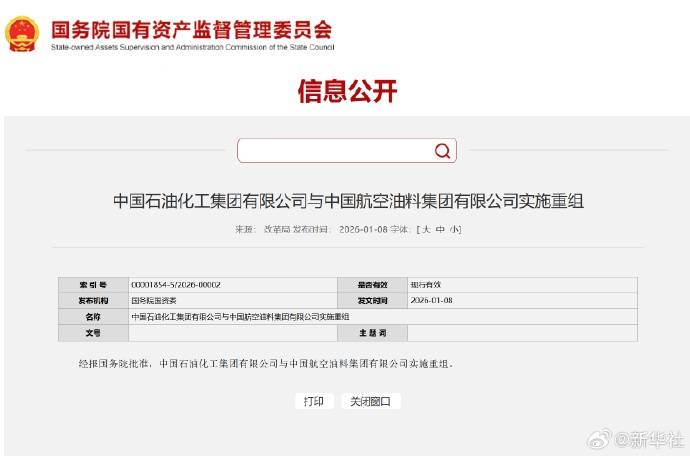
两大央企重组诞生2.8万亿能源巨无霸 聚焦产业链协同助航空燃料产业做强做优
Chang Jiang Shang Bao· 2026-01-11 23:37
Core Viewpoint - The strategic merger between China Petroleum & Chemical Corporation (Sinopec Group) and China National Aviation Fuel Group (CNAF Group) marks a significant event in the restructuring of state-owned enterprises in China's energy sector, creating a new energy giant with total assets of approximately 2.8 trillion yuan by the end of 2024 [1][4][5]. Group 1: Merger Announcement and Background - On January 8, the State-owned Assets Supervision and Administration Commission (SASAC) announced the merger of Sinopec Group and CNAF Group, which had been anticipated for over two months [3][4]. - Both companies are ranked among the Fortune Global 500, with Sinopec Group being the largest refined oil and petrochemical supplier in China and the world's largest refining company [4][5]. Group 2: Financial Overview - By 2024, Sinopec Group's total assets are projected to be 2.69 trillion yuan, while CNAF Group's assets are expected to be 762.67 billion yuan, making Sinopec's assets 35.44 times larger than those of CNAF [5]. - The combined annual revenue of the new entity is expected to reach 3.17 trillion yuan, significantly enhancing its market presence [5][6]. Group 3: Strategic Implications - The merger is expected to create the largest vertically integrated entity in the domestic aviation fuel sector, enhancing operational synergies and reducing competition between the two companies [7][8]. - The integration will allow Sinopec's aviation fuel production to be directly supplied to CNAF, establishing a more resilient and efficient supply chain [8][9]. Group 4: Competitive Positioning - The merger aims to enhance the international competitiveness of the combined entity, positioning it to compete with global giants like Shell and BP [9]. - By streamlining operations and reducing costs, the merger is anticipated to improve Sinopec's profitability and market share in the aviation fuel sector [9].
中国石化:攻坚破局 转型升级综合能源服务商
Zhong Guo Chan Ye Jing Ji Xin Xi Wang· 2026-01-11 22:11
Core Insights - The company aims to enhance its market presence and efficiency during the "14th Five-Year Plan" period by focusing on comprehensive energy services, including oil, gas, hydrogen, and electricity [2][3] Group 1: Stabilizing the Core Business - The market share of refined oil remains stable at around 50% [3] - LNG retail volume has an average annual growth rate of 56.7% [3] - The company has established 16 overseas branches, enhancing the quality of its international operations [4] Group 2: Expanding Growth Areas - The company has over 140,000 charging terminals, with a projected platform charging volume exceeding 5 billion kilowatt-hours by 2025 [5] - A total of 150 hydrogen stations have been built, connecting 8 hydrogen corridors [6] - The company has constructed 7,000 distributed photovoltaic power stations, with a total installed capacity of 266 megawatts, and expects to generate over 190 million kilowatt-hours by 2025 [5] Group 3: Customer-Centric Approach - The "Easy Car Maintenance" platform has become the largest car wash service platform in China [7] - The brand value of "Easy" has reached 22.814 billion yuan [7] - The company has provided free energy replenishment and rest services to over 4.93 million returning motorcyclists and 67.83 million travelers during the Spring Festival over the past 13 years [7][8] Group 4: Transitioning to a Comprehensive Energy Service Provider - The company is actively participating in the entire hydrogen supply chain and has undertaken 8 national-level research projects related to hydrogen transportation [6] - The company has launched a new generation of fuel card systems and a unified APP platform to enhance customer service [9] - The company has built the world's largest enterprise SD-WAN network to support its extensive user base [9]
基础化工行业周报:中国石化与中国航油实施重组,尿素市场迎开门红-20260111
Huafu Securities· 2026-01-11 08:51
Investment Rating - The report maintains a positive outlook on the basic chemical industry, highlighting strong performance in various sub-sectors and suggesting potential investment opportunities in specific companies [3][4][5]. Core Insights - The restructuring of China Petroleum & Chemical Corporation (Sinopec) and China Aviation Oil (China National Aviation Fuel) is a significant development, marking the first major state-owned enterprise restructuring in 2026, which is expected to enhance the production and application of sustainable aviation fuel (SAF) [3]. - The domestic urea market has shown signs of recovery, with prices rising to over 1700 RMB per ton, a 9% increase from the lowest point in October 2025, driven by steady demand and reduced supply [3][4]. - The report identifies several investment themes, including the competitiveness of domestic tire manufacturers, the potential recovery in consumer electronics, and the resilience of certain cyclical industries [4][5][7]. Summary by Sections Market Performance - The Shanghai Composite Index rose by 3.82%, the ChiNext Index by 3.89%, and the CSI 300 Index by 2.79%. The CITIC Basic Chemical Index increased by 5.39%, and the Shenwan Chemical Index by 5.03% [13][16]. - The top-performing sub-sectors included rubber additives (17.27%), electronic chemicals (15.08%), and modified plastics (9.87%) [16]. Key Industry Dynamics - Sinopec and China Aviation Oil's restructuring aims to streamline operations and enhance the production of SAF, positioning the companies for future growth in a low-carbon economy [3]. - The urea market is expected to continue its upward trend, with a forecast for moderate price increases in the near future due to favorable supply-demand dynamics [3][4]. Investment Themes - **Tire Industry**: Domestic tire manufacturers are becoming increasingly competitive, with recommended stocks including Sailun Tire, Senqcia, General Tire, and Linglong Tire [4]. - **Consumer Electronics**: A gradual recovery in consumer electronics is anticipated, with upstream material companies expected to benefit. Recommended stocks include Dongcai Technology, Stik, Lite-On Optoelectronics, and Ruian New Materials [4]. - **Cyclical Industries**: Focus on industries with strong resilience and inventory destocking, particularly in phosphate and fluorine chemicals, as well as polyester filament [5][7]. - **Vitamin Supply**: Attention is drawn to vitamin products due to supply disruptions from BASF, which may lead to market imbalances [7].



“绿色航油”新巨头来了!详解中国石化、中国航油重组
Sou Hu Cai Jing· 2026-01-10 14:31
Core Viewpoint - The restructuring between Sinopec and China Aviation Oil represents a strategic integration aimed at creating a "super refinery" and supply system, enhancing collaboration across the entire supply chain rather than merely combining resources [1]. Group 1: Reasons for Restructuring - The aviation industry is experiencing a strong recovery, with global jet fuel demand projected to reach 389 million tons by 2025, reflecting a year-on-year growth of 3.9%. Domestic jet fuel demand is expected to exceed 40 million tons, indicating significant growth potential in this sector [2]. - Sinopec seeks more direct sales channels, while China Aviation Oil aims to secure more stable upstream resources and reduce intermediary costs through this restructuring [2]. Group 2: Strategic Significance of the Restructuring - Sinopec's sustainable aviation fuel (SAF) has been successfully tested on domestic large aircraft such as the C919 and ARJ21, with the potential to reduce carbon emissions by over 50% compared to traditional jet fuel. China Aviation Oil plays a leading role in the promotion and application of SAF, serving 585 global airline customers [3]. - This restructuring is expected to facilitate the transition of "green jet fuel" from demonstration flights to large-scale commercial use [3]. Group 3: Impact on Consumers and Investors - As the demand for overseas travel among Chinese citizens increases, a robust Chinese aviation fuel service provider can offer more reliable and unified refueling services for international flights, benefiting industry development [6]. - Jet fuel typically accounts for one-third of an airline's total costs. The restructuring is anticipated to eliminate intermediary costs, potentially lowering jet fuel prices and alleviating profit pressures on airlines, thereby enhancing route stability and service quality [6].