
SMIC(00981)

Search documents
中芯国际概念上涨3.73%,7股主力资金净流入超亿元
Zheng Quan Shi Bao Wang· 2025-12-22 08:41
Core Viewpoint - The semiconductor sector, particularly the SMIC concept stocks, experienced a notable increase in share prices, with significant net inflows of capital, indicating strong investor interest and confidence in the sector [1][2]. Group 1: Market Performance - As of December 22, the SMIC concept stocks rose by 3.73%, ranking fourth among concept sectors, with 76 stocks increasing in value [1]. - Leading the gains were stocks such as Chuangyuan Technology, Lianang Micro, and Shenghui Integration, which hit the daily limit, with increases of 10.01%, 10.42%, and 18.65% respectively [1][3]. - The concept sector saw a total net capital inflow of 2.589 billion yuan, with SMIC itself attracting 837 million yuan [1][2]. Group 2: Capital Inflow Ratios - The top stocks by net capital inflow ratio included Shenghui Integration at 27.82%, Lianang Micro at 20.01%, and Chuangyuan Technology at 18.22% [2]. - SMIC's trading performance showed a 6.00% increase with a turnover rate of 4.05%, indicating robust trading activity [2]. Group 3: Notable Stocks - Other notable performers included Shanghai Xinyang with a 15.88% increase and Aisen Co. with an 18.65% increase, reflecting strong market sentiment towards these companies [1][6]. - Stocks like Lianang Micro and Demingli also showed significant net inflows of 345 million yuan and 242 million yuan respectively, highlighting investor confidence in these firms [1][2].



GPU与存储厂商加速资本化,外媒一致“唱多”国产芯片,上游半导体设备ETF(561980)盘中涨超3.60%
Jin Rong Jie· 2025-12-22 08:11
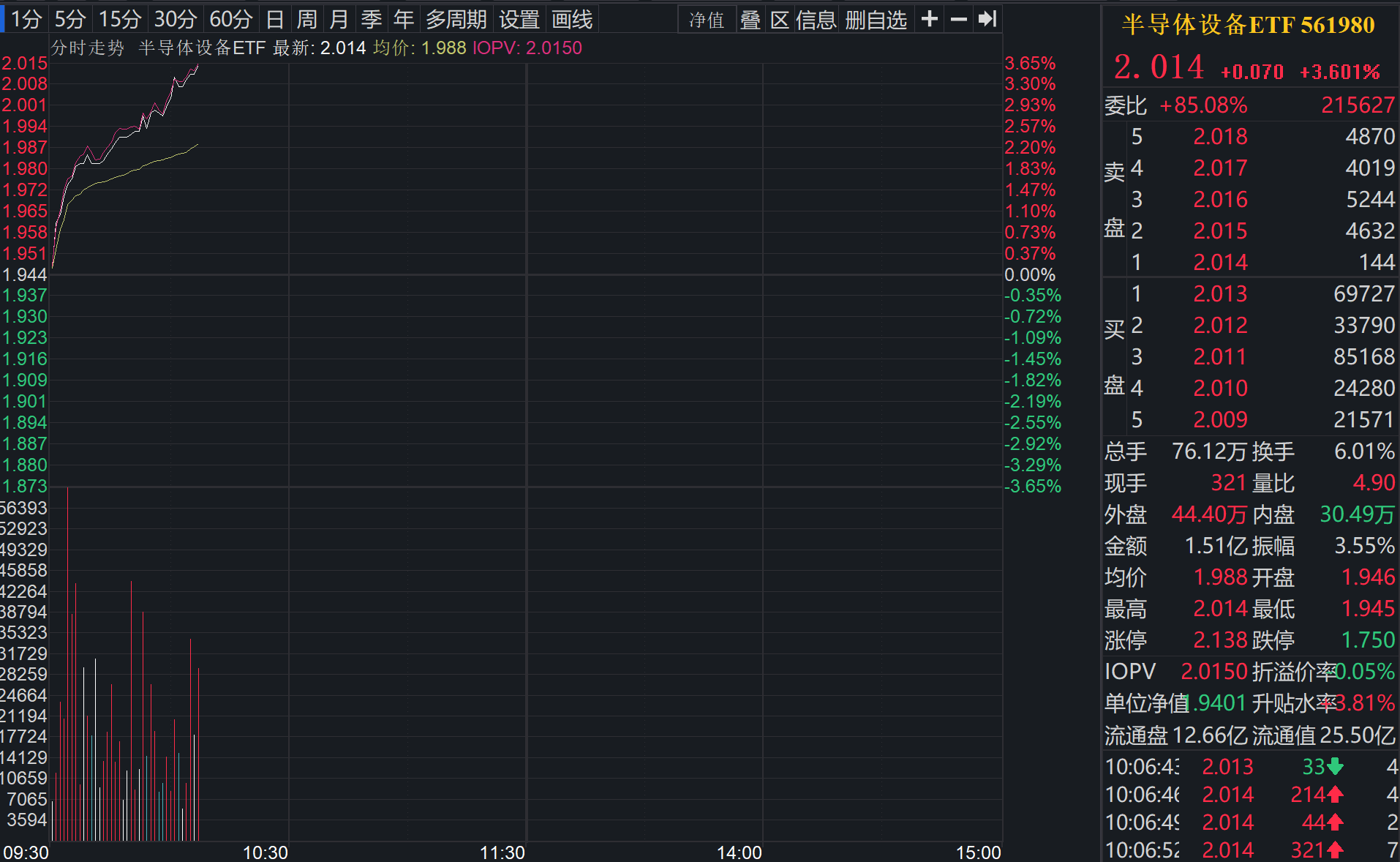
消息面上,彭博社周一发文称,中国芯片技术发展迅速,有望在2026年或2027年迎来"DeepSeek时刻",对英伟达及其供应链产生颠覆性影响。 12月22日,三大指数集体高开,芯片产业链多股拉升,存储和上游半导体设备板块表现活跃。半导体设备ETF(561980)高开拉涨3.60%,成交额迅速突破 1.5亿;成分股珂玛科技封涨停板,京仪装备涨超10%,上海新阳、长川科技、联动科技、中科飞测、立昂微等多股涨超8%。 | 证券代码 | 证券名称 | 年内最大上涨(%) | 年内涨跌幅(%) | | --- | --- | --- | --- | | 931865. CSI | 中证半导 | 80. 39 | 54. 82 | | 931743. CSI | 半导体材料设备 | 68. 13 | 47. 70 | | 980017. SZ | 国证芯片 | 71. 64 | 35. 67 | | 990001. CSI | 中华半导体芯片 | 73.01 | 37. 58 | | H30184. CSI | 半导体 | 73.78 | 39. 02 | | H30007.CSI | 芯片产业 | 72. 29 | 3 ...





科创板收盘播报:科创50指数震荡涨2.04% 半导体股涨幅居前
Xin Hua Cai Jing· 2025-12-22 07:42
经新华财经统计,12月22日,剔除1只停牌股,科创板剩余597只个股平均涨幅1.01%,平均换手率 2.66%,合计成交额1858亿元,平均振幅为3.64%。 个股表现方面,鼎通科技涨20%,领涨成分股;拉普拉斯跌10.02%,跌幅居首。 成交额方面,中芯国际成交额86.2亿元,位居首位;ST帕瓦成交额425.5万元,位居末位。 换手率方面,C优速换手率为49.02%,位居首位;龙腾光电换手率为0.20%,位居末位。 (文章来源:新华财经) 新华财经北京12月22日电 (王媛媛)科创50指数12月22日震荡上涨。至收盘时,科创50指数报 1335.24,涨幅2.04%,指数振幅为1.84%,总成交额约551.4亿元。 从盘面上看,科创板个股多数上涨,上涨个股超300只。高价股表现较好,低价股有所分化。 细分领域中,半导体、小金属、化工原料、专用机械类个股表现活跃,医疗保健、生物制药类个股下 跌。 ...
指数反攻,短线资金回归!热点开始转向,还有哪些投资机会?
Sou Hu Cai Jing· 2025-12-22 07:40
主力净流入行业板块前五:半导体,PCB板,新能源汽车,光伏,锂电池; 主力净流入概念板块前五:国产芯片,5G,华为产业链,英伟达概念,光通 信; 主力净流入个股前十:中际旭创、中芯国际、胜宏科技、新易盛、工业富联、沪电股份、紫金矿业、东山精密、浪潮信息、长芯博创 预计随着估值正常化以及遏制产能过剩的举措提振关键行业的盈利能力,MSCI中国指数将进一步反弹。到2026年底,MSCI中国指数将上涨约18%,沪深 300指数将上涨约12%。MSCI香港指数在资本流动和房地产市场情绪最终复苏的支撑下,涨幅可达18%。她还表示,预计明年三大指数的盈利增长率将在9% 至15%之间。 另外,汇丰私人银行将恒生指数的目标设定为到2026年底达到31000点,较周二收盘价上涨22%。该行指出,流动性增强和盈利趋势良好。中国提振内需的 举措有望提振企业利润率,而香港企稳的房地产市场、不断扩大的零售活动、日益活跃的IPO项目以及旅游业的增长,预计将支撑香港的经济复苏。 近期谷歌在AI方向的加速让市场看到其软硬件一体化的潜力,也强化了其自研的TPU芯片在AI计算加速的适用性,同时The Information报道谷歌和Meta正商 ...




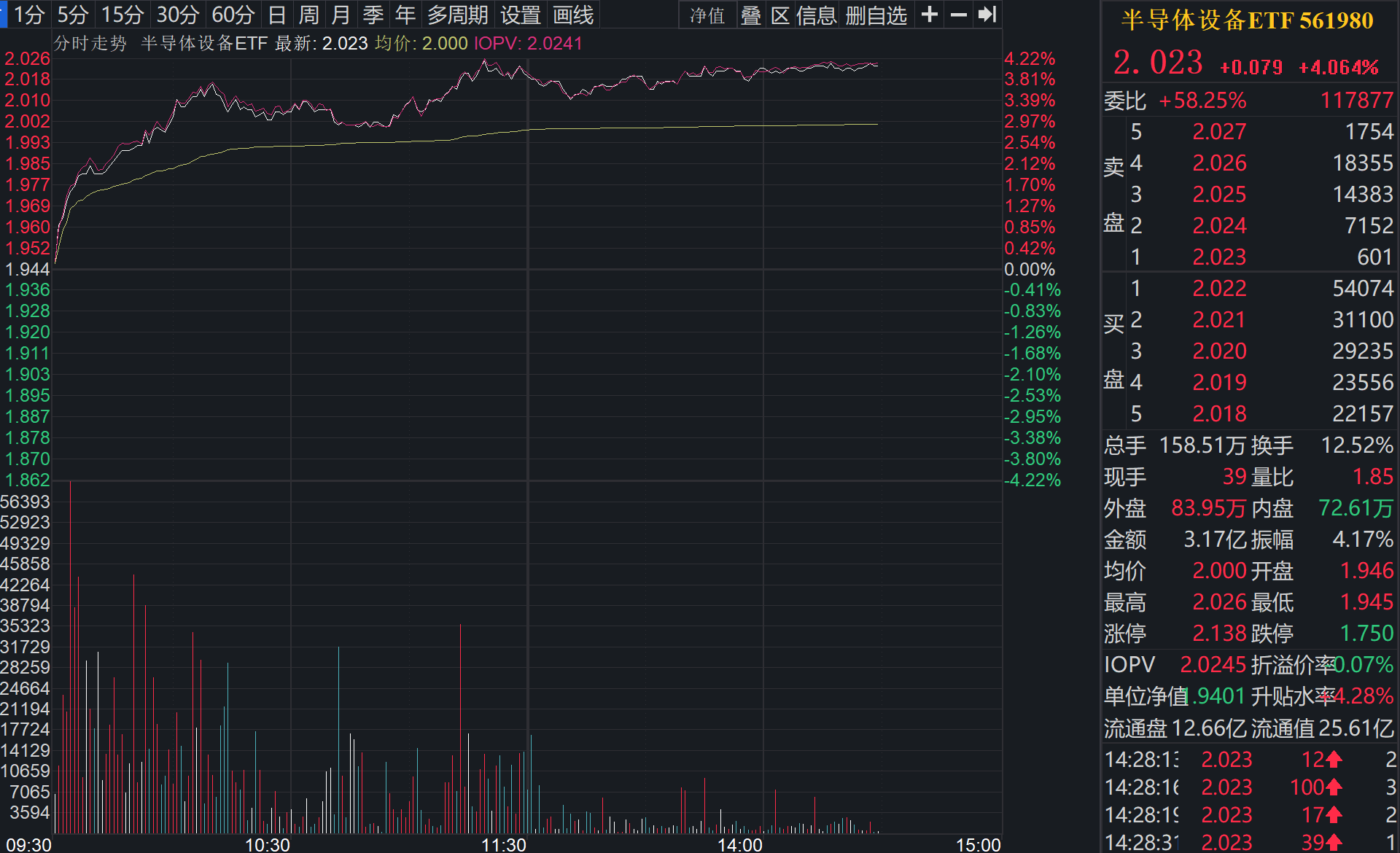
国产光计算芯片登顶国际领先水平,半导体设备ETF(561980)午后涨超4%
Jin Rong Jie· 2025-12-22 07:13
Group 1 - The semiconductor equipment and storage industry continues to show strong performance, with a notable increase in the semiconductor equipment ETF (561980) rising over 4% and a transaction volume reaching 316 million yuan [1] - Key stocks such as Kema Technology and Lianang Micro hit the daily limit, while Shanghai Xinyang surged over 15%, and Ansen Co. increased by over 13% [1] Group 2 - Researchers from Shanghai Jiao Tong University have made a breakthrough in the next-generation optical computing chip field, achieving the first "Light" chip that supports large-scale semantic media generation models, marking China's leading position in the optical chip sector [3] - Bloomberg reported that China's rapid chip technology development may lead to a "DeepSeek moment" by 2026 or 2027, potentially disrupting Nvidia and its supply chain [3] - WSTS has revised its global semiconductor sales forecast for 2026 to $975.4 billion, a year-on-year increase of 26.3%, with 2025 expected to reach $772.2 billion, up 22.5% year-on-year [3] Group 3 - According to Everbright Securities, global semiconductor sales are expected to grow further in 2025, driven by demand from AI computing power, data centers, and smart driving, following a recovery in 2024 [3] - SEMI predicts that global 12-inch wafer monthly production capacity will reach 11.1 million pieces by 2028, corresponding to a CAGR of approximately 7% from 2024 to 2028 [3] - The number of wafer foundries in mainland China is projected to increase from 29 in 2024 to 71 by 2027 [3] Group 4 - The current focus should be on leading companies in semiconductor photoresists, wet electronic chemicals, and electronic specialty gases that have technological accumulation and capacity scale, as well as deep ties with downstream wafer customers [4] - The semiconductor equipment ETF (561980) tracks the CSI semiconductor index, with over 90% of the index comprising semiconductor equipment, materials, and integrated circuit design, all of which are in the upstream of the chip industry [4] - The index heavily invests in industry leaders such as Zhongwei Company, Northern Huachuang, Cambrian, SMIC, and Haiguang Information, with a concentration of nearly 80% in the top ten holdings, indicating significant elasticity [4]

科创半导体ETF(588170)涨超3.7% 中芯国际涨超6% 研发费用超38亿
Mei Ri Jing Ji Xin Wen· 2025-12-22 06:23
Group 1 - The Shanghai Stock Exchange's Sci-Tech Innovation Board semiconductor materials and equipment index rose by 4.06%, with notable increases in constituent stocks such as Aisen Co., Ltd. (up 13.25%), Shenkong Co., Ltd. (up 9.40%), and Tuojing Technology (up 9.32%) [1] - SMIC's Q3 report revealed R&D expenses of 3.822 billion yuan, ranking it among the top semiconductor companies, ahead of Northern Huachuang (3.285 billion yuan) and Haiguang Information (2.586 billion yuan) [1] - The Sci-Tech Semiconductor ETF (588170) increased by 3.72%, tracking the semiconductor materials and equipment index, which includes 61% semiconductor equipment and 23% semiconductor materials companies [1] Group 2 - The semiconductor equipment and materials industry is a significant area for domestic substitution, characterized by low domestic substitution rates and high ceilings for domestic replacement, benefiting from the AI revolution's demand for semiconductors [1] - The semiconductor materials ETF (562590) and its linked funds focus on the upstream semiconductor sector, with 61% in semiconductor equipment and 21% in semiconductor materials [1]
ETF盘中资讯 | 光计算芯片重磅突破!商汤-W大涨7%,中芯国际涨近6%,首只“港股芯片链”ETF涨近 1.7%
Jin Rong Jie· 2025-12-22 06:09
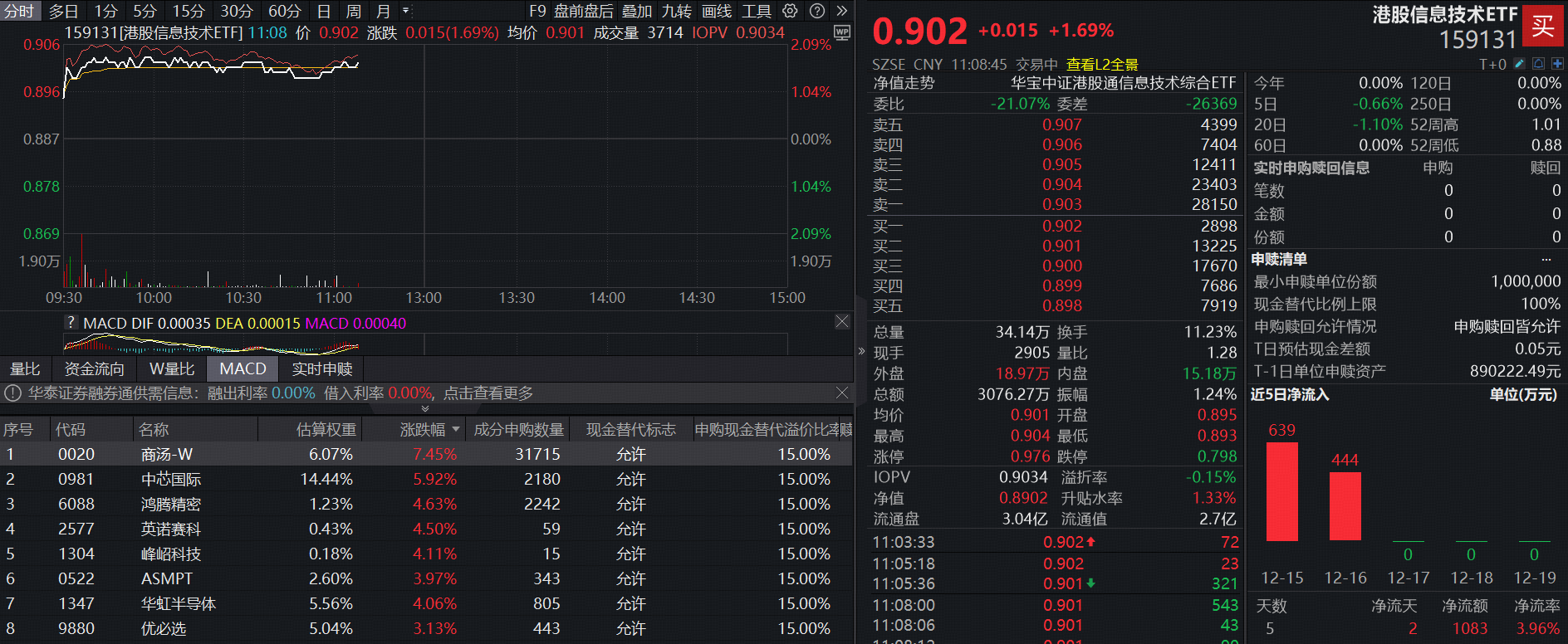
据悉,上海交通大学科研人员近日在新一代光计算芯片领域取得突破,首次实现支持大规模语义媒体生成模型的全光计算芯片,相关成果发表在国际重量级 期刊《科学》杂志。 12月22日早盘, A+H芯片半导体产业链走强,港股方面,商汤-W大涨超7%,中芯国际涨近6%,鸿腾精密涨近5%,华虹半导体涨超4%。全市场首只聚 焦"港股芯片"产业链的港股信息技术ETF(159131)场内价格现涨1.69%,实时成交额超3000万元。 风险提示:港股通信息技术ETF被动跟踪中证港股通信息技术综合指数,该指数基日为2014.11.14,发布于2017.6.23。材料中指数成份股仅作展示,个股描 述不作为任何形式的投资建议,也不代表管理人旗下任何基金的持仓信息和交易动向。本产品由华宝基金发行与管理,代销机构不承担产品的投资、兑付和 风险管理责任。投资人应当认真阅读《基金合同》、《招募说明书》、《基金产品资料概要》等基金法律文件,了解基金的风险收益特征,选择与自身风险 承受能力相适应的产品。基金过往业绩并不预示其未来表现,基金管理人管理的其他基金的业绩并不构成基金业绩表现的保证,基金投资须谨慎!基金管理 人评估的该基金风险等级为R4-中高风 ...
机构指向强确定性和弹性兼备的科技主线!半导体设备大涨4%
Jin Rong Jie· 2025-12-22 06:09
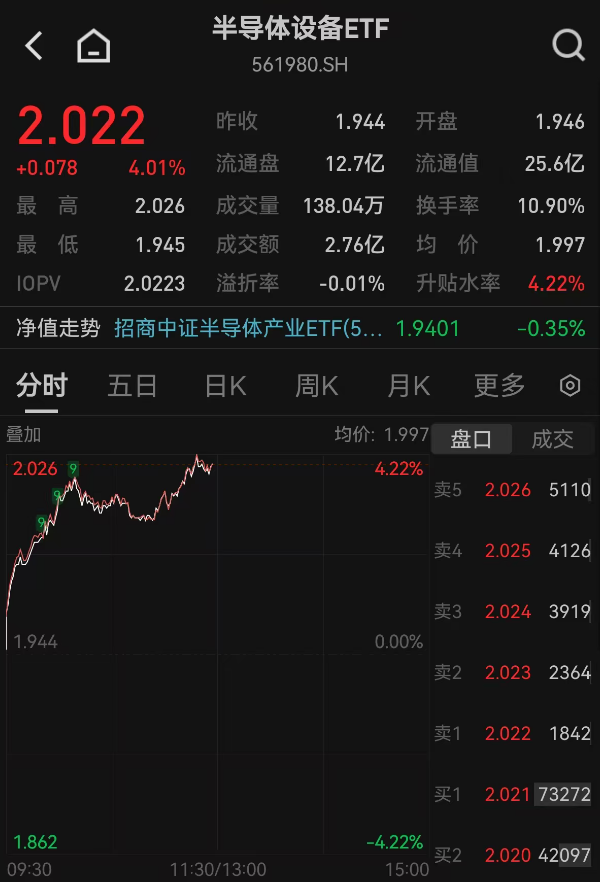
Group 1 - The semiconductor chip market is experiencing significant activity, with Kema Technology hitting the daily limit up, and the semiconductor equipment ETF (561980) rising over 4% this week, with a trading volume of 276 million yuan [1][11] - Major stocks in the semiconductor equipment sector, including Kema Technology, Shanghai Xinyang, and Aisen Co., have shown strong performance, with Kema Technology reaching the daily limit and others like Shanghai Xinyang and Aisen Co. increasing by over 17% and 16% respectively [1][14] - The semiconductor equipment ETF (561980) tracks the CSI semiconductor index, with nearly 60% of its components being equipment-related, and it has achieved a year-to-date increase of 54.82%, ranking first among major semiconductor indices [1][11][14] Group 2 - The rapid development of Chinese chip technology is expected to disrupt companies like Nvidia by 2026 or 2027, as highlighted by Bloomberg and supported by analysts from major financial institutions [3] - The ongoing AI infrastructure boom is driving demand for advanced chips, with a focus on 3nm and below processes, indicating a robust long-term bull market for semiconductor equipment [3][11] - Domestic chip companies are accelerating their globalization and capitalization processes, with significant IPOs such as Moore Threads and Muxi Technology marking a notable trend in the industry [4][5] Group 3 - The storage chip sector is also seeing a surge in IPO activities, with companies like Changxin Technology and Yangtze Memory Technologies planning to go public, which is expected to enhance capacity construction [5][6] - According to CFM's market outlook, there is a projected supply shortage for server eSSD and DDR5 RDIMM, with prices expected to rise significantly, indicating strong demand driven by AI [6][8] - The global semiconductor sales forecast for 2026 has been revised upwards to $975.4 billion, reflecting a recovery driven by sustained AI demand [8][11]


港股午评 恒生指数早盘涨0.20% 中国中免大涨12%
Jin Rong Jie· 2025-12-22 04:58
Group 1 - The Hang Seng Index rose by 0.20%, gaining 51 points to close at 25,742 points, while the Hang Seng Tech Index increased by 0.89% [1] - China Duty Free Group (01880) surged by 12% as duty-free shopping on Hainan's first day of closure increased by 61% year-on-year [1] - Lithium stocks continued to rise, with Tianqi Lithium (09696) up over 5% due to expectations of resumption of production, and Ganfeng Lithium (01772) increasing by 4.84% [1] - Jiaxin International Resources (03858) rose over 10% to reach a new high, benefiting from a more than 220% increase in tungsten powder prices this year [1] - Spot gold reached a new historical high, with Goldman Sachs reaffirming a bullish outlook on gold, leading to significant gains in gold stocks such as Lingbao Gold (03330) up 6.8% and China Gold International (02099) up 6.2% [1] - The optical communication sector showed strong performance, with Huiju Technology (01729) rising over 13% due to breakthroughs in optical computing chips, and Changfei Optical Fiber (06869) increasing by 11.01% [1] - Chip stocks strengthened in early trading, with the National Integrated Circuit Investment Fund's third phase focusing on IC substrate fields, leading to a rise of over 7% for SMIC (00981) and 5% for Hua Hong Semiconductor (01347) [1] - Pony.ai-W (02026) increased by over 9%, achieving single-vehicle profitability in Guangzhou, with two models of its seventh-generation vehicle now in production [1] Group 2 - Guoxia Technology (02655) surged over 16% as the company enters a new phase of global development, focusing on deepening "AI+" core technology research in energy storage [2] - WanGuo Gold Group (03939) rose nearly 7%, with its subsidiary Jinling Mining expected to become a world-class gold mine [3] - Goldwind Technology (02208) increased by nearly 5% as domestic wind turbine bidding prices recovered, with institutions optimistic about the profitability recovery of wind turbine manufacturers [4] - Four new stocks listed all fell below their issue prices, with Impression Dahongpao (02695) dropping 25%, Mingji Hospital (02581) down 42%, and Huazhi Biotechnology-B (02396) declining over 8% [4]

港股芯片股涨幅居前,英诺赛科、中芯国际等多股上涨
Xin Lang Cai Jing· 2025-12-22 04:38
Group 1 - Hong Kong chip stocks are leading in gains, with InnoCare Pharma (02577.HK) and SMIC (00981.HK) both rising over 4% [1] - Other stocks such as Hua Hong Semiconductor (01347.HK), Horizon Robotics (09660.HK), Jingmen Semiconductor (02878.HK), and ZTE Corporation (00763.HK) also experienced upward movement [1]